This is part three (of four) in Erik’s not-so-run-of-the-mill left behind bottles series. This time a super dark heavily Sherried offering from Cadenhead and Highland Park. Highland Park always went well with ex-Sherry casks. I used to be a big fan of Highland Park, one of the first I considered to be of the highest class available from Scotland. It is such a great tasting Whisky, honest, honeyed and humble. At least it used to be. It didn’t shout off the rooftops how great it is, and still managed to have a pretty solid fan-base around the world. Today however, Highland Park (and The Macallan) are part of a humongous marketing machine, which I tend to distrust. Sure the Whisky is still good, and there are still many, many, amazing bottles to be had (for a price), but the feeling is different, the feeling’s gone, sorry Highland Park. Just compare it to the way Springbank and Bruichladdich are marketed. The feeling is entirely different with these. Yet here we have an independent offering of Highland Park.
Cadenhead, by the way, thanks to Mr. Watt, seem to have reinvented themselves for many years to come. This bottling, it doesn’t say so on the label, seems to be the result of marrying two Sherry Butts together.

Color: Very dark orange brown, just shy of a mahogany hue.
Nose: Deep and dark, lots of oak, making it fresh. Toasted oak, and some warm plastic, which fades and disappears luckily. Fruity heavy Sherry. Meaty oak, and licorice. The wood also has quite a big floral component. Perfumy even. Next I got some Rhum Agricole “sweetness” mixed with dark chocolate. This one is neither red/black fruity, as old Longmorns nor thick and cloying. In the end it has more of the latter than the former. Elegant wood, yet definitely not old skool. Good Sherry, but modern. More and more whiffs of Rhum Agricole and cold gravy. Also drier spicy notes when you let it stand for a while.
Taste: Starts sweet and very nutty. With emerging bitterness when swallowed. A Doppler effect of bitterness. The bitterness is kept in check, so no problem here. Good tannins, not drying the mouth. Silky texture. Hints of vanillin and milk-chocolate pudding. Fruity and again this bitter end of the body. And a big body it is. Well it has been in rather active Sherry casks for 25 years, so no surprise here. Paper and clear glue. Honey, the stuff of bees, not your darling, I hear you ask? Nope, no not really, although it does remind me of licorice candy made with honey. Hardly a Highland Park. Its about the Sherry cask this one. Black tea bitterness, but with a nice edge of coal. Steam punk, but not old skool. The more this breathes in my glass the “older” it gets. More coal, and more steam (and motor oil). It may lack a tiny bit in complexity, but it makes up for it with development (in my glass). The finish is simple and again bitter (medium), but the body is very good (it finally does get into the realm of Longmorn after extensive breathing). Long aftertaste of oak, licorice and black fruits and yes, the bitter bit has the longest breath of all the notes. So it has its good and less good points. Maybe this should have been bottled a few years earlier?
Letting it breathe is a must for this Whisky, it makes all the difference.
Points: 87
 Lets backup in time even some more. We stay in the land of the independent bottler, this time Signatory Vintage. We are going to take a look at another Highland Park matured in a Sherry cask, a butt even. This one is an even younger example at 9 years of age. The G&M/Whisky Mercenary bottling was 20yo, The Wilson & Morgan was around 14yo, and this Signatory Vintage bottling is a mere 9yo. Highly unusual back then, not so unusual today, since demand has risen dramatically. There is no time anymore to age the bulk of Whisky when there are so much of you around, dear readers. We’ll also go back in time bit since this was distilled in 1988. That is almost 30 years ago!
 Color: Copper gold.
 Color: Copper gold.
 Well, weeks are only seven days so they are bound to be over very quickly over. Today is the seventh day so I hope to finish this Laphroaig Week over with a bang, but you never know. This particular Laphroaig was selected by the Whisky Shop from the stocks of Douglas Laing in the dumpy green bottle, Whisky geeks love so much. In the early days it was a mark of excellent quality, or maybe they just bottled it like this because it was bottled at cask strength. Obviously this Laphroaig is from a cask that once held SHerry, just look at the sheer amount of bottles yielded at cask strength. Great! I love the combination of (extreme) Laphroaig and Sherry…
 Color: Copper gold.
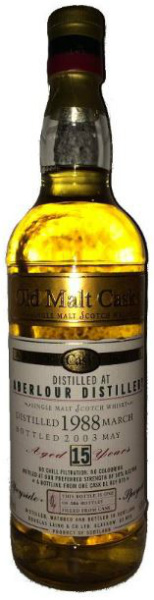 Color: Sparkling light gold.
 Color: Copper gold.
 Color: Light Copper Gold.
 A few days ago my whisky club had a tasting of Aberlours. Quite a unique one to boot since these were almost all exclusively official bottlings. We only had one independent Aberlour. It was from a Bourbon Cask and did show the distillery profile for a while, but that was quickly gone. We had a few out of the standard range and a few from the standard ranges from the past. A few bottles stood out. We liked one old 12yo double cask matured for its high dark Oloroso Sherry content (and costing next to nothing). An old 21yo from 2000 was very good and this odd one out. The 1988 Distillers Selection, that was released exclusively in Spain. After this one 1988 came only one other Distillers Selection, the 1989. Again for Spain only. For Aberlour this is quite special. It is said that instead of the usual Oloroso, for this bottling Fino and/or Manzanilla is used!
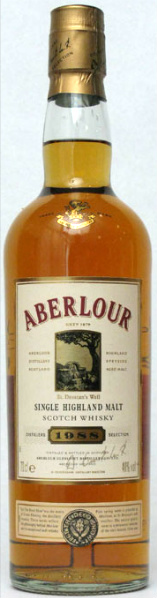 Color: Full Gold
 Why not try another Balmenach. Earlier I tried a
 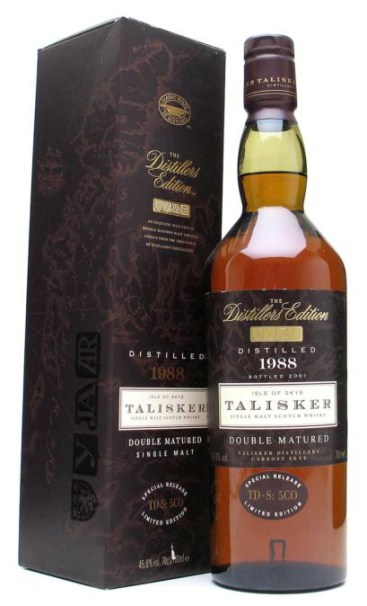 We’re on a roll with those Taliskers, so why not continue the saga with another one. Maybe this less recent Distillers Edition? The Distillers Editions are finished expressions of the ‘normal’ Classic Malt line and was introduced in 1997. Then Cragganmore (Ruby Port), Dalwhinnie (Oloroso Sherry), Glenkinchie (Amontillado Sherry), Lagavulin (Pedro Ximinez Sherry), Oban (Montilla Fino Sherry) and Talisker (Amoroso Sherry) got treated to a happy marriage with a Sherry or Port. All said to be complements to the original style of the distillery, not overpowering it. Due to the success of the new range, expansion was to be expected. In 2006 a Distillers Edition of Caol Ila (already in european oak!) finished in Moscatel and Clynelish finished in Oloroso Sherry was issued. And last but not least in 2008 Royal Lochnagar finished in Muscat was issued. We’ll probably see more expressions released in the near future.
 It’s not mere months the whisky was finished, but probably longer if not a few years. The oak is in the same spot where normally the pepper attack would be. I for one can’t detect the pepper anymore in this, and that’s a bit of a shame. Thick round body with a floral touch, violets maybe. I know that added caramel rounds out a body, but it seems to me the Amoroso does that trick here. Compared to the 10yo, this is more…ehhh round. All the extremes are toned down. Chewy and sweeter than the usual 10yo. Just a tad less balance in the finish.
 Master Quill