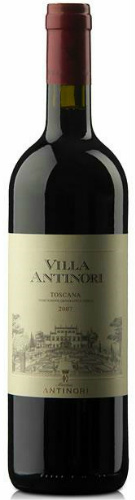
Villa Antinori Toscana IGT 2007

The history of the Antinori family dates af far back as the 12th Century, when Rinuccio di Antinoro produces wine at the Castello di Combiate near Croci di Calenzano, outside of Florence. The particular wine I’m reviewing today, Villa Antinori, was first made in 1928 and at that time it was a Chianti, but a Chianti that could be further aged. Much later, in 2001, Piero Antinori, reworked this wine into a Tuscan IGT. The wine itself is a Super Tuscan blend: with 5% Syrah, 25% Cabernet Sauvignon, 15% Merlot and of course 55% Sangiovese. After the malolactic fermentation the wine was aged in French, Hungarian, and American oak barrels for one year. ABV is 13.5%.

Villa Antinori Toscana IGT 2007Color: Dark ruby-red

Nose: Spicy and fresh, seems young although it does have some ageing under its belt. Some warm very aromatic Tuscan soil, nice! It has its roots firmly in the ground. Warm summer wind late in the evening. Nice red fruits, cherries, blueberries and slightly herbal with a little bit of wood to give it some more character. Nicely balanced wine. Lovely wine with sometimes some whiffs of field flowers.

Taste: Very supple and extremely easily drinkable and delicious. Again some terroir, but not as much as the nose had. Well integrated blend, everything seems to fall in place. Nice depth. Not very tannic, though there is some drying sensation on the tongue and it’s only slightly acidic, but the acidity increases after some more breathing. Breathing also gives the wine something of a bite, bitterness that is, from the wood. The finish is all right and half-long.

This first accompanied food and when that became to spicy, it easily overpowered this wine. The wine itself seems quite light at first, but it did pick up after more breathing. Recommended drinking window for this wine is said untill 2014, so if you have this lying around it’s now probably at it’s best, but I feel still can handle another couple of years…

Points: 83

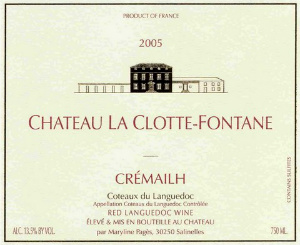
Château La Clotte-Fontane Crémailh 2007

After quite some Beers, time for another Red Wine in what turns out to be my 250th post. I’ve noticed that a lot more Whites got a chance on these pages than reds. Yet after this Château La Clotte-Fontane the next Wine will probably be a White (again) from one of my favorite regions, but more about that later. Let’s not get ahead of ourselves and have a look at his Red Wine from Languedoc. Languedoc is a Wine region in the southernmost part of France. It probably is the region that is the fastest growing in popularity by improving itself annually. Not so long ago, it was probably known only by the vast amounts of Wine produced and not especially for its quality. But as said before, that is rapidly changing.

The domaine is situated near Salinelles, between Nimes and Montpellier and spreads over 130 ha and has two types of soils. One, on the sunny eastern side, contains large pebbles. The second is rather flat and is made up of clay and limestone.
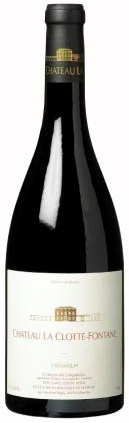
Château La Clotte-Fontane Cuvée Crémailh AOC Coteaux du Languedoc is a Red Wine with an ABV of 13.5%. It is made with two grape varieties: 60% Syrah and 40% Grenache. The Wine ages for 12 months in new French oak barrels in an underground cellar. Next to this Crémailh, the domaine also produces two other reds: Mouton La Clotte and Mathierou, but also one Rosé and one White.

Color: Intense deep red, almost black. Lets only sunlight through.

Nose: Deep and brooding, dry earth, from the clay and limestone soil. Quite modern, stylish. It presents itself as heavy, with its almost black color, but it really isn’t. Some hints of cacao and vanilla. Some fresh oak. It is almost like sharpening a pencil. The fruits are deep and sugared (not meaning sweet), plums come to mind, dried ones too. Excellent.

Taste: Full but not intense. It will probably accompany a red meat dinner perfectly, but drinking this on its own will most certainly do. Not heavy on the tannins, slightly acidic and warming. On the back of my tongue some hints of black pepper ánd clove, which gives the wine a nice ‘effect’. Fruits are more the usual reds: raspberry and essence of cherry.

After this Crémailh I’m definitively interested in the other two reds La Clotte-Fontane produces. This Crémailh is very tasty and well made. The added bonus is in the complexity (not overly complex, but there is a lot happening here) and the detail of the wine. Well done. Drink it now, it’s at it best.

Points: 87

Santa Cristina Cipresseto 2007 Rosato Toscana

Summer has arrived here finally and lasts for almost two weeks now.  That is a first! Probably a record has been broken for the last 5 years, since summers lately were less interesting than spring. That gives me lots of chances to try some summery wines in their natural habitat, meaning outside in the garden to be drunk in nice weather. Well I won’t let the sun cloud my palate, so I’ll stay critical. This is already the second wine of Santa Cristina to grace these pages. Earlier I reviewed the Santa Cristina Toscana IGT 2009.

Santa Cristina Cipresseto 2007 Rosato ToscanaColor: Beautiful red salmon.

Nose: Grounded coffee, dust and wet earth. It has a nice depth to it. Next up is the fruit. Some sweet apple juice. Classy stuff. Some floral hints. Meaty, not sweet and not acidic. Well balanced nose, that has a lot to offer.

Taste: Licorice, and a very thin acidity. Some bitterness and some wood. Taken in big gulps, a little bit of meaty body and a hint sweetness come through. The body is even less interesting than the finish, but still as nice as the nose was, the palate is rather disappointing. Totally unbalanced and a bit weak. Tastes a bit as a watered down red wine…

The landscape of Tuscany is utterly stunning, and the nose of this Rosato promises a lot. I’m almost in tears that the palate is…rather weak. It’s almost a dream gone bad! Having said that, the wine is not thát bad. It just could have been better. I have another bottle of this (from the same year). If that one turns out to be different from this one, I’ll rewrite this review. For the moment this one stands. In defence of this Rosato I have to say I probably let this lie around the cellar for to long, but I can’t image that’s it.

Points: 73

Weingärten Weissenkirchen Wachau Smaragd 2007 Grüner Veltliner

Asparagus season isn’t over yet, so we decided to do another round. Last time around I decided to accompany the asparagus with an Austrian Riesling, but there was another Austrian wine lying around, so I decided to open another Austrian white wine. This time a Grüner Veltliner from Wachau by Domäne Wachau.

Grüner Veltliner is a white wine grape variety that stems from Savagnin and further down the line, Rotgopfler and Pinot Noir. Despite of the name Veltliner, the grape isn’t related to Roter Veltliner and Frühroter Veltliner. Most Grüner Veltliners are planted in Austria and to a lesser extent, Slovakia and the Czech republic, but more recently also in the United States and Australia. One-third of all the grapes planted in Austria is Grüner Veltliner. In Slovakia one-fifth and in the Czech republic “only” one-ninth of the planted grape varieties is Grüner Veltliner. Most Grüner Veltliners age well and accompany food excellently.

LabelEspecially in the Wachau wine region on of the following terms can be found:

  • Steinfeder: lightest version with up to 11.5% alcohol,
  • Federspiel: a slightly more powerful version with 12.5% ​​alcohol,
  • Smaragd: the most rich and powerful Grüner Veltliner with 12.5% ​​alcohol and often more. (Smaragd can be compared with the german term Spätlese, the grapes are harvested late and often ripen for a prolonged time on stainless steel or large casks). (This Smaragd is 13% ABV).

Finally, Weissenkirchen is one of Domäne Wachau‘s village-bottlings. Besides Weissenkirchen itself, it comprises of the villages of Joching, Wösendorf and St. Michael. The wines are elegant, full-bodied, fruity and quite mineral.

Color: Straw

Nose: Lemony and acidic. Smells very fresh and refreshing with whiffs of alcohol. You can already smell the balance between the sweetness and the acidity. Nosed blind this could have easily been from Alsace. Nice yellow fruits. Hints of peach and dried apricots, but also some sweat! (No that’s not a bad thing, in this wine). All in all, light and fresh, but with body.

Taste: Definitively more spicy. Fruity syrupy sweetness (high iron content). Apple treacle, raisins, tree sap with the slightest hint of licorice. Green apple skin. Some hints of wood, although this probably never came in contact with wood. Some unbalance when near the finish. Short, slightly sugary, finish. The sweetness in the finish is a bit “strange”.

Of the two Austrian wines we recently had with Asparagus, we liked the Riesling Better. Having said that, on its own, this one isn’t bad either.

Points: 81

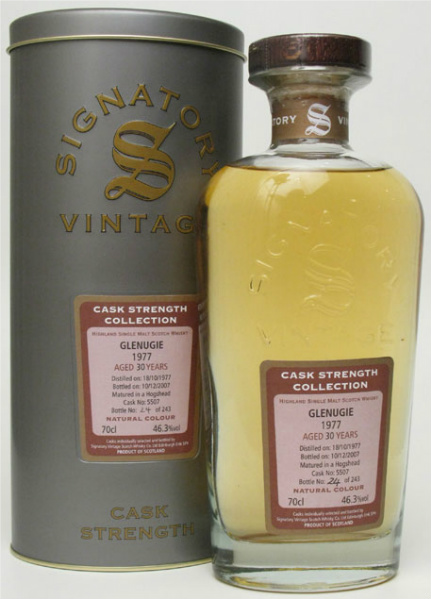
Glenugie 30yo 1977/2007 (46.3%, Signatory Vintage, Hogshead #5507, 243 bottles)

Yes, it’s a Glenugie. long time overlooked and very popular the last few years. It’s a closed distillery (1983) and quite popular with whisky aficionado’s. Just as is the case with Banff today, connoisseurs discovered a closed distillery that has a special quality to it. I have to admit that all of the Glenugies I tasted scored at least 85 points and most well higher than that. Only one is lower than that. I scored the sister cask #5506, also by Signatory Vintage, only 81 points. So let’s have a look if all those 55xx casks are the same and if this one’s any better.

Color: White wine.

Nose: Estery and fresh. Green apple skin. Grainy and a slight hint of vanilla. You could have fooled me with the age of this one. Seems much younger and cleaner, than I would have expected, knowing what this is. There is also a hint of cask toast and wood. Sweet and fruity, peaches on syrup. Creamy toffee with a hint of coconut. I like the nose, it’s like candy. Great balance.

Taste: Sweet like sugar, icing. Vanilla, no wood whatsoever, not at first anyway. It has some spice from the wood. Apples, without the bitterness from the skin. Finish isn’t too long, and just a tad sour. The wood does show its face, late in the finish. Good drinking strength with enough oomph. Again, it seems much younger. The balance in the taste is also somewhat weaker than the very nice fruity nose.

It’s nice and likeable. Nice piece of history. Just not a lot happened in all those years. For me it’s better than it’s sister cask, but still no high flier. You’ll really have to be a buff to recognize the markers of an old Glenugie. But isn’t beauty in the details?

Points: 84

Thanks go out to Nico again for handing me this sample.

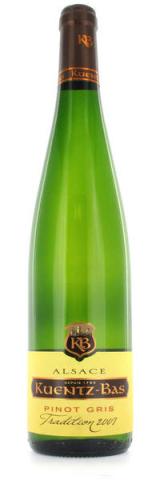
Short Stories: Kuentz-Bas Pinot Gris Tradition 2007

Kuentz-Bas Pinot Gris Tradition 2007, ABV 13%, Husseren Les Châteaux, Alsace
Color: Light White Wine.

Nose: Already a balance between sweet and sour. A bit flinty maybe, and a hint of Galia melon. Very fresh and light. Perfumy.

Taste: Well, not very sweet at first. Dryish and simple. Not overly acidic, so there is balance. I would have thought that some yellow fruit would stick out, but none of that. It has a fuller body for a second or two, and dissipates in a very light and slightly warming and short finish. After some time, there is some more sweetness to it. The perfumy note that was there in the end of the nose, seems to creep into the finish too. Easy drinkable.

Definitively better with fish than meat.

Have a look at: http://www.kuentz-bas.fr/index_en.html

Points: 79

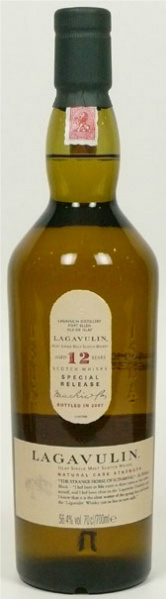
Lagavulin 12yo ‘Special Release’ (56.4%, OB, 2007)

And now for something completely different: Lagavulin. Well, we all know Lagavulin is pretty great. It’s virtually impossible to find a bad expression. So big thumbs up to the people at Lagavulin! A long time ago there was a 12yo already. Cream label, pretty good. After that they made a pretty fantastic 16yo, which was great, had a little lapse some years ago (but still good). Luckily, more recent bottlings are doing well again. Still, in 2002 the people at Diageo thought is was time to revive the 12yo as a ‘Special Release’ at cask strength this time. A release that is up ’till now, annual. Let’s try one, shall we.

Color: White Wine

Nose: At first, peat obviously, then a bit sour. Kippers, diesel and salty like the Pibroch at sea. Gravy combined with tar (from the ship’s hull), smoked fish (from the galley). This needs some air, and we’re not in a hurry. It’s rough but not unrefined, and doesn’t taste young. It smells like a whisky for an upper class fisherman.

Taste: It’s sweet, and has the obvious peat, but warm peat this time. It has a dirty edge to it, animalesque is the word that comes to mind, but does this word exist, or is it already the whisky talking? Now some ash and sweat, well it’s hard work on a boat like this. After some time it’s still sweet and some ‘black & white powder’. This is a taste that resembles liquorice (if you’re not from Holland or Finland)

Well isn’t this great stuff again! If you look at prices asked for this kind of whisky, well you’ll have trouble finding something better for your money. This should be a standard on your whisky lectern. Assuming you like whiskies from Islay that is.

Sells for 65 Euro’s

Points: 90