Bruichladdich 10yo 2003/2013 (56.3%, Malts of Scotland, First Fill Sherry Hogshead, MoS 13051, 285 bottles)

Almost two years ago I reviewed a Glen Keith bottled by Paderborner outfit Malts of Scotland. Being an indie with quite a reputation it took me quite a while to review another bottling of theirs. A sample of this very Bruichladdich was bestowed upon me by the former owner of this very cask. MoS renames the cask numbers so we do not know the original cask number. I hate it when Thomas does that, just like Bert does with his Asta Morris bottlings. Something to hide guys? Well nothing more to say really, (I’m a bit distracted by some nice live music by Primus), so let get on with it…
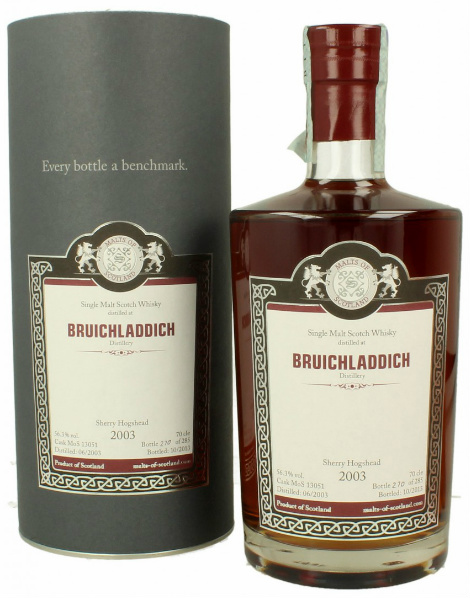
Bruichladdich 10yo 2003/2013 (56.3%, Malts of Scotland, Sherry Hogshead, MoS 13051, 285 bottles)Color: Orange brown.

Nose: Mellow Sherry of the Oloroso kind. Soft wood, dry forest plants like fern and slightly sulphury. Freshly baked bread. Chocolate, brown sugar, honey and fruity acidity from red fruits and berries. Vanillin and a distant bonfire in the woods. Wet earth and mocha. Raisins. Nice and pretty laid back. Mint in the finish (when warm).

Taste: The fruity acidity from the nose. Waxed chocolate sprinkles, cola and some wood. Again some sulphur, but not a lot. Extremely warming. The acidity stays on well into the finish and deep into the finish the sulphur gets more room to play, but still it is not a lot and never overpowering. It’s in the background carrying the aroma along with black tea leaves and a hint of woody bitterness. Not a very long finish though. Reminds me a (more than a) bit of the Bunnahabhain and to a lesser extent of a Bruichladdich I reviewed earlier. A quieter version of both I guess.

I have to say this one needed warming up. Even at room temperature I found it pretty closed, but when I held it in my hand for a while it showed a lot more of itself. Honey in the body and mint in the finish for instance. When I finished it, I poured myself a fresh dram, and again, very closed. This is an example of a closed and dry heavily Sherried expression as opposed to a fruity one. Bottled at the right time. Ready for another strange remark? The empty glass smells better than the full glass…

Points: 85

Thanx Andy!

Glentauchers 8yo 2005/2013 (46%, Dewar Rattray, For the Specialist’s Choice The Netherlands, Sherry Puncheon #900389, 403 bottles)

We are now in the middle of the rise of NAS Whiskies and very soon most Whiskies in our regular shops will have a names instead of a number or a vintage even. Whiskies that do have an age statement will be confined to airports and other travel retail outlets. But that’s only one of a few possible futures. What will happen to the Independent bottlers? Will they have a way to survive. Today many of them are capable of releasing pretty good Whiskies, although mediocrity is creeping into their products as well. How long will casks of Whisky be available to them? Are we going to see only affordable yet young Whisky from them as we already see with NAS Whiskies from the distilleries themselves. After the Ledaig I reviewed last, here we have another young Whisky coming from a Sherry cask. Glentauchers this time. Earlier I reviewed an older Glentauchers. also from a Sherry cask that was pretty good to say the least…

Glentauchers 8yo 2005/2013 (46%, Dewar Rattray, For the Specialist's Choice The Netherlands, Sherry Puncheon #900389, 403 bottles)Color: Full gold.

Nose: Sherried, creamy and fresh. Herbal and woody. Nice creamy oak, yes creamy oak. Fruity candy. Very likeable. Powdered. Quite a lot of vanilla. It really smells like a Sherry cask made with American oak.

Taste: Creamy and funky Sherry. Real acidic fruitiness right from the start. The creaminess and fruitiness don’t necessarily mix together well, especially when a paper-like note appears. In time that strange mixture passes and reveals more sweetness with the vanilla coming back here too. Paper and cardboard make up the finish, but not by itself. Notes from wood, mocha, Cappuchino, cigar box and creamy vanilla are also here to stay but mainly the fruity acidity returns with a vengeance. Whisky candy. Do you know those fruity gello’s in dark chocolate. That kind of fruity acidity contrasted by sweet dark chocolate. Accept this and you’ll be ok. Interesting stuff.

Although this has some flaws, it is also highly drinkable. This may not fetch the highest score, but it most certainly is nice to drink. Don’t analyze this to death, just grab it for the fun of it. Make it your daily drinker. I often rant a bit about reducing Whiskies, because sometimes the reduction makes the Whisky thin and watery. This time however I will hold my tongue, since I don’t feel reduction hurt the final product. It is good like this. I’ll stop now and pour myself another dram.

Points: 84

Longmorn 17yo 1996/2013 (60.8%, The Ultimate, Sherry Butt #105091, 588 bottles)

Another year is almost over so this here is already the last post of 2014. What to review I asked myself? Maybe something incredibly special, something super premium or something outrageously expensive? Nothing like that. In the end I choose this Longmorn. Why? It seems like a good idea, to do none of the above, and I happened to have only one  open bottle left om my lectern that I hadn’t reviewed yet. Tying up loose ends. I hope this last year was a nice one and of course that the next one will be even better! Hope to see you back in the new year!

Dutch outfit Van Wees bottled eight heavy Sherry Longmorn’s distilled in 1996. These bottlings were rather popular, to put it mildly, since all didn’t need a lot of time to sell out. Highly collectible, but also good drinking Whiskies. Earlier, I already reviewed two casks from this series #72315 (the first release) and #72319 (the third release). Both were similar yet different, and both scored 88 points. This third review will focus on Sherry Butt #105091 (the seventh release). The first five were all sister casks #72315, #72318, #72319, #72323 and #72324 distilled on the first of May 1996. After that, three more Butts were bottled: #105092, #105091 and finally #105084. The latter was released during the Pot Still Festival 2014 in the Netherlands, making it the only one to be bottled in 2014, yet still at 17 years of age. Those last three butts were distilled on the 25th of June 1996 and yielded less bottles than the earlier butts but are higher in alcohol. There have been more butts bottled from the 723xx and 1050xx series, but those were bottled by Signatory Vintage for their own brand. Lets see if this will be another 88 points for Longmorn…

Longmorn 17yo 1996/2013 (60.8%, The Ultimate, Sherry Butt #105091, 588 bottles)Color: Copper brown.

Nose: Honey and quite vegetal. Especially the wood and honey make this Whisky not very distant from a very good Bourbon, although both Whiskies couldn’t be more different. Dry wood, old saw dust and dusty altogether. Burnt caramel and lots of sugared red fruits. Deep brooding and syrupy Sherry. Dark stuff from the gas light era. Elegant but more mysterious than the earlier bottlings.

Taste: Hot wood. Lots of wood and a sour note from fruit and Sherry. Coffee and dark chocolate with just the right amount of bitterness. Small hint of a sulphur compound, but the rest of the aroma’s are so powerful, Sulphur doesn’t stand a chance in dominating this Whisky. This Whisky also has a lighter side to it with paper and fern. Dark mahogany furniture with layers and layers of wax put on in its history to form this brittle woody and waxy nose.

Although I own both earlier reviewed Ultimate Longmorn’s, I haven’t opened the bottles. Both reviews were done from 6 cl samples. This bottle however, is one from my own collection I dared to open (curiosity killed the cat). The bottle is luckily still more than half full, but I had a fair chance in trying this without having to analyze it. In comparison, I do believe this #105091 is very drinkable and always leaves a good impression, but this time I won’t be giving another 88 points. The earlier releases, if memory serves me correctly, seemed to be more balanced, less dry and more fruity, than this one does. This time the added paper and fruity acidity do meddle with the balance of this Whisky, still good and I will not have any problem finishing this, but just not as good as the earlier one’s I have tried.

When compared to the Gordon & MacPhail Highland Park that also scored 87 points, the Highland Park has more raisins (dominant), coal and seems to be more accessible. It is less dry and sweeter on the palate. It is similar in quality, not higher in sulphur and actually quite nice. It is seems to me they are made for one another. I will only have to try them now in reversed order…

Points: 87

This one is for Cyril, great to hear you’re doing well!

Cadenhead Creations 20yo ‘Rich Fruity Sherry’ (46%, Batch No. 1, 2013)

Cadenheads CreationsMerry Christmas everybody! In 2013 Cadenheads released a home-made blend called Cadenhead Creations (Rich Fruity Sherry). This first batch had an age statement of 20yo and was bottled in 2013. The blend was made with two casks of Single Malt and two casks of Single Grains. Samples of those casks are pictured here on the right. From left to right: Mortlach 1992 (cask #7848), Bruichladdich 1993 (cask #1648), Cameronbridge 1989 (cask #22804) and Invergordon 1991 (cask #39006). Since then two more Cadenhead Creations were released. A 21yo (black label, silver stripe, Blended Malt made with Ardbeg, Bowmore and Caol Ila) and a 17yo (white label, yellow stripe, another Blended Whisky made with Ardmore, Auchroisk, Caperdonich, Clynelish and Invergordon).

Cadenhead Creations 20yo 'Rich Fruity Sherry' (46%, Batch No. 1, 2013)Color: Full Gold.

Nose: Although it seems that this is a 50/50 mixture of Single Malt and Single Grain, the nose is more on the grainy side. Malty and waxy, paper and cardboard. Very nice wood. Meaty, nutty and spicy. Deeper down some hints of Sherry, not upfront as the label suggests. Fruity (but not sweet) and lots of character.

Taste: Malty and grainy again. The waxiness is here to, but here it is fruity and accompanied with a little bit of sweetness. Sweet paper and cardboard again. Some short, hot or red peppery attacks. Spicy and slightly bitter wood. Aspartame sweetness. The wood upfront and may be too strong. The wood makes it right across the body of the Whisky into the finish. Along the way the wood picks up a little bit of oaky bitterness, with together with the red peppery attack make the finish.

Rich, yes, rich wood. Fruity, well not so much if you ask me, the wood is way more pronounced. Sherry, well if you expect the dark Sherries from the picture above, that´s not the case here. It doesn’t remind me of Oloroso or PX-Sherry casks at all. This blend is about wood in many guises.

Points: 81 (for character)

Glen Moray 15yo 1998/2013 (46%, Cadenhead, Bourbon Hogsheads, 684 bottles)

This is the third Glen Moray on these pages. Although I use a 100 points scare for scoring drinks, and in my opinion Whisky is one of the best drinks around. Whisky usually scores in the upper ranges of that scale. So any good Whisky scores at least 80 points. Both Glen Moray’s I reviewed before, one 13yo Dun Bheagan, and one official 8yo, didn’t make it across the 80 points-line and are therefore considered bu connoisseurs to be “mediocre” at best. However, if you read my reviews carefully, they still have enough going for them, and are still pretty good drinks, or pretty good Whiskies for that matter. It’s just that a lot of Whiskies score higher than these Glen Moray’s. But here is another Glen Moray, one by Cadenhead, so lets see if this will score in the 80’s or even higher?

Glen Moray 15yo 1998/2013 (46%, Cadenhead, Bourbon Hogsheads, 684 bottles)Color: White wine.

Nose: Quite closed, or isn’t there much happening. Alcohol, hints of sweet yellow fruits. Even though it isn’t a white wine finish were Glen Moray are almost famous for, it does remind me of a white wine finished Glen Moray. Hints of margarine and vanilla. Soft touch of oak. Very restrained, it just smells like fresh air.

Taste: Yes typical thin Glen Moray again. A crumb of old dark chocolate. A little bit of oak, and an acidity resembling a wine finish. Usually Glen Moray tends to get overly sweet after a wine finish, and I can’t say that’s the case here. Lots of maltiness and a little bit of paper and bitter oak in the finish. Good, it gives it character. Anything better than that strange acidity.

Extremely light color, again casks (probably two) that weren’t very active any more. I am not completely sure this isn’t a white wine finish. A very clean expression, and that’s me being positive, because not a lot seems to be happening here… (Mind you, this is still a damn good drink!)

Points: 76

Ben Nevis 21yo 1992/2013 (46%, The Ultimate, Sherry Butt #2312, 695 bottles)

Next we’ll have a look at an indie Ben Nevis. I love Ben Nevis, it usually is a malt that strikes a chord with me. For me Ben Nevis is still a distillery working today that is able to churn out very good Whiskies, and for sure is one I’ll always keep an eye out for. That said I also am realistic. Not every indie Ben Nevis is good. It isn’t a distillery I would buy indie bottles from without tasting first. Although pretty good, The Golden Cask Ben Nevis I reviewed earlier, did have a strange, funky finish, which makes it, in my opinion, less of a daily drinker. The Ben Nevis we have at hand here was sourced from Signatory. Just have a look at the cask numbers The Ultimate and Signatory are putting out from 1992.

Ben Nevis 21yo 1992/2013 (46%, The Ultimate, Sherry Butt #2312, 695 bottles)Color: Light gold, with a slight pink hue

Nose: Yeah, now we’re talking. Fatty, buttery, vanilla and fruity. Lots happening and everything seems to fit together quite nicely. Fantastic fruitiness, all sorts of mixed up fruits, red, black and yellow fruits. Almost impossible to discern any of them. Caramel, mocha and strawberry combined with sweat. The wood shows itself here as nutty. Yes this is very special. Do I detect some old school Whisky here?

Taste: Sweet but also a little bit acidic. Very appetizing. Some burnt notes and quite spicy without it being woody. Marzipan and again lots of fruits with some nuts. Highly complex, and I’m imagining this amount of flavor and its complexity might not be for everyone. Hints of smoke, and it has a curiously hidden sweetness to it. Maybe its high in fruits that it only seems to be sweet. Pure enjoyment. Is it without flaws than? Yep this Whisky suffers a bit from a weak finish. Everything that is so well-balanced in this Whisky is absent from the finish. It has some power but after the big body, the finish is a bit weak, and missing some of the big flavors that were so apparent in the body. But hey, this to me is still a pretty good Whisky.

I have to admit, I love Ben Nevis. Most of the times I encounter one, albeit blind or not, I seem to like it. It has characteristics I do like personally. I rated a full bottle of this 86 Points. This review is written about the last drops from the bottle. It is excellent and since I’m going to score this even higher, I’d say this needs some air people.

Points: 88

Agostón Garnacha & Syrah 2013

Bodegas Virgen del Aguila, Paniza Agoston-Jabali lies at the foot of Iberico mountain range in Carinena (a DO), in north-east Spain. The Ibérico mountain range has a wide variety of landscapes and eco-systems. Half is used for vines, the other half is still forest or rocky mountain slopes

Agostón was first made in 2008. The maker calls it “daring, young, fruity & loved by everybody” All wines in this series are blends of two grape varieties. Here we’ll review the “yellow” one that is made with Garnacha and Syrah. The “red” one is made with Tempranillo and Cabernet Sauvignon. Both red wines are true 50/50 blends. The “green” one (a white Wine) is a blend of Viura and Chardonnay and last but not least a rosé Wine that has an orange label is made with Garnacha and Cabernet Sauvignon. As can be seen, all are blends of a “typical” Spanish grape and an International grape. Very daring and modern…

Agostón Garnacha & Syrah 2013Color: Deep red with purple.

Nose: Fruity and jammy. Very modern and accessible. Not very complex. Extremely likeable, like one likes a lemonade. Bold fruit, cherries, with cream and vanilla. A little bit of dairy, at first some acidity but after moving the wine around a bit in the glass, some typical notes from Syrah emerge. Obviously grapes that have seen a lot of sun. Warm but not dry or dusty. The red and black fruits are pretty aromatic.

Taste: Again very fruity and jammy but here the thick fruits are helped along with some nice acidity. Hardly any tannins to be found. I can’t imagine this has seen wood, although a little bitterness is there, also some vanillin seems present. Although very easily drinkable it will hold the fort when combined with cheeses and meats. Will do nicely too on its own.

Actually a very likeable and very nice wine, that has won some prizes along the way. Still I feel it is a very modern wine. Taylor-made for the modern, fast-forward and demanding market. No fuss, just grab-n’-buy, or buy-n’-drink or drink-n’-forget. Very fruity and just needs the drinker to sit back and enjoy himself/herself. It will not terrorize your conversation or hinder you while apping away on your phone. Nothing overly complex, no talk about tannins or how long you should put it in your cellar. Nice stuff though and not too expensive to boot. Good pick for bars and restaurants. Hip!

Points: 81

Casal de Ventozela Branco Vinho Verde DOC 2013

Vinho Verde is a Portuguese wine from the Minho province in the far north of the country. The region has many small growers, which train their vines high off the ground, in trees, on fences, and even telephone poles so there still is some room on the ground for growing food crops. Vinho Verde means “green wine” as in “young wine”, so Vinho Verdes are made to be drunk in their youth, so don’t age them. Grape varieties used for white Vinho Verde are; Loreiro, Arinto, Trajadura, Avesso and Azal. Also red and rosé Vinho Verde’s are made.

In the old days, the slight effervesce of the wine came from malolactic fermentation taking place in the bottle, normally a wine fault, but in the case of Vinho Verde, it is considered a nice “effect”. Today in most cases the effervesce comes from artificial carbonation.

Casal de Ventozela BrancoThe wine has an ABV of 11,5%, which for a Vinho Verde is rather high.

Color: Light white wine, pale straw, not green. Medium viscosity.

Nose: Very fruity and almost lemonade-like. Lots of aromas leap out of the glass. A happy and summery smell. Typical sweet creamy yoghurt with chunks of peach and even some banana. Vanilla ice-cream (mind you, not vanillin from wood). The wine does have tiny bubbles (effervesce) which adds to the summery feel. After a while the creaminess dissipates and the nose gets more acidic and even more refreshing. Nice green notes too. Gooseberries. Very nicely made with an interesting and nice nose.

Taste: Good balance between its acidity and sweetness. Both are quite soft. Again the acidity is the same as yoghurt. The fruits are also more of the acidic kind, like lemons and limes, with the peach and banana in the background. The nose and the taste match, whereas the nose was more creamy and sweetish, the taste is definitely more acidic. The tiny bubbles this wine has also add to the refreshing quality it has.

Probably a seafood wine, it does need a culinary companion. Perfect for sushi and I will have to try another one with asparagus! Lovely stuff.

Points: 83

Warre’s Colheita 2002 (2013)

A Colheita port is, like a Vintage Port, from a single vintage year ​​with the big difference that these ports are matured in oak barrels and filtered before bottling. Maturation takes place for at least eight years, but often longer, which makes it a Tawny Port. Usually the year of bottling is mentioned on the label, as is the vintage year. Because Colheita’s are filtered, not a lot of further ageing happens in the bottle, but still a lot of Colheita’s can be laid down for a while. No decanting necessary.

Warre Colheita 2002Color: Deep ruby-red which just started to fade a bit. High viscosity.

Nose: Sweet candy. Slightly winey, but foremost syrupy and very fruity. A little bit of soap. Lots of cherries and other sweet red fruits like ripe and succulent strawberry. After some breathing some spiciness and a slight hint of wood emerge. It smells young at first and fresh (acidic?). The whole seems to be crafted from the aromas of red wine, sweetness and some barrel ageing. The color is ruby-red too, so not your typical brownish tawny Port. Yes, it does smell very nice and perfumy though. I swear, when I nose this a lot I get some fresh mown grass and warm butter in there too. Easily accessible and definitely a quality wine. Do I detect a little bit of sulphur in the nose after a while in the glass?

Taste: It’s candy! Luckily not overly sweet and in the taste some nice acidity shines through. Good balance, but not very complex. Lacking depth at first. Again, not your typical tawny. It’s very nice, but it plays in another division. Very fruity and oozes summer. It sometime drinks like 5% ABV, but it still packs 20% ABV, which can be tasted in the finish. The finish itself is long, warming and very pleasant, and adds a lot to the complexity of the whole. It has the smallest hint of wood and fresh nuts, walnuts without the bitterness and hazelnuts. A little bit of tannins on the tongue. Very drinkable.

I can imagine drinking this slightly chilled, sitting outside in the sun. Very refreshing due to its toned down sweetness, nice acidity and accessible fruitiness. Although a little bit different, it did remind me of Kopke Special Reserve Tawny (150th Anniversary in Holland), although that one was even more summery, fresh and light, this Warre has more body and a heavier finish.

Points: 84

Plage du Sud Pays d´Oc IGP 2013

Next up a Rosé wine from the Languedoc region in France.

Plage du SudNot so long ago, Rosé Wines had colours almost like light red wines and were made with grape varieties like Syrah and Cabernet Sauvignon. But the fashion has changed, today the fashion is more about more elegant and more refined rosé wines from the Provence region in France and northern Italy. Very pale Rosé’s with very light old pink colours or even salmon-like colours. Plage du Sud is one of those Rosé wines from the south of France that has that pale pink colour rreferring to the Mediterranean feel from the Cote d’Azur. The wine is made with ​​Grenache (60%), Cinsault (35%) and 5% Syrah to give it a slightly heavier body.

Color: Pale old pink. Very elegant looking

Nose: Lots of aroma. Fruity with peach and banana. Sweet and sour in one gulp. The acidity is very nice and refreshing. Peach yoghurt, but also slightly floral, yes it smells of (pink) roses.

Taste: Less complex than the nose and not as aromatic as expected. Nice balance though. Light and simple. Not acidic nor sweet, keeps in the middle. All is in control and very drinkable. After a while the fruity aroma’s return. Quite nice stuff and nobody should be having troubles finishing a bottle like this. Just relax, sit back and enjoy the nice weather looking at people passing by. Do not sip this, drink this with big gulps, it tastes even better that way. Luckily they also sell nice 1,5 litre bottles 🙂

Excellent example of the modern style, pale looking Rosé wines from the south of France. The colours of these wines are really stunning.

Points: 80