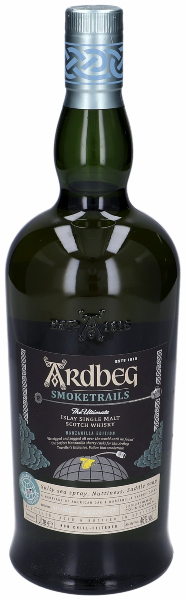
Ardbeg April: Ardbeg Smoketrails Manzanilla Edition (46%, OB, Batch No. SP/MZL: 2022/01-ST, 1000 ml)

Lets close off this Ardbeg April and the entire month of April without recycling earlier material, simply because the Ardbeg at hand is not part of the NAS special releases. This 1000 ml bottle is part of a travel retail series called Smoketrails, of which, at the time of writing, there have been three releases. First this Manzanilla Edition in 2022 (Manzanilla Sherry, a pale and dry Fortified Wine from Sanlúcar de Barrameda, Spain), a Côte Rôtie Edition in 2023 (French Red Wine from the Northern Rhône, mostly Syrah and some Viognier) and finally a Napa Valley Edition in 2024 (Red Wine from California USA, Cabernet Sauvignon). Nothing was released (yet) after these three. Maybe the short series got discontinued or maybe sales were slow, and they are waiting to release a new one, only after the old stock sells (out) some more. I really don’t know. Where the special releases are often not very much liked (not all of them anyway), these travel retail litre bottles get even less love from the “discerning” public. Because of this I was a little bit weary diving into this one expecting a bit of a weak Ardbeg.

Manzanilla is a fortified wine similar to a Fino Sherry. It is made in the same way. It ages under flor, which is a cap made of indigenous yeast. This cap protects the ageing Wine from oxidation. Due to the local microclimate (low temperatures and high humidity) Manzanilla ages under a thicker flor, than a Fino Sherry, which results in a fresher and more crisp Sherry. Manzanilla stands for chamomile infusion because it is one of the aroma’s of this Wine. Apart from this, Manzanilla has a savoury and salty flavour. The grapes that can be used for a Manzanilla are Palomino, Pedro Ximénez, Moscatel de Grano Menudo and Moscatel de Alejandría, and these grow on chalky soil, probably the origin of the salty flavour.
Color: Light Gold.

Nose: First whiff is youth, these young Malts often have this milky smell. Ardcore had the same and luckily in both occasions it dissipates quickly, unless you start rolling the Whisky your glass, than it happens all over again, but only for a short while. In this respect Ardcore and Smoketrail share a common marker. After the initial note(s), smoke comes next, as the name already promised us, and as is often the case with Islay Whiskies, smoke is never far away. Notes of burnt (news)paper. Now it also shows a more spicy (and soapy) feel to it. The “soap” adds to the whole. It’s not a problem. Also the wood starts to play its role, and I do like the wood in this one. Slightly mineral and quite pleasant overall. Definitely not very complex. However, I do like what I smell. So far so good. All in all, this has a very likeable, friendly and well balanced nose.

Taste: What can I say, youth is here as well, like in the nose. Milky again (initially), with smoke and a lot of the now easily recognizable liquorice notes, most, if not all, Ardbeg April whiskies seem to have. Nice sweetness, which fits this profile. The liquorice also develops a sort of peppery edge to it, again, very nice. This has more to offer than people led me on to believe beforehand. Definitely young, and maybe even simple and again slightly soapy, but also very, very drinkable, it tastes like a 43% ABV Whisky, kind of soft so that’s nice. Sweetish, with sometimes a rather artificial winegum kind of note to it. But the sweetness in the taste is well balanced between it and the wood and the liquorice. I guess the occasional wine gum note, as well as a particular part of the spiciness comes from the Manzanilla, otherwise this is definitely not an Ardbeg that is dominated by the Sherry, not at all. The Manzanilla is used with taste, or not a lot is used at all.

Based on comments from my surroundings, this was supposed not to be all that good, but actually, it might be simple, but there is also nothing wrong with it. No off notes whatsoever, and apart from that it has some nice aroma’s to give. This is very affordable and for that you get a Whisky that is young, but also not un-finished. It never feels like something that has been bottled too early, and its a litre bottle to boot. I say go for it! A valid option if you find all those NAS-ers too overpriced.

Points: 85

Batch No. SP/MZL: 2022/01-ST:

  • SP = Spain
  • MZL = Manzanilla
  • 2022 = Year of release
  • 01-ST = First edition of Smoketrails

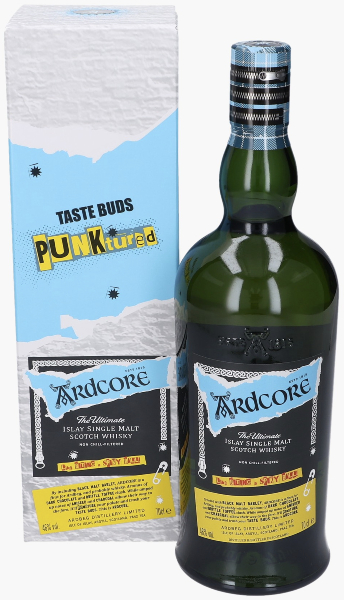
Ardbeg April: Ardbeg Ardcore (46%, OB, Black Malt, 2022)

I do have to admit, I really am a sucker for the Ardbeg visuals, and yes, the marketing does play its part in that. Even I am susceptible to that, there is no escaping from it! I just love the classic Ardbeg bottle, its shape, the green glass, and all those many different labels it now comes with. So having a few of those side by side on my lectern makes for a nice look, somewhat akin to me really liking the look of the wall of books in my living room. Also a stunning visual. People are collectors by nature, so gettin g a few of these is quite normal, also I do like the explore the different takes on Ardbeg, however I’m not a completist, I do not necessarily need to have them all, although more is definitely more. If I pass on one or the other it is mostly based on price.

For this fourth instalment in Ardbeg April, lets do even some more recycling shall we: A lot of Ardbeg special releases are different in many different ways. For instance, some of the ones I previously reviewed use casks that previously held different kinds of liquids, like fortified Wines of the Pedro Ximénez (Spain), Marsala (Sicily, Italy) or Port (Portugal) kind. Some have a more out of the box idea behind them, like BBQ casks (!), double charred casks, casks with toasted virgin oak lids (funny business with casks) or using a high density mash (funny business during production). For Ardcore, Ardbeg did a hardcore roasting, ending up with black malt. A process more common in the world of Beer. Just think of Beers like Porters and Stouts. A stage before black malt is called chocolate malt (slightly less roasted). A malt that is used by Dr. Bill for Glenmorangie Signet.

Color: Light straw.

Nose: Initially malty, milky, young. Not particularly the nicest of smells. Barley, barley sugar. Soon after the first sniff a more balanced, less young and more spicy profile emerges. Spicy wood and maybe some a-typical woodsmoke. Roling the Whisky around in my glass brings out this youth again for only (and luckily) a brief moment. Sweet yellow fruits, not ripe per se. Nice fruity notes, like peach and apricots. Fruit balanced with paper and something a bit soapy. Interesting, but not a problem though. So heavy mash was supposed to add more tropical fruit notes to “Smokiverse”, but didn’t, and now barley that has been roasted to (almost) a crisp, does. Amazing. I guess these experiments show us some different results to what we might have expected, (all this obviously based on nose alone). So these experiments supply us with some essential data, another reason why it is pointless to be so highly critical to these bottlings (apart from their pricing maybe). If the price was lower, more people could learn a thing or two from these experiments. Now this NAS-series might be somewhat elitist because of their price and how many there are. That’s why quite a few of these reviews were from bottle shares, mostly done with Nico. Between Smokiverse, Spectacular and Ardcore, and absolutely smelling past the youthy bit mentioned above, I like the nose of Ardcore best. Forget about the first whiff though…

Taste: Sweet entry, initially a bit simple. Smoky and nutty, but it quickly gains momentum and opens op nicely. A very nice effect. The typical Ardbeg liquorice is present again, yet in this one it doesn’t overpower the rest of what you can taste as it did in some others reviewed before. In the others it was maybe a bit mono, here is it quadraphonic, making for a bigger stage (well, at least stereo, let’s settle on that). Ashes, charcoal, soft peat and soft smoke, but with an added bitter/burnt edge to it. Dark chocolate, pencil lead and ear-wax. Not over the top, so it is a nice addition, giving the fruit a bit of a backbone. These notes (not the fruity ones) are amplified if you have this one after dinner or late in the evening when your palate is saturated or tired. Clay (of the artificial kind that children play with). Again, very nice. Very fruity, with all these strict edges. Wonderful combination. Great balance between the more astringent notes, the sweetness and the fruit. Nice balance as well with the nose in  mind. Also worth another mention is this wonderful development. Classy. For those who wonder based on the previous reviews, nope, this one is actually not a big gulper, this one can be sipped just fine. For me it worked best as an aperitif and not an after dinner dram. Combined with the initial whiff, this is a Whisky that needs a bit of an user manual, so its not an easy one. Slightly bitter in its aftertaste (especially with a tired palate), that’s the black malt, dark chocolate bit of this Ardbeg

Well, Ardcore suits me just fine, this is right up my alley, its fruity and offers a lot more. Develops like crazy, development also quick right out of the gate. I can’t wait to get me one of those Committee bottlings, bottled at 50.1%, which can be an ideal drinking strength, like all those Old Malt Casks from the previous two decades, especially since I feel 46% might be slightly too low for this profile. Yes this Ardbeg makes me very enthusiastic! Dr. Bill please consider this experiment a success. What about an addition (also in ABV please) to Uigeadail and Corryvreckan in the core range based on the Ardcore experiment, only slightly longer aged, to get rid of the first whiff? Oh, that would be so nice! Please? This one really seems to work best as an aperitif rather than as a digestif, it loses quite a bit of its magic after dinner. This one is meant for a fresh palate and not a tired one.

Points: 87

By now, and for now, we can identify the following three main groups for the special NAS-sers I have reviewed up until now:

1. (Part) Maturation in non-bourbon casks, easy peasy, not unusual, lots of options here,
2. Experiments with casks, experiments, nice, experiments are definitely a learning experience,
3. Experiments in production, even more experiments, how very nice, excellent!

2022 Ardbeg Ardcore: (Extremely) roasted black malt (3)
2014 Ardbeg Auriverdes: Toasted virgin oak lids (2)
2023 Ardbeg BizarreBQ: Double charred casks, Pedro Ximénez casks & BBQ Casks (1) & (2)
2012 Ardbeg Galileo: Bourbon + Marsala (1)
2015 Ardbeg Perpetuum: Bourbon + Sherry (1)
2025 Ardbeg Smokiverse: High gravity mashing (3)
2023 Ardbeg Spectacular: Bourbon + Port (1)

Benromach Contrasts: Cara Gold Malt 11yo 2010/2022 (46%, OB, First Fill Bourbon Barrels, 20/01/22)

I almost forgot to write this review, because I though I’d already done it. Here we have the first Benromach on these pages after they revamped the look in to this slightly bulkier glass bottle, more straightforward cardboard box (easier to store) and last but not least the usage of the colour red. I was a bit hesitant at first because I really liked the copper they used in the previous package, but the red stands out, looks fresh, smart and traditional. So I do like the new look a lot now, and love having them around. If this one’s empty, I’ll probably replace it with another (red) Benromach. Most likely another one from the contrasts series, since it offers interesting takes on Malt. Here it is because of the usage of Cara Gold barley.

Most Benromachs that are on the market now are fairly young, sure there are some older bottlings like the 15yo and the 21yo, which are different yet not necessarily better. The Whisky at hand is 11yo and a nice choice for starting a flight of Whiskies or as a casual sipper. Not expensive and an honest pour. Benromach produces a heavier more meaty spirit, often slightly peated and sits well with knowledgeable anoraky aficionados, you know who you are, and since you are reading this, you’re probably one of them. This particular offering is partly made with Whisky made from Cara Gold barley as well as the normal Benromach lightly peated malt, both matured in first fill Bourbon barrels.

Color: Straw.

Nose: Sweet barley first, very appealing and very aromatic. Clean, fresh, fruity and malty with malt sugars and a nice layer of dust and paper-like aroma’s adding to the whole. Nice fresh wood tones, but nothing overpowering or off. Straightforward without any frills. Candied wood and candied yellow fruit, with hints of sweet smelling smoke, as well as some licorice. Clean and modern, although some yesteryear comes through as well. More wood (perfumed, highly aromatic) and wax with ripe yellow fruits. The label claims tropical notes, and sure enough… My perception of the fruit depends on the moment I’m smelling this. The first time around I wasn’t all too sure about the fruitiness, but the second time around, yes, here it is. I recently recovered from a nasty variant of the flu, and now that the nose is working again, I certainly pick up more on the fruit now! I’m very pleased with this Benromach. It smells very nice, accessible, balanced and its very aromatic and appealing. Well made, wonderful stuff and very affordable as well. After smelling this on many occasions over time, the fruity bit does wear off if you keep this for a while in your glass, focussing on the dusty and woody notes. Still soft and friendly though.

Taste: On entry, sweet smoke and sweet licorice. More subdued fruits. Candied Barley. You could smell it already, but it is most welcome tasting it. 46% ABV is a very nice drinking strength, definitely better, for modern Malts, than 40% or 43% ABV. Back in the day 40% ABV worked well, think of very old Gordon & MacPhail bottlings, like early Connoisseurs Choice bottlings (brown label, map label etc.) Yet Malts from this century definitely need a higher strength, higher than 43% if you ask me. Sweet, woody, spicy, somewhat bitter and slightly fruity (less so than in the nose). Tropical, well maybe. The wood has more to say here than it did on the nose. So more wood, slightly harsh even and showing some bitterness. The smoke is here as well and in the triangle between the wood, the smoke and the bitterness, it does take away a bit from the balance of the palate. A new sip with a fruity start masks the bitter bit for a moment. The finish is not very long and not a lot of it carries over into the aftertaste. But almost all you get is good (it turns out the bitterness has the longest staying power). No off notes. A very pleasant, fairly simple (it doesn’t develop a lot) and affordable dram. There is some diluted vanilla present, proving the maturation on (first fill) American oak. By the way, due to the bitter note this has, it isn’t entirely a casual sipper. Good, but I preferred the nose over the palate.

By itself a (partial) Cara Gold offering isn’t saying very much, it would be really interesting to have several Benromach bottlings, like this one, made with different barley varieties, open at the same time, to be able to compare them to each other. I checked my stash, but there isn’t another one at hand. A bere barley version would be nice, come to think of it, because bottlings like this remind me of the rebooted Springbank Local Barley series, where the Bere Barley version bottled in 2017 is my favourite. Yes I often prefer it over the 16yo and the dark 10yo. Sure the 16yo and the dark 10yo are great and definitely stellar as well, but the 11yo from 2017 is so good! Don’t be fooled by higher numbers or the colour of Whisky! Final remark, this particular Benromach worked best for me in a small tulip glass, a narrow, long stemmed Riedel for instance as opposed to a bigger glass, like the Holmegaard Perfection Spirit Glass. Both are very good, yet different. Good glassware always shows you more sides of the Whisky you’re drinking, so I do recommend to invest in good and several different pieces of glassware. It makes exploring your dram a lot more fun!

Points: 85