Glenmorangie 25yo “Quarter Century” (43%, OB, Circa 2012)

And here is another entry-level malt. Anyhow, it is when you give your wife a Luis Vuitton bag very month. If you’re more middle class, or like me, no class at all, you might want to get the 18yo “Extremely Rare” which isn’t actually extremely rare but compared to this 25yo is extremely affordable and quite nice. The 18yo scored a quite nice 87 Points. The 18yo has spent all of it’s time in Bourbon casks, save for 30% of the Whisky which was transferred into Oloroso Butts (or Puncheons) after 15 years, to get a three-year Oloroso finish. This 25yo is a blend of Whisky from Bourbon and Oloroso casks, but also contains Whisky from casks that once held Burgundy Wine. Pinot Noir (red) and/or Chardonnay (white). It is unclear if the Burgundy part is a full maturation or only a finish, well the same goes for the Oloroso Sherry as well.
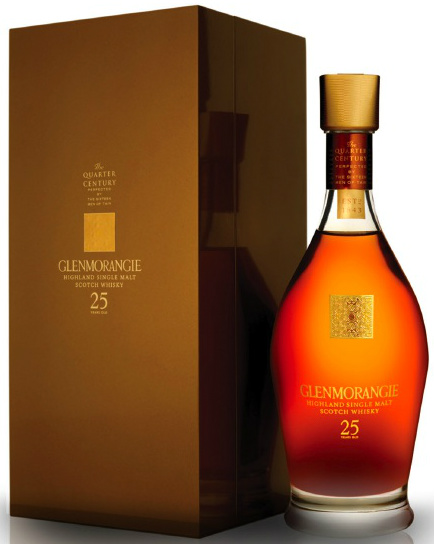
Glenmorangie 25yoColor: Orange gold.

Nose: Waxy, dusty with old wood. Old bottle. Well if anything, this does show its age.  A sharpish winey note. Burnt oak and a distinct sweetish toffee note. Very creamy mocha and milk chocolate with hints of creamy latex paint. Duo Penotti. Hints of oak, cigarette smoke and wine acidity. paper dust. The aroma’s seem to weaken with time. Fragile.

Taste: Strong sweet entry. Red sweet and sugared cherries, so quite some wine influence. Toffee is in here too. Liquid candy. Light, slightly too low in ABV if you ask me. Similar burnt note to the nose. Old wood. Easily recognizable is the American oak ageing. Creamy vanilla and mocha coffee. Slight hint of oaken bitterness. Easily drinkable. Seems simpler that I initially thought and the finish has medium length.

This proves is for me. If you want a Glenmorangie from the current range, I prefer the ones with an age statement, the older ones that is, over the ones that are named after Hyundai cars. The secret here is that the 18yo is maybe a better and definitely much affordable Whisky than this 25yo. Sure, this 25yo is a great piece of work and compared to the 18yo is slightly more complex, but the 18yo seems to be the better balanced Whisky of the two. Did I mention the humongous price difference between the two?

Points: 86
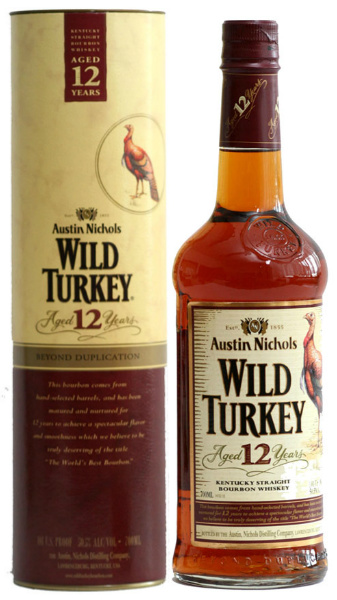
Wild Turkey 12yo (50.5%, OB, 2007)

It’s still september, so why not add another Bourbon to our collection of reviews. This time, we’ll focus on a Wild Turkey 12yo 101 proof, that was bottled a few years ago. Today’s version looks somewhat different and more blue. According to the Wild Turkey website, todays 12yo (as well as a 13yo) is only meant for the Japanese market. Over here, we still have a 101 proof, but that is one without an age statement (NAS).

Wild Turkey 12yoColor: Orange gold.

Nose: Fatty and full of aroma. Candied oranges with lots of toffee. Quite sweet-smelling. It almost smells like a dry Rum. Very appealing. Right after this (and not before), the smell of the wood. New oak with lots of vanillin obviously. Lots of nuts. Almonds combined with rather new thick leather. All aroma’s are big in this one. Also some hints of dust and vanilla powder and cookie dough. Pushed even further in the background are small, small hints of red fruits and toasted wood. Big and tasty smelling. If this tastes like it smells, this really is a winner. It’s all about toffee, vanilla and nuts.

Taste: Not as big on the toffee now, but still a big aroma. Wood plays a bigger role, and that is no surprise, considering the age of this Bourbon. Vegetal wood with a slight hint of soap. That sounds worse than it actually is. Vanilla combined with sugary sweetness. Sweet corn even. Not overly complex, but nice and big and very tasty. Quite a big finale of toffee and some big aromatic sweetness, but aided by the toasted wood note quickly balancing out the sweetness, also showing its age.

I always liked Wild Turkey’s Rare Breed, but this is another winner! I will have to return to Rare Breed for a comparison. If I remember correctly, Rare Breed shows more Rye compared to this sweetish 12yo. I also did a quick comparison with the Four Roses Single Barrel I have on my lectern, and they are quite similar in quality, and not even that far apart in taste. Four Roses has a different kind of sweetness though. It’s sweetness isn’t all that big and more focused, but very present as well. Wild Turkey has a broader kind of sweetness. Maybe the sweetness is more integrated because of its age?

Points: 83

Jim Beam “Signature Craft” 12yo (43%, OB, Small Batch)

Marketed as the super premium “Top Shelf” Bourbon in the Jim Beam range of Bourbons. No don’t worry the Small Batch series isn’t discontinued, just they are seen as Bourbons for aficionado’s and less for the “people”. Second the Signature Craft’s will bear the Jim Beam name as opposed to the Whiskies released in the Small Batch series. Bearing the Beam name is also the reason this Signature Craft Bourbon doesn’t break the bank. It’s an easy access brand. For those who don’t know The Small Batch series, it comprises of: Bookers, Baker’s, Basil Haydens (Old Grand Dad recipe and yeast strain) and Knob Creek.

Jim Beam Signature Craft 12yoColor: Copper gold.

Nose: A lot of honey and the typical Jim Beam yeast strain. Wow, really very honeyed. It’s hard to get past that. This needs to breathe for a while. Quite mellow for a 12yo Bourbon that has spent all of its life in new wood. The wood starts to work here, and adds vanilla and a teensie bit of spiciness to the whole. Honey still, but becoming more dry. Hints of a Cognac-like fruitiness. Hints of dry powder and old leather. More hints can be found, but in the end it’s all creamy vanilla with loads of honey.

Taste: less sweet than expected. More (new) wood influence here and quite warming. Runny caramel with hints of burnt sugar. Added character by the honeyed, woody bitterness in the finish. Toffee. Also a hint of menthol seems to be here, chilling my lips. The finish itself isn’t very long, and that’s quite surprising for such an old Bourbon. Well balanced though.

Somewhat sweeter than the Four Roses Single Barrel and Buffalo Trace. Super Premium, well maybe. I have to say that this is a well-balanced and very easily drinkable Bourbon. Sometimes surprising to be 12yo, since the wood isn’t always there overpowering the whole by it prolonged maturation. Although not super premium by my book, I do still like it. It stands shoulder to shoulder with both Bourbons mentioned above. By the way The Signature Craft series do remind me a lot of Four Roses. The look and feel, not the taste that is…

Points: 83

Buffalo Trace (45%, OB, Circa 2013)

A new month, and maybe it just is time for something different. Different from Single Malt Whisky that is. More than three years ago, I reviewed a Single Barrel version of Buffalo Trace, selected by Binny’s. A barrel that otherwise would have been used for the standard bottling of Buffalo Trace. Up untill now, I even haven’t tried the standard Buffalo Trace bottling, so here it is, maybe long overdue on these pages, so without further ado, straight from Frankfort, Kentucky, USA, here is Buffalo Trace.

Buffalo Trace 45%Color: Orange Gold.

Nose: Yeasty with lots of honey. Hints of bread and some great fresh and sappy oak. Glue and corn. Toasted cask, sweet and spicy and slightly soapy. Hints of red fruits and dried apricots in white chocolate and a tiny hint of cherry liqueur. Next some dried leaves on the pavement (in November). Glue and soap don’t sound very nice, but I can assure you, it all fits together quite nicely. It smells quite modern and fresh, although some old planks from an old grocery shop are there.

Taste: Sweet and toffee. Creamy vanilla. Yes, toffee and caramel, with some prickling wood spice, soon to be countered by the initial sweetness of the Bourbon. However, this sweetness seems to come and go, switching places with a dry oak sensation. Hints of acidic red fruits, and some light candied oranges. It is quite mellow and much simpler than the nose was. I no way would I have guessed this to be 45% ABV. It seems lower, mellower. In the taste there isn’t a lot of evolution and there isn’t a lengthy finish, but it does leave a nice aftertaste. Don’t get me wrong. This is a nice Bourbon, that is easily drinkable. Definitely a very good entry-level Bourbon.

Here I will compare this Buffalo Trace to the Binny’s Single Barrel version I reviewed earlier. On the nose, The Binny’s version seems to me to have more depth and has an addition of florality to it (Lavender, fresh, not lavender soap). It also has more caramel and smells sweeter. Heavier on the fruit too. It simply has more aroma. Much less virgin oak but it does have some paper in stead. The rest of the nose overlaps with the standard version. In the taste it seems more similar to the standard version. Not a lot of difference in age or “thickness”. Just a little bit more added depth and slightly sweeter. The wood has a tiny hint of pine that is quite nice. The wood itself is less of the virgin type, and more of the old grocery shop plank type. It seems to be mellower and it doesn’t have the attack and the glue of the standard version. In the end, the Binny’s version offers a different take on the standard Buffalo Trace, but the quality is there in both.

Points: 82

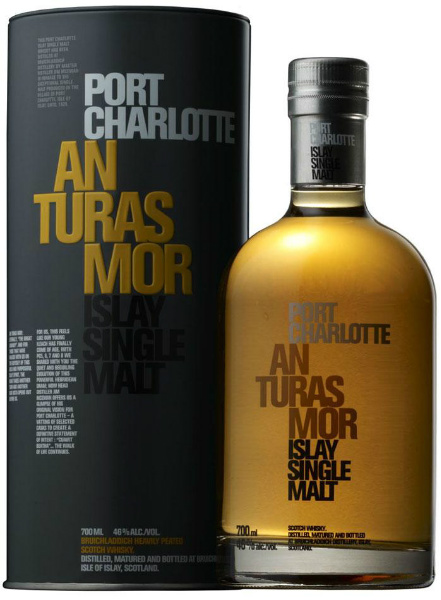
Port Charlotte “An Turas Mor” (46%, OB, American Oak Casks)

In 2000 Murray McDavid bought Bruichladdich for £6.500.000 (from Jim Beam, current owners of Bowmore and Laphroaig). After acquiring the distillery guess what was the first distillate made? Yes! Port Charlotte, not the unpeated Bruichladdich itself. The guys behind Murray McDavid are no fools. We all know Mark and Jim to be very shrewd guys. So the first stuff they wanted to make with their new distillery was peated Whisky. On the 29th of May 2001, the first Port Charlotte was made. The first Bruichladdich under new ownership was somewhat later distilled in July. (2001 which was also the year the first newly bottled Bruichladdich was released; the 10yo I just reviewed, the 15yo and the 20yo). Finally on the 23rd of October 2002 the first Octomore was distilled.

Port Charlotte "An Turas Mor" (46%, OB, American Oak Casks)Color: Pale gold.

Nose: Mild, fatty vegetal peat, with butter and vanilla, pepper and salt. It smells like lavas was one of the plants that makes up the peat. Quite soft and unobtrusive. Some smoke and a tiny hint of burnt plastic and traces of soap. Sappy licorice twig. Wood lying around in the forest. Fresh (air) and un-complex. Dry kippers with hints of tar. Dusty vanilla and some paper. Nice to smell. The nose is worth the price of admission.

Taste: Sweet and peat. Sugar water with slightly bitter peat. Sweet licorice and black and white powder (yes, licorice again). Slightly warming. Licorice and licorice twig. Very tasty (the sweetness helps it along), but not very complex, but who cares when it’s so drinkable. Reduced, brooding peat that resembles coffee a bit. After a decent body, comes alas a sort of weak finish. A finish full of paper, barley, hints of soap and sweet licorice, but I guess we can blame its youth for that.

Lots of young Whisky is noticeable in An Turas Mor, but it shows a lot of potential though. This will become a great peated Islay Whisky when it becomes of age. I feel that Port Charlotte is a sweet Whisky that can be high on aroma, but struggles a bit with its length when it’s young. Highly drinkable, likeable and definitely worth its money. Get it, it’s not as expensive as the PC’s.

Points: 84

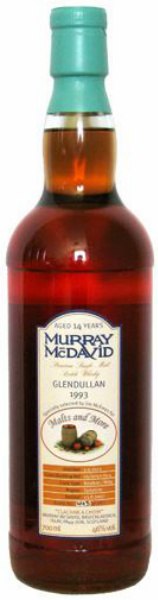
Glendullan 14yo 1993/2007 (46%, Murray McDavid, for Malts and More, Bourbon/Rioja Tempranillo, Cask #05/0052, 493 bottles)

After the Murray McDavid Rhosdhu, here is the second of three bottlings by Murray McDavid. This time we’ll have a look at Glendullan. The Edradours I reviewed last had their first appearance on Master Quill, and now we can cross off Glendullan as well. Here we have a fine example, where Murray McDavid were taking the independent bottler. Specializing in Wine cask finishes. In the early 2000’s Wine finishes were snuffed at, since most of them were overdone and the Original Whisky was probably dull (pun intended). It was just the industry trying Wine finishing out and learning on the go. They still have to wait many years to find out where their experiment were taking then. This particular Glendullan started its life as a regular Whisky aged in Bourbon casks (most likely a Hogshead).  After a while the contents were transferred into a wine cask. Tempranillo te be precise. Tempranillo is a red grape most common to Spanish Wines like Rioja.

Glendullan itself is a distillery owned by Diageo. A bottle of Glendullan is not the most common find of all distilleries, especially considering Glendullan is one of the largest distilleries Diageo owns.

GlendullanColor: Dark gold, slightly orange.

Nose: Spicy wood and a slightly acidic winey note. Very spicy oak, slightly burnt. Nutmeg, and herbal as well. Some faint odd acidic citrussy dishwater aromas. Applesauce, de Querville Calvados! Quite dusty and old smelling, like an old Whisky aged in a Bourbon cask. Behind that a more restrained fruity note, but again acidic fruit combined with hard candy versions of that fruit with added cherry and raspberry candy flavours. Almond pastry, cinnamon and nougat. It’s not quite a replacement for a Sherry aged Whisky, but not bad nevertheless. The Wine turned out very soft on the nose. I do get some grape skin, but from white grapes, not red. In the end, all aroma’s are built upon a wealth of wood, but no, it’s not woody. Needs a lot of air (time) to develop, but in the end it will not disappoint.

Taste: Fruity lemonade and warming. Citrussy again and to a lesser extent so are the apples. Present, but not so much in the Calvados way. Also grenadine and quite a lot of licorice. Old rotting wood. The kind that has been submerged for a long time in a forest. Quite thick. Some raisins. Lots of influence of the wine cask. Maybe a bit too much? The Bourbon casked Whisky isn’t really recognizable anymore. Is that bad? Nope not really. This is still a nice tasting Whisky. Less complex than the nose, but overall quite pleasing. It doesn’t show its best bits right from the start. Pour it and leave it for a while.

Quite stunning what Murray McDavid have achieved with Tempranillo. No wonder Tomatin has gone that way lately too. Complex stuff, with a stunning nose, with quite some development.

Points: 85

Rhosdhu 12yo 1996/2008 (46%, Murray McDavid, Bourbon Cask, 2.000 bottles)

Murray McDavidNext we are going to have a look at three bottlings by Murray McDavid. Murray McDavid was founded in 1996 by Mark Reynier, Simon Coughlin, and Gordon Wright, naming it after Mark’s grandparents, Harriet Murray and Jock McDavid. The motto “Clachan a Choin” translates as “the bollocks of the dog”, so yes, the logo has a dog in it. Besides being an independent bottler, maybe their biggest claim to fame was acquiring Bruichladdich Distillery in the year 2k. In 2000 the distillery was still mothballed, but Mark and his mates quickly turned it into a working distillery. Less than 12 years later in the summer of 2012, Bruichladdich was sold to Rémy Cointreau UK Limited, as well as the independent bottler Murray McDavid. Rémy Cointreau didn’t know what to do with the bottler, so less than a year later they sold it to Aceo Ltd, a supplier of casked whisky and distillery services like cask storage, bottling and labelling.
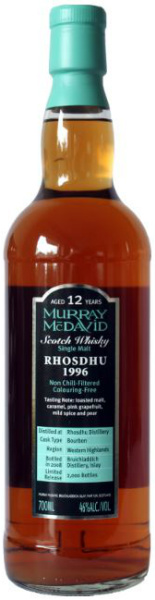
So the first of three bottlings from Murray McDavid will be a rendition of a Loch Lomond Whisky: Rhosdhu.

Rhosdhu 12yo 1996/2008 (46%, Murray McDavid, Bourbon Cask, 2.000 bottles)Color: Gold.

Nose: Spicy and briny. Funky, with some prickling cigarette smoke. Lots of grain, but also some traits I get from Rhum (of the Agricole kind) and Bourbon itself. Actually more like a Rye Whiskey. A dry and sweet fruitiness mostly. Definite cask toast. Vanilla and tangerine. Lots of saw dust and dare I say it (again), cardboard. It smells like an old (sweet) Single Grain, at the fraction of the cost. Dry powdery and again (citrus) fruity. Give it some air, and boy, does this need some air, and it’s even tarry sometimes.

Taste: Again quite grainy and fruity. A bit raw but therefore it needs the fruity sweetness it has. Vanilla powder and smelling like an old vanilla pod. Noticeable paper and cardboard again, but in no way is this disturbing in this one. Slightly weak in the finish, but otherwise a decent Whisky, helped by quite an active cask. Some acidity enters the fold when it’s time for the finale. The finale has great depth, with a toffee and caramel sweetness. Part of this caramel is even slightly burnt. The sweetness is just right, helped along by the leafy and spicy backbone.

I remember this when freshly opened and it didn’t do too much for me then (79 Points). This time around, with some more oxidation, this turned out nicely. This is a Whisky that needs a lot of air and really benefits from the heat of your hand. Keep it in the palm of your hand, don’t hold it by the stem. Knowing its secret, and if it was available today I would most certainly buy it. If you have it, remember how to treat it. Heat and air will do the trick.

Points: 83

Karuizawa 30yo 1983/2013 (55.8%, OB, Geisha Label, for The Whisky Exchange, Bourbon Cask #8606, 350 bottles)

Every time someone in the world dares to open a bottle like this, an earthquake occurs amongst collectors. Up ’till now lots of old bottles of Scottish Whiskies, particularly from closed or classic Speyside or Islay distilleries, fetched the highest prices. Today it may very well be Karuizawa, a Japanese Whisky, which is delicious and becoming extremely rare. These bottles are bottled, and hardly anyone opens them anymore. Well not Master Quill! I’m very happy to open my less than-half sample of this Karuizawa and share my thoughts with the world!

Karuizawa 30yo 1983/2013 (55.8%, OB, Geisha Label, for The Whisky Exchange, Bourbon Cask #8606, 350 bottles)Color: Vibrant full gold.

Nose: Wow, this emits heaps of aroma. Nice rubbery notes and extremely waxy. Fresh and vibrant and highly aromatic. It oozes a typical Japanese nutty kind of smell and cask toast. Fragrant green tea combined with the more obvious creamy vanilla note we know from casks made of American oak that once held Bourbon (or Tennessee Whiskey). There is some kind of sweet sensation underneath that reminds me a bit of hot sugar-water. The wood emits fresh oak and fresh tree sap, with whiffs of powdered coffee creamer. Quite floral and fruity. The fruity part are hints of fresh (thus not over-ripe) plums. The floral part is more about fruit trees in bloom rather than any kind of flowers. Elegant stuff.

Taste: Quite hot with ashes and an old oaky bitterness. Pencil shavings and some sort of hidden fruitiness. Lovely dusty nuttiness comes to the forefront too, making this a woody Whisky. Dark bitter chocolate and (ear) wax. If you can get past all the furniture and dark chocolate, there is some candied fruit behind all that.

Never owning a bottle myself I had some kind of luck having tried this one several times. Once from a freshly opened bottle, but also the last few drops from a bottle that had some time to let the Whisky breathe. I have to say that this particular Karuizawa is stellar when freshly opened, but with that the oxidation starts. Usually oxidation is not a bad this in Whisky, but sometimes oxidation changes or even ruins the Whisky. Here we have an example where oxidation really can change the Whisky. When this Karuizawa oxidizes the focus shifts more towards the (especially in the taste), whereas the freshly opened bottle is way more fruity. I don’t have a freshly opened bottle at hand, so this review is written tasting the last drops of the bottle, but I do remember the Whisky well when it was freshly opened. The score is for the freshly opened bottle. The last drops would score around 87 points so beware!

Points: 95

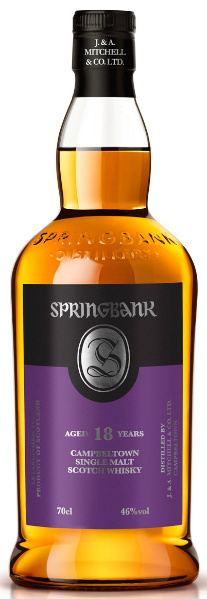
Springbank 18yo (46%, OB, 14/301)

Reviewing the utterly wonderful Glenfarclas 29yo I came across some notes and hints of coconut. Coconut is something I always found a lot of in old Springbanks, so Springbank stuck a bit in the back of mind, when I was tasting the Glenfarclas. Very conveniently, I have an open bottle of Springbank 18yo on my lectern, so lets see if this Springbank still has a hint of the old coconut up its sleeve. If I’m not mistaken, this Springbank is made from 80% Sherry casks and just 20% Bourbon. Lets hope the Springbank coconut is not (only) from the Bourbon casks.

Springbank 18yo (2014)Color: Gold.

Nose: Ferns and leafy. Garden bonfire (smoldering grass). Lots of forest floor aroma’s. Partly creamy. Sowing machine oil and slightly smoky. Sweet cold black tea. Give it some time and this actually is a beautiful nose. Red fruit juice and sweet red apples, but also some Golden Delicious, combined with hot metal. The smell of dead, old steam equipment. When given some more time to breathe some nice yellow fruits come through. Dried apricots combined with mint. Very fruity Sherry, almost a sweet white Sherry. It also reminds me a bit of Sauternes and sweet Moscato. Fabulous balance. Wonderful batch of Springbank 18yo. However, no coconut in the nose.

Taste: Sweet, oily and nutty. Fruity as well. Strange enough when the fruity part comes the sweetness hops into the back seat, so even though the fruity bit is highly aromatic, it isn’t sweet. So not a lot of fructose nor thick fruit, but a thin kind of yellow fruit. Slightly perfumy as well. Well balanced and everything stays in its place. Not a lot of development over time. Nice smoky note too and the sowing machine oil is present as well, but alas no coconut.

This is great stuff, but I still think this is not a Whisky for everybody. It’s not a lovely, fruity and soft Whisky. This is more a Whisky with muscles. A masculine dram with oil and smoke. Although almost three times distilled, it is miles apart from the typical triple distilled grassy and citrussy Lowlanders. Artisan Whisky from a lovely distillery.

Points: 88

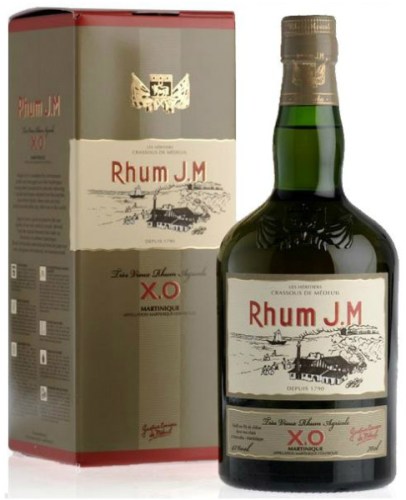
J.M XO Très Vieux Rhum Agricole (45%, Bourbon Cask Matured, Martinique)

Today I was working in the garden. Preparations have to be made for the coming summer. Getting rid of weed, clean the BBQ, plant some new flowers and so on. Evenings are still cold, so now I’m sitting inside and I notice my arms are quite red. Must be a hole in the ozone layer or something, because I can’t remember getting sunburned so quickly. Another place on earth I would get easily sunburned is not Scotland, but Martinique. Yes it’s Rhum Agricole time! Rhum Agricole is the French word for Cane Juice Rum, as opposed to Rum made from molasses. Tonight we’ll be having J.M XO. Looks cryptic doesn’t it? The XO (as for Extra Old, or Très Vieux in french) is a Rhum Agricole, which has been aged for a minimum of 6 years in re-charred Bourbon barrels.

J.M XOColor: Full orange gold.

Nose: Woody, spicy and floral. Right up is un-ripe banana. Very aromatic and dry. Lots of spices. Hints of gingerbread and cookie dough. Old soap (roses) and polished furniture. The nose is wood driven, but it is never overpowered by wood. Also the charred oak is noticeable, but again, not overpowering. Notes of an old wooden shop or a church. Even hints of incense is there.

Taste: More of the same. Wood at first, with a bit of mint, but that dissipates quickly. A short sweetish film, that also passes by quickly, leaving a nice and fruity aftertaste. Hints of tree sap, mocha, coffee with milk and milk chocolate. Tiny hint of an Industrial complex and motor oil (which is nice). Next an even tinier note of passion fruit and even less still: anise. Tasty. This is not a sweet Rum, it is rather dry and well made. The only beef I can have with this Rhum is that even for an XO it is quite light and seems to lack a bit of depth or complexity if you prefer. Dangerously drinkable.

I have to admit, since the day of Douglas Laing’s Old and Rare series (Platinum) I am a sucker for dumpy bottles made with green glass. The rest of the labels and packaging are also very appealing. Having said that, of course that is not as important as the Rhum inside the bottle. I like sugar cane Rum. With its relative dryness, it matches with Single Malt Whisky. Nothing wrong with sweet Rum obviously, but the dry style is a welcoming addition to the drink. This dryer style, can showcase its finesse and elegance some more.

Points: 85