J.M 11yo 2002/2014 Vieux Rhum Agricole “Millésime 2002” (46.3%, Bourbon Cask Matured, Martinique)

Reviewing the dirt cheap La Mauny “1749” already opened my eyes to Rhum Agricole from Martinique, but especially after reviewing the J.M XO, I started to really like the stuff. Followed quickly by the La Mauny XO. There is a difference in ABV though, the La Mauny is bottled at 40% ABV, and suffers from it, the J.M XO is bottled at 45% ABV, which seems to be a much better strength. Apart from the difference in ABV, I somehow clicked more with the taste of the J.M. Soon after, I went out and bought this 11yo J.M Millésime 2002. (Two of them actually, since I had high hopes for this one, and I got a pretty good deal on them as well). Aged in Jim Beam Bourbon casks, just like the XO, but almost twice the age. Having already tried the 2002, this time it’s not about comparing it to the XO, because both earn a place in any drinking collection. You know, a collection of bottles destined to be drunk, bottles that will be actually opened to be enjoyed. The XO is younger, has less depth but is also a high quality Rhum Agricole. Having said all that, I have to warn some people. A lot of (sweet) Rum drinkers are a bit put off when starting with Rhum Agricole. Its different. Just like heavily peated Whiskies differ from Bourbons and so on. Proceed with caution, acquire the taste, and if you put some effort into it, you’ll be rewarded with some great Rhums (If you choose wisely).

J.M 11yo Vieux Rhum Agricole Millésime 2002 (46.3%, Bourbon Cask Matured, Martinique)Color: Full gold.

Nose: Fresh, half sweet and industrial. Wax. Red fruit sweetness and acidity. Cherries, dust and toffee. Soft wood and old leather. With some air more fresh leather combined with a little bit of clear glue. Ground roasted coffee that has been around for a while. Pecan nuts with a hint of cola, brown sugar and cane juice. Hints of menthol which leaves a long minty feel in your nose and throat (already after smelling, I haven’t tasted it yet). Hints of good oak aged Calvados.

Taste: Brown sugar and slightly burnt sugar and maybe even some cask toast. Starts with a small amount of sugary sweetness, but it quickly becomes more dry. Warm apple juice and Calvados (de Querville, the older ones). Leather and more notes of apple. Hints of licorice towards the end. Although this wasn’t reduced, the ABV is natural cask strength, this doesn’t have a very long finish. Medium finish which concentrates around the burnt sugar note combined with some bitter wood. Although the Rhum as a whole is very good, the finish lets it down a bit.

Wonderful Rhum with lots of complexity which releases layer upon layer. It great, but even better if you are patient with it, since it develops a lot in the glass. Great balance too. I have to say that the way I perceive the bitterness of the finish, has also a lot to do with me and the moment when I drink it. It’s more a digestif than an aperitif. The bitterness is less obvious in the evening, than it is in the morning, so don’t let this put you off, since the bitterness is in no way overpowering.

Points: 87
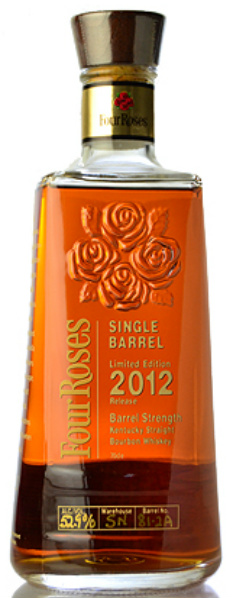
Four Roses 12yo “Single Barrel” (52.8%, OB, 2012 Limited Edition, SN 81-2R, 174 bottles)

Four Roses seems to be a very transparent producer of Bourbon. First of all they let you know everything about the ten recipes they make and how they are used in their expressions. For those of you who don’t know, There are 2 different mashbills and 5 different yeast strains, giving ten recipes. Apart from the ten recipes, the portfolio seems rather logical too. Starting off with the Four Roses “Yellow”. It is their entry-level Bourbon and is made in large quantities. Next comes a small batch and after that only single barrel expressions, the first of which is reduced to 50% ABV and the rest bottled at cask strength.

As I wrote in the last review of the “Yellow”, they can use all of the ten recipes to get the consistency you want for a bulk product, although most of it is OBSK and OESK, where B is 60% corn, 35% rye, and 5% malted barley and E is 75% corn, 20% rye and 5% malted barley. The “K” Yeast strain gives light spiciness, light caramel and a full body.

It gets really interesting when you have one of the Single Barrel expressions at hand since they can be made with only one of the ten recipes. Earlier I already reviewed the 50% ABV single barrel version which is a OBSV, where the “V” yeast strain gives light fruitiness, light vanilla, caramel and creamy notes, and “B” is the high Rye mashbill.

Today we’ll have a look at a limited edition single barrel expression bottled at cask strength and made with the OESK recipe. E is the low Rye mashbill, so I expect it to be sweeter than a “B” and the “K” yeast strain gives light spiciness, light caramel and a full body. So it should be a full-bodied, sweeter, more classic Bourbon than the 50% ABV expression.

Four Roses Single Barrel 2012Color: Dark gold copper, marginally darker than the 50% ABV expression.
Nose: Creamy and sweetish, already less woody and strict than the 50% ABV expression. It starts off with notes of hay and dry grass. Wax with a hint of leather. An old, well maintained saddle maybe? Hints of dried yellow fruits. Apricots I would say. Quite some honey after breathing, but soon after that more dry and dusty (and slightly acidic). Bad morning breath, wow.

Taste: Starts with toffee sweetness, but like the nose, the sweetness soon steps aside to let the wood through. Quite spicy and wood. The wood gives it spice, but also a more nutty and slightly acidic profile. At 12 years old this Bourbon had a lot of time to interact with the wood. The wood leaves, vanilla cinnamon and a hint of honey, but also a slightly soapy and slightly bitter finish. The finish itself starts as an attack, is long, but stays with the woody notes. Even the sweet mashbill can’t do nothing about that. Besides this, I also feel the end of the, somewhat simple, body, and the especially the finish lack a bit of balance. It’s not completely harmonious. I guess this one may have been in the cask too long. The wood won a battle with the sweetness and obviously won, where there shouldn’t have been a battle in the first place.

By the way, the picture here is of another, similar looking 2012 limited edition. The picture is for the 52.9% ABV version from barrel 81-2A, which is a sister cask of our 81-2R. Both come from the same warehouse: SN.

So what’s the verdict about our super premium limited edition? It’s a nice special edition, and a learning experience for the aficionado. I understand the pick and it most certainly is an interesting experience. So should you try it? Yes, should you buy a bottle and drink it by yourself, not really! This one is for sharing, discussion and comparing the other recipes of Four Roses.

Comparison to the 50% ABV expression is easy. That one is sweeter and more easily likeable. The difference in ABV is small, but the age probably made the difference, making the 12yo more about wood. Both are not very complex, but the 50% ABV is definitely more drinkable and better balanced, but also slightly weaker in taste. The limited edition also brings quite a lot of heat to the table. I’m trying both head to head but none is better than the other, although very different. It’s a tie!

Points: 83

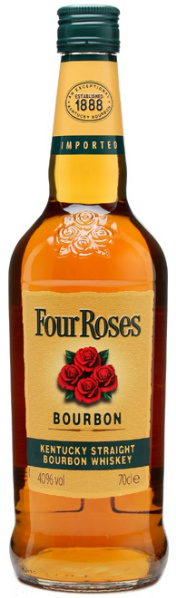
Four Roses (40%, OB, 2011)

After the highly specialized Octomore, let’s get back to basics with this Four Roses Kentucky Straight Bourbon Whiskey aka Four Roses Yellow, since it has, and you’ve guessed it, a yellow label, although with every revamp of the look, the yellow label gets less yellow. The one I’m about to review, is one that was released a few years ago, but since this is the entry-level best known product of the distillery, I expect a lot of consistency exists between different batches. Four Roses is a bit of a tricky Bourbon for me. Four Roses have their ten recipes and it depends of the usage of these recipes in blending the Bourbons if I like them or not. For instance, if you have read my review of the Single Barrel expression, you know I found the new 50% ABV version quite good, whereas I didn’t like the older 43% ABV version as much. For me it was too floral. Don’t get me wrong. It’s about the taste, not the amount of alcohol in the finished product. I understand that this yellow labelled Bourbon I’m about to review is around 6 years old and can contain any of the ten recipes Four Roses makes, although most of it is OBSK and OESK. If this means nothing to you, please have a look at my other Single Barrel review.

Four Roses YellowColor: Orange gold.

Nose: Smells young, and slightly alcoholic. Light and creamy. Even some yeast and quite some honey. Dusty, with charred oak and whiffs of the new oak underneath. It has more to do with oak than the florality of the old single barrel expression. It seems a bit closed to me, since it is a bit hard to get all of the aroma’s out of my glass from the start. Maybe it’s reduced a bit too much. Another layer shows us some cardboard and a leafy, grassy note. Dry grass mixed with the slightly spicy note that has to do with the toasted oak. The honey note quickly disappears, making it less sweet and somewhat more spicy. Otherwise quite light and yes, simple. Bourbon tea.

Taste: Cardboard, wood and sugary sweet. Waxy paper. Sugar water sweetness and a very nice oaky note. New oak, with again a grassy, spicy and soapy note. There are some good flavours in this and even has enough character for an entry-level Bourbon. The wood and cream give it its initial likeability and backbone. It maybe a bit simple, but it’s very nice as an unoffensive entry-level bourbon should be. Nice body, medium finish.

Start with something like this, share a bottle with mates, get to know it. Compare it to several other entry-level Bourbons, like Jim Beam (white), Evan Williams (black), Buffalo trace and others. Quickly move on from there, if you’re an adventurous person. My review may seem a bit harsh, but it’s actually not that bad at all. This Bourbon is pretty decent, has some nice aroma’s and is very drinkable and buying this, won’t scare your wallet at all. With the age comes also a rather simple body with a not too long finish. I hope it’s strong enough for mixing, but I couldn’t say. I’m no mixologist.

Compared to the aforementioned single barrel expression, the single barrel has more depth to it, seems better balanced and benefits greatly of its higher strength (50% ABV), although it has a tad more of the feared florality. Luckily it’s not enough to spoil it for me.

Points: 78

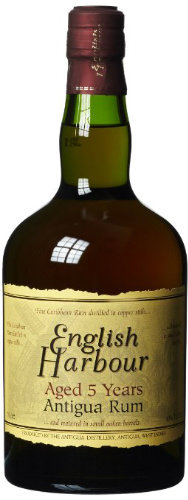
English Harbour 5yo (40%, Antigua, West Indies)

And here is another Rum in a dumpy bottle. This time, just like the El Dorado, we have a Rum with an age statement that really does mean that the contents have been aged for that period of time. Where the El Dorado is 15yo, this English Harbour only has 5 years under its belt.

Antigua Distillery Ltd. is established in 1932 with a 3-column Savalle still from France placed one year later. In 1943 Antigua Distillery Ltd. buys the Montpellier sugar estate with 2500 acres of cane field. We have to wait until the fifties to see the first Rum called Cavalier Muscavado Rum. The first Rum that was called English Harbour was released in 1990. Today the portfolio holds the 5yo we’re about to review, a 10yo, but also a 1981 vintage. This 1981 Vintage is the last of the Rum distilled on the original Savalle Still from 1933, which was eventually decommissioned in 1991…

English Harbour 5yoColor: Light orange gold.

Nose: Sugary sweet, nutty, fresh and fruity. Appetizing. Slightly dusty and some woody dryness. Fresh sugarcane-juice and hints of Bourbon. Typically vanilla, toffee, caramel and a hint of roasted coconut to finish it all off.

Taste: On entry first quite thin, but just right after that a slow, caramelly, sugary sweet sip slides down my throat. lots of toffee and creamy notes. Nougat (with hazelnuts). A distant laid back fruitiness emerges, which I can only describe as the marriage of sweet sugared cherries with dried apricots. It’s neither of the two but some sort of marriage of the two. Half long finish with a light backbone of oak, leaving a very pleasant, and slightly hot, after taste.

For the cost a very good Rum you can do anything with. The work-horse of your collection. It’s a very nice un-demanding sipping Rum, but will work excellent in cola and cocktails. Yes is may be slightly simple due to its youth, but it is highly drinkable, not too sweet, not to woody. Everything seems in its place and has no off notes whatsoever. Good stuff.

Points: 83

Willett Family Pot Still Reserve (47%, OB, Single Barrel #82028, 283 bottles)

Just like the Noah’s Mill I reviewed earlier, Willett is a brand name of Kentucky Bourbon Distillers from Bardstown, Kentucky, or KBD for short. At first not really a distiller, but an independent bottler sourcing barrels of Bourbon from other parties and in some cases for other parties. In written media about the subject the name of Heaven Hill keeps popping up, especially since Heaven Hill is a few blocks down the road from KBD. However, on the 21th of January 2012 KBD started tests distilling at their Willett Distillery in Bardstown, so in the end KBD finally became a distiller again. I say again, since the Willett distillery was already founded in 1935 by A.L. Willett and the decommissioned distillery was already bought in 1984 by Even Kulsveen (the founder of KBD).

The Pot Still Reserve I’m about to review come from single barrels, said to be 8 to 10 years old and reduced to 47% ABV, so all are slightly different. Well, they might be from different distilleries altogether as far as I know. Remember that the Whiskey is older than the three years that have passed since starting up the distillery, so these Willetts are still made elsewhere.

Willett Pot Still ReserveColor: Orange gold.

Nose: Waxy, latex paint with lots of new wood influence. Honey. Very vegetal with hints of many plants, even lavas and dry grass. Heavy note of bad morning breath, but also dusty and smooth. Hints of old dried orange skins. The whole isn’t very “big”, although full of aroma.

Taste: Sweet entry, woody, and dry right after that and spicy. Big note of watered down honey (as to say that it is not too sweet). Again quite sappy new wood and very warming. Sawdust from wet wood. Chocolate. Great balance. The ABV works very well for this Whiskey. Slightly bitter and soapy finish, but I guess we have to live with that, since I feel the Bourbon has been designed for its entry and body. A Bourbon with a bite.

For some it may be a bit to raw, harsh and outspoken, like unsanded wood. If that’s the case I can steer you towards more polished Bourbon’s like Woodford Reserve and Bulleit. I really like this Bourbon. Sure, the finish let’s it down a bit, but the rest of the experience is a very nice one. For the time being I can live with it. It is what it is.

Since this is a single barrel product, it is very much possible, other bottles are (slightly) different and have another finish. We’ll see over time when I get to taste other Willett pot Still Reserves, because I’m already looking forward to the next one.

Points: 84

Evan Williams 10yo 2003/2013 (43.3%, OB, Single Barrel #654)

Whisk(e)y certainly is a very global thing. Just read back a few posts and we have already been in Speyside, Scotland, Bangalore, India, and for this review we’ll cross another big Pond to have a look at a Bourbon called Evan Williams Vintage 2003 from Kentucky. This is a single barrel bottling. The barrel was filled on the eleventh of february 2003 and bottled on the last day of July 2013. Evan Williams himself, was a character who at the time of choosing the name, was supposedly the first person to distil Whiskey in Louisville Kentucky. In the end we may never know who was the first since not a lot is known from that time. Evan Williams Straight Bourbon Whiskey is made by Heaven Hill Distillery in Louisville, Kentucky, but bottled in Bardstown, Kentucky. Today the range consists of a Black Label, a Bottled in Bond (White Label) a 1783 (small batch) and we will have a look at this 2003 vintage single barrel. In the past also a special 23yo was released.

Evan Williams Vintage 2003Color: Light orange gold.

Nose: Nicely sweet and toffeed. Good wood notes. Nutty and organic. Very spicy, balanced with quite some vanilla from the virgin oak. Pencil shavings, sawdust and quite a lot of honey and hot bees wax. It also carries hints of grass and cherries. Smells strict and modern.

Taste: Initially light and vegetal. Dry leaves, soft oak, but quickly followed by a nice mixture of wood and sweetness, with a hint of licorice. Very appetizing and likeable. Short finish, and the its way to light too. The watery finish drowns the plethora of aroma’s that are still there. Bummer. Luckily it does leave a pleasantly sweet, sawdust and honeyed aftertaste.

What baffles me the most is the strangely low ABV for a super premium bottling Bourbon, especially since there are quite a few other expressions of Evan Williams around that are also low proof. Maybe this is Heaven Hills low proof Bourbon brand? This is a very nice Bourbon, but still seems to be marketed as an easy drinking Bourbon for the masses despite its super premium status. I would like to see a single barrel bottling like this, (with this mashbill and ageing plan), to be bottled at barrel strength. Not necessarily replacing this reduced version though. I would like to see it as an addition.  I’m hoping that cask strength vintage Evan Williams can be really a stunner. Sure Heaven Hill has other brands, but I like the taste and the flavor profile of the Evan Williams and would like to try it at cask strength. Please?

Points: 84

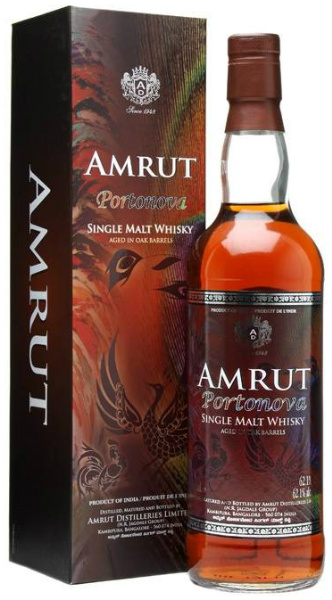
Amrut Portonova (62.1%, OB, Batch 5, 2014)

Ahhh, another Amrut. Nice. I had the pleasure to try some Amruts in the past and was very nicely surprised by the Intermediate Sherry (which I then bought) a Single PX Sherry Cask #2699 (which I then bought) and the Kadhambam (which I have yet to buy). I also tried the “plain” cask strength version, and although pretty nice, I preferred the former ones. Now this Portonova crosses my path. This time a Port finished Amrut, and yes, I have high hopes for this one too…

Amrut Portonova Batch 5Color: Light orange gold. No typical Port pinkishness.
Nose: Although this has a huge ABV, this doesn’t leap out of the glass. Give it some time and some dust and cinnamon emerges. Wow. Cookie spices, dried plums and raisins. Exotic and Christmas in a bottle. Fresh air after rain. Creamy and soft oak. Hot metal. Barley, but different from barley you get from (young) Scottish Whisky. Sweet milk chocolate and red fruit juice. Apart from this all, it has a sweet and deep feel. Exotic spices, curry, cardamom, but where is the Port? I already missed the pink hue, but I also miss its smell. Complex stuff this because there is even a lot more happening in the nose than what I noted here.

Taste: Condensed red fruits. Thick, but initially simpler than the complex nose promised. Obviously quite hot with this high ABV. The wood tastes more like paper and cardboard, than any kind of wood. Not a lot of the wealth of spices shine through on the palate, and that’s a shame. Its more a fruity Whisky with maybe some faint hints of Port. Vanilla comes next. With time if becomes more outspoken and creamy. Nice evolution though. Hints of banana in the aftertaste. Lovely.

First I have to air a disappointment. This would be a stellar malt if the spices from the nose were noticeable so more in the taste as well, without being overpowering of course. Missing the spices on the palate makes the taste of this Whisky a bit simpler than it could have been. Now that we have that out-of-the-way. The whole is still an utterly good Whisky. Very much recommended. An excellent winter warmer I would say. I will have to get me one of these soon.

Points: 88

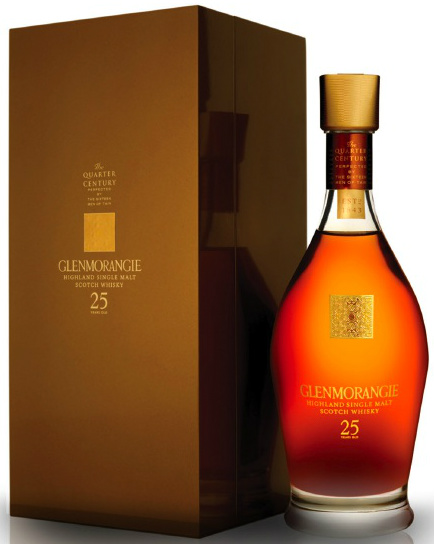
Glenmorangie 25yo “Quarter Century” (43%, OB, Circa 2012)

And here is another entry-level malt. Anyhow, it is when you give your wife a Luis Vuitton bag very month. If you’re more middle class, or like me, no class at all, you might want to get the 18yo “Extremely Rare” which isn’t actually extremely rare but compared to this 25yo is extremely affordable and quite nice. The 18yo scored a quite nice 87 Points. The 18yo has spent all of it’s time in Bourbon casks, save for 30% of the Whisky which was transferred into Oloroso Butts (or Puncheons) after 15 years, to get a three-year Oloroso finish. This 25yo is a blend of Whisky from Bourbon and Oloroso casks, but also contains Whisky from casks that once held Burgundy Wine. Pinot Noir (red) and/or Chardonnay (white). It is unclear if the Burgundy part is a full maturation or only a finish, well the same goes for the Oloroso Sherry as well.

Glenmorangie 25yoColor: Orange gold.

Nose: Waxy, dusty with old wood. Old bottle. Well if anything, this does show its age.  A sharpish winey note. Burnt oak and a distinct sweetish toffee note. Very creamy mocha and milk chocolate with hints of creamy latex paint. Duo Penotti. Hints of oak, cigarette smoke and wine acidity. paper dust. The aroma’s seem to weaken with time. Fragile.

Taste: Strong sweet entry. Red sweet and sugared cherries, so quite some wine influence. Toffee is in here too. Liquid candy. Light, slightly too low in ABV if you ask me. Similar burnt note to the nose. Old wood. Easily recognizable is the American oak ageing. Creamy vanilla and mocha coffee. Slight hint of oaken bitterness. Easily drinkable. Seems simpler that I initially thought and the finish has medium length.

This proves is for me. If you want a Glenmorangie from the current range, I prefer the ones with an age statement, the older ones that is, over the ones that are named after Hyundai cars. The secret here is that the 18yo is maybe a better and definitely much affordable Whisky than this 25yo. Sure, this 25yo is a great piece of work and compared to the 18yo is slightly more complex, but the 18yo seems to be the better balanced Whisky of the two. Did I mention the humongous price difference between the two?

Points: 86

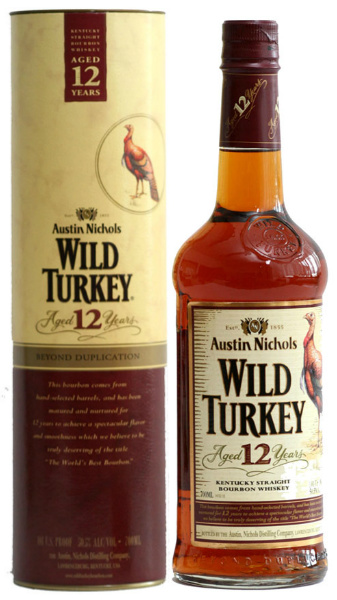
Wild Turkey 12yo (50.5%, OB, 2007)

It’s still september, so why not add another Bourbon to our collection of reviews. This time, we’ll focus on a Wild Turkey 12yo 101 proof, that was bottled a few years ago. Today’s version looks somewhat different and more blue. According to the Wild Turkey website, todays 12yo (as well as a 13yo) is only meant for the Japanese market. Over here, we still have a 101 proof, but that is one without an age statement (NAS).

Wild Turkey 12yoColor: Orange gold.

Nose: Fatty and full of aroma. Candied oranges with lots of toffee. Quite sweet-smelling. It almost smells like a dry Rum. Very appealing. Right after this (and not before), the smell of the wood. New oak with lots of vanillin obviously. Lots of nuts. Almonds combined with rather new thick leather. All aroma’s are big in this one. Also some hints of dust and vanilla powder and cookie dough. Pushed even further in the background are small, small hints of red fruits and toasted wood. Big and tasty smelling. If this tastes like it smells, this really is a winner. It’s all about toffee, vanilla and nuts.

Taste: Not as big on the toffee now, but still a big aroma. Wood plays a bigger role, and that is no surprise, considering the age of this Bourbon. Vegetal wood with a slight hint of soap. That sounds worse than it actually is. Vanilla combined with sugary sweetness. Sweet corn even. Not overly complex, but nice and big and very tasty. Quite a big finale of toffee and some big aromatic sweetness, but aided by the toasted wood note quickly balancing out the sweetness, also showing its age.

I always liked Wild Turkey’s Rare Breed, but this is another winner! I will have to return to Rare Breed for a comparison. If I remember correctly, Rare Breed shows more Rye compared to this sweetish 12yo. I also did a quick comparison with the Four Roses Single Barrel I have on my lectern, and they are quite similar in quality, and not even that far apart in taste. Four Roses has a different kind of sweetness though. It’s sweetness isn’t all that big and more focused, but very present as well. Wild Turkey has a broader kind of sweetness. Maybe the sweetness is more integrated because of its age?

Points: 83

Jim Beam “Signature Craft” 12yo (43%, OB, Small Batch)

Marketed as the super premium “Top Shelf” Bourbon in the Jim Beam range of Bourbons. No don’t worry the Small Batch series isn’t discontinued, just they are seen as Bourbons for aficionado’s and less for the “people”. Second the Signature Craft’s will bear the Jim Beam name as opposed to the Whiskies released in the Small Batch series. Bearing the Beam name is also the reason this Signature Craft Bourbon doesn’t break the bank. It’s an easy access brand. For those who don’t know The Small Batch series, it comprises of: Bookers, Baker’s, Basil Haydens (Old Grand Dad recipe and yeast strain) and Knob Creek.

Jim Beam Signature Craft 12yoColor: Copper gold.

Nose: A lot of honey and the typical Jim Beam yeast strain. Wow, really very honeyed. It’s hard to get past that. This needs to breathe for a while. Quite mellow for a 12yo Bourbon that has spent all of its life in new wood. The wood starts to work here, and adds vanilla and a teensie bit of spiciness to the whole. Honey still, but becoming more dry. Hints of a Cognac-like fruitiness. Hints of dry powder and old leather. More hints can be found, but in the end it’s all creamy vanilla with loads of honey.

Taste: less sweet than expected. More (new) wood influence here and quite warming. Runny caramel with hints of burnt sugar. Added character by the honeyed, woody bitterness in the finish. Toffee. Also a hint of menthol seems to be here, chilling my lips. The finish itself isn’t very long, and that’s quite surprising for such an old Bourbon. Well balanced though.

Somewhat sweeter than the Four Roses Single Barrel and Buffalo Trace. Super Premium, well maybe. I have to say that this is a well-balanced and very easily drinkable Bourbon. Sometimes surprising to be 12yo, since the wood isn’t always there overpowering the whole by it prolonged maturation. Although not super premium by my book, I do still like it. It stands shoulder to shoulder with both Bourbons mentioned above. By the way The Signature Craft series do remind me a lot of Four Roses. The look and feel, not the taste that is…

Points: 83