 And here is another Master of Malt bottling. Earlier I reviewed a reduced Tomatin, that was a true disappointment. I didn’t even know it’s possible to ruin a Tomatin, since usually I like Tomatins. So with this one I do worry a bit. This also is a Bowmore of the eighties, which quite often turn out to be your better hand-soap (lavender and violets come to mind). I once tried a 1989 Berry Bros. & Rudd bottling that made me physically ill. That was a first for me, so I tried that one half a year later and it happened again.
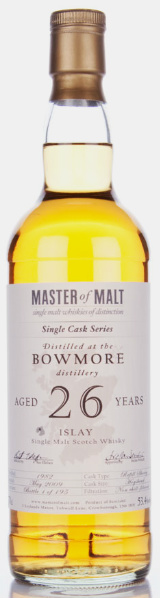 Color: Gold
Nose: Powdery and sweet. Not very Islay to be frank, hardly any peat or smoke. Lots of flowers though, soap, also some clay and thick, so it seems to have body. When freshly poured it is very closed. After a while some smoke trickles trough. Hey, waiting even longer there is peat too. All in minute quantities. Again not very Islay-ish. Is this really a Bowmore? Wet paper and a small hint of licorice. It’s not bad, but not very balanced either. Now we have sour oak. It’s fresh, fruity and floral, luckily not over the top lavender-soap eighties Bowmore.
Taste: Sweet and syrup, with ash and some wood. It actually attacks you in the beginning. The sweetness disintegrates quickly into something acidic. It’s like a syrup that shows, when stripped from your throat, some lemon. The attack is nice, and the middle is also quite nice, but bold tastes fade and leave you with a fairly dull and anonymous finish. What can this be, a strange and unusual Bowmore distillate in a Fino Sherry cask? Well, let’s leave it at that.
In the end it’s not a FWP-Bowmore from the eighties, but it also isn’t recognizable as a Bowmore either. It’s ok on the nose and when it enters your mouth is shows some promise. Halfway through though and especially the finish are a bit weak, which is a surprise after the bold body. But the most remarkable achievement is making and finding a Bowmore that has nothing to do with…Bowmore!
Points: 84
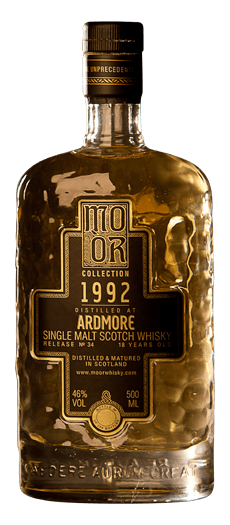 Color: White wine.
 In this day and age of battles, battles for oil, battles in politics, and even dance battles, now there are also battles in Whisky. The guys in the picture are Jan Beek (right) and Dennis Mulder (left). They do tastings/battles to see who bottles the best Whisky, the distilleries themselves or the Independent bottlers. Jan represents the independent bottlers and Dennis the official bottlers. Time for my own battle. Well not a battle with axes and swords. Earlier I reviewed an official
  Color: Lively orange brown.
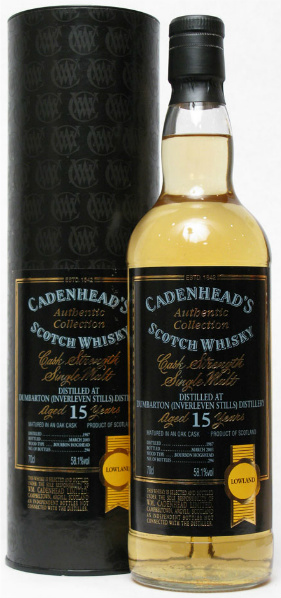
 And here is another Cadenhead’s, from the same kind of cask, from the same year 1987, with three years more ageing. Cadenheads call this Distilled at Dumbarton, made with Inverleven stills. Everybody else calls this whisky just Inverleven. To clear things up. The Single malt whisky that was made this way, was called Inverleven. Inverleven was made untill 1991. This was made with the ‘normal’ type stills. In the same building was also a Lomond type still that was installed in 1959 at the Dumbarton distillery and ran untill 1985 (With the malt being called “Lomond”, not Loch Lomond). Loch Lomond lies close by to the north. Only a few kilometres away, still Loch Lomond is a Highland Whisky, and Inverleven a Lowlander. To wrap things up. The Dumbarton Distillery was the spiritual home of the Ballantine’s Blend.
 Color: Light gold. (Darker than the 15yo Cadenhead).
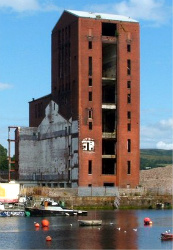
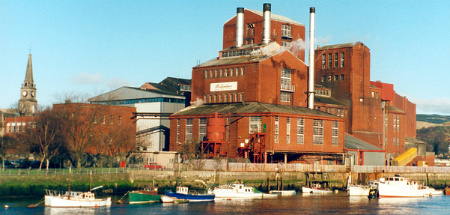 I ended the last post about Gordon & MacPhail’s Inverleven with the hope that they wouldn’t reduce the next issue (so much). Frolicking around in my stash of samples I unearthed this unreduced Inverleven bottled by Cadenhead’s. It’s from another year, so this may have a different profile, but still worth checking out. Dumbarton was foremost a Grain Distillery. The distillery was built in 1938. In 2002 the distillery was closed and demolition commenced in 2005. I’ve added a picture here, because I have always liked the big red brick industrial complex on the river. By the way, after stopping the production of the Inverleven malt, the Stills went on to Islay to produce Port Charlotte at Bruichladdich.
 Color: White wine.
 Erik Molenaar is the boss of this outfit. Did Erik source a tiny Hogshead of Ledaig? “Honey. I shrunk the Hogshead” maybe? Nope, Erik shared a cask with a shop in Maastricht. Slijterij Bams. The share of the shop was 218 bottles, Erik’s share was only 36. Funny enough the label of ‘the other’ bottle states 50.6%. The humor doesn’t stop here. Bams don’t have it on their list anymore. Sold out? But The Kintra version is still available! So I can’t wait to try this. I hear that modern Ledaigs can be pretty good…
 Color: White wine.
 Lot’s of ash in the finish. The lack of balance is a bit disturbing. There is also a bitterness like earwax and a hint of crushed bugs.
 I caught a cold last week, which is very unfortunate when you try to write tasting notes. Fortunately my nose is back in business now, and in the process ‘got a rest’. Let’s start whisky reviewing again, with an example of a whisky that should be light and is ‘low’ in ABV.
 Well living in the low-countries and doing a Auchentoshan review without pointing at the site of the A toshan man is impossible. So
  For now I will do a short intro to Auchentoshan. officially the first word of Auchentoshan is in 1823 when a guy named Thorne got a licence. But there is reason to believe that Auchentoshan started in 1800 named Duntocher. In the past the Germans didn’t like Auchentoshan too much and bombed the place already in 1941. Smart as the Scottish are they waited for the end of the war, rebuilding Auchentoshan. Just to be sure, they started rebuilding in 1948. In 1984 Stanley P. Morrison buys the place and sells his own company to Suntory ten years later. In 2008 Morrison Bowmore starts with the new packaging we know today. But first this expression by indie bottlers The Cooper’s Choice (actually The Vintage Malt Whisky Co. Ltd.) The people behind Finlaggan.
 Why not try another Balmenach. Earlier I tried a
 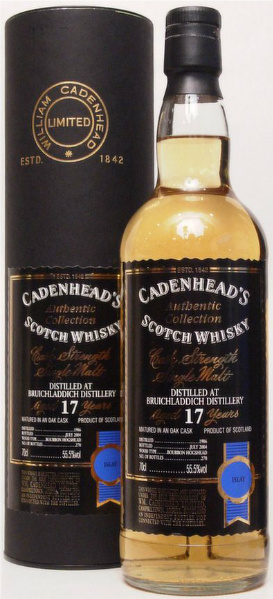 Also from 1986 but several years younger, a 13yo to be precise. Even though it was younger, this bottle showed more character to it. The 13yo was almost empty and maybe these Bruichladdich’s need a lot of air. Let’s have a look in my controlled environment and using my glass of choice, how this Bruichladdich really is. (This bottle, just open).
 Master Quill