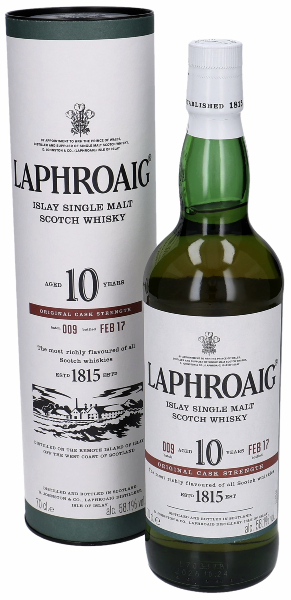
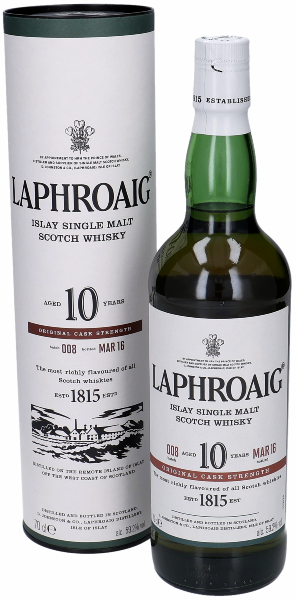
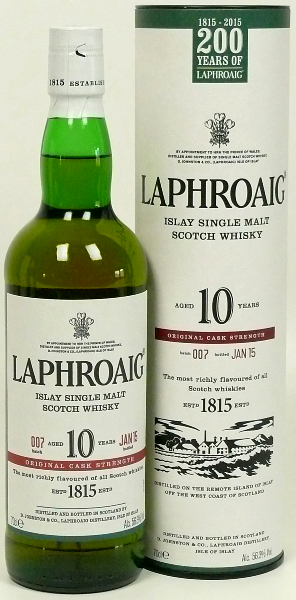
Laphroaig 10yo Original Cask Strength Batch 008 (59.2%, OB, 2016)

Back in 2023, matching up batches #006 and #007 was quite fun. Both Laphroaigs were stunning and scored the same. Lots of similarities and yet some noticeable differences as well, especially in the taste. As mentioned in the review of #007, I started looking (again) at cask strength Laphroaig 10yo’s at a time batches #001 through #005 were long sold out and fetching hefty prices at auctions, and now even more so. From batches #006 upwards, there was not really a problem finding those at reasonable prices, so I did just that.

I still haven’t got several of the earlier batches, so like star wars starting with episode 4, I’m going to use batch #006 as my starting point and work my way up and maybe I’ll get a chance to review the earlier ones as well some time in the future. If possible, I’ll try to compare one batch to another batch, (it worked for me to do pairings), but my stash is somewhat limited and the number of batches is rapidly growing, so it is impossible to compare each batch to each other batch. Although some people did do verticals of tastings of many different batches. For me: box ticked for comparing #007 to #006. Both batches were reviewed from bottles I had on my lectern. Now let’s do the next two. First off this batch #008 from my own bottle and the next review will be batch #009 from a sample provided by Nico, which comes in handy, so I can skip this one at home and open another batch. That would be batch #011 actually, since Auke already provided me with a sample of batch #010. 2023 is already a few years back so I won’t be comparing batches #008 and/or #009 with the two earlier reviewed batches, however I will compare batch #009 to #008. Lets start with batch #008.

Color: Light copper gold.

Nose: I just poured it and it seems the whole room now smells of peat, the longer it stands the “thicker” the air. In my mind this glass stands on my lectern emitting aroma’s like a chimney emitting smoke, you just can’t see it, but you can most definitely smell it. Powerful, earthy peat, with lots of smoke. Meaty, fishy, tarry rope kind of stuff. Medicinal iodine laced peat, with some artificial lemon like aroma (ever did the dishes?) and even a hint of grandma’s old dried out floral bar of soap, both just a hint, so don’t be alarmed. Nice vegetal aroma. Very well balanced batch this one.  Fresh and at the same time very earthy and brooding. Liquorice and sweet liquorice wood sticks. Still also this pleasant smelling soapy edge. Soap on the nose is often good, if the floral bit fits the rest, not so much in the taste. Remember Bowmore’s FWP? (If not and you are proficient with google you might want to look up Serge’s review of Flowermore 38yo on Whiskyfun.com). More smoke and lost of ashes. Smells like a house that once was on fire and was abandoned for a few months. Glowing embers and bonfire notes, but also a sugary sweetness in the smell as well as some accidentally crushed beetle. Childhood memory, though terrible, it comes in handy when reviewing Whiskies. Still smoke is the main ingredient of this nose especially if you allow a glass like this peated candy to stand around for a while. The nose is excellent.

Taste: Initially sweet, with lots of liquorice, even sweeter than the nose promised, like keeping Liquorice Allsorts in your mouth for a long time. This one is like peated candy. Liquid peat and liquid ashes and therefore turns dry quite quickly. The sweetness takes a backseat to even let this slight bitter note some room. This smoky peat has a slightly bitter edge to it, which is slightly different from woody bitterness. Crushed beetle again. I never dit taste the beetle mishap described above, but how it smelled is recognizable in the taste as well. Both the taste and the smell of this batch are about peat, smoke, ashes and liquorice. The sweetness, though present, is overpowered by the aforementioned foursome. Its actually hard to find something more to it than this. Yes what you get is very good again, but I’m definitely not sure of this batch #008 is on par with both #006 and #007, without comparing it to one of those.

I do can recommend having an archive. I have bought a lot of standard 60ml sample bottles, with special inert lids, to keep things like they were, and occasionally it is very useful to be able to go back for some reason or another. Not to dent a particular sample from my archive too much, I poured a little bit of batch #006, not to really compare the nose of the taste, but to compare the scores. I do can say that #006 has more of a classic Laphroaig nose, more old style so to speak, it even has clay, that batch #008 clearly doesn’t have. Batch #008 has some kind of “fire” theme going on. Batch #006, since it is not overpowered, that much seems more elegant, both nose and taste. Not sure if elegance is something that springs to mind when reviewing a 10yo Laphroaig bottled at cask strength. Final remark: batch #008 is raw and in your face and therefore also simpler and also slightly less balanced. I preferred batch #006, but I’m also quite happy that there is quite some difference between the two.

Points: 90

“An Islay Distillery” 9yo 2008/2018 (54.9%, Cadenhead’s, Small Batch, One Bourbon Barrel & One Sherry Hogshead, 330 bottles)

Let’s kick in the open door: this is a Lagavulin (supposedly). It’s not on the label, but I have been assured this is a Lagavulin. However, we still can’t be a 100% certain now can we! Lagavulin used to be, and probably still is, my highest overall scoring Distillery from Scotland. There were hardly any bad or mediocre Lagavulins around. Even the affordable standard 16yo (The White Horse version) was stellar, the newer “Port Ellen version” is still very good. When the 12yo returned as an annual special release at cask strength, again very, very good. Right about the time, lets say 2021, maybe even earlier, signaled a noticeable downfall in quality. Picking up notes of a milky almost new-make spirit. Around 2019 with the release of the 10yo, the 9yo Game of Thrones and the 11yo Offerman Edition came the time that made me look elsewhere. Especially because of the 10yo (and the 8yo, come to think of it). The 9yo and the 11yo were still decent. So, in come the independents! Thank god for them! An indispensable lot. Diageo protects the Lagavulin name with their life, so that’s why companies like Cadenhead’s can’t put the Lagavulin name on the label without being shot, or worse. Hence “An Islay Distillery”. Some others at least think of a resounding name from which the public might or might not guess that it is a Lagavulin, or leave some subtle hits on the front and/or back label. I am buying some of these anonymous Lagavulins just to see if all these younger Lagavulins have the same milky taste I dislike like the 10yo and the latest batches of the 12yo’s have. I hope not. Here is an example from Cadenhead’s, but there will be more in due course.

Color: Orange Gold.

Nose: As expected, peaty and smoky, not even all that heavy, even though there is a lot to take in right from the start. This leaps out of my glass. Some nice wood, although quite masked. Menthos with floral vanilla and quite dusty. Perfumy kippers, salty and smoky. More notes of fresh oak. Vegetal wood, mature and appetizing, so not sappy wood which is more fresh. Hints of textile, melting plastic and wet dog. Silent yet deep dark peat. Smouldering (I love that word, have to use it more often if applicable) embers. Funky organics. There is quite a lot going on, that’s for sure. Something does remind me of matches a bit, but to be honest, I don’t really pick up on any sulfur right now. It has a fresh feel to it as well, like walking in the woods on a sunny and somewhat cool day. A temperature just right for walking. Next a sweeter, yet organic note, like smelling the left over stones from eating really ripe cherries (just before they go soft). Combine this with some light beech wood smoke and maybe a more smoked meat note. This smells entirely different from an officially released Lagavulin 9yo (The Game of Thrones version). The nose keeps developing in my glass showing more traits of red and black ripe fruits and vanilla in a thin coat of peat. Maybe I do pick up on some sulfur now (a fart?). Still in a minute quantity then. Some Iodine, now that’s detectable. Sea-spray? Nevermind. Bonfire on a good day. Big nose, slightly creamy and sweet if you let it breathe. I do like it quite a bit and can’t stop smelling it for the layers it shows.

Taste: Yes, holy moly. Big peat but also big on the warm plastic I also found in the nose. Just enough wood, nice. Also sweeter than expected. Licorice. Definitely not a weak Whisky like the 10yo, much bigger and bolder. The 10yo seems unfinished, milky, nothing of that here. This is 9 years old and it is done and dusted, it’s ready. Very big for a Lagavulin. Iodine and warming. You can think of Lagavulin as an elegant Islay Whisky in general, but mainly because of the 16yo, this 9yo is not, it is raw and unpolished, a different take if you will. You can even see some resemblance to the boldness of the 16yo, at least the 16yo from a while back. The Whisky is so big that the plastic bit, that usually is a big off note, killing even, only plays its part in the whole. It is in no way overpowering nor bad. Still the whole is in your face! Sweet, (burnt) wood, toast, peat, licorice and warm plastic. That’s it, those are the main markers. Luckily more is happening in this one, especially on the nose. You can pick up on the American oak, I’m pretty sure both casks are American oak. The sherry bit is similar to the Sherry you get from a good batch of the 16yo. Cow dung in the finish. Aftertaste is sweet, peaty and plastic-y and very low on bitterness, lets say soft tannins.

Well, this is a small batch and in this case combining two casks, a Bourbon barrel and a Sherry hogshead, together normally good for some 600 bottles at cask strength. However only 330 bottles have been bottled, why is that? Not all has been bottled, leaky casks? I wonder…

I took this bottle to Nico, who seemed to really dislike it, claiming it was too much and over the top. For him this was just wrong, so be warned, this might not be for everyone. Of the two, I am definitely the one who likes extremes more. I’m still actually amazed he feels this strongly about this Whisky he claims is wrong, since I do really like it. I wonder, is my palate shot? Luckily no, since most other Whiskies we both still tend to score pretty similarly, but sometimes something like this happens. For instance, I really like the Palo Cortado Springbank 10yo, I also got pretty enthusiastic about it on a Springbank society tasting (in public). Nico did not (he didn’t even order it). In the end, I feel this 9yo is some sort of a 16yo on steroids and after that even some more steroids. It also seems to have some off notes the 16yo doesn’t have, which in this case works for me just fine, but it might not work for you, as it did for Nico. It is definitely a big Whisky, I’ll say that, very big.

Points: 87

Ardbeg BizarreBQ (50.9%, OB, Double Charred Casks, Pedro Ximenez Casks & BBQ Casks, 15/2/2023)

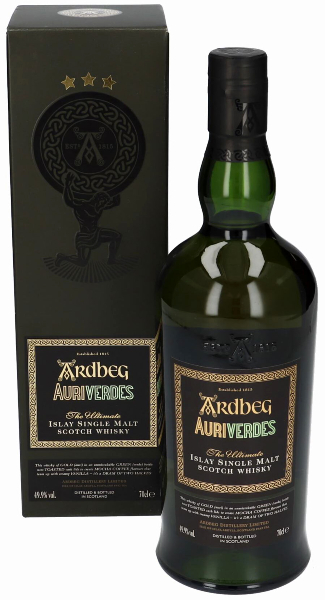
The previous post, which was quite long to be honest, was about a somewhat experimental special release Ardbeg called Auriverdes. Auriverdes was released way back in 2014. More recently though, in 2023, Ardbeg released this BizarreBQ, and I thought, hey, why not do another, preferably shorter, review of a special Ardbeg. I’ll even post a minimalist picture of the bottle without the box, (because there isn’t any). The previous post is about Auriverdes alone and this one will be about BizarreBQ obviously, but also a bit of it in comparison to Auriverdes, since both Whiskies have quite some charring going on. I also thought, when selecting all Ardbeg’s on these pages, what a visually appealing look it is, to have all those beautiful green Ardbeg bottles lined up one after the other. This 2023 Ardbeg is most definitely experimental, because BBQ casks, really? What is that? Pssssst. Yes? These casks underwent yet another super-secret char, making the inside of the cask even more akin to the charcoal you’d use for BBQ-ing. Ahhh, OK. Amazing.

Color: Pale orange gold, with an ever so slight pink hue.
Nose: Thick fat peat with lots of smoke and iodine. More upfront and smells way younger than Auriverdes did. We’re definitely in NAS territory all-right, since a lot of the nose smells like a very young Whisky. Earthy, wet and dry tea-leaves, vegetal and even more iodine now (80’s Laphroaig style). Quite spicy and herbal. Warming and very well balanced. I like this nose a lot already, apart from the initial overtly youthful bit. Smoke from burning newspapers, burnt match sticks, mixed with the smell of a crushed beetle. Somewhat sweet smelling, but couldn’t say if this is the PX speaking, since Auriverdes was on the sweeter side as well. If smelled “blind”, I probably wouldn’t have mentioned PX-casks at all. I guess all the charring that was going on defines this nose, and the “sweetness” might be the newly released vanillin from the oak, especially if it’s American oak. After the bold bits wear off, (it is initially quite fresh and sharp), the nose becomes more friendly, Gin-like, with hints of Rye Whisky and yet it still is quite a balanced endeavour altogether. Slightly more wood now with black coal and licorice coming to the forefront, as you get in modern day Ardbeg. The smell reminds me of old steam trains, more than an actual BBQ, with or without meat on it. Based on the nose alone, a very nice Ardbeg indeed, makes me feel a bit melancholic again, yet less so than Auriverdes managed to do, which in comparison has a more classic nose.

Taste: Sweetness, accessible, likeable. Bigger than Auriverdes. Fattier and even sweeter. Like Auriverdes, again somewhat simpler than the nose, but very drinkable indeed, without losing the freshness and sharpness which is present in the nose. I would say, great balance again. Not really a PX sweetness here too, yet more so than the nose showed. This Sweetness, the feel of it might be somewhat closer to a Whisky from a PX-cask, but still not all that much. All good so far. Some sweet licorice, a whiff of polyester and horseradish. After sipping it now, I get the horseradish on the nose as well, as well as the hint of polyester. If you do your own boat-repairs, you know what I mean. By the way, the polyester bit is not as bad as it might sound. Chewy wet wood. After the big bold entry this Whisky has, it also falls short in the finish a bit and not a lot actually remains for the aftertaste. Maybe herein it shows its youth. Lots of upfront stuff because of the charring, but lacking some depth due to age of the Whisky. Alas this has quite a short finish and only some lonely, left behind, licorice in the aftertaste.

I feel the whole of this Whisky is (much) younger than is the case with Auriverdes. But hey, still not a bad Ardbeg again, fetching a decent score. Yet again it is a special release that scores lower than the batches of Corryvreckan and Uigeadail I reviewed. But it does offer another perspective on the Ardbeg theme. Of course there might be some batch variation with Corryvreckan and Uigeadail, since they are released regularly as opposed to the one-offs that are these specials. If you want to spend your money wisely and don’t mind staying with those two expressions alone, you will be fine. If you are more adventurous and are willing to spend a bit more on a variation of the Ardbeg theme, and mostly with a lower ABV as well, than those special releases are for you. Only if you believe, that since you spent a fair bit more money, you are getting a better Whisky, than those mentioned from the core range, you are likely to get disappointed and get a bit salty. That being said, there are obviously also special releases which are definitely better than the core range. Some of which will be reviewed on these pages in the future and by now are or have become quite pricey.

Points: 86

Ardbeg Auriverdes 12yo 2002/2014 (49.9%, OB, American oak casks with toasted virgin oak lids, 6660 bottles)

I have to say that many of Ardbeg’s “special” releases aren’t getting a lot of love. It almost seems to be in fashion to slam these releases. Maybe a combination of NAS and silly marketing or the combination of NAS and the pricing of these “specials”, because obviously these Whiskies could be containing pretty young stuff. Maybe people dislike the posh new owners LVMH. How can a leather bag and a mediocre Champagne be the owners of the mighty beast that is our Ardbeg. Whisky is romantic and better than all other alcoholic beverages! Another explanation might be that the core range is actually quite good. Especially Uigeadail and Corryvreckan if you ask me, both better than the 10yo, An Oa and the 5yo Wee Beastie. All five are more affordable than all these special releases. Most of which are often NAS Whiskies (Hence the funny names) and also are a bit more experimental in nature as well.

In 1997 Ardbeg was bought by Glenmorangie, so the experimental nature of these releases comes as no surprise when, since 1995, they have Bill Lumsden on the payroll (Head of Distilling & Whisky Creation at The Glenmorangie Company). For those who don’t know Dr. William “Bill” Lumsden (The Mad Scientist), he previously experimented quite a bit with Whiskies at Glen Moray before experimenting on an even higher level at Glenmorangie and Ardbeg. Online, two of the most disliked Ardbeg expressions are Perpetuum and the Auriverdes at hand. Perpetuum in fact wasn’t even very experimental. Old en Young Whiskies from Bourbon and Sherry casks. Still, I found it was a decent expression and I never had a dull moment with it. I scored it 86 points which is certainly not bad at all. But the two aforementioned cheaper ones from the core range: Uigeadail (2018 batch) scored 87 and Corryvreckan (2014 batch) scored a whopping 89 points, so both outdid the “special” release. As mentioned above , this time around we’ll have a look at another unloved Ardbeg: Auriverdes. Is it experimental? The Whisky matured in second fill Bourbon barrels. The original lids were removed and replaced with new virgin oak ones, which were toasted using a very special secret toasting process, which accounts for the experimental bit.

Color: Light gold, not pale.

Nose: Nice funky peat, soft smoke with some notes of crushed beetle. A fireplace in December. The smell of Christmas in a log cabin. Hints of black coal and glowing embers. Old bicycle inner tubes. Less salty and fishy than expected from a south shore Malt, even though more than enough organics are happening in this nose. After a while, a more fresher approach starts, with breaths of fresh air, and more citrus-like aroma’s without being overly fresh or acidic, just adding to the perfume. After this fresh phase, we’re back in the realm of black coal and chimney smoke in winter, preferably on a dark evening after a snowy day, only lit by street lights, by odd coloured sodium lamps. Tiny hints of sweetish licorice powder, a Licorice-Menthos combo and some dust for old-times sake. Ooooh, the rubber comes back. I think this is a really nice smelling Ardbeg. Maybe some experimentally and specially and secretively toasted cask ends, but other than that, no funny business and nose-wise quite a successful experiment. I really do like the nose on this.

Taste: Sweet licorice comes first, as well as the crushed beetle. Somewhat vegetal and tea-like. The texture seems a bit thin initially. An indistinct fruity note is also present. Citrus, only more sweet, more sugared, than it is acidic and maybe some other ripe yellow fruits as well. Warming going down. Somewhat sweet, somewhat peaty and more of the Menthos feel that came rather late in the nose. It tastes somewhat like a minty licorice powder. Whisky-candy. The sweetness works very well in this Whisky. After swallowing, a nutty note emerges as well as some distant vanilla. Initially not big-bodied at all, maybe this is what people dislike in this expression. It is definitely simpler than the nose. The nose is really good and melancholic, the taste is initially a bit watered down, or maybe not mature enough. Is this the youth a NAS Whisky allows for? Yet it has great balance. Everything fits and works together well. Mind you, this is still not bad, but the nose carried some sort of a promise of things to come, a promise that hasn’t been kept entirely. I expected more complexity. During sipping, the nose still keeps on evolving, and truth be told, the taste does collect itself, which makes for a highly drinkable Ardbeg. I’m not having a beef with this one at all. Well, well, well, the taste really does develop after a while. This needed some time as well, time I might have saved, if I had added some water (but why hurry). It did gain even more balance and the body and especially the finish are bigger now, still not very complex though.

If really analysed well, with more than enough time, it is much easier to pick up on the true Ardbeg underneath. Maybe these specials aren’t for casual sipping at all, and if you try to be patient and give it some time, these special releases might be better than I was lead to believe by the internet. Maybe you got to work them a little, and since you are reading this, you as an experienced taster, are very able to do so, so please do.

People can be so judgemental these days, living fast, judging fast, too self confident. That’s human nature in the 21th century Whisky world or maybe even the world in general. I’m actually amazed how negative some people are and how vocal about it as well, and a lot of less experienced people just run with this and claim the same, unsure about their abilities to smell and taste. I see around me that even experienced aficionados fall into this abyss. If this is you, maybe you should learn to relax a bit, sit back some more, take some more time to smell the roses, (or Ardbeg in this case). Don’t be biased that Ardbeg is trying to pull one over your eyes and dupe you, because they probably aren’t. Not from the Whisky makers perspective anyway. Marketing may be another story entirely. Bill may be a mad scientist who tries to explore, often with an idea and sometimes by trial and error. This is definitely not a bad Ardbeg and don’t believe anyone telling you this. I feel this is a decent malt if you only let it. Don’t fool yourself and don’t let yourself be fooled, make up your own mind, and if after this you don’t like it, it must be true. Only then.

Points: 87

Laphroaig 10yo Original Cask Strength Batch 007 (56.3%, OB, 2015)

I have to admit, I bailed on Laphroaig for a long time when the first signs of considerable quality loss were visible in the regular 10yo. A marketing person would mention that it has been made with an “improved recipe”. Change of ownership and the decision to sell out the brand a bit, with issuing lots of mediocre bottlings. Some luckily turn out to be a bit less mediocre than I initially thought. Assumptions, assumptions. The mother of all…thanks Jane!

The 1815 Edition, Brodir and Lore, weren’t as bad as others led me to believe. So after the 10 Cask Strength “Red Stripe”, I somehow “forgot” about newly released bottlings of Laphroaig and turned my attention elsewhere. Little did I know, because, forgetting about Laphroaig made me also pass on all these wonderful 10yo Cask Strength batches for a long time. So rather late, I started to backtrack. At the time of writing, batches #006 through #015 are still “reasonably priced” and batches #001 through #005 are already quite expensive (at auctions). Nevertheless, I was also able to get some Batch #006 and used that one as a starting point and work my way up from there. I still have to figure out a plan for batches #001 through #005 though. I’ll probably have to throw some money at these or hopefully score me some samples of those. As could be read earlier, batch #006 was very good indeed, now let’s move on to batch #007 a.k.a. the “James Bond” batch, I wonder why…

Color: Light orange gold. Batch 006 is ever so slightly darker.

Nose: Top notch peat, prickly smoke, briny and sweet. Starts big, but after some breathing it softens up a bit. Gaining even more balance. Yes, this needs some air. Very, very nice. In the plethora of Laphroaig’s slightly less fantastic (travel retail) bottlings, this shines like a big sun! Chalk and paper and some warm asphalt. Tarred rope, dried fish. Sweet and creamy. Fireplace on a chilly evening. Hints of Christmas spices and even a cold sea breeze whiff by. Man, this smells so good. Brings back memories. Hidden away between all these hard hitting aroma’s is some nice fruitiness and the tiniest hint of chlorine, hidden away in a breath of fresh air. This bottling is a testament that Laphroaig still has what it takes and for me it also functions a bit as an apology for the rest of the aforementioned bottlings, which aren’t all that bad to boot, but still… This one is definitely for Islay aficionado’s. If you are a novice please turn to “Lore”, get a bottle of this as well, but open it only of you feel you can appreciate something like this.

Taste: Licorice and sweet black and white powder. Nice soft peat hinting at a higher age than the 10 years claimed. Soft cream and again some hints of acidic red fruits. The smoke and sweetness perform a delicate dance. Warming going down. Take this as a nightcap and you’ll sleep like a baby, or so I imagine. Don’t taste this carelessly or a lot might go unnoticed, This needs your attention like a faithful dog. This Laphroaig will love you back in the same way. Licking the insides of your face. Come to think of it, this does have a animalesk note, wet dog maybe too? Nice balanced finish, but the aftertaste doesn’t seem very long. It does leave a minty feel on my tongue though.

Amazing this is so much better than a lot of the Laphroaig’s I reviewed last. Considering the price, I have not really a use for a “Lore”, a “1815”, a “An Cuan Mor”, or even a “Brodir”. Sorry, but this one here, this is the one for me, I like it even way more than the 18yo, which is no “dog” as well. If I need Laphroaig-variation, I’m getting several different batches of the 10yo Cask Strength. that sounds like a sound plan! I really like Ardbeg Uigeadail and Ardbeg Corryvreckan, but these Original Cask Strength’s trumps both, it also costs a bit more, don’t forget about that. Luckily these three are different from one another, so this warrants me (and you) getting all of them. Yey!

Both #006 and #007 smell quite similar, and the difference, as well as the beauty, lies in the details. Batch #006 seems a bit more raw, more sea, minty, fresh salty air and less sweet, but also has a more perfumy note. Meatier even maybe and some more clay. Batch #007 has a meaty note as well, but it differs. Batch #006 has a black tea note that is absent from batch #007. Batch #007 is slightly sweeter smelling and has a herbal and spicy note which batch #006 doesn’t have. Batch #007 has a slightly more classic Bourbon cask note, and even hints of a fruity Sherry note. Batch 006 is dirtier and slightly “bigger”. I couldn’t say one nose is better than the other. As said above, similar quality, just some differences in the details. One moment I prefer a detail from one batch, and the next from the other…

Where the noses of batch #006 and #007 were quite similar, there is a slightly bigger difference taste-wise. Batch #006 is nicely sweet and very ashy, more raw and somewhat simpler maybe. Batch #007 tastes sweeter and more mellow, softer and fruitier, and slightly more polished and balanced as well, so I’m sure this taste profile would suit me better on other days. Batch #006 is more of a fisherman’s dram. Ashy, tarry and minty. Bigger, with more length and also slightly hotter, more powerful. Both are equally good and therefore score the same. But if I had to choose at gunpoint, today, I would prefer Batch 006 (the empty glass even smells bigger). If you aren’t an anorak or a completist, you don’t need both and either one of them will do, if you are an anorak you most definitely need both. Lots of them, for future reference!

Points: 92

Laphroaig 10yo Original Cask Strength Batch 006 (58%, OB, 2014)

So in 2019 I reviewed some Laphroaig’s meant for travellers. “Lore”, “The 1815 Edition” and “Brodir”. So with this, we have now a small part of that retail channel covered. Laphroaig also has/had some entry level Malts for the general public like the 10yo, “Select”, “Quarter Cask”, and to a lesser extent, (due to price), the 15yo and 18yo. There are also bottles for collectors, criminals, presidents and owners of luxury yachts, like the 27yo, 28yo and 30yo. All in fancy white coffins for your hamster. Luckily those Whiskies are very good, so when you spend a lot of “hard earned” cash on those, and decided to open them en drink them, at least you won’t be buying a dud.

Now, what if you are a Whisky enthusiast, connoisseur, aficionado or anorak, and somewhat shorter on funds, yet still a canoe in the backyard. What do you do? Yes, I do admit I am one of them, I have been infected. In stead of only drinking the stuff, I also spend some time writing about it, how anorak-y or insane can you get? So what do we do? We, for instance, are interested in lots of independent bottlings of Laphroaig and are more than happy to pay a somewhat higher price for them. Usually they are also less expensive than the Laphroaig’s in the coffins mentioned above. Don’t we buy official releases then? Isn’t there a reasonably priced, very, very good official Laphroaig on the market then? Yes there is! We anorak-y and insane people are going for the 10yo Original Cask Strength, a bottling John Campbell makes just for us. He said so himself! It is usually sold only online, at the distillery and not our usual watering hole, so the general public doesn’t know about them and therefore this is our little secret.

Since batch 011 however, it does seem to surface in some shops as well. It’s, obviously, cask strength, so not for everyone, It still is love it or hate it, so again not for everyone, and as said above, a bit hard to get. It is released in numbered batches. All things we aficionado’s like. Why do we like this one so bad? Because it is seriously good, it has batch variation, so we buy all different batches and it does remind us of the Laphroaig’s of the good old days, days when even the standard 10yo was a belter, less so today alas. The 10yo is made for a different audience altogether. Now, do you understand why the “Lore” and the “1815” were bought as bottle shares?

Color: Full Gold

Nose: Soft peat, nutty and sweet, almost perfumy. Wet earth after heavy rain (remember how fresh the air is after that?). DAS pronto (clay), paint and meaty. Quite some clay notes to be honest. Smoked and dried meat. Very, very fragrant. Hidden away, very well hidden are some red fruity notes (half ripe forest strawberries. You can sometimes smell the ripe aroma’s of the fruit, the sweeter bits that is, not the promise of fruity acidity. Hints of cola. Black and white powder, Licorice and iodine. Cold gravy. A hot aroma, like almost melting plastic cable. The initial smell, not when it is already melting, that could be a foul smell. Warming and animalesk. Sometimes even whiffs of sweet pickle water. Dried out plants in full sun and some sweetish spices. Sweet, dusty, balanced and complex. Dried fish. Smells much older than 10yo. No strong in your face peat and certainly no harsh and sharp smoky notes. A sort of Cask Strength “Lore” if you ask me, only way better. It adopts a bit of the gentleman-like qualities of the “Lore”. Quite different from other expressions from this series, I have tried before. Softer and maybe a tad more complex? Hints of old wood. Furniture-grade. Distant roadside dry grass fire, and then the perfumy bit returns. Yes this is a damn complex Malt.

Taste: Wonderfully sweet and fruity, black and white powder, lots of licorice, and I mean a lot of it. Cold ashes and liquid smoke. Amazing balance. Sometimes I get slightly sweet White Wine notes. Animalesk again. More licorice and ashes (and some cola again), this time mixed with crushed beetle (I already smelled the beetle before tasting it). Sweet peppermint, like Menthos (combined with licorice), and an acidic top note intertwined with the minty note. Can’t call the acidity fruity though, it’s different. Very earthy peat, sweet and earthy, and therefore less peaty. Masked by the plethora of aroma’s is some woody bitterness. The nose gets better, than it already is, when you sip this Whisky, the warm oral cavity does its work wonderfully. What an amazing Whisky this is, especially the nose is super-complex for what is considered a heavy hitting, heavily peated Malt. So much better than most other affordable Laphroaig’s. John Campbell, thank you, top stuff!

Man, one just can’t have enough of these 10yo’s.

Points: 92

Caol Ila 11yo 2008 (56.5%, Jack Wiebers Whisky World, Auld Distillers Collection, Bourbon Cask, 120 bottles)

Well here is Caol Ila #15 on Master Quill, once a scarcity and when officially bottled again, initially called a hidden Malt. Today it is probably the most abundant Whisky available, since Caol Ila is in operation 24/7. Diageo are putting out lots of expressions themselves and independent bottlers are going ape-shit with Caol Ila as well. It is probably the most readily available Islay Malt to them, and for a fair price to boot, since most independently bottled Caol Ila’s are quite affordable, although, I believe, not for long.

Caol Ila is always featured on my lectern, and after the Port Askaig-Caol Ila, which this one replaced, it is time to review the latest Caol Ila that found a spot on my lectern. Jack Wiebers is known for bottling parts of casks and bottling the rest later or bottling all at once and just slapping different labels on the same bottling. “Jack” loves making labels. This is likely to be one of those cases, since also in existence is this: Caol Ila 11yo 2008/2020 (56.5%, Jack Wiebers, The Old Pub Dogs, Bourbon Barrel #3071, 180 bottles). Just 300 bottles in total, at cask strength, from a barrel seems a bit much, so my guess would be, if all those 300 bottles were 70 cl, and if both bottlings came from the same cask, then it was probably from a hogshead. Nevermind though, lets see what’s in the bottle, shall we.

Color: White Wine

Nose: Peat upfront, almost heavy peat. Smoked and dried fish. Licorice and salty. Smells more like one of the three on the south shore to me. Slightly more meaty and somewhat bigger than the average Caol Ila. I think we have the relative youth of this offering to thank for that. I can smell this is fruity underneath, but all is well masked by the peat ‘n smoke. Well balanced. The fruity bit also plays a role in making the whole somewhat less “raw”. Lovely wood pops up, a more interesting smell than oak alone. Right after this a breath of fresh air. This is Islay on a cold and windy, yet sunny day. Peaty and smoky, yet not gloomy. After the “simple” Craigellachie, this is way more complex and a welcome change of pace. This Caol Ila has a lot to give. Hints of burning plastic, but it is a mere hint, only adding to the complexity. This level of complexity demands attention, this is not for casual sipping. You can do that obviously, but you’ll miss out on lots of the details this has. The fruity bit changes into a more citrus kind of aroma, making it more fresh (and even more sunny). The smell of wood changes into that of a century old cabinet. Wow, and this is only from 2008. This is just great, a must have by the nose alone. Only a few drops of water, right after pouring this dram, opens the nose right up.

Taste: The balance is the first thing on my mind after the first sip. Works really well this one. Fruity and soft to medium peat. The nose had definitely more peat to it, wait a minute, here it is, it just takes a little time to get there. Peat and iodine, check. Some acidity as well, After sipping, the nose gets even better. Also late to this party is a little sweetness. A thick toffee sweetness, so no sugar water. I’m distracted by the nose, it is so good, making it almost hard to write the notes for the taste of this Whisky. Go figure. The citrus acidity pairs up quite well with the sweet licorice note. There is also some nuttiness here, only it is a light note this time. After this, some pencil shavings emerge, as well as some dust (and do I detect a slight hint of soapiness now?). Fresh almonds, mixing well with the sweet bit. Well balanced, very well balanced in fact, the planets aligned for this offering bottled by Mr. Wiebers. Lucky Berliners!

I have to say, when casually sipping this one, I missed out on a lot of the wonderful details this dram has. Be sure to give it your full attention. This is a wonderful Caol Ila. Highly recommended, especially since this was a really affordable release to boot. Alas, I don’t have another 2008 vintage in my stash. It would have been really interesting to compare this to another one, oh well…

Points: 92

Kilchoman 5yo 2008/2013 (59.4%, OB, Sherry Finish, Small batch for Germany, Cask #392-393-394/2008, 780 bottles)

Kilchoman, even though not that old (first distillation was performed in 2005), seems to be fully accepted as a full blown Islay Malt. Good when young, and it also matures well. Great people with great vision. Lots of variants around, however for me, Kilchoman still works best in a Bourbon cask or the occasional Sherry cask. That’s why my attention mainly goes out to the bottles with the red labels and boxes (pictured below). Often single casks at cask strength. By the way, worth a mention, the Sauternes I reviewed last was very nice as well. This time around, on our hands, seemingly the best of both worlds. Bourbon matured Kilchoman, finished in Sherry casks. I guess the mentioned cask numbers are for the initial Bourbon casks, and it probably has been finished in one Sherry butt (considering the amount of bottles in this release), since the label states this is a single cask release. What was the number of the Sherry cask I wonder. There are probably some SWA-rules for this, for which I’m now too lazy to look up. Anyone? All in all quite a confusing small batch/single cask release…

Color: Full Gold (slightly hazy).

Nose: Well, heavily peated indeed. Lots of luscious sweet, tarry and smoky notes. Salty kippers with crushed beetles, giving me salty dried out lips (after sipping it obviously). Tarry rope. Notes we know from Islay. Amazing balance for a five year old Malt. Mature stuff, and rightly accepted into the Islay fold. Nutty. Definitely not a sunshine Malt. Who needs sunny beaches when you can have this beach with grey skies and torrential rain in a bottle right here with you. Nothing bad about bad weather, with a dram like this in your glass. Sweet licorice powder and powdered sugar. Dare I smell a slightly floral note here? You might resent me for this, if you’re one of those brutal-Malt lovers. Mint candy (you know those with lots of sugar, a trace amount of mint, which is probably artificial). Not a lot of noticeable Sherry influence though. The Pulteney I reviewed before this Kilchoman, also wasn’t very Sherried, but at least it had some noticeable Sherry influence. Maybe the sherry influence in this Kilchoman lies within the slightly cherried fruity sweetness and the wonderful balance of the nose. However, when this Kilchoman heard me talk about a fruity note just now,  it responds with even more licorice powder and peat. Hints of warm mineral machine oil. The nose, especially after some extensive breathing turns into something really wonderful. OK, it is wonderful in a way a tank can be wonderful. The nose is really, really good.

Taste: Initially a sweet Beer-like quality. More licorice notes and definitely less peaty than the nose. WYTIWYG (What You Taste Is What You Get). It is Whisky like a peaty lemonade. One big taste. Where the Pulteney, was complex and layered, this tastes like one big thing. Salty kippers with crushed beetles, giving me salty dried out lips (yes, copy & paste indeed). Salty and peaty licorice All-sorts. The nose seems complex and somewhat layered, the taste isn’t. Don’t get me wrong, in general this isn’t a bad thing. It just isn’t complex at all. Even the finish is rather simple, yet very tasty, as is the aftertaste. Simple, yet very tasty and effective. Hey, and it’s only five years old, and in no way is it immature or “un-finished”. My tongue reveals (in the aftertaste), that this has some wood, which is completely masked by the licorice, the dominant note in this Malt. This one worked very well for me in the morning (on a day off from work for writing reviews). Ain’t that brutal, ‘eh?

Well one thing is sure, the nose of this Malt is better than the taste. The nose is actually truly amazin’, the taste is actually really very good (to put it in perspective for you). Simple or not this is great stuff. So it’s WYTIWYG and WITIRL (What I Tasted I Really Liked) or to paraphrase agent Cooper; “damn good Kilchoman!” Dear Readers (and Nico), you might want to consider picking this one up from an auction (just make sure to let this breathe for a while).

Points: 90 (yes I must be mad, second 90 points in a row).

Lagavulin 12yo (56.5%, OB, Special Release, Refill Casks, 2021)

All of a sudden summer is over (on my side of the planet anyway) and now we are in this, still sunny, yet colder autumn season. After the 13yo Aberlour, I was planning to do another Aberlour review, yet a human can be very predictable. A change of season and the body started to crave some…peat! All of a sudden I found myself reaching for peated Malts. So no Aberlour, let’s do a Lagavulin in stead. Don’t worry, the Aberlour will surface eventually. Back to the Lagavulin at hand. More than ten years ago… wait a minute, I have to let that sink in for a while… ten years. Wow! Well in 2012 I did the last review of a Lagavulin 12yo Special Release, in that case the 2007 edition. These special releases continue to be very good, so I have no reason whatsoever to believe this might be any different. Well, Master Quill is still around and the 12yo Lagavulin is still around as well. So without further ado, let’s dip into this Lagavulin straight away.

Color: Pale White Wine.

Nose: Sweet and soft peat and delicate smoke. This is somewhere between rough and elegant. Fruity with citrus, apple (Calvados), very soft vanilla, some iodine and a somewhat milky acidity I got from the 8yo and the 10yo as well as, to a lesser extent, in the 9yo GoT and the 11yo Offerman editions (all three of them actually). Initially this resembles new make a bit and gives this Malt a youthful edge. However, luckily I might add, in here this milky note is much less pronounced than in the other two/four/six Lagavulin’s I mentioned. Yes this one is again slightly older, but also bottled at cask strength, and this probably makes a difference as well. I don’t like this milky characteristic in Lagavulin. For me Lagavulin is dropping the ball with these newer expressions, and unfortunately this element is now becoming apparent in this 12yo Special Release as well. I hear some rumours of Lagavulin overcooking for a higher yield if that makes any sense? Maybe 2008/2009 is some sort of pivotal point for Lagavulin, trying too hard to meet demand? After some breathing this milky note, dissipates or maybe my nose gets used to it and doesn’t smell it any more. (I tried it again later and the milky bit is gone. Pouring me a new one brings it back, so nothing wrong with my nose after all). A short while later, the nose (of the Whisky, not my nose) becomes more balanced. Still fruity and sweet (and youthful), with added dishwater and warm plastic (both fitting the whole). Quite prickly clean smoke and tarry licorice. A slightly spicy smoke maybe, crushed beetle and the tiniest hint of oak, late saltiness and iodine again. It smells refined and this is definitely not your hard hitting peated Whisky. I will have to compare this one to a Laphroaig 10yo Cask Strength in the future, as well as to the previous version of the 12yo Special Release.

Taste: Again sweet and fruity on entry, but also quite creamy and right out of the gate again quite youthful. A very friendly rendition this time. Not a hard in your face Malt, lacking even any bitterness from the wood. Some well integrated smoke, licorice and ashes. Tarry rope, sweet mint (Menthos) and salty. After all that fruit I didn’t expect all these Islay notes any more, but it’s still here. Lacks a bit of development and complexity, although un-complex it is not. The whole is more a banks of the Thames kind of Whisky than shores of Islay, and that probably isn’t a coincidence, but probably by design. Ashes, some iodine and wet marshland wood. Nope, not a lot of wood in this one. Part of these casks must have been at least second refills or otherwise somewhat inactive. The colour seems to suggest that as well, because it is quite pale for a Diageo bottling, a company know for their love for chill filtering and caramel colouring. Still very balanced and equally tasty though. The quality is on a slippery slope, but I still do like it, yet in a different way than I used to with these 12yo’s. It’s tasty and highly drinkable. Every aroma is neatly stacked upon another, like blocks of Lego. And every block is clear of a different colour and easily discernable. This Lagavulin is definitely more minty and modern. Still a nice expression though, just different. No need for water, but feel free to do so. The finish is of medium length and balanced throughout. No bad markers at all, apart from the milky youth bit mentioned above. The finish is sweet and smoky, the aftertaste is medium at best, warming, fruity and ever so slightly smoky. A good way to remember it, because the finish as well as the aftertaste don’t contain the questionable bits.

This is a friendly and tasty Malt, yet not exactly the high quality we are used to for the 12yo Special Release. It doesn’t even feel like a 12yo (it feels younger). Maybe lacks some strength, but in part it makes up for this with its accessibility and likeability throughout. Still good stuff but comparing it, from memory, to the 2007, it definitely is a different puppy altogether, which can be good, since it gives us another choice, and a way to match the Lagavulin 12yo Special Release to your mood. A good reason to have several editions open at the same time, if you needed one. However it unfortunately is also a bad thing, since I feel the quality is also a bit less. I worry about the future (in general as well as for the 12yo Special Release). Nevertheless, this one will split opinions. People who know the Lagavulin 12yo’s from the past will not be impressed by this one whereas others might like the new friendlier direction, and will have no clue why I’m on about sliding quality. For me, even though I do recognize its faults, I also do quite like it (to a certain extent). I’m curious about how the next few editions will be.

Points: 87

Port Askaig 10yo “10th Anniversary” (55.85%, Elixir Distillers, P/000247, 2019)

As far as I know there is no distillery called Elixir nor is there a Port Askaig distillery. Maybe there will be in the future? Nope, this Elixir distillers is a brand of the people behind The Whisky Exchange (London, UK). When creating an Single Malt Islay brand, you have some more room than a single distillery, because you have the opportunity to use the output from more than one distillery, as long as you keep it a Single Malt. So one distillery at a time in a particular bottling. I haven’t got any other Port Askaig’s lying around at the moment, but on the back label of this particular bottle it is mentioned that this comes from a distillery on the north-east coast of Islay. Historically Bunnahabhain and Caol Ila, and more recently also Ardnahoe is situated there. The back label also mentions that the distillery is close to Port Askaig, so geographically it is most likely this Whisky was distilled by Caol Ila. This Whisky was blended from just 33 casks (distilled in 2008). 20 refill American hogsheads, 8 first fill Bourbon barrels and 5 ex-solera Sherry butts. If these are true solera casks, then the casks could have been used for Sherry for quite some time. Last but not least, this hasn’t been chill-filtered and no caramel colouring has been added. Why should they when the glass bottle is this dark. So why 55.85% ABV I hear you ask. Well, The latitude of Port Askaig is 55.85º N. The longitude is -6.11º W, and to be honest, -6.11% is quite useless for an ABV.

Color: White Wine.

Nose: Soft fruity and tea-like peat. Elegant indeed. A special mix of fruitiness and florality (and dust). Citrus mix and a wee note of sweet red fruits. Friendly and elegant. For some, this might be slightly too perfumy and the fruity bit slightly too fruity (sweet), but personally this all sets it apart from other modern Islay Malts, making it rather unique in that respect. Very interesting blending result. Even though this mostly has been in contact with American oak, something did overpower the vanilla note one would expect. I wonder what the 5 Solera casks could do to this Whisky. The peat is soft and elegant as well, without smelling salty or tarry. Extremely well balanced. This bottle is now almost 90% empty and since it didn’t get the attention it clearly needs (more about that below), I couldn’t even tell you how it compares to a freshly opened bottle. After pouring, the nose still develops over time, getting better (as in, it shows more of itself). The development becomes apparent when re-pouring this dram. The freshly poured Whisky seems a quite different from the Whisky after breathing for a while and constantly sipping it. So it has a lot to give. Slight notes of burnt herbs, warm dry earth and freshly peeled almonds. Hints of old Malt, so for a 10yo, quite a feat. A worthy anniversary bottle. After a long while and after extensive tasting, the nose produces an iodine note combined with soft oak. The next day, the empty glass simply oozes with Iodine, and when cleaning with only water, even more Iodine notes come to the fore. Amazing.

Taste: Less fatty and fruity than the nose, so quite a surprise here. Seems thinner and sharper yet still soft. Prickly (sweet) smoke, slightly sweet chocolate powder and plenty of warm tar. Chewy and sweetish licorice in many guises. Warming. Less complex and quite different from the nose. Here the vanilla is present. Even though it seems less fruity at first, there still is a lot of nice fruits to behold. Acidic fruits well integrated with the smoke and peat. Again nicely balanced. The finish seems medium to short initially, but there is a lot that stays behind, and comes back for a nice and lingering, warm aftertaste. All in all a very interesting and well made Malt. Good job, showing a different side to an Islay Malt.

Again a Whisky that needs your attention to get the most out of it. I had a lot more fun and picked up on a lot more now when analysing it for this review, than I had when carelessly and randomly pouring it for a dram in the evening. It has a lot to offer, so make sure you focus a bit on it. Just give it the attention it needs and deserves. However, in this also lies its fault. If you don’t give it this attention, and you do carelessly sip it (as we usually do), this might pass a bit anonymously. This has probably to do with its softness and elegance, so maybe a bit too much of that?

Points: 87