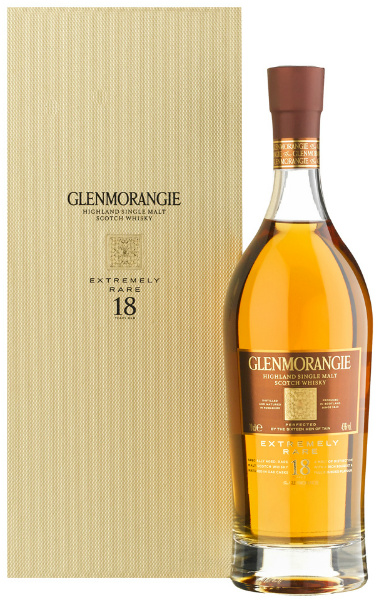
Glenmorangie 18yo “Extremely Rare” (43%, OB, Circa 2010)

I’m not to sure what I think about the NAS (No Age Statement) craze at the moment. Sure the number is not important, but the taste is. So why did the scotch (marketing) guys were indoctrinating us (the consumer) with the slogans that “age matters”, and “older is better” and so on. We’ve come to live with age statements, and now they want to make us believe that “age doesn’t matter”. NAS gives them the freedom to blend without restrictions, any age goes as long as its 3yo, otherwise they can’t call it Whisky, and thát still is a word they would like to use on the labels.

We are now living a while with NAS bottlings, and yes, the Whiskies got younger, but not necessarily better, if you ask me. And by the way, I still prefer age statements. I’m more inclined to buy something that is good and has an age statement, like Benromach 5yo than something that doesn’t have an age statement like Tomatin Legacy or Laphroaig Select. But maybe that’s only me. In the end I do believe that age matters.

Time for another 18yo, this “Extremely Rare” Glenmorangie. What’s up with the funny name? It already has an age statement and it seems to be a blatant lie, since I see this in every shop and nobody tells me there is a shortage of this. Stop it! Great packaging though (it’s from their “Prestige Range” you know), and for an 18yo it’s not very expensive to boot. The whisky was aged for 15yo in Bourbon Casks and finished for three years in Oloroso Casks.

Glenmorangie 18yoColor: Gold

Nose: Fruity and spicy wood. Nutty and sweet. Honey. Hint of smoke and cask toast. Dried sweet orange skins. Lots of sugared yellow fruits. Almond dust. Quite a full aroma for a Glenmorangie. Reine Claude’s, wax, some smoke again and vanilla. Chocolate.

Taste: Matches the nose. Marzipan and lots of yellow fruits. Figs and toffee with the sweetness kept in check. Waxy as older malts tend to get (nice!). Easily drinkable, immediately nice. Not a lot of wood actually. The wood impairs milk chocolate, yet hardly an oaky sensation. Just like the Highland Park, 43% is too low, 46% probably would have been better. There is enough going on in this one to not let it get hot. Especially the finish, again just like the Highland Park 18yo, is the weakest link.

You see that age matters. Just like the 18yo Highland Park, this again is a perfect example how Whiskies do need quite some ageing, especially in a cold climate as Scotland has. Although there are some nice examples of NAS Whiskies, I do like my 18yo’s

Points: 87

Highland Park 18yo (43%, OB, 2012)

Nerdy anorak types like me still shed some tears when we think back to the “wide neck 18yo” Wow what a piece of work that was. That one was replaced by a new 18yo in the more feminine bottle. Since that replacement I tasted some less interesting batches which made me lose my faith in my beloved 18yo. I have never bought an 18yo since. Today I got an opportunity to try one batch of the “newer” 18yo’s, a look that is already with us since 2007.  Rumours are this 18yo will stay in the fold of Highland Park, so it’s not all NAS for the forseeable future, but prices will rise by 20%. So lets find out if this 18yo is good enough to stock up on. (L0470P L4 07/11)

Highland Park 18yoColor: Orange full gold.

Nose: Fresh, coastal. Hints of Sherry, Heather, clay and honey, yes recognizable as a (modern) Highland Park. Almonds and a small hint of peat and pencil shavings. I have to say I still remember this nose from a long time ago. Reminds me a bit of the “wide neck” 12yo. Quality stuff, although for me the E150 is noticeable too. Nice nuttiness.

Taste: Waxy, fruity and very likeable.  Hot butter and peat. Lots of fruit yellow and red, but also a peppery attack I don’t remember from earlier bottlings. Fern. It’s very aromatic and well made. Warming (beer like) finish with hints of smoke ánd a small amount of clay and peat. Excellent balance and overall tastes good. All-round ‘eh!

All goes well untill the finish. The finish is good but just too weak. If Highland Park are really planning to up the price of this I would most certainly hope they will give it some extra ABV to help the finish along. Still I’m happy to recognize this still as a classic Highland Park, it’s nice to still taste the typical Highland Park profile. I hope the 12yo is also still up to par too.

Looking at the present range of Highland Park, and I tasted quite a lot of them, some are a bit underwhelming and some are not reasonably priced anymore. When playing the game of elimination this 18yo is the last one standing…

Points: 87

The Balvenie 17yo “Peated Cask” (43%, OB)

Time for another Balvenie, excuse me, “The” Balvenie. Some say it is some kind of middle of the road dram, and yes there may not be a true cask strength version around. Some say you’re foolish for sometimes spending a lot of hard-earned cash on a Whisky that is in no way full of aroma and almost always diluted. Yes sir, we’ll add the water for you and charge you more for it. They might be right but they also might not get it at all, or at least some of the time. Most statements might be true, but that doesn’t mean The Balvenie is a bad Whisky. Far from it. The Balvenie is about delicacies. It is some sort of homeopathic Whisky. Just a tad of wood here, a tad of wood spice there. A splash of Rum wood for that one and let use a spoonful of Sherry wood there. This time we do not get a peated Balvenie, but we get a Balvenie with a pinch of peat, subtle difference. This version was launched in 2010 and replaces the Islay Cask version which was made with ex-Laphroaig casks, and this one is said to be made with casks that once held peated…Balvenie! Wow.

The Balvenie 17yo Peated CaskColor: Sparkling light gold

Nose: Clay, lightly peated and malty. Sweet vanilla and a breath of fresh air. Licorice and more hefty vegetal and meaty notes. Marmite. All aroma’s seem to fit pretty good together. A distinguished gentleman in an excellently cut Savile Row suit. Cheers!

Taste: At 43% it is hardly too light, and it is a warming Whisky. Suits the bad weather outside. A nicely balanced liquid that pours down gently into ones throat. Smoky sweet vanilla, definitely American oak, with notes of peat and tar on top. Not woody at all. Sweet vanilla, but also hard candy sweetness, but not the fruitiness of those sweets mind you. Sugared apricots and honey drops. Cold black tea. Quite a long finish. Lots of staying power. Not really a peated Whisky but a peat flavoured Whisky. Nicely done. Definitely a step up, and sideways (for the variation), from the 15yo Single Barrel and probably my favorite Balvenie with the 21yo Port Wood. Ok, some of the 25yo’s and the thirty are pretty good as well.

This version is bottled at 43% ABV but there is also a higher strength version around. Cask strength, you ask? No, not quite, 48.7% ABV. Batch code on the reviewed bottle: L9097OK.

Points: 88

This one is for Colin and Krzysztof, sorry I couldn’t make it guys.

Longmorn 17yo 1996/2013 (60.8%, The Ultimate, Sherry Butt #105091, 588 bottles)

Another year is almost over so this here is already the last post of 2014. What to review I asked myself? Maybe something incredibly special, something super premium or something outrageously expensive? Nothing like that. In the end I choose this Longmorn. Why? It seems like a good idea, to do none of the above, and I happened to have only one  open bottle left om my lectern that I hadn’t reviewed yet. Tying up loose ends. I hope this last year was a nice one and of course that the next one will be even better! Hope to see you back in the new year!

Dutch outfit Van Wees bottled eight heavy Sherry Longmorn’s distilled in 1996. These bottlings were rather popular, to put it mildly, since all didn’t need a lot of time to sell out. Highly collectible, but also good drinking Whiskies. Earlier, I already reviewed two casks from this series #72315 (the first release) and #72319 (the third release). Both were similar yet different, and both scored 88 points. This third review will focus on Sherry Butt #105091 (the seventh release). The first five were all sister casks #72315, #72318, #72319, #72323 and #72324 distilled on the first of May 1996. After that, three more Butts were bottled: #105092, #105091 and finally #105084. The latter was released during the Pot Still Festival 2014 in the Netherlands, making it the only one to be bottled in 2014, yet still at 17 years of age. Those last three butts were distilled on the 25th of June 1996 and yielded less bottles than the earlier butts but are higher in alcohol. There have been more butts bottled from the 723xx and 1050xx series, but those were bottled by Signatory Vintage for their own brand. Lets see if this will be another 88 points for Longmorn…

Longmorn 17yo 1996/2013 (60.8%, The Ultimate, Sherry Butt #105091, 588 bottles)Color: Copper brown.

Nose: Honey and quite vegetal. Especially the wood and honey make this Whisky not very distant from a very good Bourbon, although both Whiskies couldn’t be more different. Dry wood, old saw dust and dusty altogether. Burnt caramel and lots of sugared red fruits. Deep brooding and syrupy Sherry. Dark stuff from the gas light era. Elegant but more mysterious than the earlier bottlings.

Taste: Hot wood. Lots of wood and a sour note from fruit and Sherry. Coffee and dark chocolate with just the right amount of bitterness. Small hint of a sulphur compound, but the rest of the aroma’s are so powerful, Sulphur doesn’t stand a chance in dominating this Whisky. This Whisky also has a lighter side to it with paper and fern. Dark mahogany furniture with layers and layers of wax put on in its history to form this brittle woody and waxy nose.

Although I own both earlier reviewed Ultimate Longmorn’s, I haven’t opened the bottles. Both reviews were done from 6 cl samples. This bottle however, is one from my own collection I dared to open (curiosity killed the cat). The bottle is luckily still more than half full, but I had a fair chance in trying this without having to analyze it. In comparison, I do believe this #105091 is very drinkable and always leaves a good impression, but this time I won’t be giving another 88 points. The earlier releases, if memory serves me correctly, seemed to be more balanced, less dry and more fruity, than this one does. This time the added paper and fruity acidity do meddle with the balance of this Whisky, still good and I will not have any problem finishing this, but just not as good as the earlier one’s I have tried.

When compared to the Gordon & MacPhail Highland Park that also scored 87 points, the Highland Park has more raisins (dominant), coal and seems to be more accessible. It is less dry and sweeter on the palate. It is similar in quality, not higher in sulphur and actually quite nice. It is seems to me they are made for one another. I will only have to try them now in reversed order…

Points: 87

This one is for Cyril, great to hear you’re doing well!

Akashi 5yo ‘White Oak’ (45%, OB, 500 ml)

Next up a Japanese 5yo Single Malt Whisky from the Eigashima Distillery. Please don’t confuse this with the 5yo Akashi “Blended Whisky”. This peculiar blend is not a blend as we know it. The Malt Whisky isn’t blended with Grain Whisky but with a Spirit. The Malt Whisky itself is not only Malt Whisky from Eigashima, but also contains imported Whisky. Altogether there is 34% Malt Whisky in this Blend. The Spirit part (66%) is made with Spirit from molasses, partly barrel aged. There is some controversy about the Spirit used, and calling this a Blended Whisky. Alas no controversy about our 5yo Single Malt. Besides both 5yo Whiskies, there is also a 12yo Akashi Single Malt. Code on the inside of the front label is: 112102.

Akashi 5yo 'White Oak' (45%, OB)Color: Gold, with a tinge of ocher (dandruff)
Nose: Worcestershire sauce. lactic acid and right after that virgin oak and cigarette tobacco. Cooled off warm milk. Extremely funky and yeasty. This Whisky oozes aroma, and you have to sniff it all out to get to the woody part and the feeling you are nosing a Single Malt Whisky. Warm dry forest floor and the fruitiness comes from ripe apple skins. This apple note is connected to a powdered sugar sensation. For best results let this breathe for a while. Small hints of menthol and spicy wood tends to play a greater role.

Taste: Extremely malty and after that paper and oak. Dried leaves. Some sweetness from sweet tree sap (I imagine). Very naturally occurring sweetness like stevia. The wood becomes slightly bitter and next comes a slightly peppery attack. Tiny hint of burnt plastic and the bitterness stays. It tastes a bit like sake. The finish disintegrates leaving you with the bitterness and a funky kind of acidity, in part cow dung. The finish is definitely the weakest point of this Whisky.

Very simple, immature and straightforward Whisky, that doesn’t come to us without flaws. Some strange aroma’s in here that to me seem like distillation faults. Having said that I don’t dislike this, but I most definitely like the first half better than the last half.

Points: 71

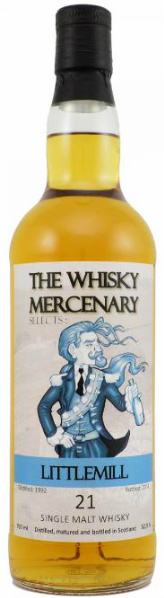
Littlemill 21yo 1992/2014 (52.9%, The Whisky Mercenary, Bourbon Cask)

Littlemill then. These days everybody seems to be raving about this sadly closed distillery. The official bottling seemed not to be very popular in its day and initially not a lot of tears were shed when this distillery closed in 1997 and subsequently was destroyed in a fire in 2004. Lots of Whiskies from the early nineties are bottled recently and surprise, surprise, a lot of them seem to be pretty good if not spectacular! Here we’ll have a look at a Littlemill that was aged in a Bourbon cask. This particular example was selected by Jürgen Vromans a.k.a. The Whisky Mercenary, who to this day has Always picked some great Whiskies. Just have a look at these reviews: Glenlossie, Tormore, Clynelish, Dailuaine and Cooley.

Littlemill 21yo 1992/2014 (52.9%, The Whisky Mercenary, Bourbon Cask)Color: Light gold

Nose: Fruity, waxy and spicy. Vanilla bean and vanilla Ice-cream. A breath of fresh air, but also some sea wind. Spicy oak with mocha. Extremely pleasant. Thin layer of honey and beeswax. Sugared yellow fruits, but also tiny, tiny hints of mustard. Hints of freshly cut oak but also an old cigar box. Cold tea (plain black tea, without milk or lemon). In the best sense of the word, a wood driven nose. Complex and very appetizing. Sometimes dry and dusty, the next very aromatic. Nice stuff!

Taste: Sweet and highly aromatic. A bit wet behind the ears, youthful oak. Yes this Whisky has been in an excellent cask. Lots of wax, beeswax, earwax, but also natural furniture polish, that doesn’t smell like an oil refinery. The wax and wood have an underlying sweetness and are aided by a nice hint of black fruits, and some oaky bitterness. Very well-balanced, and just right. It was bottled at the right moment. Maybe when it was younger it would have been more fruity, but would it have been such a distinguished gentledram?

Not every Bourbon cask is just a Bourbon cask, and not every freshly distilled Spirit that is meant to be a Single Malt Whisky is alike. Still when you take a (freshly used or refilled) Bourbon Barrel or remade Hogshead and put new-made Spirit in it, you more or less know what you’re going to get. Sometimes some especially great wood finds its way into the cask, or the barley was great, or fresh, or from a great variety. Sometimes something magical happens. Single cask Whiskies like these are all about the details so it takes an anorak like Jürgen to pick them out. Well done.

Points: 88

Glenfarclas 16yo 1995/2011 (53.9%, Kintra, Confidential Cask, Sherry Butt #5, 120 bottles)

In the depths of my ever-growing amount of samples, I found this sample of an undisclosed distillery named Glenfarclas. Actually, Glenfarclas isn’t stated on the label, but it has somehow become common knowledge that this Whisky was made by Glenfarclas and hand-picked by Erik Molenaar of Kintra from the Netherlands. Erik as well as Glenfarclas have been featured before on these pages, so why not continue immediately with this undisclosed Glenfarclas…

Glenfarclas 16yo 1995/2011 (53.9%, Kintra, Confidential Cask, Sherry Butt #5, 120 bottles)

Color: Copper brown.

Nose: Heavy on the Sherry there! Velvety but also a lot of sulphur. Licorice, dry air and wood. Black and white powder and cookie dough. Lots of aromas and all are on full volume. Meaty (cold raw meat), creamy, vanilla but also some mint and flint. Lot of aroma from wood, without being overpowering. Like the wood of an old door which has just been stripped of its thick layer of cracked paint (and cooled off) (no, I’m not on LSD, it’s an association).

Taste: Full on funky sherry, thick. Coal. Watered down red berry juice with (bitter and sweet) licorice (The Whisky is not watered down, mind you, nor tastes like it’s watered down). Quite sweet at first but quickly taking a turn towards the drier side. Sulphur here again, but all very tasty if you like your heavy hitters. Sometimes a whiff comes across like a rum (heavy on wood). Towards the finish some nice red fruits come to the front. Strawberries (not fresh ones, but ones that have been frozen). Spicy and prickly wood.

Definitely not your daily drinker type of malt, but a nice, albeit flawed expression of a nice Sherry bomb (hello NSA, it’s me again). I like this pick by Erik. It is a Whisky which is far from boring. A lot is happening in this, and not even all at the same time. However, a word of caution. This malt loses a bit of its balance when it gets enough time to breathe. The aromas start to unravel a bit, the wood gets weaker and even worse, a soapy component rears its ugly head, so no slacking with this one!

Points: 88

Glen Moray 15yo 1998/2013 (46%, Cadenhead, Bourbon Hogsheads, 684 bottles)

This is the third Glen Moray on these pages. Although I use a 100 points scare for scoring drinks, and in my opinion Whisky is one of the best drinks around. Whisky usually scores in the upper ranges of that scale. So any good Whisky scores at least 80 points. Both Glen Moray’s I reviewed before, one 13yo Dun Bheagan, and one official 8yo, didn’t make it across the 80 points-line and are therefore considered bu connoisseurs to be “mediocre” at best. However, if you read my reviews carefully, they still have enough going for them, and are still pretty good drinks, or pretty good Whiskies for that matter. It’s just that a lot of Whiskies score higher than these Glen Moray’s. But here is another Glen Moray, one by Cadenhead, so lets see if this will score in the 80’s or even higher?

Glen Moray 15yo 1998/2013 (46%, Cadenhead, Bourbon Hogsheads, 684 bottles)Color: White wine.

Nose: Quite closed, or isn’t there much happening. Alcohol, hints of sweet yellow fruits. Even though it isn’t a white wine finish were Glen Moray are almost famous for, it does remind me of a white wine finished Glen Moray. Hints of margarine and vanilla. Soft touch of oak. Very restrained, it just smells like fresh air.

Taste: Yes typical thin Glen Moray again. A crumb of old dark chocolate. A little bit of oak, and an acidity resembling a wine finish. Usually Glen Moray tends to get overly sweet after a wine finish, and I can’t say that’s the case here. Lots of maltiness and a little bit of paper and bitter oak in the finish. Good, it gives it character. Anything better than that strange acidity.

Extremely light color, again casks (probably two) that weren’t very active any more. I am not completely sure this isn’t a white wine finish. A very clean expression, and that’s me being positive, because not a lot seems to be happening here… (Mind you, this is still a damn good drink!)

Points: 76

Dalmore 11yo 1999/2011 (57.2%, Kintra, Refill Sherry Butt #3079, 120 bottles)

Dalmore then. Not so long ago I reviewed the official Dalmore 12yo and rummaging through the ever-growing stock of samples, I found this almost 12yo Kintra bottling. If it was only given two extra months and two extra days, this too would have been 12 years old!

Dalmore was founded in 1839 by Alexander Matheson but the Sunderland’s start distilling there. Soon after the MacKenzie brothers, Charles, Andrew and Alexander start to run the distillery. When Alexander Matheson dies in 1886, his successor sells the distillery to the MacKenzie brothers (1891). In 1917 the Royal Navy takes over and use the facility to make mines! After three years the Navy moves out and in 1922 the distillery is again up and running. In 1960 The MacKenzie brothers merge with White & Mackay and in 1990 White & Mackay were bought by American brands. In 2001 White and Mackay were sold again and called Kyndal spirits but the White & Mackay name returns a year later. In 2007 it is sold yet again to the United Breweries Group, an Indian conglomerate.

Dalmore 11yo 1999/2011 (57.2%, Kintra, Refill Sherry Butt #3079, 120 bottles)

Color: Light ocher gold

Nose: Big. Vanilla ice-cream and light wood, with some light menthol cigarette as well. Powdery and dusty. Cherries and Licorice. Horseradish. The wood is very perfumy. Definitely floral and perfumed soap. Strong aroma from a high strength Whisky. Half sweet, salty toffee with funky Fino or Manzanilla Sherry notes, but not as much as in other Fino matured Whiskies, so this might not be one. Red fruit hard candy drops and it does have a salty edge. Animalesk (cow dung) and soft wood. So enough happening on the nose.

Taste: Nice burn and quite sweet actually. Spicy sugared oak with white pepper, but also a sour oak note which turns into ripe black fruits. Quite a lot of wood. Coconut and maybe some peach. The horseradish returns and here it is less sharp but more sweet. Ahhh how nice it is to have a cask strength Whisky again. A breath of fresh air. Vanilla ice-cream returns for the finish. Otherwise the black fruits stay on so the funky sourness is there to stay too. Nice example to analyze like this. But the a word say it all. It is a Whisky you have to work with. If taken casually you won’t fully appreciate it, and maybe even won’t like. This needs your full attention and time.

Quite a nice development. It starts out pretty sweet, after which the wood shows itself. After that, the body collapses a bit to reform behind the lines to come back with a nice finish. Although not without its faults, the whole is quite nice and absolutely an experience. Nice how easy the development can be followed. The more it breathes the better it gets. Very nice pick Erik!

Points: 85

Reisetbauer 7yo 1998 (56%, OB, Chardonnay & Trockenbeerenauslese Casks, 350 ml, LWH 098)

Hans ReisetbauerAnd now for something completely different! An Austrian vintage Whisky made by Hans Reisetbauer. This Whisky was distilled in 1998 and matured for 7 years in Chardonnay casks but also in casks that once held Trockenbeerenauselese, a (very) sweet and syrupy white wine. Casks come only from Austrian wine makers Alois Kracher and Heinz Velich. When looking for information, Hans seems to win a lot of prestigious prizes for his Eaux-de-vie or brandy’s made with fruits, and is regularly awarded as the best distiller in Austria. Hans decided to have a go at making Whisky. Hans planted four hectares of his own summer barley which was harvested for the first time in July 1995. Hans uses a double distillation regime.

Reisetbauer 1998Color: Gold

Nose: Creamy and lightly fruity. Apples and not winey at first. Fruity sweet with caramel. Very mild and definitely decent smelling (I may have expected something less good?). Powdery and dry, nice wood. Hint of vanilla. I’m not sure about the Chardonnay yet, but after some breathing I do smell the Trockenbeerenauselese. Having said that, it does remind me a bit of a Glen Moray in…yes, Chardonnay.

Taste: Sweetish and very vegetal. Fresh wood and a spicy (and winey) oak attack. Paint and plastic. Here most definitely the wine casks make their mark and mask that this is actually Single Malt Whisky. Maybe using the more traditional kind of cask would have been a better idea and use the Chardonnay and TBA casks for a finish. Quite hot and the heat has staying power. The aroma’s fade out leaving a hint of tannins, plastic and acidity. Still not a bad finish though.

I have heard people claiming this was terrible, but I don’t agree. Yes it is maybe too heavy on the wine casks used, but I can look past that and there definitely is some quality and potential here. Would love to see how Hans improves himself making Whisky.

The picture on the left is of the 700 ml bottle, simply because I couldn’t find a picture of a 350 ml bottle like mine, and I don’t think an empty bottle would make a good picture here. As can be seen on the bottle label, there were 1500 bottles made. On some bottles however instead of the 1500 bottles statement there is a code LWH 098 or LWH 007. Some bottles, bottled at 43% ABV, have a different label where the vintage (1998) is replaced by 7 years, but carry the same code LWH 098 as some 1998 vintages. Do you still follow?

Points: 75