This year Bowmore introduced, just like Macallan actually, a series of three bottles for travel Retail, without age statements but with names, and not any name, but names based on colors. Macallan tried it with the following nouns: Gold, Amber, Sienna (is that a color?) and Ruby. Bowmore are using the colors more as an adjective: Black Rock, Gold Reef and White Sands. The first two being also litre bottles. Non of the bottles have a great reputation and in case of some of these Macallan’s I have found out first hand that…well not that great. Now here is one of the three Bowmores, the most affordable of the three.
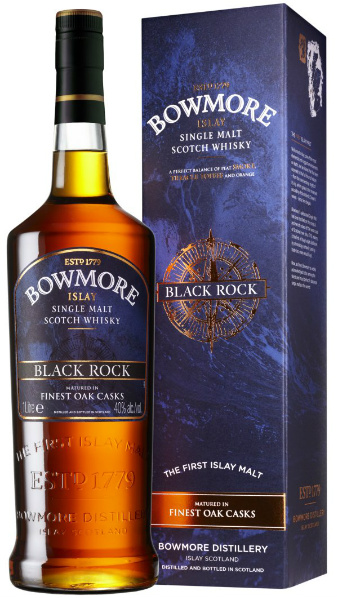 Color: Red orange gold, cognac
Nose: Nice peat and maritime smoke, rubber and tires, but mixed with some strong acidic fruitiness. lots of earwax too. Salty, tarry and smoked dried fish. Vanilla. The longer the glass breathes the more pronounced and likeable the fruit notes get. Starting with your typical red sour berries and moving into the black fruits Bowmores have long been known for. That can still be done Excellent nose if you ask me.
Taste: Ashes and watery. Oh no, it’s too thin! Brief dry Sherry attack, which quickly dissipates and transforms in paper and ashes. Actually behind this is a (burnt) caramel note, and quite a lot of it. The back label states that is has been “treated” with E150, but I get a lot of this. Damn shame. Bowmore have become so good they don’t need that! The taste is very simple and the Sherry didn’t handle all the water used for reduction too well. It shows potential but driven by the decision to bottle this at 40% ABV (Economics I guess), they somewhat ruined it. A little bit of Rochefort under my tongue.
Easily drinkable due to the strength, but ruined a bit by reduction. Still underneath (and the nose still shows it), this was a good Bowmore.
Points: 81

 Unlike Benrinnes, Dailuaine has been featured a few times already on Master Quill, the last one just a month ago, so it doesn’t need a big introduction, nor does
  Color: Gold
 From 1955 through 1956, the distillery is again completely rebuilt, this time because of economics, not disaster. In 1966 the distillery is equipped with six stills, but are not configured in the expected three pairs which a normal double distilling distillery would have. Benrinnes have two groups of three stills which makes for a partial triple distilling configuration (sounds a bit like Springbank doesn’t it?).
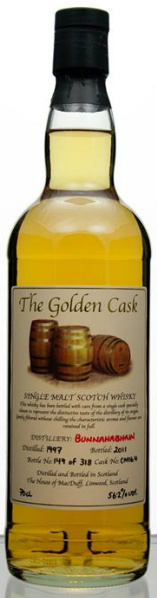 Another House of MacDuff bottling and yes, another Bunnahabhain from this independent bottler. The one I reviewed earlier was distilled in 1972 and bottled at 40 years of age! This again is a fairly light-colored malt, so it seems like a not so active cask. Still, knowing who picks the casks I still have high hopes for this one. It can’t be bad. It seems to me that Bunnahabhain is a very popular distillery for this independent bottler since they have managed to bottle already five Bunnhabhains, this one from 1997 was their first.
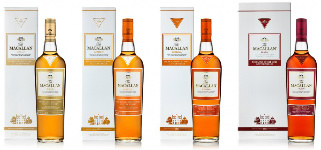 Sienna is part of the 1824 family. The other members being Gold, Amber and Ruby. The names are derived from the color of the Whiskies. Yes no age statements but now we get colors! I’m just speculating here but it seems to me that with increasing color, more (Oloroso) Sherry casks were used. Obviously other Sherries might be used as well.
 Color: Deep orange gold.
 Color: White wine
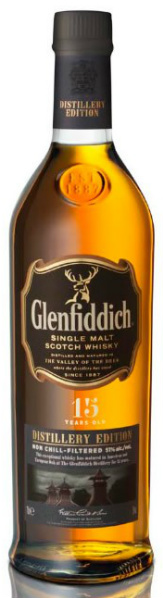 Some time ago there used to be a 15yo Cask Strength, which was exactly 51% ABV too, just like this one, so I can’t help but feel this is it’s replacement. Who else in their right mind would think that all Glenfiddichs at Cask Strength come out at precisely at 51% ABV? The 15yo is also a pretty special age statement for Glenfiddich, since all hand bottled Glenfiddichs were released as 15yo’s.
 Color: White wine
 Color: Light gold
 Master Quill