 Solera is an ageing system for Sherry (and other fortified wines), in which younger wines in upper rows of casks are used to top up casks of older wines stored below. Every time a batch is bottled, the wine is taken from the bottom row. Not everything though, usually up to 30% of the cask is bottled. After this, the casks in the bottom row are topped up with the wines from the casks in the row directly above, and that row is topped up with wines from the row directly above that, and so on. After a startup period this system gives wines of a consistent age and quality, even if one particular vintage is weaker than the others.
 Color: Light copper gold.
Nose: Very malty, and immediately recognizable as a Glenfiddich. It has a lot of traits of the 12yo “Special Reserve” I reviewed earlier. Lots of vanilla. There is also a light Sherry influence. Waxy. But overall it’s quite flowery and light. When tried blind, a definite Lowlander, (which it is not). Likeable.
Taste: Creamy, and very malty. In the back there is a little bit of mint, which makes it fresh and lively. Ice cream, winegums and apples. It starts to break down late in the mouth, where it shows an added sour note. The finish is short. Where the nose was more floral, the taste is more fruity. Loveable.
I don’t know if it’s a step up from the 12yo “Special Reserve”, but it is most definitively a variation. And yes, I think it’s better, and it’s extremely drinkable. Again nothing wrong and again a perfect malt to get you into Single Malts. It’s well made. Even if it’s the only Single Malt at the hotel bar, I would still pick this over any other drink available. But when spoiled for choice, well, it’s a great malt to get you into Single Malts.
Points: 82
 And then there is Glen Keith. Glen Keith lies a stone’s throw away from Strathisla. The spirit from Strathisla was pumped to Glen Keith for filling into casks, but also the boiler at Glen Keith warms water for Glen Keith’s production. Glen Keith’s production started in 1958 with three stills (triple distillation). In 1970 the first two stills in Scotland that are heated by gas were installed. Soon after that, the distillery stopped the triple distillation. In 1983 a sixth still is installed. The distillery is mothballed since 1999, but plans are to restart the distillery next month (April 2013).
 Color: Copper, cloudy.
 This is now my favorite Christmas malt. Just smell that dried Orange in combination with the cloves. It’s not a perfect old bottle though, but it’s so clearly a time capsule. It’s impossible to not love this. I was always a big fan of Strathisla of the sixties and seventies and this Glen Keith is therefore really no surprise at all. Merry Christmas everybody!
 Let’s continue with Glenfiddich. Known for their big out turn and fairly priced Whiskies. No cheap entry-level Glenfiddich this time, like the
  Color: Full and dull gold.
 A few days ago my whisky club had a tasting of Aberlours. Quite a unique one to boot since these were almost all exclusively official bottlings. We only had one independent Aberlour. It was from a Bourbon Cask and did show the distillery profile for a while, but that was quickly gone. We had a few out of the standard range and a few from the standard ranges from the past. A few bottles stood out. We liked one old 12yo double cask matured for its high dark Oloroso Sherry content (and costing next to nothing). An old 21yo from 2000 was very good and this odd one out. The 1988 Distillers Selection, that was released exclusively in Spain. After this one 1988 came only one other Distillers Selection, the 1989. Again for Spain only. For Aberlour this is quite special. It is said that instead of the usual Oloroso, for this bottling Fino and/or Manzanilla is used!
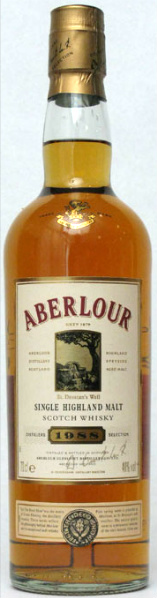 Color: Full Gold
 oday I have the chance to give this another go. First of all, I can look at this by daylight and I can’t see the red lemonade anymore. It has this orange brown color most Bourbons have.
 Happy new year! I wish all my readers a great year full of fulfillment, health and great drams. please don’t settle for mediocrity. Try to broaden your horizons for true beauty that can be put in your mouth, but do it in moderation, we don’t want to create modern drunks.
 Well what would be a better start, than with an old Strathisla! In the past I tried some nice old Gordon & MacPhail Strathisla’s from this series. The review for the 25yo can be found here, but together with this 25yo I tried the 21yo and that was similarly spectacular. Mind you these are the old 80’s bottlings for the italian market, and whiskies with these labels were issued for a couple of decades, so every batch will differ (massively). The 21yo and the 25yo were quite dark, and hopefully not colored, and being from the early eighties, the distillate is early sixties or maybe even late fifties.
 Short finish. The 21yo and the 25yo performed better in that respect. Treat this elderly Whisky with respect, but be bold and take bigger gulps. The whisky itself, maybe is a tad fragile and subdued, but hey, the stuff was made some 55 years ago and along the way was reduced to a mere 40%, so give it a break will you?
 Belgium’s own, Bert B. came into the Cadenhead’s shop in Amsterdam (The Netherlands), with a tale of buying the ‘Winkeldochters’ in an old liquor store in a long forgotten town, near the coast. Howling wind and rolling bushes through the streets. Winkeldochters translates into shop’s daughters. It’s a great Flemish word for those items that are around for a long time in a shop which in fact never get sold.
 Well one of these bottles he bought was this Dufftown from Cadenheads. He opened it in the shop and we tried this. He didn’t like it then and exchanged it with Andries (The Cadenhead’s Shop owner) for a wedge of cheese, a cup of coffee and a wooden clothes pin. Andries was kind enough to pour me a nice sample of this (100ml) to take home with me. Cleaning out the closet, I stumbled across this sample, so here it is…
 Color: On the edge between copper gold and copper brown.
 Points: 92
 So there are quite a lot of official Wine finishes by Glen Moray themselves. Now Ian MacLeod decided to add their wine finish of their own, or maybe bought it straight from the distillery.
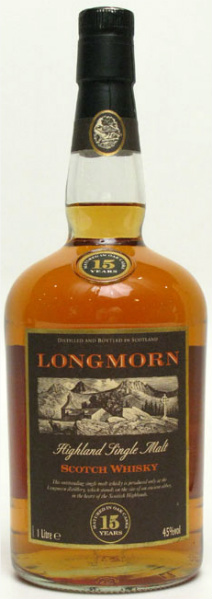 I just found out that Longmorn isn’t on Master Quill yet! Longmorn is one of my absolute favorites. Just have a go at a sixties or seventies fruitbomb or heavily sherried expressions from the days the stills were heated with coal. Sometimes it almost tastes like the coal went into the whisky too. A liquified locomotive. But no use crying over spilt whisky and let’s start-up with this old 15yo. This 15yo is no more and was replaced in 2007 by the current 16yo. So it’s off the market for five years now, but bottles are found in some shops and are still fairly cheap at auctions. Also the packaging has dramatically changed. The 16yo new bottle has metal and leather glued to it, and has an intricate box. This 15yo looks fairly simple. Surely Longmorn are capable of making a pretty good standard whisky? Lets find out how this eighties distillate behaves, and maybe we get a chance in the future to compare this to the new 16yo expression. I tasted the 16yo once in 2009, and scored it a measly 81. I hope it got better in the mean time.
 Allt-a-Bhainne is a new distillery, now owned by Pernod Ricard (through Chivas Brothers Ltd.). It was founded in 1975 to be used for the Chivas blends. Pernod Ricard bought Chivas from Seagram in 2001. The distillery was shortly mothballed between October 2002 and May 2005. Just two years before the foundation of Allt-a-Bhainne, Chivas also founded Braes of Glenlivet (Braeval) for the same purpose, and therefore is considered it’s sister distillery.
 Master Quill