Dallas Dhu 1971/1994 (40%, Gordon & MacPhail, Connoisseurs Choice, Old Map label, ID/H)

Again a distillery that was founded in the Pattison crash year of 1898. Building was finished one year later and the first spirit that came off the still was on the 3rd of june 1899. It’s history is like many other distilleries. Closures during both world wars, and of course a big fire on the 9th of April 1939. The last day spirit came off the stills was the 16th of March 1983. 1983, a dark year when a lot of distilleries were closed. In 1986 the distillery was sold to Historic Scotland who run the place as a museum now.

Color: Full Gold

Nose: Fruity and sweet. Lightly woody. Fresh and a bit rural. Distant farmyness. Wet grasslands. Wet trees. That sort of thing. Hard powdered candy with some liquorice. Woody vanilla ice cream. Smoked bacon with cardboard and almonds.

Taste: Sweet and sherried. Cardboard in here too. There also seems to be some smoke in here. Watery vanilla ice cream. Some sourness of the wood is in the finish and later on some bitterness too. Nothing to worry about.

It’s very easy drinkable. But for me this is an example of those G&M’s from the past where the whisky didn’t stand the reduction to 40%. Also I find that the caramel coloring changed the original whisky considerably. Fortunately G&M know their market and don’t reduce their whiskies that much. Don’t know about the coloring though…

In the past I hated these Map labeled Connoisseurs whiskies and in fact I believe I don’t own even one. For me they got reduced too much and some are that much colored, that the caramel coloring changes the character of the whisky. The industry made you believe that it doesn’t alter the whisky, but having done some tests, it certainly does. It brings some sort of roundness and balance you get from most blends and it makes all of those Connoisseurs Choice Whiskies a bit similar in taste and definitively similar in color. Still the old Dallas Dhu that’s in here shines through.

Points: 86

Again Muchos Grazias to Nico for this sample.

Dailuaine 17yo 1980/1997 (43%, Hart Brothers, Sherry)

Dailuaine is a distillery that also is around for a long time. Founded in 1852 and rebuilt into a big distillery, for the time, in 1884. Just five years later Dailuaine became a landmark since it got Scotland’s first Pagoda roof, from Charles Doig. Also noteworthy is the fact that Dailuaine and Talisker distilleries merged in 1898. Again the year of the Pattison Crash. Mind you, Dailuaine and Talisker aren’t exactly across the street from one another.

Again we have here a distillery with a fire. But this fire forced the distillery to close for three years! This happened between 1917 and 1920. After that, like with many others, the years of expansion. Today Dailuaine is in the portfolio of Diageo and mainly used for the Johnnie walker blends.

Color: Light Gold.

Nose: Musty, vaguely sherried and sweet. Rather thin. Floral and perfumy, which do not necessarily go together. The nose is quite elegant. Vanilla. Nice clean sour oak. Barley and apple compote. Given some time, the floral part is overshadowed by the sour oak. Otherwise quite nice and good balance.

Taste: Well I got cannabis in there again! Typical sweet and sourness from applesauce. Honey. Very clean otherwise. The woodyness doesn’t need a lot of time to rear its head, pencil shavings. This isn’t bad. Without it, its character would be even less interesting. Still this has a lot of body. The sourness of the oak, dominates this finish. Reduction is ok on the palate, but makes the finish a bit weak and short.

A bit anonymous this one. Taking this blind it could have been anything.

Points: 85

Thanks go out to Serge for handing me this sample a long time ago.

Glenrothes 1979/2002 (43%, OB)

Glenrothes was founded in 1878 by James Stuart & Co. and some partners. James Stuart was the man who at that time also had The Macallan (since 1868). James soon developed some financial troubles, so he was thrown out of the partnership and returned, with his tail between his legs, to Macallan. The rest of the partners formed William Grant & Co. and finished the building of the distillery. The first spirit ran off the stills just one year after its foundation. The rest of the history seems rather volatile, having suffered several explosions and fires. (1897, 1903 and 1922). After this period of ruining the place, came the period of expansion. From the sixties through the eighties, consecutive pairs of stills were added. Now there are 10 in total. Today The Edrington group is the owner of Glenrothes, just as they do with The Macallan.

Color: Copper Gold

Nose: Sherried, Very round and sweetish. Toffee and caramel. Seaside freshness. A bit creamy and no off notes. Smells young like lots of other of these Glenrothes’ cannonballs. Dark chocolate. Reminds me of those cherry bonbons with liqueur. Distant hint of toasted wood.

Taste: Sweet and slightly sherried. The cherry bonbon is here too. Nice toffee flavour and syrupy texture. More character evolves in the glass after letting it breathe. Here come some hints of oak, bitterness and some woody spices. Menthol. Still it remains sweet and syrupy. Also, in my opinion, not a lot of development. Give it more time and the wood kicks in some more. More wood and bitterness that stay and define the finish. Quite unusual for a Glenrothes OB.

At 85 points this is the best OB I’ve tasted from Glenrothes, and look at this extra special luxury packaging!

Points: 85

Glenrothes 1989/2000 (43%, OB)

When my interest into Single Malt Whiskies took some form, and all was looking fabulous, I hoped I would really like Balvenie and Glenrothes. I really like the way the bottles looked. Just have a look at these nice cannonballs! In the case of Balvenie, I didn’t quite get to that high status of being a favourite and alas the same is true, for me, for these Glenrothes. I tasted quite a few of these, but I never scored these cannonball bottles above 84 points. Blind and not blind. I still love the way these bottles look.

Color: Copper gold.

Nose: Very musty. Lots of sherry in here. Someones bad breath. Old raisins. Gravy. Very powdery, the fat make-up powder people wear on their face. Slightly tarry (from the Sherry cask). Creamy. Actually quite nice.

Taste: Sugary sweet, again lots of Sherry influences. Only hints of wood. Very drinkable, but also rather simple. The raisins return here, and they’re a little dirty and tarry.

One of the slightly better usual suspects from Glenrothes. Especially at this age, approximately 11yo. Still I can’t get over the fact that all these Whiskies are a lot alike.

Points: 84

Benromach 18yo (40%, OB, Circa 2003)

Founded in the year of the Pattison crash 1898 and located on the outskirts of the ancient market town of Forres. Mothballed between 1931-1937 and 1983-1998. Since 1993 the distillery is owned by Gordon & MacPhail. Yes, the bottlers. The first Benromach that was released and made by the new owners is Benromach Traditional, that was released in 2004. The year they started with the new look and bottles in tin tubes we know today. During the G&M years more and more new released see the light of day. Today the distillery is known to be Speyside smallest working distillery and is operated by just two people…

Color: Gold

Nose: At first rather closed, but after some breathing, comes a sweet, bold nose. Dare I say sherried? Creamy with a hint of smoke. Almonds. Dusty. Cream and a bit buttery. The oak is slightly floral. Licorice with the slightest hint of tar. Very nice.

Taste: Sweet, oak and honey. Similar to the nose. Caramel with cherries. Creamy, nutty and slightly oaky. Almonds. The slight oakyness is also slightly sour, which is no problem. Not even that simple as expected, and very drinkable. Toffee and again some licorice. I’m quite surprised here. Has great body and the 40% even tastes nice.

An excellent Benromach and very good at 40% ABV. Just one catch. They don’t make this anymore. But sure did a great job in raising awareness. I will have to look further en dig deep into all the other bottlings by the distillery. Well done.

Points: 87

Caperdonich 38yo 1972/2011 (46%, Mo Òr, Bourbon Hogshead #7437, 162 bottles, 500 ml)

Amongst others, the most ‘famous’ bottlings of Caperdonichs from 1972 are the Duncan Taylor ones from the 74xx series, and they had a lot. Earlier I reviewed Cask #7424. Lately these casks were sold out and prices are soaring now. Now we have this. Mo Òr also have a Caperdonich from 1972 and it is a bourbon hogshead. But wait, it is Hogshead #7437! Could it be they have obtained one of Duncan Taylors fabulous Hogsheads of Caperdonich 1972. Let’s have a look. Well it turns out Duncan Taylor also have a Cask #7437 yielding 161 bottles. Being a hoggie, this can’t be a cask share since precisely 300 bottles at cask strength can’t come out of one hoggie. (I’ll spare you the math). Well are there two casks with the same number, or did the guys from Mo Òr buy up all the bottles and reduced them to 46%? I’ll have to ask.

Color: Gold

Nose: Yeah this definitively is a 1972 Caperdonich from the good casks. Nice waxy, old bottle smell. Very elegant granny in her old room. Being used to these casks at cask strength, this sample does seem less up front. Still I like this very much, the reduction didn’t spoil the whisky at all. It shows a dimension, that was hidden behind the fruits and wax in the cask strength versions. It makes it smell like an old spices warehouse. Still the fruit and the wax, such a typical combination for these Caperdonichs are só good. After some air lightly spiced wood and vanilla enter the mix. This is an example of perfect balance.

Taste: Here there is some spicy wood, it has a touch of cannabis (given off by the oak), that makes this very nice! Light waxiness and so very fruity. Half sweet. Think yellow fruits, peaches, partly in syrup. Wow! I was afraid reduction would make the palate thin, but it didn’t. Hint of coffee. Again perfect balance. Reduction probably did shorten the finish a little. But that doesn’t spoil the fun. One element of caution. Don’t let it sit too long in your glass. Air brings out a little bitterness and other woody parts that don’t do this Caperdonich right.

Unbelievable that after all these years there is no strong wood that ruins the picture, bitters the finish, and overpowering it all. They don’t make them like this anymore. Do yourself a favour and try one of these before it’s too late and they are gone forever. Fabulous stuff! Of all casks #74xx, cask #7424 is considered the best, and that one I scored 93 points. This Mo Òr isn’t scoring much less. I would have loved, for educational purposes, to taste a cask sample of this. Well done Mo Òr!

Points: 91

Thanks go out to Henk for handing me this sample.

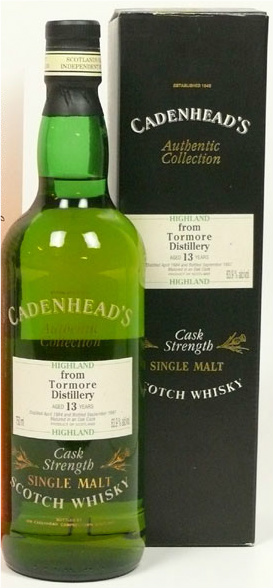
Tormore 13yo 1984/1997 (63.9%, Cadenhead, 750 ml)

The other day, I reviewed a reduced Tormore by indie bottlers Mo Ór, that I called feminine. It was Floral and fruity, very easy accessible. I said other Tormores were more metallic and industrial. Luckily Master Quill has a vault where a whisky archive is kept, so I was able to find a Tormore fit for comparison. Here we’ll have a look at this Tormore bottled by Cadenhead. This particular offering was bottled for the good people of the U.S. of A. Hence the 750 ml bottle from 1997. 1997, that means this Tormore was bottled around the time previous reviewed Tormore was distilled (1996). Both Tormore’s are about the same age too. Let’s see if thís Tormore is any feminine.
Color: White wine.

Nose: Well this does start floral again. How consistent, but soon caramel and wood and yes, a metallic touch. Clean and very toffee like. Compared to the Mo Ór this isn’t all that fruity. Dry. Still very floral and sweaty maybe. Great stuff.

Taste: Well strong, it’s almost 64% ABV. Half-sweet, and the metallic part returns. Still that’s no bad thing here. Lots of caramel and toffee notes. This finishes a bit sour, from the oak, but no big problems here. Otherwise quite un-complex.

Tormore’s are definitively the odd ones out. Rather unpopular and who is surprised when you taste the official 12yo. But when you get your hands on a clean ex bourbon cask at cask strength, you might be in for a pleasant surprise. Even though they may not be the high scoring Whiskies, they do have something in them I particularly like. There’s a potential here that isn’t used. The stills have purifiers on them, that makes the spirit very clean. Most of the Tormore spirit is put in Refill Bourbon barrels and hogshead and most of it doesn’t even age on site. So you’re bound to have something ultra clean.

Still I consider myself lucky I got my hands on a second bottle of this. Great stuff.

Points: 86

Tormore 14yo 1996/2011 (46%, Mo Òr, Bourbon Hogshead #6868, 500 bottles, 500 ml)

Tormore. One of those distilleries, you don’t hear about too much. Tormore was founded in 1958 by Long John International, and distilling started in 1960. It was the first distillery that was built after the Pattison crash of 1898, and thus the first to be built in the 20th century. Today Pernod Ricard is the owner of Tormore and is already the fourth owner in its short history. Tormore was originally built with 4 stills and in 1972 that amount was doubled. In 1984 the heating system for the stills was converted, so that it could be heated with… woodchips to heat the stills. Officially only a 10yo was released, later replaced by the current 12yo. For a short while also a 5yo and a 15yo existed. So mostly independent bottlers issue Tormore Single Malt today. Still, over the years not a lot was issued this way, nor does it usually score very high. I guess it’s time to have a look into Tormore. First a Tormore bottled by Dutch bottlers Mo Òr, who’s Macduff and Miltonduff started this blog to boot.

Color: White wine

Nose: Nutty and soapy. Smells very floral. Fresh and exuberant. Sour spring fruits. Creamy and a bit sweaty as well. Toffee. I can imagine why they bought this cask. It seems to me this is a happy and positive Whisky. Absolutely a young Whisky. Very likable. Maybe they should sell this in a spray as an eau de toilette.

Taste: Creamy and nutty. Very simple and seems younger than it actually is. Again very likeable and sweet. Vanilla ice cream and some caramel, and mint. No extremes in this. Hardly any wood. There is some wood noticeable in the finish. Hints of Belgian beer in the finish. Hops. Given some time in the glass, some spiciness does come through. Short finish though.

There seems to be a nice and unpretending balance to this. For me it’s very feminine. It’s easy and has a lot of fruits and flowers going on. Not a typical Tormore though, it doesn’t resemble the other Tormore’s I know, which were more industrial, or even metallic. This is nothing like that, this is organic summer garden. Biological Whisky maybe? Give it some time to breathe, it will enhance the character a little, by shedding its initial sourness.

Points: 83

Thanks go out to Henk for handing me this sample.

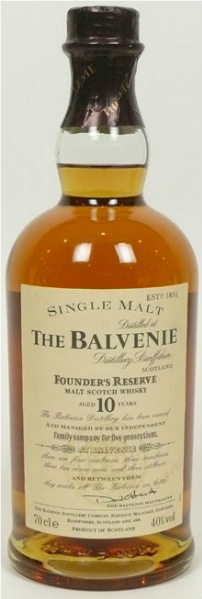
The Balvenie 10yo “Founder’s Reserve” (40%, OB, Circa 2003)

And here is another entry-level whisky by the same owners as Glenfiddich. I guess Glenfiddich was (not anymore) the poor man’s Single Malt Whisky and The Balvenie is the more posh one. Even Glenfiddich started to churn out Vintage Releases from the seventies, that have a heft price tag. Balvenie makes about half the amount of Whisky Glenfiddich makes and with that still is a top ten seller. So William Grant & Sons have two golden goose’s on hand.

When looking around. and being new to Single Malts I almost fell in love by the shape of the bottle and really liked the way their labels looked. Not a lot to choose then. There was this 10yo (Founders Reserve), a 12yo (Double Wood), a 15yo (Single Cask), a 21yo (Port Wood) and a 25yo (Single Cask). And there was one limited oddity, the 17yo (Islay Cask). Nothing more. Today like with others there is more choice than ever. Lets have a look at the cheapest Balvenie, the 10yo “Founders Reserve”…

Color: Gold

Nose: Perfumy and powdery. Almonds and lemons. Apple pie. Hint of wood. Creamy. banana and cookie dough. Syrupy. Sweet and light.

Taste: Sweet and very fruity. Cardboard. Very short finish. Sweet but very light. Hints of smoke? Hints of wood and wood-shavings that give it just a little bit of character. Vanilla ice-cream.

First of all I have to admit it was a very long time since I’ve had those standards like this one and Glenfiddich 12yo. I almost never have a whisky that’s 40% ABV, or it has to be a very old Gordon & MacPhail bottling. So I’ve become very much detached of these standards. With that I may become a bit decadent and in memory unappreciative of these whiskies. Having said that I have to admit that these two whiskies surprised me a lot with their quality and taste. Nice stuff. There is one big if. These type of malts seems to me are so easily drinkable, that you would drink them the way you drank lemonade when you were a kid. These types of malts make alcoholics out of us 😉

Compared to Glenfiddich 12yo “Special Reserve”, both are different styles. This is sweet and fruity. Nothing more. Glenfiddich is more honest in style, more of a Lowlander I would say. I thought Glenfiddich was better.

Points: 77

Glenfiddich 12yo “Special Reserve” (40%, OB, Circa 2003)

Looking back I’ve reviewed here a lot of old, priceless or impossible to have malts. Let’s counterpart that decadence a little bit with some malts that are interesting when crossing over from blended whiskies or other types of distilled drinks. The first that comes to mind of course is Glenfiddich. Glenfiddich is up there with their Single Malts since 1964. Already in 1964 they have sold 48.000 bottles of Single Malt Glenfiddich and today they still outsell anybody. Today they sell around 12.000.000 bottles annually. That’s a share of about 20%! Lets have a go at this Glenfiddich 12yo. A bottle that was bought ten years ago. Today the “Special Reserve” doesn’t exist but it is replaced by a normal 12yo in the same colours. It’s probably the same.

Color: Gold

Nose: Very malty and grain alcohol. Grass and lemons. Hay with mocha. If I had done this blind I would have said that it’s almost like a blend or a Lowlander. In part very clean, but sometimes also some hints in the depth that make it a bit dirty, syrupy and waxy. Soap-like perfume. Fresh apples and light peppermint. Not very complex, but it has its balance.

Taste: Green and grassy. Grainy again. Hints of tarry toffee and apple compote. Very light and fruity. Easy drinkable. Finishes a little bitter. Altogether the finish is short. There is more to the nose than the palate.

Perfect start for people wanting to cross over from blended whiskies into Single Malts. The transition will be a smooth one and no shocking differences will emerge. People who scoff at this are wrong. This is not a bad whisky. I have tasted far worse than this. It’s completely inoffensive and yes, not a high flyer. But it isn’t here to fly high. It’s here to get you there…  Often the only single malt whisky in a bar, but easily the best drink available. An honest product.

Points: 80