Longmorn 1971/2004 (40%, Gordon & MacPhail, Distillery Label, JD/AII)

The old Jameson opened my eyes for old bottles. Not true actually. I’ve known it all along. I just needed a kick in the bee-hind, to open some more, before I one day, kick the bucket. Luckily I had a birthday two months ago, and that is always a good reason to pick a nice one from the collection and “because you’re worth it…”. Of course, “Thursday” is also a good reason in my book. 1971 is quite a legendary year for Longmorn. At Longmorn nobody will concur, because they haven’t done anything different in the years before and since 1971. However, there somehow are a lot, very good sherried, and otherwise matured, Longmorns from around 1971. I particularly love the 1971 from Scott’s Selection, although true Longmornado’s tell me there a many better ones. Great!
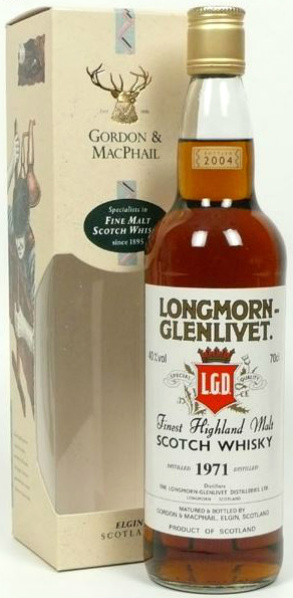
Longmorn 1971/2004 (40%, Gordon & MacPhail, Distillery Label, JD/AII)Color: orange gold.

Nose: Waxy. Old black fruits and just like the Jameson I reviewed last a bit of steam. Buttery and beautiful Sherry and black coal. It doesn’t leap out of the glass and I believe that is due to the reduction to 40%. I’m not worried yet, because these old distillates can handle a lot of water. Today’s Malts do need a higher strength. Nevertheless it seems the nose suffered a bit in power. Maybe this is one for a Cognac copita (the big balloon glass). Luckily I have a whole bottle of this, so I can experiment a bit. Slightly tarry but right after that a fresh note of faint menthol/mint. Way down deep into the nose some licorice pops up, well hidden in the dark fruitiness. Again, a wonderful old bottle.

Taste: Sweetish black tea, and again pretty fruity. Raspberry hard candy, and some cherries. The whole is quite soft, so again, maybe this was reduced too much. It’s great as it is, but I can’t shed the feeling, a lot was taken away from this Malt as well. Now it’s too damn drinkable, so I don’t think this will last me a long time. I’m sorry the body isn’t a bit bigger. I’m accepting this now and I move on. This is great stuff extremely well-balanced. A nice nuttiness comes to the fore and then even some honey. Hurray for air, breathing and developing Whisky. Great combination of fruit and the hints of tar and black coal. Tiny hint of burnt Sugar towards the end. The finish could be longer, but we’re rewarded with a wonderful aftertaste. It even reminds me a bit of some Rhum Agricole in the finish. Be patient and give it time to breathe. It opens up. wow!

I’m a sucker for Sherried Longmorns from the second half of the sixties through the first half of the seventies. These Whiskies are so good. Sure there are a lot of Longmorns around that are better than this one, but there are not a lot of Whiskies better than Longmorns like this. Give it time to breathe, it will open up and become bigger than it initially was.

Points: 91

This one is dedicated to David Urquhard (1952-2015) who passed away on 30 November 2015, aged 63.

Glenfiddich 19yo “Age of Discovery” (40%, OB, Madeira Cask Finish)

After an (alas imaginary) short break on the beaches of Barbados, back to Scotland again. From the oldest Rum brand in the world we now focus our gaze at the Whisky that started it all for Single Malts, Glenfiddich. Up ’till now lots of Glenfiddich have found their way onto these pages. The Whisky at hand is the first of three “Age of Discovery” bottlings. All three are accompanied by little stories about traveling and discovering new territories by usage of tall sailing ships. This particular Madeira cask finished Glenfiddich is about discovering the isle of Madeira (and Madeira Wine). The other ones are about sailing up the rivers of America for Bourbon casks (not a Bourbon finish, but wholly matured in Bourbon casks) and finally a Red Wine finish with the story of Darwin visiting the wine making regions of Argentina. Let’s not get ahead of ourselves and have a look at this Madeira finished one first.

Glenfiddich 19yo "Age of Discovery" (40%, OB, Madeira Cask Finish)Color: Full gold.

Nose: Funky and acidic. Where is this going? Some wood, rotting wood. Barley and grainy in fact. Waxy.  I’m getting a lot of wax lately, so maybe that’s just me. Luckily with time the aroma’s start to gel a bit. Started out very unbalanced, but the balance returns. Still the whole doesn’t seem to be very complex and obviously is very light. Maybe it wasn’t such a good idea to reduce it to 40% ABV. Mint & toffee come next. Unbelievable how malty this is after 19 years.

Taste: Sugar water with mocha, toffee and more sugar-water. So yes, quite sweet and appealing. Did the Madeira do that? Lots of vanillin from the American oak. Creamy. Pudding. Custard. Caramel, Toffee. After that it falls flat on its face. Short finish and hardly any aftertaste save for some creamy sweetness. Sure it’s nice and very, very easily drinkable, but hey, where is the development, where is the complexity? It’s a shame this got reduced so much because it tastes like nothing special now. It’s nice, but it is in no way better than a good Malt that costs much less than this one does.

I don’t know if this was meant for travel Retail? A lot of those big box Whiskies that are meant for travel Retail are 40% ABV. Why? Is the industry afraid the traveller at hand will open and drink the bottle on the spot? On the ferry or on the plane? Well, if that’s so, a traveller will get pretty plastered drinking a bottle at 40% ABV as well. So no need to put so much water into the Whisky bottle I would say. I guess you pay for the packaging this time. It’s nice, but could have been so much more. Expect to finish this bottle very quickly, because it drinks like lemonade, but alas also has the complexity and length of a lemonade.

Points: 81

The Benriach 17yo “Septendecim” (46%, OB, Peated, 2013)

Last summer I already reviewed The 18yo Benriach “Dunder”. A peated Benriach finished in high ester Rum casks. This “Septendecim” is a 17 year old peated Whisky. Well, I may be wrong, but maybe this “Septendecim” is the basis for all those 18yo Limited production’s of late? Up untill now there are already three releases in this series. It started with “Albariza” which was finished in PX Sherry casks, the second was the aforementioned “Dunder” and last month the Benriach “Latada” was released. Again a peated Whisky finished this time in Madeira casks.

The Benriach SeptendecimColor: Gold.

Nose: Fatty, fatty, thick peat. The peat is instantly recognizable from the Dunder I reviewed earlier. Bonfire in the woods. Tiny hints of electrical fire and molten plastic. Sounds terrible, but it doesn’t harm the overall smell, so easy yourself back into your chair. Quite clean and smoky. Kippers, salty and tarry. But it’s not Islay I’m getting. I still get a secondary feeling of a forest. Clairvoyant? Who knows. After some air, the whole gets even more cleaner, smokier and shows hints of citrus. Lemon, not lime. Quite nice. I would have never given this 17 years if I had tasted it blind. Hints of coffee, but not dark roasted stuff, more Cappuccino. Last one to show itself is the wood. Fresh oak.

Taste: Sure, fatty, a bit fruity and obviously peaty, but also much lighter on aromatics. Cold chocolate milk and coffee again. It has some sweetness too, but that is more hidden. Just like the nose, I wouldn’t have given this 17 years. Even at 46% ABV. it doesn’t seem to be heavy on the alcohol, I’m actually amazed how light this actually is. The lightness (and the coffee with milk) makes this dangerously drinkable for a richly peated Malt. I keep wanting more, and want to sip it more. Having said that, It would have been nice to try this one at 50% ABV and see a bit more complexity at this age. Medium finish with a buttery, vanilla and smoky aftertaste.

The “lightness” in the taste made me believe this is the Whisky they use as a basis for the “Limited Production Series”, especially when its 17 years old and that leaves some room for finishing.

Points: 85

The Glenlivet 12yo (40%, OB, 2012)

About a year ago I already reviewed The Glenlivet 12yo, but that one was bottled around 2005. Now I stumbled upon an example of the same stuff, this time bottled in 2012. We all know the big boys want consistency, so now we have a chance to find out. For those of you who don’t know already. Due to the enormous rise in popularity of Single Malt Whiskies, a distillery can’t afford anymore, to wait 12 years to make an entry-level Malt. This 12yo will be replaced in most markets, apart from Asia and the USA, where I’m informed, the consumers like “numbers” more than the consumers in other markets. The replacement is The Glenlivet “Founders Reserve”. Yes, a Whisky described by only letters, no numbers anymore for us Europeans.

The Glenlivet 12yo (40%, OB, 2012)Color: Gold.

Nose: Malty with sweet fruit and quite some wax. Nice aroma. One thing if for sure. The aroma of the 12yo never holds back, its vibrant and wants you to drink it. Definitely not a closed spirit. Vanilla and oak, parts of it even new oak, since the wood smell is a little bit sharper. Sweet and candied. Fruity. No pineapple this time, but I do get some apricots. Powdered coffee creamer (the initial smell of it, not the fatty part). At least this nose lives up to its earlier brothers (or sisters if you like).

Taste: Strange enough, this starts with wood, partially bitter and partially burnt. Then a quick passing by of some (sugared) fruit and some soapy (ear) wax, which is quickly overtaken by paper. Diluted red fruits and the bitterness never moves an inch. Not as sweet as the older versions. Quite a difference from the 2005, 12yo, I mentioned above. Not a long finish and the aftertaste isn’t all that pleasant as well.

When reviewing the 2005 version and comparing that to the new “Founders Reserve” I was quite shocked by the difference in taste. The “Founders Reserve” tastes as a very young and immature Whisky, almost as if it wasn’t ready, but the marketing department wanted it out anyway. Now that I have tasted this 12yo from 2012, and do remind yourself how much the Whisky world has changed between 2005 and 2012, the difference in quality isn’t all that great, although the taste is quite different. My advise would be, get yourself an old 12yo, but do not pay too much for it, and be surprised how nice it was.

Points: 76

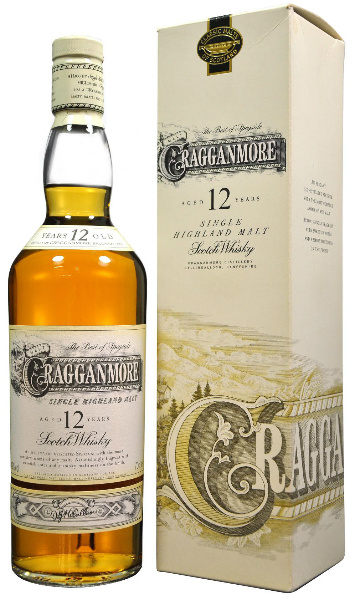
Cragganmore 12yo (40%, OB, Circa 2002)

A short introduction: Cragganmore was founded in 1869 by Glenfarclas’ John Smith and stays within the family untill 1923 when it is sold to the newly formed Cragganmore Distillery Co. In 1927 Cragganmore is 50% owned by DCL, one of the precursors of todays Diageo. In 1965 DCL buys the second half of Cragganmore to become 100% owner. In 1988 this Cragganmore 12yo becomes part of the Classic Malts Series, and in 1998 the Cragganmore Distillers Edition sees the light of day (more about that later), but let’s not get ahead of ourselves and have a go at this 12yo that was bottled back in 2002…

Cragganmore 12yo (40%, OB, Circa 2002)Color: Gold.

Nose: Fruity and malty. Quite some hints of caramel. Chilled produce, sugared yellow fruits and some candied orange. Waxy with an air of menthol. Hints of cardboard and toasted oak. Perfumy and vegetal. Fern on a dry forest floor. Sweetish, but also some oak acidity. Give it some time and the oak turns more spicy. Otherwise it is light, with creamy vanilla, wax and candied sweet yellow fruits.

Taste: Waxy and toffeed. Quite fruity and light. Dried peach and old dried apricots. Hints of clay. Warming. Damp earth from the forest again. Maybe some mushroom? Yellow fruit sweet yoghurt. A funky acidity creeps in. Very soft warm oozing caramel. Soft distant wood. Cigar box wood. Simple, light and likeable. Tiny hint of beer and hops in the finish, which comes as a surprise, also quite sweet with a burnt wood edge too it.

In the end I still feel that it is bit anonymous really. The distillery character is somehow hidden behind fruity sweetness, caramel and wax. Nice fruitiness though. Very easily drinkable. Again an entry-level malt to get you going. Nothing wrong with it, but also nothing special. One you’ll finish quite quickly and you’ll start wondering afterwards where it has gone. If anything, it does invite you to take another sip, as I will do right now..

Points: 81

The Balvenie 12yo “Doublewood” (40%, OB, Circa 2014)

Somehow a lot of Balvenies were already reviewed on these pages. However not the most popular one, the entry-level 12yo “Doublewood”, yes not a NAS bottling yet. Before the 12yo, the 10yo “Founder’s Reserve” was the entry-level Balvenie, but that one was discontinued in favour of this “Doublewood”. As I said before, Balvenie is a Single Malt I like to like, or like to love if you prefer, but somehow I don’t buy a lot of them anymore. Sometimes a bit weak and if they are really good, they are also really expensive. Once I had my own bottle of “Doublewood”,long, long ago, and it was very nice. I had several “Doublewood’s” since, but just like the 15yo “Single Barrel” I found the quality to be somewhat slipping, but they always stayed true to the Balvenie style, and for me that is elegance. Time to fill in one of the gaps on these pages and finally review the 12yo “Doublewood”. I can only hope this recent bottling does the trick for me again…

The Balvenie 12yo DoublewoodColor: Bright ocher gold.

Nose: Lots of caramel to welcome you, and hints of sugared orange skins. Creamy with slightly spicy oak. Sweet sawdust and sweet whipped cream. Hints of Cream Sherry, but the American oak donated a lot of vanilla to this Balvenie. It’s almost like there is also some virgin oak in this one. Hints of dried crushed leaves in autumn and a tiny burnt note. Smells fresh and well-balanced, although it does remind me of a heavily caramelized Whisky.

Taste: Nice but also rather thin. Sugary sweet and again caramel and cream. Yes, loads of vanilla are present as well as fresh almonds. It’s an ice-cream of a Whisky. The creamy aroma’s are quite big so it seems ok at 40% ABV. The lowest possible ABV to call itself Whisky, does show in the short finish. It hardly leaves any after taste. The finish itself seems to be built around a toffee flavour.

So this is probably a very nice entry-level Whisky. Very appetizing and sweet, with all the sweet markers. Toffee, caramel, Sugar and vanilla. Nothing to scoff at. Pretty good balance, but also quite simple. Not for analyzing, but for drinking without giving it too much thought. The only beef I have with this one is the short finish.

Points: 83

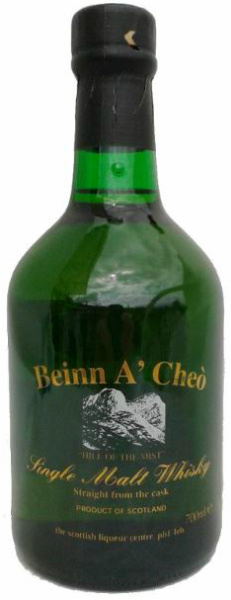
Glenallachie 11yo 1995/2007 (59.4%, The Scottish Liqueur Centre, Beinn a’Cheò, Bourbon Hogshead #33, 273 bottles)

And here is already the third Glenallachie of 2015. Earlier contenders for the Glenallachie award were a 2007 distillate of Dewar Rattray (83 Points), and not so long ago an 1995 offering from Kintra (82 Points), so both scoring low 80’s, which makes them nice, but not great in my book. This time around we’ll have a look at a Glenallachie bottled by The Scottish Liqueur Centre. Yes I know, they are not the most widely known independent bottlers around. The Scottish Liqueur Centre is owned by Morrison & Mackay. Still no bells ringing? What about one of their other brands: Carn Mor, surely you have heard about that! More recent bottlings of Beinn a’Cheo (mountain of mist) no longer have The Scottish Liqueur Centre on their labels, making Beinn a’Cheo a true brand of Morrison & Mackay, just like Carn Mor is.

Glenallachie 11yo 1995/2007 (59.4%, The Scottish Liqueur Centre, Beinn A'Cheò, Cask #33)Color: White wine.

Nose: Spicy and fruity and lots of other traits you know from typical Refill Bourbon casked high strength Whiskies. Remember all those Cadenhead bottlings? Fresh and slightly soapy. Old lavender soap, which only adds to the nose, not disturbing it. Whiffs of rural organics. And nice warm barley. Typical oak. Hints of vanilla from the American oak. When all that is out-of-the-way and the Whisky settles down in my glass, some nice fruits emerge along with a nice fatty creaminess. I won’t say it’s simple, but it is typical, well and it’s not really complex either. Not bad though. The oak really gets out when you warm it up in your hand. Wait a minute, warming it in your hand and giving it some time to breathe it really opens up. Finds balance. Nice fruit agian, but the sweeter fruits are now accompanied by citrus fruits. Sometimes this nose reminds me of Angostura 1919, a Rum.

Taste: Sweet. with almonds and fruit. Quite a surprise after the “typical” nose. This goes to show, that nosing isn’t everything. It’s sweeter than usual, but never crosses the line. However it’s sweet enough never to make it your daily drinker, the ABV is too high for that anyway. The wood is here too. Bit mocha and oak, milk chocolate. The wood forming a spine for the big sweet fruity body of the Whisky. Lovely stuff. I also like the almond that returns for the finish, although the oak plays a bigger part, turning herbal with air. After the heat passes your throat. The finish is nothing more than the fruity sweetness, some paper and overall “shortness”. The finish is definitely the weak part of this Glenallachie. Not a lot remains.

There is a lesson to be learned here. This is no spectacular Whisky when freshly opened. It’s closed and seems very simple. This is maybe thé example to let a Whisky breath to unlock its full potential. If you do, this ugly duckling turns out to be quite special after all.

Points: 86

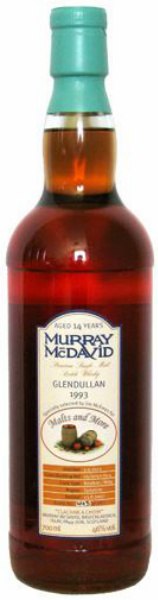
Glendullan 14yo 1993/2007 (46%, Murray McDavid, for Malts and More, Bourbon/Rioja Tempranillo, Cask #05/0052, 493 bottles)

After the Murray McDavid Rhosdhu, here is the second of three bottlings by Murray McDavid. This time we’ll have a look at Glendullan. The Edradours I reviewed last had their first appearance on Master Quill, and now we can cross off Glendullan as well. Here we have a fine example, where Murray McDavid were taking the independent bottler. Specializing in Wine cask finishes. In the early 2000’s Wine finishes were snuffed at, since most of them were overdone and the Original Whisky was probably dull (pun intended). It was just the industry trying Wine finishing out and learning on the go. They still have to wait many years to find out where their experiment were taking then. This particular Glendullan started its life as a regular Whisky aged in Bourbon casks (most likely a Hogshead).  After a while the contents were transferred into a wine cask. Tempranillo te be precise. Tempranillo is a red grape most common to Spanish Wines like Rioja.

Glendullan itself is a distillery owned by Diageo. A bottle of Glendullan is not the most common find of all distilleries, especially considering Glendullan is one of the largest distilleries Diageo owns.

GlendullanColor: Dark gold, slightly orange.

Nose: Spicy wood and a slightly acidic winey note. Very spicy oak, slightly burnt. Nutmeg, and herbal as well. Some faint odd acidic citrussy dishwater aromas. Applesauce, de Querville Calvados! Quite dusty and old smelling, like an old Whisky aged in a Bourbon cask. Behind that a more restrained fruity note, but again acidic fruit combined with hard candy versions of that fruit with added cherry and raspberry candy flavours. Almond pastry, cinnamon and nougat. It’s not quite a replacement for a Sherry aged Whisky, but not bad nevertheless. The Wine turned out very soft on the nose. I do get some grape skin, but from white grapes, not red. In the end, all aroma’s are built upon a wealth of wood, but no, it’s not woody. Needs a lot of air (time) to develop, but in the end it will not disappoint.

Taste: Fruity lemonade and warming. Citrussy again and to a lesser extent so are the apples. Present, but not so much in the Calvados way. Also grenadine and quite a lot of licorice. Old rotting wood. The kind that has been submerged for a long time in a forest. Quite thick. Some raisins. Lots of influence of the wine cask. Maybe a bit too much? The Bourbon casked Whisky isn’t really recognizable anymore. Is that bad? Nope not really. This is still a nice tasting Whisky. Less complex than the nose, but overall quite pleasing. It doesn’t show its best bits right from the start. Pour it and leave it for a while.

Quite stunning what Murray McDavid have achieved with Tempranillo. No wonder Tomatin has gone that way lately too. Complex stuff, with a stunning nose, with quite some development.

Points: 85

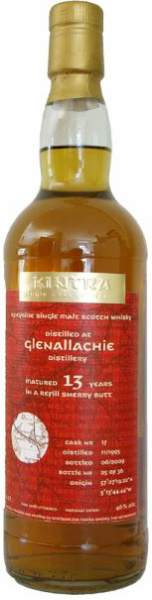
Glenallachie 13yo 1995/2009 (46%, Kintra, Refill Sherry Butt #17, 36 bottles)

Rummaging through the unsorted part of my sample collection I found this Kintra from 2009. Another Glenallachie and that’s great! Kintra’s big cheese, Erik started releasing Kintra Whiskies in 2009 so this is one of the first bottlings, and who knows, maybe even the very first. 2009 saw the release of a 1996 Ben Nevis, a 1997 Clynelish, a 1984 Macduff and in June, this 1995 Glenallachie.

A mind boggling amount of 36 bottles were released of this Glenallachie, so this is a collector’s item for sure! I don’t think this was from a small cask, probably only part of a cask, just like the Ledaig he bottled in 2010.

Color: Gold.

Nose: Fatty and fruity. Some butter and wood smelling like jasmine. Thus quite floral and spicy. Fresh air. Hints of white pepper and again and again this florality whiffs by. Pencil shavings come next. A lovely nose. Nice added depth from the Sherry cask, not only giving it some mustiness, but also some fruit. When smelled more vigorously, whiffs of toned down peppermint pass by, but also some hay, dry raisins and cardboard. If I would hazard a guess, I would say Fino Sherry?

Taste: Spicy first but quickly turning into sugar water sweetness. Dare I say it has some peat to it? The spice and the sweet balance each other out, so it’s not overly sweet. Warming going down. Hints of milk chocolate and a slightly burnt note. Still, lovely stuff, but also a bit unbalanced. Highly drinkable and enjoyable nevertheless. The sweetness makes way for a more woody, and acidic, dryness towards the finish. The finish itself is of medium length and pleasant, but doesn’t leave a great aftertaste, since especially a weak wood and cardboard note stays behind for a short while.

This is one of those highly drinkable Whiskies, where the weakest link is the finish, and especially the aftertaste. To get past that you tend to take another sip, and yet another sip, and yet another, so you’ll finish your glass rather quickly and after that you ask yourself where has the bottle gone? Maybe not my favourite Kintra bottling, but still very good and entertaining.

Points: 84

Linkwood 18yo 1991/2010 (52.9%, Bladnoch Forum, Hogshead #10346, 252 bottles)

Another Linkwood then. Linkwood is quite a difficult distillery for me. Somehow I don’t seem to like Linkwood that much, and I don’t buy any of Linkwood without tasting it first. This one I did buy blind. First of all I like Raymond Armstrong (the former owner of Bladnoch Distillery) and just like Dutch independent bottlers The Ultimate were/are able to bottle some great Whisky at very fair prices. Luckily a lot of my tasting is done blind, so it’s not the name that makes for a lower score. Don’t get me wrong, I did come across some good Linkwoods as well. So with an open mind let’s have a got at this 18yo Linkwood.

Linkwood 18yo 19912010 (52.9%, Bladnoch Forum, Hogshead #10346, 252 bottles)Color: Light gold.

Nose: Acetone, unmistakable. Nail polish remover. Lots of sappy leaves too. Quite nutty as well. Well not dull isn’t it. This spirit jumps right out of my glass. The acetone seems to “remove” itself, but it’s just me not smelling it anymore since it tries to anesthetize me. Put it away for a minute and smell it again, and you’ll be hit in the head again. Even though some might like it, it most definitely is flawed. Nice wood underneath it all. Coffee, cloves and some mocha-cream. Hazelnut pastry. Vanilla, hints of lemon and even a bit perfumy after a while. If you factor out the solvent, this is quite a bold body from a highly active and spicy cask. Quite nice but with a rather unusual defect. No I don’t hate it. Maybe this needs to oxidize a bit?

Taste: For a brief moment there is a solvent. It is quite hot, but the solvent (not ethanol) is quickly replaced by a more woody and leafy aroma. Woody and nutty. Sweet, with a lot of vanilla. Even though the solvent part seems to dissipate for a while, the whole stays quite hot and overpowering, just as it did with the nose. Freshly painted wood and freshly sawn, not entirely dry, oak. The feeling something other than Whisky is going down my throat. Medium finish.

In a way this was difficult to score (but not really). First of all I liked it maybe a bit more than I scored it, but I don’t think this isn’t one to finish quickly. Quality wise this couldn’t score very high since it has some obvious flaws, not exactly from the middle cut maybe? (although hard to imagine).

Points: 79