 And now we return to Bourbon. A Kentucky Straight Bourbon Whisky from Lawrenceburg Kentucky. First of all, when writing about Four Roses we have to look at their ten recipes. What? Ten recipes. Four Roses has ten different recipes for making Bourbon. They combine two different mash bills with five different yeast strains.
  The ten recipes are called OBSV, OBSK, OBSO, OBSQ, OBSF and OESV, OESK, OESO, OESQ, OESF.
The letters V, K, O, Q and F designate the yeast strain used. V is described as giving light fruitiness, light vanilla, caramel and creamy notes. K gives light spiciness, light caramel and a full body. O gives rich fruitiness, light vanilla, caramel and also a full body. Q gives essences of floral aroma’s and finally F gives essences of herbal aroma’s.
The letters B and E are used for the Mash Bill. B is 60% corn, 35% rye, and 5% malted barley. E is 75% corn, 20% rye and 5% malted barley. You might wonder what the O and S stand for. O stands for Four Roses Lawrenceburg, and S means Straight Whiskey. If you want some more information about how a specific recipe might taste, have a look over here.
I think this is genius, because this scheme allows for a lot of variation (you hope) in the finished product. There are some people in the USA, that bought some single casks from those ten different recipes, if not all. I know for a fact that Binny’s just did that, but there are more. So if you’re interested in the differences between those recipes, you can have a go with those specific single barrel bottlings.
 Now, we have here a Single Barrel (100 Proof), do we know which recipe it is? Yes we do! It’s OBSV (60% Corn mash bill, Rich in Spiciness, Full Body). I’m very curious. I love the concept, and the looks of it. I once had the previous version of the Single Barrel (43% ABV), which I didn’t like too much. Too weak, very light and too floral and girlie for my taste. OK, let’s have a look at this new one and see if its more masculine 😉
Color: Dark Gold Copper
Nose: Dusty, slightly woody, fern, not overly complex, or is it? Give it some time, creamy, vanilla ice-cream and an exotic sweetness you can smell in a good Gewürztraminer. It also had a meaty component, like gravy. All in all, a very intriguing nose. I like this.
Taste: Spicy, licorice. Hints of wood only, almost no toast. This rose has quite a firm body. Since it’s a “B” and not a “E” I’m surprised at its sweetness. But is definitively tastes as a Bourbon with a high rye content. It’s like a ping-pong match between the corn and the rye. It’s not balanced in a way that you have a ‘married’ taste, that tastes always the same, but it’s balanced. It goes to and fro, your palate never gets a rest, and is always surprised with each sip. There goes a coconut by the way…
 For me this is a work of high quality and more than one step up from the old Single Barrel. It seems to me this is like a sponsored bottle: for the quality you get it’s really dirt cheap, even without the discount I got, so I bought me a case of this. 50%ABV is excellent too. Again kudos, this time for the people at Four Roses. Excellent.
Points: 83
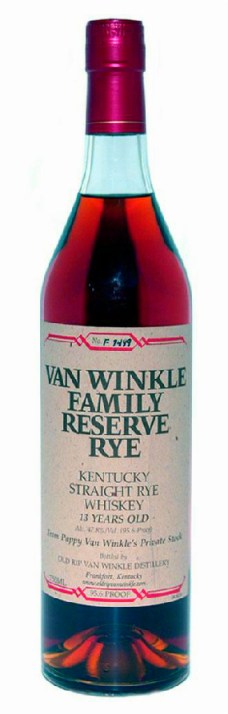 Just a shift in grains in the mash bill. By law its required to be made of a mash of at least 51% rye. The other grains of the mash are usually corn and some malted barley. Rye whiskey is called Straight, when it has been aged for at least two years. Now this 13yo Rye. Well first of all, this isn’t 13yo. Its called 13yo because Julian van Winkle bought the Rye’s in this whisky at 13yo. He nevertheless let the Whiskey age until its 18th year and at that age it was put in stainless steel tanks, to stop its ageing. Where does this come from? Van Winkle isn’t a distillery so they got their whisky from somewhere else. A lot of their Bourbons come form the sadly deceased Stitzel-Weller distillery, but this Rye is supposedly from Medley (Owensboro Kentucky) ánd Cream of Kentucky (Frankfort), and has an unusual high corn content for a straight rye.
 And that’s not all, the finish also has some honeyed caramel. Honeyed caramel with a bite. What else do you want…
 For this review I’ll use and oddity of Buffalo Trace, well it’s definitively and oddity for us Europeans. They already bottle a lot of different whiskies that also taste quite different, lot of different mash bills. Here we have a single barrel version of the regular Buffalo Trace. A single cask picked by Binny’s (from the Chicago Bay Area). So the bottle is the same as the regular one, except for an elliptical golden sticker. Issued in 2010.
 ose: Honey, and a lot of it! Even the waxy part is there, honeyed furniture wax. Hints of toasted oak. Fresh sea air and meaty. Like sitting on the porch of your sea-side cabin, and the smell of freshly made meatballs float by. Chocolaty and vaguely spicy. Very balanced. Nothing in this overpowers the rest.
 Yeah this is not bad, not bad at all. This will be no problem to finish, no problem whatsoever. Before finishing this piece, I already poured it four times. Very good standard bottling! Ok,ok, Single Barrel of a standard bottling. A shame really that I don’t have the standard version at hand…
 Here at Master Quill I’ve explored some Scottish Whiskies and I think it’s time to expand a little. There is a lot more out there and I feel it’s time for me to look into what America is capable of. The journey started for me with a Bourbon, as can be read
 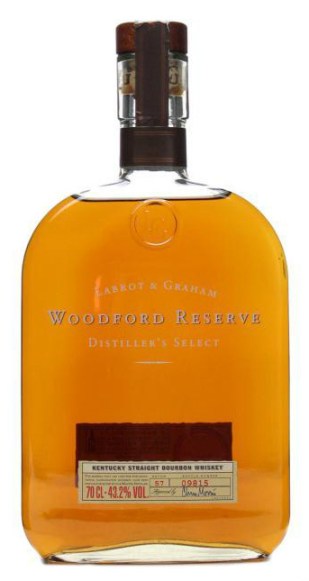 Lets move on to the next candidate. The first Bourbon we will explore is the small batch Kentucky Straight Bourbon Whiskey, Woodford Reserve. This bourbon is made by Brown-Forman, but marketed under the name of the previous owners from long long ago: Labrot & Graham. The Distillery was built near Versailles (Kentucky) in 1812, but distilling activities started as early as 1797. Brown-Forman owned this distillery previously from 1940-1960 and now owns it again from 1996 onwards. The first batches were distilled ‘elsewhere’. Whisky is distilled partly in Scottish Pot Stills and partly from Column Stills from their Early Times plant in Shively (Kentucky). Besides this there are also Woodford versions made for the Kentucky Derby at a slightly higher ABV (45.2%, I don’t know if there are more differences, besides the illustrations on the bottle). There is also a small Masters Collection series and now a new Double Oaked version.
 And even later than that the toast from the cask. This really unwinds slowly. Still its a bit unbalanced, and thin. I would have bottled this at a higher ABV.
 Master Quill