
 The Old Train Line series is probably the series with the most beautiful labels I know. The series is bottled by German bottler Jack Wieber based in Berlin.
Macduff itself is not thát old, just founded in 1962, with production starting just one year later. Macduff started out with only two stills. Sometimes a still was added, and today, Macduff has five. Since Martini was once an owner of Macduff, the malt is popular in Italy and the rest of southern Europe.
Color: Brown
Nose: Meaty and minty. Gravy with tar and old wood. Very perfumy too. It’s a meaty tea, that shifts a bit into coffee territory. Hard pressed powder candies. Very distinct, not to say unique. Also the wood plays a very unique role here. Mens cologne.
Taste: Minty wood. laurel licorice combined with the powder from the candies. Not sweet, but there is a lot of sourness from the oak. Mocha coffee with honeylike wood spice and black coal. Wow, this has a very heavy beerlike finish. After giving it some time, some black fruits emerge in the finish. Dry.
Try to imagine a Macduff with a lot of color from a sherry cask. Now try to imagine how it would smell and taste like. Do you have it? Well, this is nothing like that! This will surprise you. That’s nice. Still the balance isn’t quite there. And the finish is strange, soap, spice and a lot of beer, and rather short too. It’s definitively not a big sherry monster, but it does come across as a very old whisky. Dying to know what kind of Sherry this cask held before.
It does need a lot of time to open up, tastewise, for the nose the oxidations does nothing. Give it time and you’ll be rewarded.
Points: 88
 Founded in 1843 by William Mathesen, but whisky was distilled on site as early as 1703 (or 1738). Glenmorangie is now known for their stills with very tall necks that ensure a very light and clean spirit that had to reach incredible heights. Glenmorangie are also known for their Dr. Bill Lumsden, a man who doesn’t fear innovation and experimentation with his grains and woods.
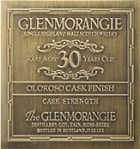 The whole is pretty balanced. It’s easy noticeable that this is from light spirit. The nose is great, and the taste is very nice. The only two things that let this down is its lightness. And a Glenmorangie should be light, that’s one of their pillars. Personally I like a bit of body to it, like yesterdays
 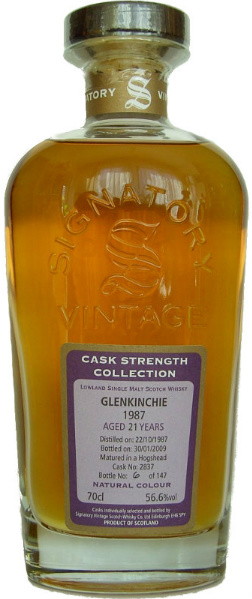 Glenkinchie, a rarely seen Lowland distillery within the ranges of independent bottlers. Founded in 1837, Glenkinchie is foremost known for the closure of Rosebank. When Diageo set up their range of classic malts they chose Glenkinchie over Rosebank. As you might know, Rosebank is known to have a huge following, so this decision wasn’t welcomed at all. Now Rosebank is no more, we’ll have to see if this Glenkinchie is worth your money. Instead of a regular Diageo bottling, let’s try an independent one.
 Springbank, the strongest survivor of Campbeltown, and one of the few family owned distilleries. Once a great center for whisky, and once a region of its own, it still is, but barely.
 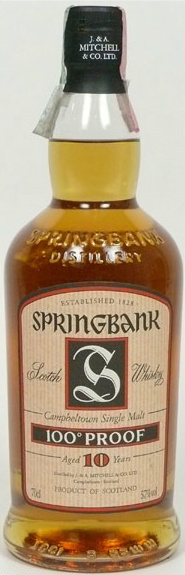 The people behind Springbank do their utmost best to let Campbeltown survive as a region. Glen Scotia is intermittently operated by the crew of Springbank, and of course Springbank themselves are responsible for Longrow, Hazelburn and Kilkerran (Glengyle Distillery). All names from a distant Campbeltown past. Founded in 1828 by the Reid family, who were married into the Mitchells. In 1837 the Mitchell’s bought the distillery. In 1897 J. & A. Mitchell Company Ltd. is founded, the company that is still on the label today. Since 1969 J. & A. Mitchell is also owner of Cadenhead’s. Between 1979 and 1987, Springbank was closed. And since 1989, production is again as it should be. Almost nobody malts themselves these days, but Springbank take the remarkable step to reopen the maltings in 1992. Springbank is a cult malt has a great following, and is by far the most popular malt on Wall Street.
 Yes it’s “Snickers” in a bottle. Slightly unbalanced by the soury woody, and peaty, finish. The finish also leaves a minty sensation on the tongue. Sweet mint as in “After Eight”.
 It’s Islay time! oops, maybe that was from Ardbeg. Well Bowmore is also from Islay and both are in the same time-zone. I see it’s the first Bowmore here, so I choose a potentially good one. Obviously not from a single cask, since no Bourbon Cask (Barrel or Hogshead) can yield 708 bottles.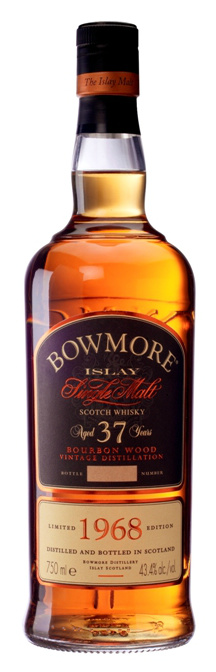
 Clynelish is a very popular dram. There are several reasons why. First of all it’s a sister of Brora, which maybe the best malt of all. Second. Clynelish has a unique waxy personality and it’s spirit is always of high quality. It’s very hard to find one that is not up to par.
 Taste: Spicy and definitively from a sherry cask. Wood, beer and spice again. Sweet and tarry. Shortbread and gingerlike. Turkish delight and has some traits of a Riesling wine. Full bodied. Slight sour wood and licorice on the finish.
 Glengoyne then. Glengoyne got my interest because they were one of the first to specifically state, ‘unpeated malt’ on their labels. Also, I like the looks of the bottle ánd for still using Golden Promise amongst other barley’s of course. Golden Promise is somewhat of the holy grail of grains, because it is supposed to be very flavoursome. But the yield is not so good, compared to the favorites of today (which make all whiskies taste the same, to come out bluntly). So lets see if this one, and remember this is a fairly priced bottle, makes a golden promise.
 Taste: Toasted wood, but still a lot of yeast. Can’t shake the Sherry here. High proof, so it makes an impression. Although this has bold flavours, the quality of the spirit shines through. Very Ahorn syrupy sweet, and corn sweetness, that’s totally different from the Ahorn. It almost tastes like a wheater! This could be a Weller, with some sherry musty and creamy yeastyness. It’s a picture with thick broad strokes. It is thick.
 Convalmore is one of those distilleries that is no more. Thinking of closed distilleries I alway think about Monty Pythons dead parrot sketch: It’s not pinin’! It’s passed on! This distillery is no more! It has ceased to be! It’s expired and gone to meet ‘its maker! It’s a stiff! Bereft of life, it rests in peace! If you hadn’t nailed it to the perch it’d be pushing up the daisies! ‘Its chemical processes are now ‘istory! It’s off the twig! It’s kicked the bucket, it’s shuffled off its mortal coil, run down the curtain and joined the bleedin’ choir invisibile!!
  Convalmore was founded in 1893. A large part of the distillery was destroyed in a fire in 1909. It was rebuilt with an added continuous still to make whisky at a lower cost. This didn’t work so the stills were discontinued in 1916. In 1962 the stills were heated indirectly with steam. Convalmore was mothballed in 1985 and the buildings were sold to William Grant & Sons in 1990, who use them for storing their own malts.
 The beer returns, with the wood, in the finish. Well its safe to say that this one is all about the wood. you don’t hear me say that it’s too much of overpowering. No. it is a woody whisky, but it is one of those that really should be woody. Wood is its strength. The rest of the body is firm enough to counterpart the wood. Again very interesting, but no easy dram. I hate the word, but this may be for connoisseurs only.
 Instead of expanding into unchartered territory, let’s do something oppositional and do yet another Port Ellen, and another bottle by Douglas Laing. This time from the old series in the normal scotch whisky bottle and not from the new tall bottle. People tend to think this older look contains better whisky. Let’s see if that’s true. By the way ,I read somewhere that in the few months Port Ellen operated during 1983, there weren’t a lot of good casks around, and they filled almost anything they could get their hands on. This Port Ellen looks quite light in color. Is this from a tired butt or a normal refill Fino butt?
 Taste: Peat and rhubarb. Sweet, big, leafy and chewy. Black tea with clean refined sugar. No rubber here and it’s no monster either. The peat is very mild here and the finish is quite simple. Still it seems to be very balanced, just not very complex. It has the dryness and a bit of the spiciness of the oak, but not the bitterness, and that’s a big plus (not a Chevrolet). It has citrus with cardboard in the finish. If tasted blind, I would have thought it to be some odd ten years younger.
 It’s an end of an era, even if it was a tired cask, this is still very typical and good. Really a shame this got closed. In a way it resembles Talisker in it always being decent. This may be no high flyer, but is has a lot of fine moments to give. No I’m not sentimental, this is good in itself. A very nice Islay Whisky. As I’m sipping the last few drops: “Here’s looking at you kid…”
 This Port Ellen is from Dutch retailers
 Don’t smoke or eat. Just you with this Port Ellen. It has balance and complexity, but seems so fragile.
 Master Quill