This is the world’s first certified organic Single Malt Scotch Whisky since 2006. Fully UK Soil Association accredited. Words coming from the label of this Benromach. Benromach received certification in October of 2000, and starting distilling right away. They released the first fully certified Organic Whisky in 2006. However, it was Deanston who were certified first, in April of 2000, and started distilling right after summer. However, Deanston’s first release (batch 1) wasn’t bottled until early 2016 as a 15yo. Bottled in February, released in March. Batch 2 was released a year later in 2017. Both matured in Bourbon Casks. 2017 also saw the release of a 14yo Deanston Organic that has been matured in Virgin oak, just like our Benromach, so back to Benromach for now, but I’m sure we’ll see a Deanston Organic grace these pages as well somewhere in the future.
Since such Whiskies, like the “Contrasts”, are released in (big) batches, there are some slight differences in the codes used on the bottles. Codes are often useful for identifying different batches with different characteristics. Looking at you Springbank Distillery. For this particular release I have seen two rotations (but there are probably more): 210191 06.04.2021 (Tuesday) Imported by Schlumberger of Germany and 210104 09.04.2021 (Friday) Imported by Van Wees of The Netherlands. The latter bottle is the one I have here, bottled in the same work week as the “German” bottling, so it is highly unlikely that it contains different Whisky from the Dutch one, but you never know.
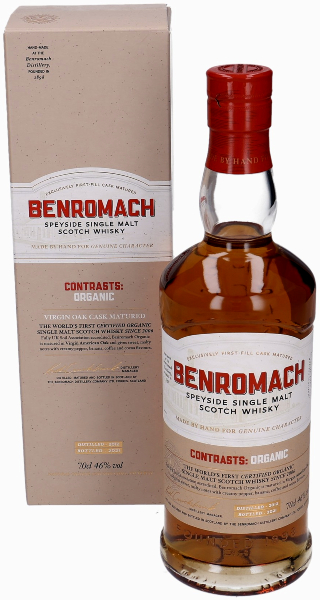 Color: Full Gold.
Nose: Sweet, big and grassy. Barley sugar and creamy vanilla. Caramel. The green vegetal note, which I like very much, turns from hay and grass into wood. Smells clean and very nice. It reminds me of how I perceived the smell of Whisky when I was introduced to it a long time ago. This might be a simple Whisky in many books: it is probably only 8 years old, maybe 9 years, it is virgin oak and it is reduced to 46% ABV. But even though virgin oak has been adopted very late in Scotland, a Whisky like this does show some of the essence of what Whisky is all about. Whisky has always been something based on barley, yeast, water and wood. Although the wood was never really virgin oak, no mostly ex-Bourbon barrels and hogsheads and ex-Sherry butts, puncheons and hogsheads. That’s it. Sure this “Contrasts” is named after organic Barley, and it surely does play its part, but Virgin Oak is dominant. It is new wood, that has been charred/toasted, giving off these creamy and grassy notes. Vanillin form the oak mostly, yet also slightly burnt notes like charcoal and cold toast. In this bottling, the wood shows us some wonderful, almost perfumy notes behind this big creamy wall, a wall which luckily has many big holes in it so we can see (smell) beyond. The grass and vegetal traits have great staying power, and sometimes a more perfumy note whiffs by, and sometimes also a more distant greasy and gravy-like note, making it temporarily a bit cheeky and dirty (petrol?). A playful, dare I say, fruity acidity and an overall very rewarding nose. Nothing wrong here, the nose really turned out well.
Taste: Quite a lot of wood and White Wine-like vanilla notes, Definitely virgin oak, which differs considerably from first fill and refill Bourbon casks. Caramel and toffee and lots of different woody notes. Clean fresh oak, sawdust and hits of a burned beam. More of the leather and wood of a classic interior than of something youthful, colorful and fruity. Slightly heavy built. Interesting, but I guess maybe not for everyone. I do hope Benromach continues with the Contrasts: Organic, but will also release versions maturing in refill casks (only) and first fill barrels/hogsheads (only). So to educate ourselves what the influence of the wood was and to better understand the Organic Barley. Also to know of the barley variety would be a bonus to us, maybe in small print as not to distract from the Organic bit which gave this bottling its name. Second sip shows us more of the char the wood received, releasing this bourbon-like vanilla yet also some more woody bitterness. Pencil shavings come to mind now, but also a slight shortcoming in the balance department. Looks like you should bottle Virgin oak early, as I said, it is overpowering and puts more of a stamp on the Whisky than the barley variety ever could. I wonder how the Deanston 14yo (also virgin oak, would fare in the bitterness department, since it was aged almost twice as long). I do understand the restraint about using virgin oak in the past. It does overpower and the Whisky also does show a lack of complexity, yet it is still fun. If you also like your Bourbons than chances are you might like a virgin oak Scotch as well, not saying its similar to Bourbon, because it isn’t, if only based on the ingredients used.
Looks like the contrast series could be a very interesting series, also an educational one. The last review I did of a “Contrasts”, focused on a barley variety called Cara Gold. This time around no mention of any barley variety, but organic it sure is.
Are you experienced? In a way that you can approach any Whisky with an open mind, I assure you, you won’t be disappointed with this one. You won’t believe how many people discard a Whisky beforehand because of the price or bases on assumptions. These Benromachs are fun and also quite inexpensive. When this bottle will be empty I will be very happy to replace it with another contrasts. Sure, this Whisky was recorded in Mono. It is clean and virgin oak. End of story.
Points: 83

