 Lots of times I witnessed situations where an ‘old’ bottle from Gordon & MacPhail was opened and we all started guessing how old the whisky was, since only a distillation year was printed i.e. “1970”. I fondly remember the discussions when a particular bottle was bottled because the bottle had a ‘nipple’. Another situation could be when a particular bottle was distilled and/or bottled, because only the age of the whisky was printed i.e. “30yo”. Very annoying when you taste a Strathisla 25yo by Gordon & MacPhail that was made for several decades with the same label and different batches are very different. Lots of those ‘old’ bottles don’t have such information, or do they?
Luckily for us there are some hints to be found. I’ll tell you about two of them.
- Laser Code
- Code on the bottom of the bottle
Laser Code
 In the case of Gordon & MacPhail, since 1988 a laser Code can be found somewhere on the bottle. Usually printed on the back of the front label, or on the back of the bottle, near the bottom, for newer releases. As can be seen on the picture to the left. Here an enlarged view through the back of the bottle, through the whisky. The code is IB/ABD.
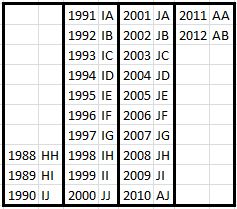
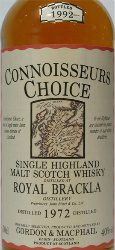 Of interest are the first two letters. IB in this case. The code used is like this: A=1, B=2, C=3, D=4, E=5, F=6, G=7, H=8, I=9 and J=0. IB therefore is 92. The bottle is very probably from 1992! The second series of letters are probably a batch code. On the right is a picture of the same bottle from the front, and indeed it is bottled in 1992.
So continuing on from this code, here above is a complete list of codes that are used up untill now.
Like with any system there are of course a few exceptions.
- There are cases known where the laser code states a particular year, but the bottling actually happened the following year (january or february). An example of this is a Longmorn 14yo that according to the label was distilled on the 30th of may 1975 and bottled on the 14th of february 1990. Code IJ would be expected, but the code on the bottle turned out to be HI/DCB, which is the code for 1989.
 Sometimes the first part of the code comprises of three letters instead of two. This is very rare and when this happens two of the three letters match the table given here.
- It seems 1991 was a year where Gordon & MacPhail were a bit inconsistent with the codes used. I’ve come across examples where the labels clearly state a year of bottling, but the laser code used on the back of the label is wrong. I’ll give three examples from the Connoisseurs Choice range:
- Convalmore 1969/1991 with the following code: HB/AJB. HB would have been 1982, but that was a year no laser codes were used. The correct code would have been IA.
- Coleburn 1972/1991 with code HG/ACD. HG would have been 1987, but that was also a year that laser codes were not used.
 In this case too there is a neck label with 1991.
- Tomatin 1964/1991 with code HI/AAF. HI is 1989, but here there is also a neck label with 1991.
Bottle Code
On the bottom of the bottle, in the glass are a lot of codes. I’ll take two of my older G&M bottles as an example.
- Strathisla 25yo: Liquor Bottle Scotland, 750ml, 79 08*, 66 mm, SC 999.
- Strathisla 15yo: 750ml, 66mm, 49, SD 133, also some signs I can’t reproduce here.
* 79 08 doesn’t seem to mean that the bottle was produced in (August) 1979. I’ve come across SC 999 bottles that had 90 08 or even 99 08 on the bottom.
The important stuffs are the ‘model numbers’ for the bottle. Here they are SC 999 and SD 133.
Doing some research in the invaluable archives of Whiskyauction, I comprised a list of codes and the years the bottle was used for bottling. All years stated here are confirmed by a year stated on the label of the bottle:
- SC 96 (75cl): 1972, 1973, 1974 & 1975.
- SC 803 (75cl): 1975, 1976 & 1977.
- SC 99 (75cl): 1977.
- SC 999 (75cl): 1978, 1979, 1980, 1981, 1982, 1983, 1984, 1985, 1986, 1987 & 1988.
- SC 247 (75cl): 1983, 1984 & 1985.
- 4699 (75cl): 1982, 1984, 1986, 1987, 1989, 1990, 1991.
- SD 522 (75cl): 1989.
- 6436 (75cl): 1989.
- SD 133 (75cl): 1990 & 1991.
- SD 686 (70cl): 1991, 1992, 1993, 1994, 1995 & 1996.
This information is far from complete and hopefully correct. Up to this point no contact was made with Gordon & MacPhail. There is probably a lot more information to be found, so if new things do pop up, I’ll add them to this article.
 Ahhh, yes, Gordon & MacPhail never cease to amaze me! Next up is this Glencraig 1970/1996 (40%, G&M, Connoisseurs Choice, Map Label, IF/CCC), but now it turns out that the exact same bottle with the exact same code (IF/CCC) was also released with the Old Map label too. Why? Can we conclude from this that 1996 was the year the labels got changed?
 Color: Full Gold
 Color: Full Gold
 Like with many Gordon & MacPhail bottlings, it is reduced, this time to 45% ABV. I am a fan of cask strength Whiskies, but I learned to appreciate these reduced Whiskies more. Is it age? I’m a bit held back only by the fact that not every Whisky likes to be reduced. Let’s hope it’s not the case with this one.
 On Monday, July 23 2012 it was announced that Bruichladdich of Islay was sold to Remy Cointreau for £58.000.000 to enrich their high-end portfolio of brands and to
  confirm their strategy in the luxury spirits segment. If I’m not mistaken it’s their first distillery, and maybe there is more to follow? We’ll see what happens next. In stead of picking one of their numerous official bottlings by the old owners, first a Sherried example from independent bottlers Gordon & MacPhail.
 Taste: Ok, half sweet. Tarry and thick. Toffee with some ash. Nice body and good balance. The nose and taste seem to match. It has the sourness of oak. There is some peat in the depth, but as with the nose, it has more smoke. Wycam’s cough drops! Very nice not over the top Sherry, but also not all to complex.
 Time for another Lowlander. Rosebank this time. I reviewed a
  hoping for a resurrection. Who knows. For the time being, lets see if this Rosebank is any better than the Glenkinchie reviewed earlier.
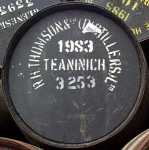 Teaninich isn’t amongst those superstars of Single Malt Whiskies around, but it has a fanatical following with certain enthusiasts. Well I’m one of them. Almost every time I taste a Teaninich, blind or not, this always tickles my fancy. I connect with it. It suits my palate. Dare we say: “For reasons not even science can wholly explain…”
  Teaninich was founded in 1817. In 1970, yes a small jump in time, a whole new six still ‘distillery’ was built alongside the current one, consisting of four stills. The new one was called the A-side (The old stuff was therefore called the B-Side). They worked together as one distillery. In 1984 the old distillery was mothballed, and 15 years later, demolished.
 I
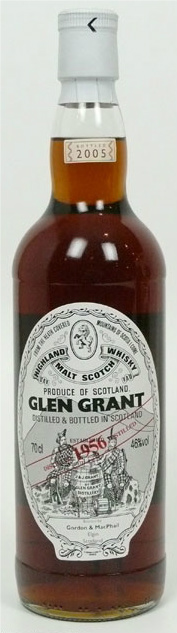
I  just had to write another one about Glen Grant. Do I really have to revert to Gordon & MacPhail to find me a good Glen Grant? There are a lot of great Glen Grants around, but are they bottles of the past maybe? Here I have another Glen Grant that as it turns out ís from Gordon & MacPhail. Will it be good or do Gordon & MacPhail also have some mediocre casks? This one is bottled for La Maison du Whisky who usually pick good casks, so no need to worry, this probably will turn out all right. Besides, this is no 70’s Glen Grant, but a 1956. The year Alfred Hitchcock became American and made
  Glen Grant if you want a good one. Well as I said there are a lot of other good Glen Grants around. We’ll have to keep searchin’ to find us one, but for the time being we’ll have this Gordon & MacPhail 1956, and that’s no punishment! The nose is to die for, that alone is worth almost a 100 points. But the whole I will score…
 And here’s already the second Strathisla by Gordon & MacPhail. This one has bottlecode SC999 and Gordon & MacPhail used these bottles roughly between 1981 and 1987. But if I would have a guess, this seems to be closer to 1981 than 1987. And thus this would be a late fifties distillate! (And the previous 15yo Strathisla, one from the mid seventies). That’s quite a difference and will probably be evident in the taste and smell. Also note that this 25yo is notably darker. Like the 15yo, this bottle was also bought for a
  Just have a go at this standard G&M, 25yo Strathisla, and find yourself a sweater made from those fabulous looking Strathisla sheep!
 I’m a big fan of old Strathisla’s. When I taste some from the 60’s or 70’s, I’m in heaven. With some old sherry cask bottles around, you can’t go wrong with Strathisla (and Longmorn, and Macallan, and…). Even 60’s bourbon casks are fantastic. So for this one, I certainly had high hopes and I paid some good money to get one. When I bought it at an auction, I thought it would be older than it turned out to be. Just look at that label with its 70° Proof and 26⅔ FL. OZS. The glass code on the bottom of the bottle (SD133) makes it from circa 1990.
 Color: Full Gold (Caramel?).
 Master Quill