Angostura 12yo “1824” (40%, Circa 2014, Trinidad & Tobago)

Are you mad? Reviewing the same Rum again? Nothing better to do? Well, at first I didn’t want to write two reviews about one Rum. I actually wanted to write one review about two Rums, expecting both to be the same, with just an upgrade in the presentation. When I was on my way writing the previous review, I grabbed this more recent bottling of the “1824” and was quite surprised about the difference when smelling it. I poured it back, without even tasting it, and right on the spot decided to break up the review and write two of them. So here is number two. By now we already know there is a difference in smell, but does it also taste differently? Let’s find out…

Angostura 1824 (2014)Color: Copper brown, ever so slightly lighter than the 2008 version.

Nose: Dry and woody with only a distant funkiness. Well balanced yet very laid back in the nose. Nice red fruity acidity kicks in. Dry vanilla powder and sugared almonds. Sugary in its sweetness as opposed to honey, caramel and toffee. There is vanilla. Smelling very smooth, almost elegant and sometimes perfumy. Sweet black tea with a tropical twist. Dried pineapple? It smells nice, smells like a decent brown Rum, but lacking something. It doesn’t smell like something special, but it does smell rounded out and appetizing. Also performs a bit poor in development. Altogether very middle of the road. Yes, smelling like an Abuelo, but that comes from a different place entirely.

Taste: Starts with red fruity acidity, sugary sweetness with some toffee. Warm diluted, but thin, caramel. Sugary with an herbal quality (cannabis), maybe that’s the influence of the wood. I imagine splinters taste like this. Quite simple with a short finish. Luckily this doesn’t remind me of the “1919” but this new “1824” isn’t one to be overly enthusiastic about as well. Bugger. At least Angostura was able to show its potential with the old “1824”. By the way, this Rum tastes better in big gulps. You need to concentrate it yourself to get the most out of it.

Well, there goes batch consistency. Quite worrying, the difference between a 2008 and a 2014 bottling can be so great, especially when the newest one isn’t the netter of the two. New and improved? nope, alas. Obviously they didn’t change the taste profile of this Rum with the new glass container it comes in, but if I were you, I would still seek out bottles looking like the one from the previous review. That one had a lot more going for it. This newer bottling is not a bad Rum, but the older one is a bit better better!

Tasting the old and the new “1824” side by side I now notice that the old “1824” is more akin to the old “1919” I tasted earlier. Having said that, the old “1824” is still a lot better than the new “1824” and both are better than the old “1919”. Capiche?

Points: 80

Angostura 12yo “1824” (40%, Circa 2008, Trinidad & Tobago)

A long time ago I reviewed the 8yo Angostura “1919” and to be honest, great quality, but it’s taste is not for me. Since then a long time has passed, tried the “1919” on many occasions and it still didn’t manage to grow on me. Well, sometimes that happens. Something like the saying about the organic matter and the personal-cooling-propellor-device…

As I said a long time has passed without the urge to try more Angostura and why should I, since the now defunct Caroni Rum also comes from Trinidad? I somehow liked all Caroni’s I tried better than Angostura “1919”. Finally time has come to try the older brother of the “1919”. A distinguished gentleman from the drinks business personally recommended me this 12yo “1824”, so I just had to buy it. Here goes…

Angostura 1824 (2008)Color: Copper brown

Nose: Initially sweet, but soon more funky, and dries out over time. Nutty start with nice wet outdoorsy clay. Like running with Wellington’s through the fields in autumn. A wonderful depth I didn’t expect, why? Just read the review of Angostura’s 1919 which turns out to be something completely different from this. Soft elegant notes of wood and even some red fruit scents. Red berries. After the Rum got time to breathe more and more vanilla surfaces, and for a moment I got scared this is developing into the vanilla I remember so well from the 1919. No, in this one it stays in check, it is under control, so to speak. A slightly burnt note appears as well, giving the whole some more oomph. The burnt note combines well with the dry woody notes that lies underneath.

Taste: A thin kind of sweetness to start with, with some burnt caramel and toffee combined with hints of red berries. Nice sugared fruity sweetness. At 40% ABV, it tastes a bit thin, but the aroma’s are lovely. Not overly complex, but it works well as a whole. Nice sweetish and warming. You can sense there is more to this Rum than meets the palate, but it probably is reduced too much, weakening that mystery. I’ve said it before, and I won’t say it again. (Hint: it’s about reducing too much), there, I’ve said it anyway! The funkyness from the nose is present again in the finish and aftertaste, where a sweet and slightly burnt not have the longest breath.

I scoffed a bit at the Angostura 1919. I can recognize the quality of that Rum, but after drinking the whole bottle over a prolonged period of time, I never got around to like it. In the world of Rum it is my main example of a decent Rum I really don’t like. It may work very well for you, but it is most definitely not my cup of tea. This 1824 however very much is my cup of tea. With nice Rum funkyness we know from Jamaican high ester Rum, and Borgoe 15yo to name but a few. Nice.

Points: 85

Dos Maderas PX 5+5 (40%, Spain)

Well after the fairly unusual rant of the last post lets leave the Whisky (business) behind and focus on some Rum. My other favorite distillate. A wonderful complement to the Whisky world. Oh yeah! This time around we” have a look at a Spanish Rum, although the Rums themselves come from Barbados and Guyana, places we know make excellent Rum, so if you can’t make top-notch Rum yourself, buy the best you can.

Dos Maderas is the Rum brand of Spanish Sherry producers Williams & Humbert. Williams & Humbert have a long history already, which, if you’re interested can be found all over the ol’ interweb. Remember, Google is your friend. Alexander Williams and Arthur Humbert started their wine-business in 1877. By 1972 the company was sold, and since then two times more. Current owners are the Medina’s who worked at the bodega and wanted it for themselves.

As I mentioned above, Williams and Humbert buy their Rums from Barbados and Guyana. Both Rums are approximately 5 years old. In Spain they are aged further for three years in cask that previously held a Palo Cortado Sherry. Part of this is bottled as the 5+3 expression. Another part is then further aged for another two years in casks that previously held PX Sherry, thus giving us the PX a.k.a. the 5+5. By the way both Sherries mentioned above, aged for twenty years in these casks, so these casks should impar a lot of aroma. Let’s see…

Dos Madeiras PX 5+5Color: Dark copper brown.

Nose: Smells extremely sweet. But also the liquid makes you believe that, since it is very syrupy. Hints of burnt sugar and definitely some Pédro Ximenez. Besides the depth this Sherry gives, it also impairs a fruity acidic note. Hints of paper and cardboard in the back and even some raisins. Not a lot of development and overall quite simple. Its like the sugar content this must have stopped its evolution and hides any possible form of complexity. Given the fact this contains 5 year old Rum from Barbados ánd Guyana, both highly aromatic Rums, the PX finish is a bit overpowering. That’s not bad, but its more about the PX, than it is about Rum. Altogether nice, but in a flavoured kind of way.

Taste: It starts with Rum, where the nose was more PX. Burnt sugar and Demerara qualities. Heaps of sweetness. It’s a light Demerara style which leaves room for the Bajan Rum as well. However, the PX takes the driver’s seat rather quickly and puts both Rum’s in the back to come along for the ride. Toffee, sugar and caramel, partly burned. Luckily there are some hints of vanilla and green olive (towards the finish). Hardly any wood. Finish is PX again. Aftertaste is PX as well.

I havent tried the 5+3 expression yet, and thus I don’t know if that one has some finesse to it. In this 5+5, the PX overpowers everything. I do like my PX’s, so I kind of like this, but it doesn’t have a lot to do with Rum. Maybe a shorter finish in the PX casks would have been better, and then they should be brave enough to call this 5+4 or even 5+3 1/2. But who am I to say so. Still good stuff though.

Points: 80

A.H.Riise X.O. Reserve Christmas Rum (40%, 875 bottles, 2013, Saint Thomas, U.S. Virgin Islands)

Albert Heinrich Riise was born on the 11th of September 1810 on the Danish Island Ærø. In 1932 he graduated as a pharmacist in Copenhagen. In 1838 he followed his dream to work as a pharmacist in the Danish West Indies in St. Thomas. In 1842 he married Henriette Marie Worm (1821-1889) on St. Croix. The couple had 13 children. I guessed he felt at home in the Carribean! In 1843 he had his own pharmacy which he turned into a succesful business. Being an excellent pharmacist Riise used Caribbean plants and herbs for the manufacture of pharmaceutical alcohols and cosmetics. He especially was succesful in selling Riises Bay Rum, yes you guessed it, a perfume! He also started distilling Rum and bitters as medicine. Way to go Albert. In 1868 an epidemic broke out of cholera, yellow fever and smallpox. No Rum would cure that, so the family decided to go to Denmark for a year, but in the end never returned to live on St. Thomas. Albert passed away in 1882 and his wife Henriette followed him in 1889.

A.H. Riise X.O. Reserve Christmas Rum has aged up to 20 years, and was finished in PX Sherry casks. Each bottle comes from a single cask.

A.H.Riise X.O. Reserve Christmas Rum (40%, Saint Thomas, U.S. Virgin Islands)Color: Brown with an amber hue.

Nose: Nice Demerara type of Rum nose with notes of cloves in (partly dried) orange skin and cinnamon. Old wood, speculoos cookies and very festive smelling. Its like visiting and old distillery museum where a lot is done with spirits and spices or a bakery museum where all the spices are stored for making cookies. Vanilla, hot butter and fruity acidity. Very aromatic. Also hints of ginger, cardamom, dust and nutmeg. Very nostalgic, appetizing and tasty. Based on the nose alone a must-have so lets see if it also tastes as good…

Taste: Thick and sweet. Syrupy. Sugared red fruits. White pepper and some wood. Fresh cookie dough. The orange skins are present too, but without the cloves. Noticeable is the finish in PX casks. Not the longest of finishes, but warming and just right. The part that stays on the longest is the fruity acidity, but wait…the cloves return for the finish, excellent!

The nose alone puts me in a melancholic mood and puts me in a bakery or Jenever distillery where spices and botanicals are used for the spirit. It makes me feel like it’s the 1930’s again (or so I imagine, since I wasn’t born yet in the 1930’s). The nose is very nice and suits the Christmas name they use for this Limited Edition. The taste is somewhat simpler and the finish shows that 40% ABV was  a little too light for this kind of rum. On the website the claim is made, or maybe that’s just how I read it, that the typical aroma’s come from the PX casks that were used for the finish and not by added spices, so it should not be a spiced Rum. In the end that’s not entirely important, since it is a very nice Christmas Rum, and even if it was spiced, isn’t Christmas a time to forgive? Wink, wink, nudge, nudge. Merry Christmas everybody!

Points: 87

Havana Club “Selección De Maestros” (45%, Cuba)

Havana Club is the story of José Arechabala y Aldama (Don José). In 1862 the 15yo José moved from Spain to Cuba, and in 1878 he founded the La Vizcaya Rum company in Cárdenas. He changed the name of the company to his own in 1921 and left his son-in-law José Arechabala y Sainz to run the company. In 1923 José passed away and the second José was killed just a year later by kidnappers. Gabriel Malet y Rodriguez took over, but he died already in 1926 to be succeded by Don José’s nephew José Fermín Iturrioz y Llaguno (Josechu). Under Josechu, the Havana Club brand came to be in 1934. Like so many businesses the company was nationalized on the first of january 1960, and the family moved back to Spain and the US. After nationalization, the government changed the name of the distillery into Havana Club. The Cuban government started selling Havana Club Rum in 1972 in Eastern Europe. In 1977 a new factory went into production in Santa Cruz del Norte and a second factory was opened in 2007 in San José. In 1993 the Cuban government signed a deal with Pernod Ricard, where the latter would take upon itself to “sell” Havana Club to the consumer all over the world except for the US, because Bacardi already sells a brand of Rum called Havana Club (made in Puerto Rico) in the US since 1994, after buying the name and recipe from the Arechabala family. Pernod Ricard and Bacardi, both Giants in the drinks business, are fighting over the brand and its use in the US in court ever since…

Havana Club Selección De Maestros (45%, OB, Cuba)Color: Full gold, toffee.

Nose: Just like the Cubay 10yo, this is full on aroma. Again a Rum that jumps at you from the glass, so don’t pour yourself too much at once. Somewhat less creamy and soft, but sharper and seems to have a more pronounced wood nose. A treat to nose, well-balanced but again not the most complex stuff in the world. It’s probably just the Cuban style I guess. Hints of mocha, milk chocolate and hazelnuts. Wood becomes more and more dominant. Pencil shavings and fresh succulent oak, but also a sharp dry oaky smell which transgressed into a more paper and dry leafy note. So lots of oak in the nose. Raw in a good way.

Taste: Yup oak again, but only for a short while. The sweet constituents are quick to take over. Sugar water, and creamy toffee. Quite warming and good length. This has some serious staying power for a Cuban Rum, which is supposed to be light. Quite creamy and some caramel, in a way I like my Havana Cigars. Compared tot the Cubay 10yo, this has 5% more ABV and it shows. Good length and good delivery. Fruity black tea. Overall this isn’t a very complex Rum, but it does have something of a bite and again is very drinkable and loveable. Wood. The pencil shavings from the nose stays behind for the aftertaste.

Definitely in the same style as the Cubay 10yo, but for me it even has more simplicity, which in this case is not necessarily a bad thing. Remember the Cubay has something I liked and couldn’t put my finger on? Well I still haven’t found out what it is, but this Havana Club I like as well. Overall quite nice and drinkable. I love the slightly higher ABV. On the other hand, it’s also a bit raw, good raw, and lacks a bit of complexity and development, which in this case I don’t mind. A bit young, and definitely a lot of fresh oak, but for me this one surpasses the Cubay 10yo in balance. Nice and tasty stuff but maybe a wee bit too expensive.

Points: 83

Cubay 10yo “Reserva Especial” (40%, Cuba)

Ron Cubay was founded in 1964 in Santo Domingo, which is some 25o km’s to the east of Havana. The Cubay rum is produced in the Cuba Ron distillery, which also produces… yes you’ve guessed it: Havana Club. Cigar lovers will already recognize the marketing plan similar to that of Cohiba, and later, the Trinidad brand. The Ron Cubay brand was intended for domestic consumption only. But soon after taking a course in marketing and dare I say it: capitalism (I’m just kidding), it became apparent it was time to export the next Cuban brand, so the Ron Cubay was first exported only five years ago, in 2010. I just don’t know if the Cubay brand was shrouded in the same kind of mystery as Cohiba and especially Trinidad (as Fidel’s private brand).

The full range of Ron Cubay consists of five variants of which only three are exported. The 3yo “Carta Blanca” (a White Rum), the 7yo “Anejo” and the 10yo “Reserva Especial”. They found the 4yo “Carta Dorada” and the 5yo Anejo Suave” a bit obsolete and settled for the 3yo, the 7yo and 10yo. Ron Cubay is produced with Cuban molasses from sugar cane. In Cuba it is illegal to use imported molasses for making Cuban Rum. Cubay is distilled with a column still. The 10yo I’m about to taste is fully matured in American white oak casks of different sizes and levels of char.

Cubay 10yo Reserva EspecialColor: Orange gold, toffee.

Nose: Aromatic and sweet, creamy and buttery. This flies out of my glass. Citrussy and fresh. Hints of oranges and fermented apple-juice. Light black tea with a splash of lemon. Vanilla latex paint. All of this is mixed with quite some wood, but in no way is the wood overpowering. Its soft and soothing, sometimes meaty and only gives a spicy backbone. Mixed in with the wood, some aged Calvados and honeyed sugar-water. So the apply part is growing. Altogether fruity and if you want it, there is some florality as well. Great balance. A lovely nose.

Taste: Fruity and very appetizing. Toffee and hard coffee candy. Some wood upfront, but even less than in the nose. Quite warming, and when the first sip goes down a more dry woody residue stays behind in my mouth. Woody and licorice. Again not overpowering. The start of the body is the best part for me, quite some vanilla combined with a tasty fruitiness. The development into the finish is eventful. Something is happening. The finish has medium length, with a hint of walnut bitterness, and has a tendency to fall apart a bit into the wood spice and an acidic fruity part. This is much less pronounced than in the Abuelo 12yo, where the acidic fruity part bothered me a bit. Sugar water again, and after a while it’s gone. The aftertaste shows this has been in wood for 10 years. I would say the bitterness is slightly hoppy now. More pronounced and velvety and less fatty than the initial walnut bitterness.

Nice stuff and dangerously drinkable. Especially in the taste not overly complex, but just tasty. Although this has quite some aromatics it has the strength of the scent of a flower, so I’m not sure if you should use this as a mixer. I know for sure it will do well as a nipper. I can’t put my finger on it yet, but I really like it. Recommended.

Points: 82

Borgoe 15yo “Single Barrel” (40%, Suriname)

After the pride of the SAB company why not move on and have a look at their Grande Dame. Where the 8yo was released in 2006 to commemorate the 40th anniversary of SAB, this 15yo “Single Barrel” was released in 2011 to commemorate the 45th anniversary. Maybe next november we’ll see the next anniversary bottling, a 20yo maybe? The 8yo and the 15yo thus are specials, but there is also a more standard range Borgoe. The first one of those is called the Borgoe ’82 “The Jubilee Blend”, the second is called the Borgoe “Extra”  and the third and last one is the Borgoe 5yo “Vintage”. By the way, all White Rums made by SAB have different brand names, so Borgoe only exists as a Golden (or Dark) Rum, whichever word you prefer. Borgoe uses both simultaneously.

Borgoe 15yoColor: Orange gold.

Nose: Very funky smelling. Still caramel and toffee, but there is a lot more going on. Very nutty. Organic clay. After the fatty and creamy introduction, Wood and deep sugared fruits. Honey with dark brown banana skin. This is completely different from the 8yo, not just an older version of it. I’m not completely sure everything is as it should be , but whatever it is, I love it. Fresh cigar box wood. Pencil shavings and dust. Just like the 8yo, the aroma’s it started with take a back-seat and it turns more dry. Smells like a worthy super premium Rum to me.

Taste: It starts out with the simple sugary sweetness, like the 8yo, as well as the fresh woody bit. After that, everything changes and it becomes incomparable to the 8yo. Where the 8yo went down in a hurry, this 15yo sticks to your throat and takes a long time to get down, developing along the way. Perfect balance between the nose and the taste. Again the thick creamy and nutty aroma. Tiny hint of burnt wood bitterness, but that only aids the wonderful taste. Excellent length in the wonderful tasting finish and a good aftertaste. Some tiny acidic wood note appears in the aftertaste, but that is hardly a problem, when so much other aroma’s keep lingering on. This one is far from tasting “thin” even when it shares the low ABV of the 8yo: 40%.

One thing strikes me as odd. The website mentions: “Our own master blender created this special Rum along with the best Rum makers of the Caribbean” and on the back label it states: “The golden rum was selected from each single barrel by our master blender and blended to ultimate perfection”. So several Rum professionals created this Rum or only their master blender? How can this be from a single barrel and be blended? Did they blend the Rum, put it back into a barrel, marrying it and then bottling it from a single barrel? Strange…

Twice the age of the 8yo, twice the price of the 8yo but also twice the taste of the 8yo. Definitely worth the money, if you can find it, because it seems quite hard to get lately.

Points: 86

Borgoe 8yo “Grand Reserve” (40%, Suriname)

Borgoe is one of a few (Rum) brands of Suriname Alcoholic Beverages (SAB for short). Other Rum’s made by SAB are Mariënburg and Black Cat. Both are White Rums. SAB is foremost a producer of Rum, but also some Vodka is made. Besides this, SAB also functions as an importer of several foreign “alcoholic beverages”. SAB was founded in 1966, but its predecessor was founded in 1882 as the “Suikeronderneming Mariënburg” and today is one of the most succesful enterprises of the country. To commemorate its 40th year of existence, the 8yo Borgoe was released in 2006. Borgoe 8yo has fully aged in American oak barrels straight from Kentucky.

Borgoe 8yo Grand Reserve (40%, OB, Suriname)Color: Orange gold.

Nose: Nicely sugared, hints of fruit and full on aroma, that leaps out of my glass. Lively and leathery. Sunny and happy, this want to be drunk (pun intended). Heavy fruit syrup and elegant wood. The heavy nose is not always sweet, It has its dry spells. After a while, the wood starts to play a bigger role, but foremost a sort of vanilla powder, locked into the woody backbone is present. Wet warm cotton with a meaty twist to it. Powdered coffee creamer. Sometimes the heavy aroma retreats and it allows some notes of black tea and licorice to escape from the glass. When this happens, the fruit takes a back-seat as well and a more floral note appears, honeysuckle, so not typically flowery-floral. Sawdust, new wood, not particularly an oak aroma though, and a tiny hint of ashes. Even though I used many words up ’till now to describe the nose, I wouldn’t say it’s as complex as it seems. Medium complexity it is then, but, there is evolution in the nose. The sweetness retreats even more, the “wood”, played its part and now a more plant-like aroma emerges. Dried and fresh. It’s a more overall feel, so hard to pin anything down, although lavas seems to be one of them, as well as italian laurel (licorice). Funky.

Taste: Caramel, wood, burnt sugar and toffee, but the sweetness speeds down my throat, and a more watery episode follows. In that watery, and thus, thin episode, the licorice from the nose pops up. Sugar water with toffee aided by a wooded note, nothing more really. The nose presents itself as syrupy and heavy, but the taste and especially the mouthfeel is not. Definitely getting more oaky now, but not fat succulent old oak, but a younger type of oak, young, fresh and slightly acidic. Tree sap. Quite a short finish, also slightly unbalanced. Overall it tastes nice, but quickly gone. The, slightly bitter, Italian laurel licorice really shines in the aftertaste.

Tasty stuff that could have been more like a Pussers or Demerara style of Rum, judging by the nose alone. It isn’t, and maybe it shouldn’t. Where in Demerara the nose, the taste and the body are heavy, here it comes across as too much reduced, where some aroma’s even seem to be stripped, thus missing some complexity. I can’t explain that. The watery part is obvious, but missing something from the body is a first for me. Still, it’s a nice sipper, easy-going and easy drinkable. Although it looks like a premium Rum, it drinks like a daily drinker, a sipper, not a mixer. But for the money I expected a more complex Rum. Nevertheless, good stuff, so no cause for alarm, although I feel SAB can still improve on this Borgoe Grand Reserve, and turn it into a really good Rum.

Points: 80

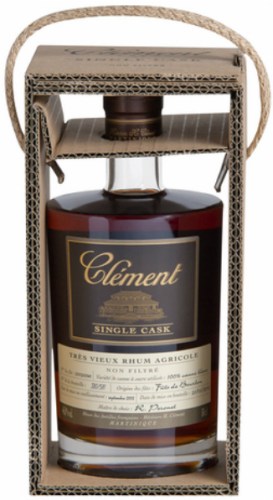
Clément 9yo 2002/2012 Trés Vieux Rhum Agricole (46.8%, Bourbon Cask #20070077, 100% Canne Bleue, 587 bottles, 50 cl, Martinique)

After the excellent offerings from J.M it would be a blasphemy not to recognize Homère Clément, the godfather of Rhum Agricole on Martinique. In 1917 Homère started his distillery on the domaine he acquired in 1887. With the death 0f Homère in 1923, the property with its distillery is taken over by Charles Clément. Charles started making Rhum under the Clément Brand in 1940. The Cléments were already making Rhum for about ten years but under the brand name of the domaine itself: Rhum du Domaine d’Acajou. Charles died in 1973 and the next generation Clément is taking over. It is the generation of George and Jean-Louis-José Clément who saved J.M from bankruptcy but don’t interfere with its Rhum making and management. Investing in the property and distillery, to allow the people behind J.M to make the best Rhum possible.

From Clément’s prestige range comes this single barrel. This “100% Canne Bleue”, non filtré is the first of two single barrel releases. Canne bleue is a cane variety that, apart for its blue color, is known to be the best sugar cane variety for producing Rhum Agricole. Not so long ago a second version in this series saw the light of day, called “Vanille Intense”. Not to be mistaken for a spiced Rhum. No vanilla and/or vanillin was added. Only casks were selected that had the natural potential of releasing slightly more than usual amounts of vanillin from the American oak, as opposed to European oak, which tends to release more tannins.

Clément 9yo 2002/2012 Trés Vieux Rhum Agricole (46.8%, OB, Bourbon Cask #20070077, 100% Canne Bleue, 587 bottles, Martinique)Color: Dark orange brown.

Nose: Fresh and smells of new wood. Also a leafy, plant-like quality. Caramel. Big, hefty aroma, sometimes a whiff of this reminds me of Jamaican high ester Rum, although the whole profile is quite different from that. In the distance even a red fruity aroma. Mostly berries. Burnt sugar with hints of spicy White Wine. Gewürztraminer. Sweet spices. Oregano and to a lesser extent thyme. Toned down vanilla ice-cream.

Taste: A very nice subdued sweetness. It’s like the sweetness has depth in part because its burnt sugar. Milk chocolate, some vanilla and a hint of a paper-like quality, cardboard, cola and lots of cask toast. Just like a great wine, this Rhum Agricole has perfect balance between the sweetness and acidity. The sweet is obvious, the acidity is from the oak. Just like the nose it has this great woody flavour, without it being too sappy or bitter, although the bitterness that is there stays on well into the finish, and even the hoppy aftertaste. The finish is long and has a tiny amount of soapiness to it as well as a bit of red berries and the burnt sugar. The burnt sugar retreats and lets a more creamy and toffeed layer take over for the aftertaste.

It’s really amazing how much color this Rhum Agricole got from only nine years in a Bourbon barrel. It looks like a stunning dark brown Rhum. That must have been very active casks. This is good stuff. Big aroma, big body, long finish. For some a bit too much of the burnt wood and sugar notes, but it comes with the territory. Good ‘un this is. Usually more is more, but I somehow do like the 50 cl size of this. It’s easier that way to get another “100% Canne Bleue” single cask, from a different cask naturally, for comparison. This is a big one. The J.M 2002 shouldn’t be tasted right after this.

Points: 87

J.M 11yo 2002/2014 Vieux Rhum Agricole “Millésime 2002” (46.3%, Bourbon Cask Matured, Martinique)

Reviewing the dirt cheap La Mauny “1749” already opened my eyes to Rhum Agricole from Martinique, but especially after reviewing the J.M XO, I started to really like the stuff. Followed quickly by the La Mauny XO. There is a difference in ABV though, the La Mauny is bottled at 40% ABV, and suffers from it, the J.M XO is bottled at 45% ABV, which seems to be a much better strength. Apart from the difference in ABV, I somehow clicked more with the taste of the J.M. Soon after, I went out and bought this 11yo J.M Millésime 2002. (Two of them actually, since I had high hopes for this one, and I got a pretty good deal on them as well). Aged in Jim Beam Bourbon casks, just like the XO, but almost twice the age. Having already tried the 2002, this time it’s not about comparing it to the XO, because both earn a place in any drinking collection. You know, a collection of bottles destined to be drunk, bottles that will be actually opened to be enjoyed. The XO is younger, has less depth but is also a high quality Rhum Agricole. Having said all that, I have to warn some people. A lot of (sweet) Rum drinkers are a bit put off when starting with Rhum Agricole. Its different. Just like heavily peated Whiskies differ from Bourbons and so on. Proceed with caution, acquire the taste, and if you put some effort into it, you’ll be rewarded with some great Rhums (If you choose wisely).

J.M 11yo Vieux Rhum Agricole Millésime 2002 (46.3%, Bourbon Cask Matured, Martinique)Color: Full gold.

Nose: Fresh, half sweet and industrial. Wax. Red fruit sweetness and acidity. Cherries, dust and toffee. Soft wood and old leather. With some air more fresh leather combined with a little bit of clear glue. Ground roasted coffee that has been around for a while. Pecan nuts with a hint of cola, brown sugar and cane juice. Hints of menthol which leaves a long minty feel in your nose and throat (already after smelling, I haven’t tasted it yet). Hints of good oak aged Calvados.

Taste: Brown sugar and slightly burnt sugar and maybe even some cask toast. Starts with a small amount of sugary sweetness, but it quickly becomes more dry. Warm apple juice and Calvados (de Querville, the older ones). Leather and more notes of apple. Hints of licorice towards the end. Although this wasn’t reduced, the ABV is natural cask strength, this doesn’t have a very long finish. Medium finish which concentrates around the burnt sugar note combined with some bitter wood. Although the Rhum as a whole is very good, the finish lets it down a bit.

Wonderful Rhum with lots of complexity which releases layer upon layer. It great, but even better if you are patient with it, since it develops a lot in the glass. Great balance too. I have to say that the way I perceive the bitterness of the finish, has also a lot to do with me and the moment when I drink it. It’s more a digestif than an aperitif. The bitterness is less obvious in the evening, than it is in the morning, so don’t let this put you off, since the bitterness is in no way overpowering.

Points: 87