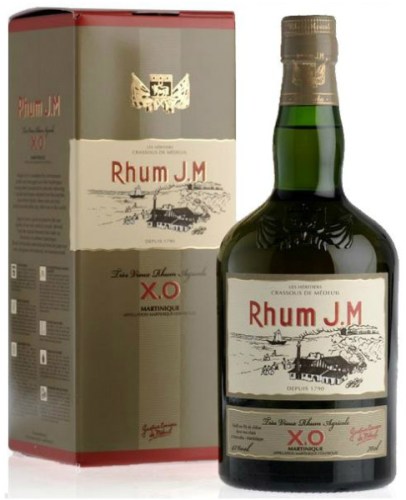
J.M XO Très Vieux Rhum Agricole (45%, Bourbon Cask Matured, Martinique)

Today I was working in the garden. Preparations have to be made for the coming summer. Getting rid of weed, clean the BBQ, plant some new flowers and so on. Evenings are still cold, so now I’m sitting inside and I notice my arms are quite red. Must be a hole in the ozone layer or something, because I can’t remember getting sunburned so quickly. Another place on earth I would get easily sunburned is not Scotland, but Martinique. Yes it’s Rhum Agricole time! Rhum Agricole is the French word for Cane Juice Rum, as opposed to Rum made from molasses. Tonight we’ll be having J.M XO. Looks cryptic doesn’t it? The XO (as for Extra Old, or Très Vieux in french) is a Rhum Agricole, which has been aged for a minimum of 6 years in re-charred Bourbon barrels.
J.M XOColor: Full orange gold.

Nose: Woody, spicy and floral. Right up is un-ripe banana. Very aromatic and dry. Lots of spices. Hints of gingerbread and cookie dough. Old soap (roses) and polished furniture. The nose is wood driven, but it is never overpowered by wood. Also the charred oak is noticeable, but again, not overpowering. Notes of an old wooden shop or a church. Even hints of incense is there.

Taste: More of the same. Wood at first, with a bit of mint, but that dissipates quickly. A short sweetish film, that also passes by quickly, leaving a nice and fruity aftertaste. Hints of tree sap, mocha, coffee with milk and milk chocolate. Tiny hint of an Industrial complex and motor oil (which is nice). Next an even tinier note of passion fruit and even less still: anise. Tasty. This is not a sweet Rum, it is rather dry and well made. The only beef I can have with this Rhum is that even for an XO it is quite light and seems to lack a bit of depth or complexity if you prefer. Dangerously drinkable.

I have to admit, since the day of Douglas Laing’s Old and Rare series (Platinum) I am a sucker for dumpy bottles made with green glass. The rest of the labels and packaging are also very appealing. Having said that, of course that is not as important as the Rhum inside the bottle. I like sugar cane Rum. With its relative dryness, it matches with Single Malt Whisky. Nothing wrong with sweet Rum obviously, but the dry style is a welcoming addition to the drink. This dryer style, can showcase its finesse and elegance some more.

Points: 85
Teeling 13yo 2002/2015 (55.5%, OB, Single Madeira Cask #935, 311 bottles)

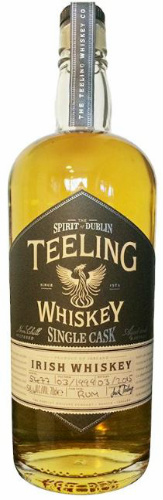
In 2012 Jack Teeling sold his Connemara distillery for €71 million to Beam Inc. and everybody, especially Jack himself, thought that would be his end in the Whiskey business. Back to buildings and properties or so it seemed. But Jack wouldn’t be Jack and Whiskey wouldn’t be Whiskey, so Jack hatched a new plan for a new brand and a new distillery that has just been opened this month in Dublin. Up ’till now, the standard range consists of a Small Batch release, finished in Rum, a Single Grain, finished in Red Wine casks and a Single Malt Whiskey that is surprisingly not finished! (At least it doesn’t say so on the label). Also three super premium Whiskies are released. A 21yo (Silver, Sauternes finish), a 26yo (Gold, White Burgundy Wine finish) and finally a 30yo (Platinum, like the Single Malt, unfinished). These three don’t come cheap. This year Teeling started to release Single Cask bottlings in Germany, Belgium and this release for the Netherlands for the Specialists’ Choice. All again finished in different casks: Port, Rum, Carcavelos and today’s special: Madeira. By the way the picture on the left is from another Single Cask release, since I don’t have a picture of the new release just yet…

Teeling Single CaskColor: Reddish orange gold.

Nose: fresh air, new wood, not necessarily only oak and definitely notes of a sweet wine. Milk chocolate, mocha and luke warm coffee with lots of milk. Slightly oxidative, spicy and creamy. Paper towel with a tiny hint of soap. Young, spicy and vibrant. With young I don’t mean that it reeks of new make spirit. I mean vibrant, lively. Very appetizing. Lovely nose. It reminds me a bit of Single Malt Whisky, when it was new to me. Barley, sappy oak, grassy, creamy vanilla, some mint, red lemonade and a fresh pot of coffee.

Taste: First is a hot mixture of oak and sweet white wine, biting each other a bit. Its sweet and has notes of acidic oak, but also spicy oak and paper. Another layer contains hints of hard to get red and black fruits, something not quite uncommon to other Irish Whiskey’s like Jamesons 18yo and Redbreast 15yo. It seems a bit disjointed, especially when the sweetness is pulsating and the wine turns from a sweet entry into something a little bit more sharp. But you can’t not like it. It’s really an enfant terrible, but it still charms you into liking it and forgiving it. When it’s faulty it’s a lovely fault. Slightly bitter in the finish soon overpowered by different shades of wood, spicy and acidic, add to that the contributions of the Madeira and you have something you can’t put down, but is not entirely easy.

For me this is an example why Whiskies like this should be cask strength. The aroma’s seem enhanced by the higher strength and a Whiskey like this should bite you back a bit. It’s not your simple entry-level Whiskey. Are you experienced?

Points: 85

Aberlour 16yo (43%, OB, Double Cask Matured, Circa 2003)

Here is another oldie from the archives. This time another big well-known brand with one of their succesful numbers. This bottling still exists, although it went through a few newly designed labels. As far as I know this was the first edition of this particular bottling. Double cask matured. Slap Double Wood on the label and you have a law-suit on your hands, but essentially it’s the same thing. Bourbon cask matured Single Malt Whisky with a finish in Sherry casks. Aberlour are well-known for heavy usage of Oloroso Sherry casks, but we already know from the 1988 bottling, that other Sherry casks are also used, and since this isn’t a highly priced expression I do suspect other than Oloroso casks may have been used with this one too. And why not?

Aberlour 16yo (43%, OB, Double Cask Matured, Circa 2003)Color: Copper gold

Nose: Sweet Sherry, and vanilla, which would already suggest maturation in Sherry and American oak casks. Sweet and slightly winey. Some hints of powder and dust and hardly any (tannic) wood, so definitely longer maturation in American oak than European oak. Just smell those vanilla and pudding notes. After a while more floral notes emerge. I’m not very good with flowers so I can’t tell you which flowers yet, but believe me it is floral right now. Together with the floral bit, elegant polished wood comes to the fore with some bad breath too. The Sherry part is getting less and less pronounced, so most definitely a finished Whisky all right.

Taste:  Sweet and again a combination of vanilla, pudding and a more winey note than a typical Oloroso Sherry note. Sweet and simple would sum this up just nicely. Creamy with a hint of bitter plain white oak, so at least the sweet vanilla body is given some backbone with wood. Slightly cardboardy finish as well as waxed milk chocolate. You know the shiny stuff. Leaving this in the glass even longer, a more candied fruit note emerges. Dried apricots and some honeyed almonds. It picks up more of a bite too. Not a very complex malt yet very likeable. Highly drinkable, but it wouldn’t be my first pick for a daily drinker, since it lacks some complexity and the finish seems to be not as well-integrated as should. Having said that, giving this some air to let it settle some more, does do wonders for this Malt and adds some nutty bitterness too.

In effect this does remind me of Bourbon matured Aberlours I’ve tasted in the past, but also the 1988 I reviewed earlier. When I come to think of it, it does also remind me a bit of Highland Park 12yo. Quite good, but also quite simple with a less than perfect finish. I haven’t tried them yet, but I expect later batches of this Whisky to be better in this respect, with hopefully more Oloroso casks used for finishing, but also a slightly longer finish in those casks will help it along as well.

Points: 85

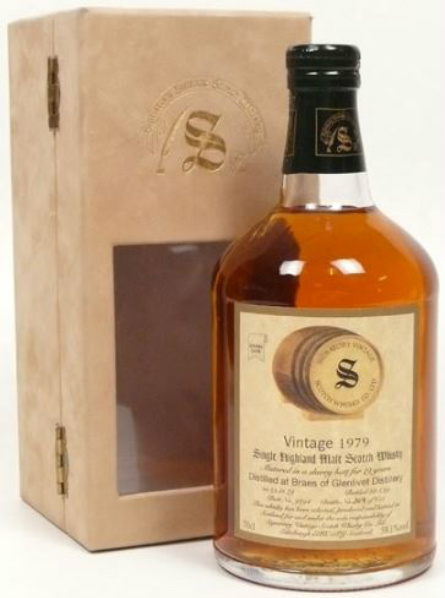
Braes of Glenlivet 19yo 1979/1999 (58.1%, Signatory Vintage, Sherry Butt #9294, 658 bottles)

The day before yesterday I reviewed the first Braeval on Masterquill.com, the domain I was finally able to acquire. Today we’ll have another first, this time the first Braes of Glenlivet. Well not really since both are one and the same distillery.

Braes of Glenlivet was founded just in 1973, so it’s not thát old. At that time Seagram’s was a company with only two distilleries: Strathisla (I love Sherried Strathisla’s from the 60’s and 70’s) and Glen Keith (equally so). Both distilleries are next to one another by the way. Chivas needed more capacity, due to huge demand of the Chivas Regal 12yo blend in the States and was looking for a distillery to take over. When that didn’t work, plans were made to “build” five distilleries in the same amount of time. Braes of Glenlivet was the first in 1973 and Allt-a-Bhainne the second a year later. The next three distilleries were brought into the portfolio by acquisition in 1978: Glenlivet, Longmorn and Glen Grant (now owned by Campari since 2006). Other noteworthy facts are that the name of Braes of Glenlivet changed to Braeval in 1994 (to allow Glenlivet to be The Glenlivet, as in “there can be only one”). Breaval was mothballed between 2002 and 2008 and is the highest situated distillery in Scotland. 1665 feet.

Braes of Glenlivet 19yo 1979/1999 (58.1%, Signatory Vintage, Sherry Butt #9294, 658 bottles)Color: Copper Gold.

Nose: Musty and a high quality Sherry note. Not a big heavily Sherried nose (hence the color). But dry and meaty. Slightly smoky (char) and vegetal (fern). Nicely oaky but also pencil shavings, which usually isn’t oak but cedar. Perfumy. This needs some air to balance itself out. Again the wood is playing a big role in this Braes/Braeval, just like the one I reviewed before. The vegetal part is developing into what I can only guess is a Japanese tea kind of note. Not floral, so it’s not the perfumy part of the nose, but very deep, profound, but also elegant and light. Having said that, next up is a hint of Velpon or Uhu (clear glue). Great herbal and earthy complexity (surely not only from the wood?), with a tiny hint of new make spirit. This is a very nice one to take deep breaths of. Stuff for connoisseurs I guess, so maybe not everybody’s cup of tea.

Taste: Strong, sweet and dry at the same time. Very nice. Lot’s of Beer and Hops, and not really Sherried for me. The hops doesn’t make this all that bitter. Quite some masked sweetness and again quite woody too. The bitterness is really a hoppy one. Interesting. Just like it’s younger brother, it’s coming undone a bit in the finish. The alcohol is really prominent, so most definitely a force to deal with. Finish with tea and wood, a hint of soap and rather drying. Beer and soap who would have guessed? The complexity of the nose isn’t really here in the taste. And I really miss the high quality Sherry I smelled initially. Beer and Sherry who would have guessed?

What really caught me by surprise were the similarities between the 1991 Braeval bottled by The Whisky Mercenary and this particular expression from 1979. Especially on the nose. One was distilled in 1991 and this one in 1979. Both have a similar full on smell and a woody part that plays a big role in the bigger picture. This Signatory has a more pronounced Sherry derived full and sweetish body, whereas the 1991 was more fruity.

Points: 85

The Glenlivet 18yo (43%, OB, Circa 2003)

When thinking of the middle of the Whisky road, for me, two distilleries somehow stick out. Glenfiddich as the daddy of Single Malt and Glenlivet. There may be others. Both have a big reputation, huge sales and lots and lots of versions. Most encounters with Malts from the standard range of these distilleries will be in hotel bars and such. Here we’ll have a look at (The) Glenlivet 18yo. This is already the fifth Glenlivet bottled by Glenlivet themselves on these pages, but only the third from the standard range. Earlier we had a look at the 12yo and the 15yo “French Oak Reserve”. The 18yo is another step up from both predecessors. By the way, just recently it was announced that Glenlivet are discontinuing the highly popular sales hit: the 12yo. A decision Diageo say they could’t make when everybody is fearing the discontinuation of their Talisker 10yo. Diageo think that would be stupid…

The Glenlivet 18Color: Amber gold.

Nose: Waxy and fruity. Quite nice, but also pretty simple. Can’t imagine the recent version of this 18yo smelling this “old”. Burnt paper and a slight hint of Sherry. Some vanilla mixed with a more organic note. Quite dusty, but it somehow seems to be a sweet dust. Fruity Sherry with hints of meaty Sherry. Also some hints of Bourbon casks, especially the vanillin and creamy pudding.

Taste: Quite sweet, but when that dissipates more fruity notes appear. Also the slightest hint of tar and a burnt note similar, but not the same as the burning paper note I got in the nose. Sweet Sherry and cookie dough. Very likeable and highly drinkable. Great fruitiness. I even have some cooked banana in here but also some maracuja and dried apricot.

This tastes way nicer than the Macallan 1986 Sherry I reviewed last. This tastes more like an old Whisky, with a bigger body and kind of sweetness that is acceptable due to its balancing with the burnt notes. Quite nice, but slightly too sweet to be a daily drinker, although maybe it is. Good standard bottling from a decade ago. Now I’m curious how a more recent 18yo will taste.

Points: 85

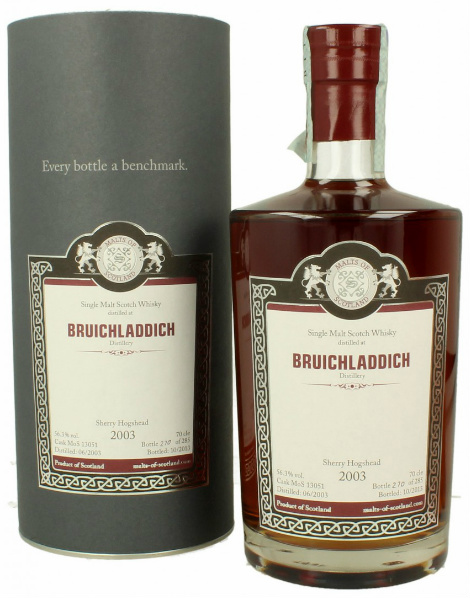
Bruichladdich 10yo 2003/2013 (56.3%, Malts of Scotland, First Fill Sherry Hogshead, MoS 13051, 285 bottles)

Almost two years ago I reviewed a Glen Keith bottled by Paderborner outfit Malts of Scotland. Being an indie with quite a reputation it took me quite a while to review another bottling of theirs. A sample of this very Bruichladdich was bestowed upon me by the former owner of this very cask. MoS renames the cask numbers so we do not know the original cask number. I hate it when Thomas does that, just like Bert does with his Asta Morris bottlings. Something to hide guys? Well nothing more to say really, (I’m a bit distracted by some nice live music by Primus), so let get on with it…

Bruichladdich 10yo 2003/2013 (56.3%, Malts of Scotland, Sherry Hogshead, MoS 13051, 285 bottles)Color: Orange brown.

Nose: Mellow Sherry of the Oloroso kind. Soft wood, dry forest plants like fern and slightly sulphury. Freshly baked bread. Chocolate, brown sugar, honey and fruity acidity from red fruits and berries. Vanillin and a distant bonfire in the woods. Wet earth and mocha. Raisins. Nice and pretty laid back. Mint in the finish (when warm).

Taste: The fruity acidity from the nose. Waxed chocolate sprinkles, cola and some wood. Again some sulphur, but not a lot. Extremely warming. The acidity stays on well into the finish and deep into the finish the sulphur gets more room to play, but still it is not a lot and never overpowering. It’s in the background carrying the aroma along with black tea leaves and a hint of woody bitterness. Not a very long finish though. Reminds me a (more than a) bit of the Bunnahabhain and to a lesser extent of a Bruichladdich I reviewed earlier. A quieter version of both I guess.

I have to say this one needed warming up. Even at room temperature I found it pretty closed, but when I held it in my hand for a while it showed a lot more of itself. Honey in the body and mint in the finish for instance. When I finished it, I poured myself a fresh dram, and again, very closed. This is an example of a closed and dry heavily Sherried expression as opposed to a fruity one. Bottled at the right time. Ready for another strange remark? The empty glass smells better than the full glass…

Points: 85

Thanx Andy!

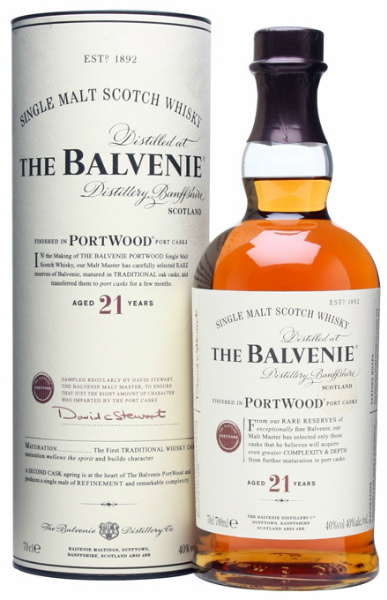
The Balvenie 21yo “Portwood” (40%, OB, Circa 2013)

A long time ago, as I got interested in Single Malt Whisky I always wanted to really like Balvenie. There was some nice variations of Balvenies around, even from independent bottlers like Cadenheads, and the bottles looked so nice. Uniform and beautiful. 10yo Founders Reserve, 12yo Double Wood, 15yo Single Cask, 17yo Islay Cask, 21yo Port Wood and the 25yo Single Cask. I bought the 12yo, the 15yo and the 21yo As often is the case the 12yo “Doublewood” was the first one I opened. I have to admit I never bought any more than those three…

The Balvenie 21yo Port WoodColor: Orange gold.

Nose: Malty, vanilla powder and definitely some winey notes. Lots of cream and vanilla. Next to come through are some vegetable or plant like notes, but also some new wood and tree sap. Elegant wood, in no way overpowering, even at this age. Very organic. Hints of (saw) dust and very light chocolate (milk). Tiniest hints of cask toast and…wait for it…chlorine. Yet over all a nice nose. Balanced but light by reduction?.

Taste: Cardboard and wine. Malty and quite sweet. Very likeable. I like the fact that the Port is definitely there, but again, not overpowering. Mocha, licorice (Port related this time) and Tiramisu. Not bad, but the taste is really to weak. Definitely reduction!

Yes I will get on my horse now. This one is very nice, but almost reduced to death. It is too mild and especially the finish is almost ruined. You’ve probably had the experience of dabbling with water, and one of those times you slipped, and added a little too much. Remember how that tasted like? Remember how the finish got weak? Well that is what happened here. I can’t help but feel this is a money decision and not because they believe this Malt would be at it’s best @40% ABV. In 2002 I bought myself a bottle of this and remember it to be very, very good, also reduced to 40% but way more aroma in that one. This newer 21yo Port Wood doesn’t cut it (as much) for me. I’m planning to open that older version soon and I’ll get back to you on that subject a.s.a.p. Fun fact: I bought this 21yo, ten years ago for 58 Euro’s and I was recently informed, that very soon, the 21yo will cost almost 200 Euro’s. So If you like it, don’t hesitate, get it while you can for around 125 Euro’s.

Points: 85

Laphroaig Week – Day 2: Laphroaig 18yo (48%, OB, Circa 2012)

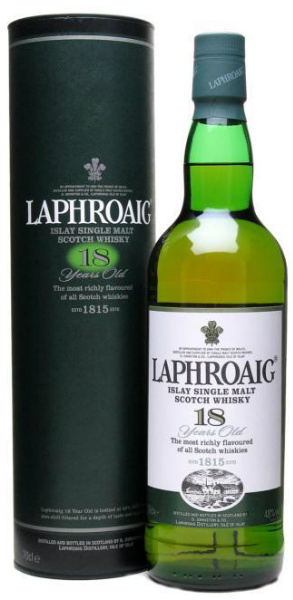
Laphroaig SignAll good things come to an end, and after that they come back again. It happened to Lagavulin 12yo, and it is said to happen shortly to Laphroaig 15yo. Not yet, but soon very soon though, with a special 15yo commemorating Laphroaigs 200th anniversary. Yesterdays 15yo was eventually replaced by an 18yo and by some curious coincidence we’ll be having a look at that very replacement right now. Is it a step up from the 15yo, or maybe a step down? One thing is certain, the ABV went up a few notches from 43% to 48% and the box didn’t come back. The bottle I’ll be reviewing now, is still an 18yo which looks like the release that replaced the 15yo. In 2013 the look for the 18yo was slightly revamped.
Laphroaig 18yoColor: Light gold.

Nose: Peaty, salty and pretty smoky. Kippers with seaside saltness. A promise of salt and smoke. Warming and vegetal. Garden bonfire, and wet freshly cut peat. Mocha. Lit fireplace in an old farmhouse. Good nose but very straightforward. You more or less get what you’ve come to expect from a modern Islay Whisky. Islay Whisky, not especially Laphroaig even. When smelled longer I also get some deeper, more meaty notes. Dried meat again, warming and salty.

Taste: Definitely more points in the ABV department (when compared to the 15yo). Again, also in taste more straightforward. Burning wood and quite sweet actually. Lots of ashes and licorice powder. Ferrero Rocher cherry bon-bon fruitiness, combined with licorice root, fatty peat and smoke. Again it is what you might expect.

This 18yo lacks the awesome specialness of the 15yo. They are both Islay and both Laphroaig, whereas the 18yo is straightforward and obvious in what you are getting but the old 15yo is much more than that. It delivers more aroma’s than the 15yo, and the delivered aroma’s are more special. The 15yo is very fruity ánd Islay, The 18yo is ónly Islay. Yesterday’s 15yo to me is a special Laphroaig, this 18yo is indeed a modern Laphroaig which doesn’t surprise, it’s decent, it’s good, but it doesn’t bring anything extra to the table anymore. Dare I say that it’s good but a bit anonymous? Is the 15yo a Whisky they can’t make anymore? I don’t mean that particular age statement…

Points: 85

Caol Ila 21yo 1981/2002 (58.2%, Signatory Vintage, Cask #467, 361 bottles)

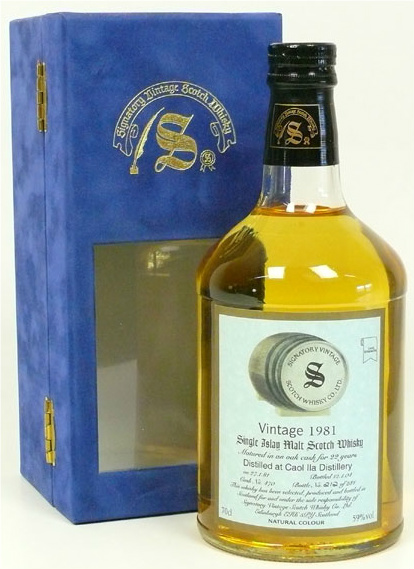
Ahhh, a dumpy Signatory Vintage bottle, nice! Maybe not thát long ago that this was bottled, but an oldy in today’s market nevertheless. This is Whisky I grew up with. Can you imagine, shops full of bottles like this. Today a fairly rare site. I couldn’t find a picture though of the reviewed bottle (cask #467). Pictured here is a similar bottle drawn from cask #470. The right bottle should look similar, maybe the box had a different colour.

Caol Ila 22yo 1981/2004 (59.0%, Signatory Vintage, Cask #470, 281 bottles)Color: Light gold.

Nose: Nice fatty old peat. Toned down, laid back and elegant. Quite light. Notes of fern and dry grass. This doesn’t leap out of the glass as your regular Sauvignon Blanc. One to savor right from the start though. Typical Caol Ila coffee I always tend to smell in late 70’s early 80’s Caol Ila distillates. No heavy peat, no heavy smoke. Quite an a-typical Islay Whisky.

Taste: Sweet, herbal and grassy. Short fresh attack, clean at first but not for long. After a few seconds a wave of licorice root and primarily loads of ashes. Crushed beetle. Not so much peaty yet. Extremely warming. This is what you want in your hip flask standing on the beach in a storm. (Apart from a young and feisty Islay Whisky that is).

For a 1981 Caol Ila it ís lacking a bit of complexity. I know examples which had some more fatty and funky peat in them. Good but not as good as Caol Ila from these days can be.

Points: 85

Thanks go out to my mate André for providing this sample.

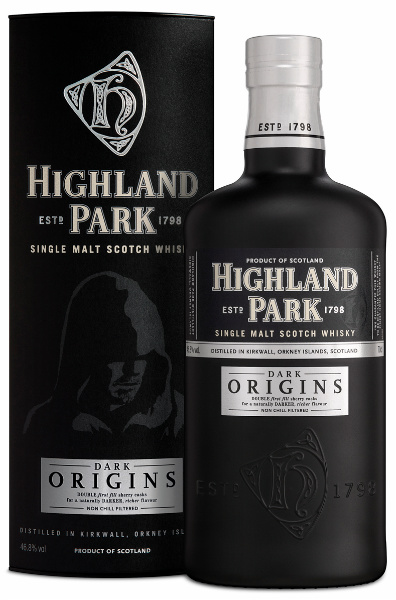
Highland Park “Dark Origins” (46.8%, OB, 2014)

Not too long ago I reviewed a recent 18yo and quite liked it. I always loved Highland Park, but with issuing so much single cask releases I also noticed a drop in quality for the standard range, especially the 12yo and the 18yo. At one point in time I even scored one batch of 18yo a sad 78 points. Luckily the 18yo I reviewed last was again a lot better so I hope Highland Park is keeping up the good work.

This time I have the Dark Origins in my glass that was released just last year. Like so many others these days it is a NAS offering. Somehow by the looks and the (marketing) statements made with this bottle it looks like an addition to the standard range. Not like Tomatin have done with the Legacy, to place it before the 12yo, and making it quite inexpensive. No, Highland Park let us know that this offering has twice the amount of first fill Sherry cask used in this as compared to the 12yo. A statement that can only be described as behind-the-desk-conjured-fog as we don’t know how many first fill casks go into the 12yo, nor do we know the aged of this Dark Origins. So lets forget about that quickly and have a sip, shall we? By the way This Dark origins is way more expensive than Tomatin’s NAS offering.

Highland Park Dark OriginsColor: Full gold

Nose: Malty and quite funky at first. A hint of smoke and soap, and yes Sherry is in here too. Chocolate and roasted vanilla. Sea spray, buttered toast and a breath of fresh air. Extremely likeable nose.

Taste: Chocolate and prickly oak. Toasted cask and some residual sweetness from red fruit hard candy. Quite smoky and there even is an earthy note, not very different from peat. The nose was quite good but here in the taste department it is all a little bit simpler, yet very well made and quite tasty. Slight acidic off note in the finish, mixed with a soapy texture.

Well this simply is too good to be only young Whisky, but then again, Highland Park always used to be one of the best. It’s a high-class distillate, and very well may be this good when young. Still, I believe there is some older stuff in here. By the way, give it time to breathe. Dark and rich it will be then.

Points: 85