 New Lochnagar was founded in 1845. New Lochnagar? Yes. First Lochnagar was built in 1823, and burnt down by “the competition” just three years later. The distillery was rebuilt, only to burn down again in 1841. So the distillery was rebuilt again in 1845 as New Lochnagar. Lochnagar became Royal in 1848 (it lies very close to Balmoral Castle). No more fires burning down the house, but still a lot of construction going on. In 1906 the distillery was rebuilt yet again and in 1963 completely renewed.
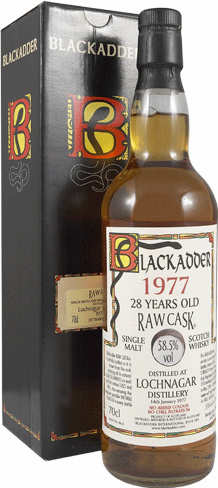 Here we will try an independent Lochnagar, again a Blackadder Raw Cask with cask sediment in the bottle. This time no powdered char, but only small chunks of charred wood.
Color: Full Gold
Nose: Fresh, sea spray wich changes quickly into a damp wine cellar. Very spicy wood and vanilla. Resembles the sweet smell of a bourbon, high on rye. Mocha with a hint of ground coffee. Varnish and fresh mint leaves (not bruised). This smells like it will be very sweet. Very nice nose.
Taste: Strong and sweet, but luckily not as sweet the nose predicted. Butter caramels and the varnish is here again. The whole is very full bodied. Wood with Aspirin (wow, that’s a first). Nutty and ashy. The finish is drier than in the beginning, but still sweet enough to mask a lot of the wood. It doesn’t taste like it, but underneath it’s pretty woody. The dry finish ends in a little bitterness that reveals this woodyness.
In the end a quite nice Lochnagar. The finish is dryer and has some bitterness that seems a bit off compared with the sweetness from the beginning. Maybe not a 90+ scoring malt, but definitively a very interesting Lochnagar if you want a complete collection. Still, with these flaws in the finish I have a little soft spot for this Lochnagar, since the nose and the initial taste are really great.
Points: 88
p.s. This one is at the time of writing still available in Russia for 534 Euro’s
 Time for another Lowlander. Rosebank this time. I reviewed a
  hoping for a resurrection. Who knows. For the time being, lets see if this Rosebank is any better than the Glenkinchie reviewed earlier.
 One of the other gems he found there, was a very old 20yo Sestante Mortlach, so the theme for this year soon became Mortlach. I have to admit, I really love a tasting with a single distillery theme, especially when a lot of bottles are brought in. Strange enough that was not the case with Strathisla, but with Mortlach we had 14 of them, and an extensive aftertasting with some other gems. (Laphroaig 10yo unblended bottled in the mid 70’s!).
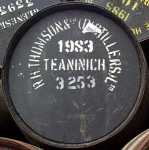 Teaninich isn’t amongst those superstars of Single Malt Whiskies around, but it has a fanatical following with certain enthusiasts. Well I’m one of them. Almost every time I taste a Teaninich, blind or not, this always tickles my fancy. I connect with it. It suits my palate. Dare we say: “For reasons not even science can wholly explain…”
  Teaninich was founded in 1817. In 1970, yes a small jump in time, a whole new six still ‘distillery’ was built alongside the current one, consisting of four stills. The new one was called the A-side (The old stuff was therefore called the B-Side). They worked together as one distillery. In 1984 the old distillery was mothballed, and 15 years later, demolished.
 The Old Train Line series is probably the series with the most beautiful labels I know. The series is bottled by German bottler Jack Wieber based in Berlin.
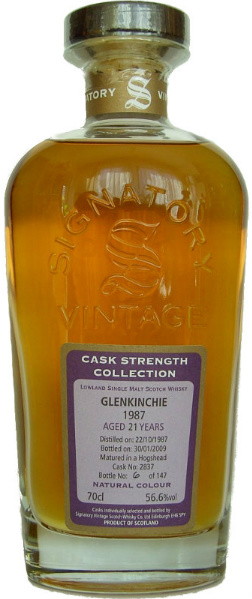 Glenkinchie, a rarely seen Lowland distillery within the ranges of independent bottlers. Founded in 1837, Glenkinchie is foremost known for the closure of Rosebank. When Diageo set up their range of classic malts they chose Glenkinchie over Rosebank. As you might know, Rosebank is known to have a huge following, so this decision wasn’t welcomed at all. Now Rosebank is no more, we’ll have to see if this Glenkinchie is worth your money. Instead of a regular Diageo bottling, let’s try an independent one.
 Instead of expanding into unchartered territory, let’s do something oppositional and do yet another Port Ellen, and another bottle by Douglas Laing. This time from the old series in the normal scotch whisky bottle and not from the new tall bottle. People tend to think this older look contains better whisky. Let’s see if that’s true. By the way ,I read somewhere that in the few months Port Ellen operated during 1983, there weren’t a lot of good casks around, and they filled almost anything they could get their hands on. This Port Ellen looks quite light in color. Is this from a tired butt or a normal refill Fino butt?
 Taste: Peat and rhubarb. Sweet, big, leafy and chewy. Black tea with clean refined sugar. No rubber here and it’s no monster either. The peat is very mild here and the finish is quite simple. Still it seems to be very balanced, just not very complex. It has the dryness and a bit of the spiciness of the oak, but not the bitterness, and that’s a big plus (not a Chevrolet). It has citrus with cardboard in the finish. If tasted blind, I would have thought it to be some odd ten years younger.
 It’s an end of an era, even if it was a tired cask, this is still very typical and good. Really a shame this got closed. In a way it resembles Talisker in it always being decent. This may be no high flyer, but is has a lot of fine moments to give. No I’m not sentimental, this is good in itself. A very nice Islay Whisky. As I’m sipping the last few drops: “Here’s looking at you kid…”
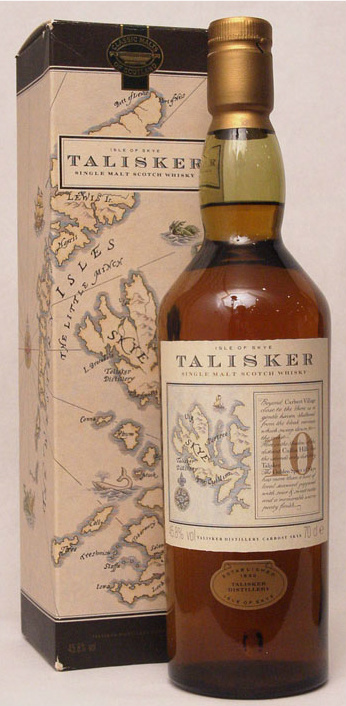 For those of you who have read my
  This profile is great and if you want this, you’ll have to pay some serious cash to buy yourself an old Islay whisky or even Brora. I know, an older expression of the standard 10yo Talisker is getting more pricey lately, but still nowhere near to the prices asked for the aforementioned bottles. Do yourself a favour and get it while you can, and beware, this is dangerously drinkable. This will be empty before you know it. I left myself a 125 ml sample of this, but I almost drank it all writing this! Stay away, just drink milk instead, its good for you, unless you are lactose intolerant I guess.
 Yeah, yeah, I know, this is not a Bourbon. But I did say I would throw in the odd Rye, didn’t I? And why wouldn’t I, since Rye is really America’s first whiskey. What is it precisely? This is a Kentucky Straight Rye Whiskey. Technically a Bourbon is very close to a Rye Whisky.
 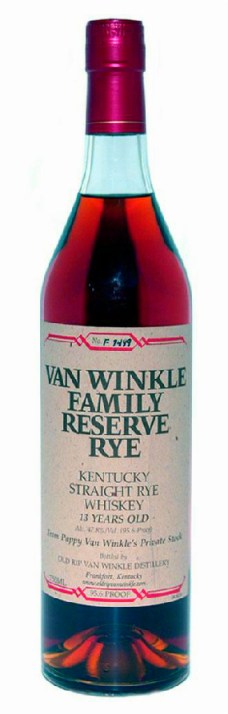 Just a shift in grains in the mash bill. By law its required to be made of a mash of at least 51% rye. The other grains of the mash are usually corn and some malted barley. Rye whiskey is called Straight, when it has been aged for at least two years. Now this 13yo Rye. Well first of all, this isn’t 13yo. Its called 13yo because Julian van Winkle bought the Rye’s in this whisky at 13yo. He nevertheless let the Whiskey age until its 18th year and at that age it was put in stainless steel tanks, to stop its ageing. Where does this come from? Van Winkle isn’t a distillery so they got their whisky from somewhere else. A lot of their Bourbons come form the sadly deceased Stitzel-Weller distillery, but this Rye is supposedly from Medley (Owensboro Kentucky) ánd Cream of Kentucky (Frankfort), and has an unusual high corn content for a straight rye.
 And that’s not all, the finish also has some honeyed caramel. Honeyed caramel with a bite. What else do you want…
 And here’s yet another Speysider and not just any Speysider but an example of Speyside’s finest distillery…probably. Just consider the statement for a moment (maybe not if you’re called Luc). There’s also Macallan, Longmorn and Strathisla in Speyside. I know there are others, but I didn’t want to make this list too long. Glenfarclas isn’t mentioned on the label, but let me tell you this is a Glenfarclas, and a very old one too. I have tasted several very old Glenfarclas, and sometimes they tend to be very woody, but that’s also because there are a lot of very old Glenfarclas around, and 42yo is a long time to spend in a cask. I’m 42 now and I wouldn’t want to spend my whole life in a cask.
 To the whisky then. Glenfarclas is still a family owned operation that started legally in 1836. In 1965 it was bought by John and George Grant. Since then there were a lot of Georges and John Grants. Very popular names indeed in that family (and The Beatles for that matter). Sometimes they have extra letters for identification purposes.
  Next time I’ll be up at Glenfarclas, I’m dying to meet Ringo S. Grant! Good to see a still family owned distillery surviving competing with the big conglomerates like Diageo. There are several more like Bladnoch for instance. Power to them!
 Master Quill