Glenfiddich 21yo “Havana Reserve” (40%, OB, Circa 2003)

And here we have an old, and somewhat controversial, Glenfiddich that was totally matured in boxes that once held cigars. Oops, I mean, casks that once held Cuban Rum. Cuban Rums is a light Spanish style Rum which doesn’t mean it doesn’t have a lot of aroma. Rum casks weren’t used much for finishing Whisky, and even today distillers and bottlers tend to prefer the obvious Bourbon and Sherry casks. Especially today, other casks are used as well, from fortified wines like Port and Madeira and red and white, sweet and dry Wines. So a Rum cask you say? Yes, we have had more of those on these pages. A fairly recent Benriach comes to mind, to name but one. Controversial? Yes. Problems arose when Whisky like this was sent to the US of A. They still had an Cuban Embargo, so more cigars for us, as can be read on these pages as well, oops I slipped up again. There still was an Cuban Embargo back then, so no Whisky with the word “Havana” on the label was allowed into the country.

Glenfiddich and The Balvenie have the same owners, William Grant & Sons. Yup, those from Hendrick’s Gin as well. Bad boys down there! Bad boys since they also decided to sue our beloved New Zealand Whisky Company for blatantly stealing the “Double Wood” words and misguiding the poor public, who now must believe that Balvenie Double Wood is the same as the NZWC’s Doublewood, and New Zealand is somewhere in the Speyside region…

William Grant was looking for the perfect Rum casks for their Glenfiddich and considered casks that once held Rums from Venezuela (Spanish style), Guyana (Demerara Rum a heavy English style Rum) and some others. Finally Rum from Sancti Spiritus was chosen to fill up the casks for two years, After two years the Rum was replaced with Whisky for a six month finish.

If I’m not mistaken, the first release was called Havana Reserve and the second was called Gran Reserva. Rumour has it, that for this second release the same casks were re-used, thus explaining reports of the Gran Reserva being lighter than the initial release. A third version was released. Just to be absolutely sure, this Whisky was not finished in Cuban Rum casks, but in casks that once held Dominican Rum. The label now mentions Carribean Rum finish in stead of Cuban Rum finish. Later, subsequent batches simply were called Rum cask finish, so absolutely nothing could be misunderstood and when changing Rums the label can stay the same.

Glenfiddich 21yo Havana ReserveColor: Full gold.

Nose: Very aromatic. Creamy, toffee, nutty, thick and chewy. Next a floral layer which at times is quite perfumy, with great earthy undertones (given by the Rum cask). Vanilla and restrained wood. Half dried grass is noticeable, but covered under a thick semi-sweet layer of aromatics. Fruity, baked banana and dried sweet apricot. In the distance there is even a hint of licorice. But the Rum, is the Rum noticeable? Yes If you know the style of Rum the Cubans make, and you know this Whisky is finished in Cuban Rum cask, than yes, its noticeable, otherwise you must have some experience in tasting to smell and taste it. The Rum upped the aromatics and the chewyness a bit, as well as the sweetness. Great nose.

Taste: Sweet with lots of toffee. Earthy and “green”. Broken off branch and fresh tree sap. The baked banana returns. It’s a big Malt. It is overwhelming in fruit and floral notes. Has some bitter wood and slightly burned edges to it. Wood obviously. Oak, fresh oak and even some pencil. The body of the Whisky already shows it will not be as complex as the nose. However the biggest problem, relatively speaking of course, is the partial disintegration towards the finish. It’s like a band just before breaking up. Some aroma’s don’t want to work with each other anymore, and get separated from each other. Still in the fold though, but more apart. Underneath the woody bitter note and on top some acidity. Short finish, which surprised me since it’s a bigger Glenfiddich than usual, and this has aged for a whopping 21 years, you know. Not a lot happening in the aftertaste. So on entry I was quite happy with the performance of the 40% ABV. but the finish needed some more.

This is a beauty. Excellent smelling Glenfiddich. Tastewise, well, not at the same level of greatness as the nose, then again, it was (since it was bottled some time ago, and since has been discontinued) a mass-produced Whisky aiming at the public already gained by the rest of the Glenfiddich bottlings, without scaring them away. With this in mind, they did what they could, to keep this public and at the same time be a bit more adventurous.

Points: 84
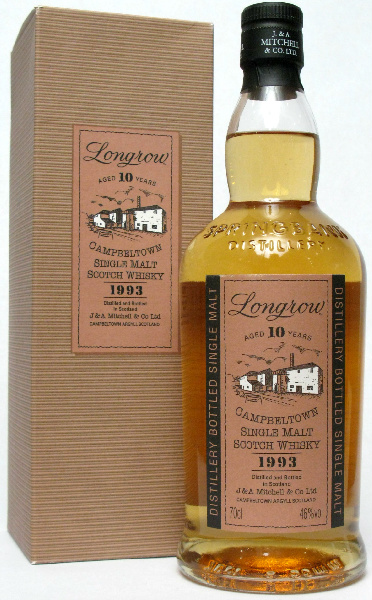
Longrow 10yo 1993 (46%, OB, 2003)

Another peated whisky in the summer? Has Master Quill gone completely crazy? Yes, because who wants to be “normal”! If you feel like it, just do it… By the way, it’s raining like crazy outside, so it only seems fitting.

2001 saw the first release of a 10 year old, with a vintage. Remember the classic brown paper Longrow label on the tall bottle? The first two releases, both in 2001 and both distilled in 1991 were a “normal one” said to be only from Bourbon, but also, for one time only, a Sherrywood. The series was short-lived, and was discontinued in 2006 after the 1996 vintage, in favour of the 10yo without a vintage statement. Throughout the series I don’t believe all normal ones were from Bourbon casks only, if any. You know Springbank, they tend not to repeat themselves. Just compare the last two releases of the Longrow 18yo (with the white labels), since the 2016 release contains Rum casks. Never a dull moment with Springbank and all of their other brands. Today we’ll have a look at the 1993 vintage of the 10yo, that was released in 2003.

Longrow 10yo 1993Color: Light gold.

Nose: Nice fresh peat. Fatty and smoky. The peat is smelling three-dimensional. It’s not only just there, it goes deep, and seems without end in complexity. Peat mixed with hints of lemon, waxy apple skins and vanilla. Cookie dough. Whiffs of warm apple pie. Burning leaves, sugared yellow fruits and even hints of sweet-smelling sweat, crushed beetle and slightly burned herbs and even has a quaint nuttiness about it. Very balanced stuff, with only a mere hint of wood. All seems to fit in together nicely. This is the best peat I’ve smelled in quite some time. I must admit, it had plenty of air to work with. Love it.

Taste: Quite sweet on entry. Heavy on licorice and the peat is shoved into the background, by the sweetness. The sweetness dissipates and leaves more room for a sort of herbal fruitiness. Prickly licorice and the nuttiness from the nose. Alas the peat never really makes it to the top and the wonderful depth it has on the nose doesn’t really blossom tasting it. Long finish, built around the caramel sweetness and with a larger role for sour oak. Coffee and chocolate in the aftertaste. It still is a wonderful Malt. Just if the complexity of the nose would have shone through in the taste, it would have been a truly exceptional Whisky.

Well this might not be a Whisky from the seventies, but it does remind me of the quality of that decade. I’m actually amazed a bit that many of the vintages are still available, although somewhat more expensive than the new 10yo.

Points: 88

Caol Ila 1991/2000 (46%, Wilson & Morgan, Barrel Selection)

This Caol Ila is one I just cracked open, literally. It is an oldie I bought some 15 years ago. Sure it is a reduced independent bottling, and it didn’t cost much, but its a Caol Ila and its bottled by Wilson & Morgan, who have bottled a lot of good Caol Ila’s, just have a look at this 24yo expression distilled in 1975, to name but one. The cork broke on this one. This time it didn’t only just break off, it seemed to disintegrate completely. Vaporized into thin air, so to speak. Luckily most of the crumbs were easy to fish out of the bottle and hardly anything sank to the bottom. Just a few weeks ago I wrote an ode to the screw cap, now you know why… Karma strikes again.

Caol Ila 1991/2000 (46%, Wilson & Morgan, Barrel Selection)Color: Pale gold.

Nose: Ahhh, right after pouring the room filled with the smell of beautiful peat. Nothing harsh and rough, but smooth and refined. Nice, clean and soft and aromatic peat. Helped along with a citrussy fruitiness. Well-balanced and much nicer to smell than the Kilchoman Spring I reviewed (much) earlier. Smells quite sweet. Leafy and chewy. Dry vanilla powder, maybe even some powdered coffee-creamer. Some hidden tar, but also an expansion on the fruits. We have hints of sweet, ripe pineapple, mango and banana, mixed with vanilla from the wood, and the wood itself somehow didn’t make it. Crushed beetle and some distant dried basil in the background. Remarkable. Ohhh yes, and some bonfire smoke. I nearly forgot to write that down! I have to say it again, well-balanced stuff and remember, this isn’t even ten years old, which today has become standard.

Taste: Quite sweet on entry. Sugar water. Syrup. Very fruity and a little hoppy bitterness. Big and chewy. Sweet, funky and nutty peat. Not at all earthy. Nice touch of smoke, but not much. It’s like all the aromas are fighting over front row seats. As mentioned, there is a lot of sweetness, that exerts itself right from the start, but these is a lot of fruitiness as well. The Whisky is also nuts. I mean, full of nuttiness. All big and all upfront. I always get some coffee in good Caol Ila’s, and this time is no exception. Sweet coffee, with a tad of toffee in the coffee. It’s not stong black coffee but rather a sweet Cappuccino or Latte Macchiato. Underneath a nice, herbal and lightly bitter undertone (from oak). Long finish and similar aftertaste. Leaves me behind with salty lips. Good Whisky! I hope todays young Caol Ila’s are just as good and affordable.

Ohhh these were the days, where young Whisky seemed better than it is these days, or maybe I’m biased.  This is a very tasty Caol Ila, not overly complex and one I’ll come back to again and again. This will not take years to empty, which it usually takes me, since there are lots of open bottles around the place…

Today there is much ado about young Whiskies, especially NAS Whiskies. It seems NAS isn’t really accepted by everybody. It sometimes is viewed as a devilish plan selling us inferior and immature Whisky (sometimes at a premium price). On the other hand, when distilleries and independent bottlers alike, just mention an age statement of a young whisky there doesn’t seem to be much of a problem anymore, since you know what you’re getting. Just look at the recently released Lagavulin 8yo and compare that to the plethora of NAS Taliskers (also owned by Diageo) and NAS Laphroaigs (not owned by Diageo), which seem to be under par and the fantasy names do not help the acceptance process of the (educated) public, or those who have seen different times buying Single Malt Whiskies.

For the fun of it, let’s compare this “9yo” Caol Ila to the NAS Talisker ‘Neist Point’. Smelling the Talisker after the Caol Ila, it is remarkable how much the Talisker smells of grainy immature Whisky and even shows some whiffs of new make! Much more than when smelled by itself alone. Although having new make in the mix is illegal, since Whisky must be at least 3 years old, there must be a big component of very young Whisky in the Talisker. The Caol Ila behaves like a 9yo, nice, well made, good cask, but lacking some of the complexity often brought to a Whisky by extensive maturation. In the taste it is noticeable that the Talisker has some more happening than just the new make, and young Whisky, alone. Thank God almighty. The Talisker needs some air to get the new make out, after that it is not bad, not bad at all. Sweet as well and buttery. The taste of the Talisker grows on you, even though the new make never really leaves the scene. A draw, or is it? Considering the amount of money Diageo wants for the Talisker (in some markets), the jury made a unanimous decision in favour of the Caol Ila. [sound of judge’s hammer on wood]

Points: 85

Lagavulin 12yo 1995/2008 (48%, OB, European Oak, for the Friends of the Classic Malts)

So with the longest day of the year at hand, some would say that this isn’t the time for Peat. Peat needs rugged shores, strong gale force winds and driving rain to be thoroughly enjoyed, doesn’t it? Why not take a light, grassy and lemony Lowlander instead, or even some tropical stuff? Well what can I say, I just felt like it, that’s all.

A week ago I hosted a Whisky-tasting centered around the indie bottler, Signatory Vintage. I opened some bottlings of them, which will feature on these pages soon. Of course a good tasting needs an even better after-tasting, like a good party needs an even better after-party. The after-tasting, yes you’ve guessed it: Lagavulin. The distillery that’s celebrating its 200th anniversary this year, with the release of a 8yo, which will also feature on these pages shortly.

But first this oldie (but goldie). Relatively speaking of course. This Lagavulin was released in 2008 and it took well into 2015 to sell out. It was available in shops for a whopping 7 years! Now that its gone, prices are soaring. It was available for such a long time, because there may have been a lot of bottlings around, but it also gained a bit of a reputation. A lot of people, including fans of Lagavulin weren’t very fond of this particular bottling. I consider myself a fan of Lagavulin, so I just has to open it, and try for myself! But first a thought…

Bottlings like this, baffle me to the max. All this time we hear the industry explaining to us, that colouring is done to ensure consistency in colour from batch to batch. Also, the public, when buying Whisky, or any other brown spirit, may be put off when the aforementioned spirit is too light in colour. So why then is this one-off Lagavulin, bottled in a brown glass bottle, coloured with E150, when we, the public can’t even see the colour of the spirit untill after the purchase? Boggles the mind, and mind you, don’t go around thinking that caramel colouring doesn’t affect the taste, because it does, just read Michel’s article back from the day I used to be in the “Coloured Gang”. Sure, it may be a bit lengthy, but it definitely worth it.

Lagavulin 12yo 1995/2008 FFOTCMColour: Orange brown, just like a Bourbon.

Nose: Excellent smoky nose. It starts with more smoke than peat. Sure peat is next. Earthy, sweet and fatty clay. Ashes. Nice wood, accompanied by red fruity notes and some Italian laurel licorice as well. The fruity bit smells more yellow than red. Funky chewy sweetness. Cream Sherry. Mocha cream, cookie dough and light chocolate powder. Leather. Milk chocolate shavings on vanilla ice-cream held up by the wood. Again a lovely smelling Lagavulin, which always works well when it’s matured in Sherry casks. Hints of tar and also some spices. The creamy Sherry notes overpower the spices a bit, so its hard to tell them apart. If you have read the article I mentioned above, you might remember my comments about mellowing out the aroma’s by E150. I feel that is the case here also. This Lagavulin has a nice, very nice actually, but rounded out smell.

Taste: Quite sweet and creamy on entry, quickly followed by peat and toasted cask. Small vegetal bitter note. Very nice. Lots of sweet licorice, almonds and black and white powder. Pepper & salt and definitely some smoke and nuts. Smoked nuts? Smoked sweet almonds (not the salty ones). Red cocktail cherry and a whiff of artificiality in the fruit department. The sweetness is of the typical sugar-water kind. Its fantastic on entry, but the body is losing it at bit already. Falling apart and being quite simple. In no way, has the finish the length of other Lagavulins, but the one big taste lingers on for a while in the aftertaste. However, it’s more the sweet and fruity bit, with only a hint of smoke, than the peat.

This Lagavulin has matured in first fill Sherry casks, not made with American oak. There was a time when (probably) all Sherry matured in European oak butts and puncheons, which are quite large casks. Today a lot of Sherry casks are made from American oak, impairing vanilla and giving off a more creamy feel. Also the casks made today (hogsheads) are smaller than the butts and puncheons, thus allowing for some quicker maturation.

Let me start by saying this is a good Lagavulin. It drinks easily and there is more than enough happening. I like it a lot. However, if I compare this to other Lagavulins, it isn’t the best one out there. I believe the colouring did its part in mellowing out the aroma’s and blending them together into one big (nice) taste. Nothing sticks out really. Apart from the E150, the casks themselves probably weren’t the best money could buy as well, as well as its previous contents. So for a Lagavulin its good, but nothing more than that, but it’s also a Whisky most others can only dream of producing. Lagavulin has stiff competition from… itself.

Points: 88


Glenrothes 1987/2002 (43%, OB)

Here is another vintage Glenrothes. After the 1992,  the 1989 and the 1979, this 1987 is the fourth of these vintage bottlings on Master Quill. All were nice, but never scoring very high. All were nice, with enough difference to warrant buying more than one, but also none of them blew me out of the water. Just look at both other Glenrothes I reviewed earlier. One bottled by Wilson & Morgan and one by Douglas Laing. Both managed to score higher than the official bottlings. By now I can say that I expect this one to be nice, but again I don’t think it will blow me out of the water.

Glenrothes 1987/2002 (43%, OB)Color: Gold.

Nose: Dusty, definitely Sherried. Spicy and tickles the nose. Also some burnt elements. Next some aroma’s you get from an old (dry) cellar or attic. Funky but not the funky damp notes you sometimes get from cellars. More like the odours of stored old stuff. Old paper, old cardboard and old wood. Old, worn out vanilla pods. Later a breath of rural fresh air, coming to you over water. Let it breathe some more, and it becomes more like a “normal” Whisky. Vanilla, wood, fruity Sherry notes and spicy oak and cask toast. Hints of butter and dry grass (not hay), and even some toffee.

Taste: Short attack of (fresh) oak and a more waxy note, quickly succeeded by cherries and sugared yellow fruits. Fruity sweet toffee, alas a bit diluted. Über-fruity sugar-water. Warming. Apart from the initial wood, this is quite a fruity expression of Glenrothes. Hints of soap and paper from the nose and a growing aroma of burnt wood. At best a medium finish with a note of Beer and burnt wood. Yes, a bit bitter, which adds to the character of the Whisky after the initial sweetness and fruitiness. The aftertaste matches the nose exactly.

Although the nose isn’t one of the most balanced expressions of Glenrothes, the taste is way better that way, helped along by the sweetness it has. It’s all right this one. It may be a bit simple, diluted and lacking complexity. It does some across as balanced and tastes nice. Maybe it’s time to up the strength a bit?

Points: 83

Glencadam 30yo 1975/2006 (54.4%, Dewar Rattray, Cask Collection, Bourbon Cask #7588, 216 bottles)

Why not make it a double bill, and review our third Glencadam. Both Glencadam’s I reviewed earlier managed to score a nice 85 Points, so let’s see if this one does better. This particular on is 30 years old, and by itself it’s older than both previous examples put together. This is another one from the attic, since it was released back in 2006. The difference couldn’t be greater when comparing it to the Glencadam I just reviewed. It is twice the age and this one comes from a Bourbon cask, surely it will do better?

Glencadam 30yo DRColor: Full gold, and only slightly lighter than the 15yo.

Nose: Half sweet and nice biscuity barley. Slightly spicy and reminds me of old Dutch Jenever. Definitely some Bourbon influences. Some waxy elements, but not much. In fact the Whisky smells quite young and vibrant and not at all would you expect it to be 30 years old. Fresh, hints of citrus and only mere hints of vanilla. Dusty wood completes the nose. That’s it, not much more is happening. After a while more fruit comes to the fore. Sweetish yellow fruits. Some unripe banana skin. Adding to the structure of banana comes powdered coffee-creamer, in the smell a creamy variant of vanilla. Dusty and slightly dried out ice-cream after you spilled it and didn’t clean it right away. Given some time the freshness takes a back seat and the whole is nice but also rather dull. Not a very active cask I’m afraid. Having said that, it does smell like something from the past.

Taste: Wood, paper and cardboard and after that a short, sharp attack, quickly followed by a short sweet note. After the sweetness comes some woody bitterness. Distant dull vanilla. Waxy again. Cold candle wax. So the body is present and almost chewy, yet surrounded by dry paper and woody notes. A nice old Bourbon matured Whisky, but not a stellar one like 1972 Caperdonich or 1976 Tomatin, to name but a few. Here also some fruit emerges, but again a bit dull. Dried bits of pineapple and some old broken almond bits, you sometimes find in the couch. Luckily the sweetish and fruity note dominate the body, not leaving much room for the woody bitterness. The finish has medium length, but there isn’t much happening afterwards. What stays around for the longest, apart from general (cardboardy) creaminess, is a sour note you get from (new) oak.

Not bad, quite nice, but also not spectacular as well. No real off notes and nothing (bad) overpowering the whole. Still a nice one to pick up when all of its distant relatives are sold out. Definitely a lot better than most of the modern Whiskies though. I’ll have fond memories of this nevertheless.

Points: 85

Glencadam 15yo 1989/2005 (58%, Signatory Vintage, Cask Strength Collection, Sherry Butt #6014, 578 bottles)

Another one I found in the attic. Although this hasn’t been bottled ages ago, this time around I have a Signatory Glencadam bottled back in 2005. That’s already 11 years ago. Time flies. This is just the second Glencadam on these pages and it seems not to be a Malt with a big reputation. Having said that, the “new” 10yo I reviewed last time around, was something of a nice surprise for me. Quite impressive for an officially bottled 10yo. However, I have seen it before that the first release of something is better than most subsequent releases. Just sayin’…

Glencadam 15yo SigVColor: Copper gold.

Nose: Creamy and strictly Sherry. Smells like a Red Wine cask actually. Whiffs of stale Beer. Wow, where is this going? Hints of caramel and licorice. Creamy and perfumy. Definitely more floral than most Whiskies I recently tried. Floral pudding. Sure some dried apricots underneath, but not enough to call this fruity as well, although the fruit aroma becomes stronger with prolonged breathing, so it may be more fruity then I initially thought. Hardly any wood. Fruity and floral it is and dry warm wind blowing over the top. After even some more time the floral part seems to have disappeared. Interesting effect. It’s all about what evaporates the first. It becomes nicer over time, and better balanced as well.

Taste: On entry again the feeling this comes from a Wine cask. Apart from the slightly harsh winey note, a lot of paper and cardboard notes. A Beer-like carbonation taste (not saying there are bubbles in this one, an effect I know from a certain Teaninich, also bottled by Signatory (not reviewed yet, but I do have a bottle of that somewhere). Lots of pronounced Italian laurel licorice. Cumin and slightly minty. Hidden sweetness and a nice bitter (hoppy?), and slightly soapy, edge well into the finish. Well this one seems to have it all doesn’t it?

If you work on this a bit it is quite nice and wonderfully complex. For some it may be an acquired taste. You need to let this breathe for quite some time though, although seeing it change with time is quite nice as well. Interesting Malt. Recommended for aficionado’s. I liked the feel of the 10yo I reviewed earlier, and this one doesn’t disappoint as well. However, I’m not that positive about some of the other regular releases by the owners themselves, so be careful with buying those without trying.

Points: 85


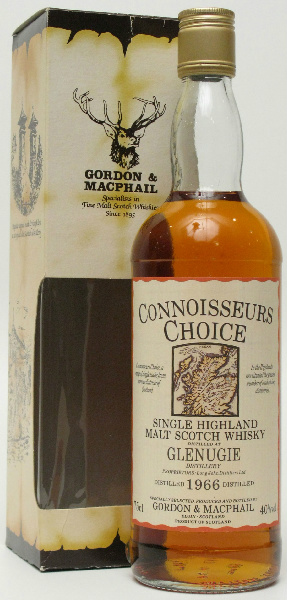
Glenugie 1966 (40%. Gordon & MacPhail, Connoisseurs Choice, Old Map Label, 75cl, 4699)

Up next a blast from our collective Whisky past. This is only the second Glenugie on these pages, and rightfully so. It’s closed and it’s today, bottlings like this moved into the realm of collectors (who don’t drink it) and anoraks (who do). So what do we have here? A few years ago an anorak posted an article about what clues can be found on a G&M bottling to date it. We see that this bottle doesn’t have a neck label to date it, so it’s not from the 1991 batch, but earlier. We do know it is an 75cl bottle and on the bottom the glass code 4699 can be found. This particular glass container was used in between 1982 and 1991, which isn’t really helping, but narrows it down a bit. I’ve seen this bottle with different cardboard boxes though, so that isn’t helpful either. The box in the picture isn’t necessarily the box the bottle was sold in. Second we do not know if only one bach was released, looking like this. There may be different batches with different boxes who look exactly the same filled in exactly the same coded bottles. I’m guessing the one I’m about to taste is more form the second half of the eighties than the first half, but that’s only speculation. Let’s try it then shall we?

Glenugie 1966Color: Slightly orange gold.

Nose: Very dusty and old smelling. Funky dry Sherry. Deep grassy, slightly waxy and old soft oak(y). Time capsule. Some faint red berry fruit in the background. Add to that a more creamy, vanilla note and some burnt wood. It’s a mere hint that burnt note though. Adds to the character fo the Whisky. If you let it breathe for a while, more and more of this red fruit comes to the fore, cloaked in the wood and creamy notes. Diluted warm caramel and slightly dusty as well. This is an old gem, and needs to be treated as such. It’s fragile at 40% ABV. Don’t be hasty too. With even some more air, hints of licorice and a floral note emerges. Floral but not soapy. Elegant and distinguished florality. Vegetal (with some wood), floral and fruity, that sums it up.

Taste: The wax, diluted caramel and the wood are up front here. Diluted sweetness. It’s slightly sweet at first, but that is quickly gone. It’s so obvious that I do feel that some caramel colouring has been done. Yep, toffee, hard candy coffee bon-bon. More wood, slightly sappy and bitter. It has some creamy nuttiness to it. Does warm hazel-nut milk make any sense? Disappears rather quickly, hence it has a short finish. The finish is made up of toffee and it’s actually almost the only thing that is noticeable in the aftertaste (as well as a hint of paper…).

Wonderful old malt, that has been diluted too much and might have seen some caramel colouring. You know it’s there, but it lost its battle trying to show it to us, since it has been hindered by too much water. Bummer. I have to report this to the Whisky police and hopefully the culprits will be brought to the Whisky-tribunal. Smells great though, that’s where the potential is still noticeable, or should I say that’s where you can still get a glimpse of what could (should) have been…

Points: 83

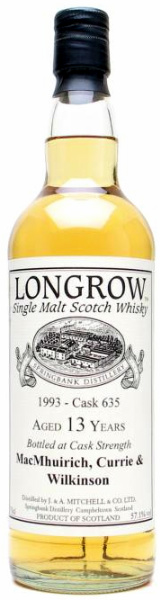
Longrow 13yo 1993/2006 (57.1%, OB, Private Bottling, for MacMhuirich, Currie & Wilkinson, Cask #635)

This is a sample I have lying around for a very long time. I last tasted it last some ten years ago, and there was definitely something wrong with this. Just have a look at the review posted by Serge. yes, he’s a big fan of this one! Ten years ago I found it pretty odd as well, but come to think of it, Springbank make such good Whisky, what must have happened for it to be so “strange”, and for it to be bottled? Today I’m becoming more and more a fan of Springbank, feeling they can’t do anything wrong. In these days of NAS (some bad, some good), Springbank are able to churn out one good bottling after another. NAS or no NAS. So this less than half full sample got plenty of time to balance itself out with some air, so let’s see how this private cask of MacMhuirich, Currie & Wilkinson will do in 2016. Sounds like a law firm, doesn’t it?

Longrow 1993 Private Bottling Cask #635Color: Light gold.

Nose: Light peat, but not much and some burning plastic. Herbal lemon. Deeper down a more buttery note. Fatty with hidden sweetness. Slightly burnt wood (toasted cask), fresh dried oak and an acidic off-note. Bread, butter, paper, cardboard (they all go together) and caramel. Toffee even. Next some crushed beetle. In my case an accident, because I’m not cruel to animals, but once I’ve gained the experience, I’ll never forget the smell. Well, it’s in this Whisky. (Tobacco) smoke and cold charcoal. Hints of menthol. It is a nose that wants to be dry and spicy, not fruity. It’s not floral, but may very well have been. Add to that a creamy, butter and toffee and you have this in a nutshell. Very well hidden is the aroma of new make spirit, a sweetish Vodka aroma. Sure, this is (still) lacking in balance a bit, but it’s not as bad as it was ten years ago. It did get better with “some” air. I actually like how it smells now.

Taste: Sweet, but with a lot of bread and paper notes. Floral plastics and vegetal. The initial sweetness works well with the relatively high ABV. Sweet sugared yellow fruits. Sugared apricots. the body itself is not so sweet. Interesting. Damn, this is really about vegetal paper. Paper, cardboard, wet paper, pulp. It’s hard to impossible to get past this. The paper notes overwhelm the entry and the better part of the body. When this dissipates, an acidic note shows itself which just is wrong. Towards the end of the body, the Whisky also becomes slightly soapy. Yeah, lets add to the plastic pleasure. Hey, now I get some smoked eel skin as well as the aroma of an ash-tray and sweet jasmine powder. What a Whisky. This has quite a few flaws, so maybe it’s good the finish is not very long (and hardly an aftertaste).

If after Serge’s review (and mine) you still want to buy it, be advised that you should let this breathe extensively. And I do mean extensively this time. It will help the nose along, the taste however is beyond repair. I wonder what went wrong here. It probably wasn’t the spirit going into the cask, but was the cask somehow contaminated? Rotting bung cloth? A fungus maybe? In the end not a complete dud, so I won’t be scoring this 55 Points like Serge, but for a Longrow this is not a good score either…

Points: 80

Bunnahabhain 8yo (43%, Gordon & MacPhail, The MacPhail’s Collection, Refill Sherry Butts, Heavily Peated)

Let’s continue with a Margadale. You might have never heard of Margadale, but that is how the heavily peated Bunnahabhain spirit is actually called. Margadale has a peating level between 35 and 40 ppm. Bunnahabhain means “mouth of the river”, now guess the name of the river itself… I would have liked it if they really would have called it Margadale, just like Tobermory and Ledaig. Now, the peated spirit Bunnahabhain produces is called Margadale, but when the spirit becomes Whisky, the bottled peated Bunnahabhain is called Moine. That’s probably a name you have encountered before. Only Berry Brothers & Rudd have once bottled a peated Bunnahabhain with a mention of Margadale. Bunnahabhain used to be an (almost) unpeated Islay Whisky, even the water used didn’t ever flow over peated land, but when the going got tough, aided by some changes in ownership, they started to make peated Whisky as well…

Bunnahabhain 8yo The MacPhails CollectionColor: Straw, light gold.

Nose: Fatty and buttery. Nice Islay peat. Sea breeze, salty and warming, but also with a soft quality to it. Peat, smoke, crushed beetle and tar. Burning newspaper. Hidden sweetness and florality. Effective and typical. Everything is there, but nothing is overpowering the rest. I would say elegant, as far as heavily peated Whiskies can be called elegant. Nice citrussy note, giving some freshness on top of the peat, smoke, tar and saltness. The floral and fruity notes are deeper and heavier and lie more on the bottom, or in the depth of the nose. Balanced and fine. With some more air it dumbs down a bit. Hints of (burning) paper (again), and the fruits come more to the fore. Dried apricots and white grape. Here you can see how the Sherry casks worked. It adds fruit and a nice woody spiciness. It somehow lacks the obvious vanilla you get from American oak Bourbon casks, although most Sherry casks these days are made with American oak as well. Sometimes you could guess its relative youth, but on the other hand, this shows enough complexity to be considered and older Whisky. Good ‘un. Nice distillate.

Taste: Right from the start we get some separation. The aroma’s aren’t very well-integrated. Interesting. Starts off with smoked salt and creamy butter and a nice White Wine acidity. Fatty peat, very fatty and buttery indeed. Licorice, sweet wood and honey sweetness. Sweetness there is, but not your regular white sugar sweetness. Yes runny thin honey it is. All the way through it keeps not integrating well. The acidity is displaced and hangs around too long in the back of my mouth, and the sweetness is trying to get too much to say underneath. Not sure this Sherry is a perfect match for the peated spirit. The more it breathes, the more it actually develops in the wrong way.

Nice stuff at 43% ABV. Sure, in times it is a bit thin, but I have no problem with the reduction. It makes this Islay Whisky very accessible. Don’t let it breathe though. It allows the acidity to develop and hold it hostage. The wood makes the Whisky, but in this case the wood broke the Whisky. It’s not terrible, but especially in the details this Whisky fails a bit.

Points: 80