 Well here you go, day four and here is the third and last of the Mashman’s choices from Glengoyne. Hardly a surprise after the last two days, isn’t it? This time a Pedro Ximénez Sherry Butt. Pedro Ximénez or PX for short, is a very sweet dessert Sherry. Oloroso Sherry were always considered to be the best for maturing Whisky, but it turns out that PX Casks are very good too. Let’s see how this PX-Glengoyne will do.
This is wat Peter had to say about his choice: “sweet, rich, wonderful and moves beautifully when shoogled*, just the way I like my whisky and my women!” So Peter shoogles his women? I mush have a go and shoogle my granny then!
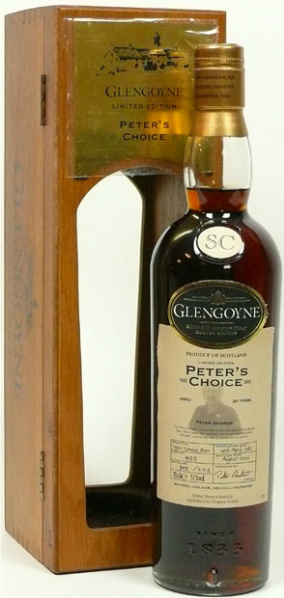 Color: Sparkling copper brown, almost with a red tinge.
Nose: Quite fresh and light, but also raisins and alcohol. Dusty powdery wood. Utterly balanced, but not very outspoken. Charlie’s choice was definitely more ‘heavy’, this is friendlier. Dry meaty and slightly woody. Very slick and elegant yet again. Not a sherry monster. Honey sweetness and leafy.
Taste: Again very elegant, and sweet, easily recognizable as a PX Sherry. There is wood, but not very much, also something hoppy, with a hint of soap. The body is firm enough to withstand the soap, so don’t see that as a problem. The whole is thinner than Charlie’s choice though. The finish here is again beer-like and a bit sour. If that had stayed more fatty and sweet, that this would have been a score into the 90’s.
A very nice pick by Mashman Peter, may the shoogle be with you! This is the last of the Choices from personnel of the Glengoyne distillery, tomorrow the choice is mine again! Nosing the three Mashman’s choices, I would say the best nose is on Charlie. Tastewise it is a tie between Charlie and Peter, where Charlie is more brutal, or sporty, and Peter is more dressed to the occasion, so to speak. Both score the same and which one is better is dependent on how you feel. So two ties here, one between Charlie and Peter and a second between Oloroso and Pedro Ximénez.
Points: 88
 * Shoogle is a Scottish word which means to gently shake or agitate.
 “In my time at Glengoyne this is the best cask I have tasted. Heaps of complexity with no rough edges.”
 Robbie is the distillery manager and Deek and Billie are warehousemen.
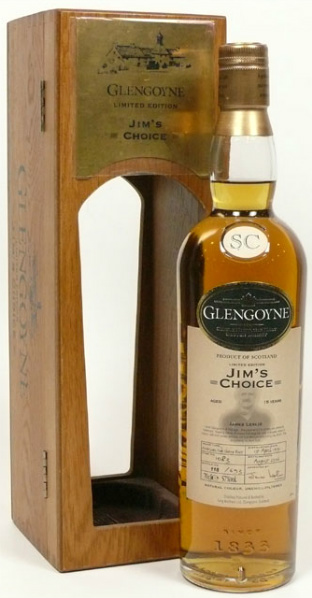 Color: Gold.
 Color: Gold
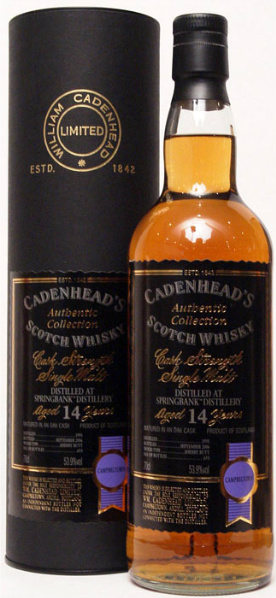 Color: Copper Gold
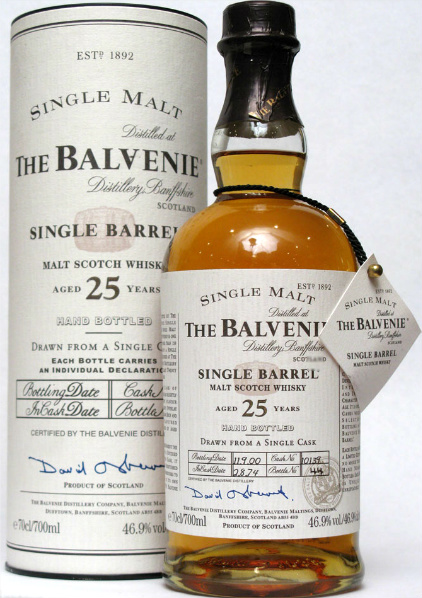 Color: Gold.
 It’s not only the bitterness that is obvious. Comparing these two there is infinitely more. That goes to show, how big the differences can be between two similar bottles, and how buying without tasting is so tricky. I would also like to point out that the reduction that obviously took place here isn’t a problem, this Whisky holds the fort. Actually it’s the best Balvenie I had in a very long time. Still no 90’s score though…
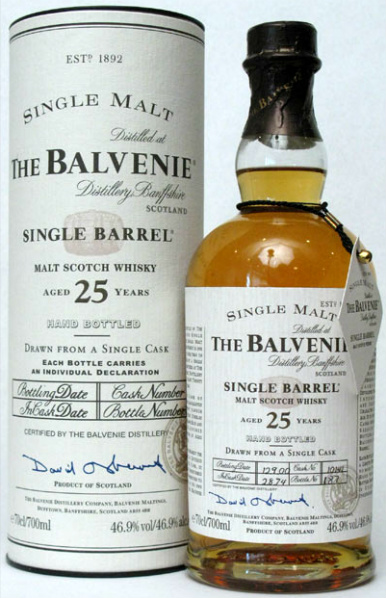 Color: Gold
 The fattiness dissipates quickly and the whisky breaks down in towards the finish. Wood attack! put this in your mouth and you think is pretty good (not great alas), but the vanilla fat is stripped, and you get hit by more bitterness than expected. The palate does lack complexity and balance. Aiii.
 First of all, the picture below is a picture of a similar bottle that was bottled at Cask Strength for Switzerland a year later. The picture is for cask #4726. Glenfarclas is great, it’s family run and most of the make is going into Single Malts, so no room for error, everything must be good. Second, it’s at its best as a Sherried Whisky and even in these times the Grants are able to make a very good Sherried Whisky. The self-proclaimed kings of the Sherried Whisky, namely The Macallan, gave up on this practice. For reasons only the marketing department will know. Good luck to them, Glenfarclas may very well be Speyside’s finest!
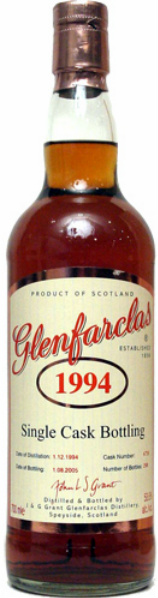 Color: Lively orange brown (like a Bourbon)
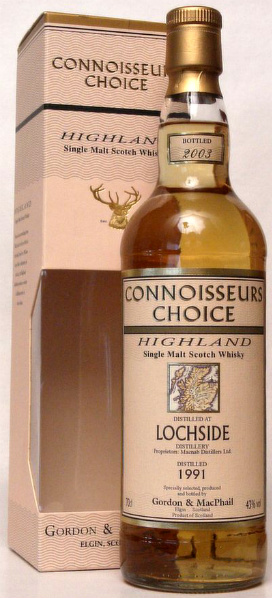 Color: Light Gold.
 Solera is an ageing system for Sherry (and other fortified wines), in which younger wines in upper rows of casks are used to top up casks of older wines stored below. Every time a batch is bottled, the wine is taken from the bottom row. Not everything though, usually up to 30% of the cask is bottled. After this, the casks in the bottom row are topped up with the wines from the casks in the row directly above, and that row is topped up with wines from the row directly above that, and so on. After a startup period this system gives wines of a consistent age and quality, even if one particular vintage is weaker than the others.
 Color: Light copper gold.
 Master Quill