Highland Park 19yo 1984/2003 (50%, Douglas Laing, Old Malt Cask, Sherry, DL REF 406, 636 bottles)

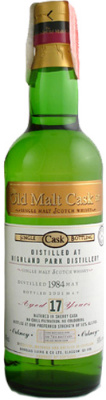
I saw some prices for official Highland Parks the other day, and I just had to try this one. It wanted to be picked. It’s and eighties Highland Park by Douglas Laing. A sherried one that was released almost ten years ago, and the cost then was next to nothing. (around 50 Euro’s). Well a lot has changed in the Whiskyworld the last decade. So Highland Park 19yo. Alas I wasn’t able to recover a picture for this bottle so I will show here a brother of the 19yo, the 17yo that was released two years earlier (Also a 1984). The 19yo I’ll review here will more or less look the same.

Color: White wine.

Nose: Apple sauce, very clean, a little bit of wood and a little bit of spice. Dusty but overall fruity. Lot’s of toffee and again warm sweet apple sauce. Although pleasant, it doesn’t seem quite right. There is something like coal smoke in the distance, maybe even some sulphur. A slight hint of burnt wood and paper and cardboard. The longer this breathes the better it gets. The apple bit wears off.

Taste: Short attack that dissipates quickly and falls again into a fruity sweetness. Alongside the apple there also is some blackcurrant. It’s nice, it’s a lemonade at first, that drinks nicely away. Prickly smoke in the back of your mouth. The 50% ABV delivers good oomph.  Licorice and a hint of wood with a lighter acidic and slightly bitter finish, after the ‘full’ body. The finish is the weakest part.

Likeable, but nothing special. It has its merits, but if I had tasted this blind, I would have never guessed this was a Highland Park. It’s quite far from the official Highland Park’s. I’m guessing Fino Sherry, but also a tired cask. In almost 20 years the Whisky hardly picked up any color, a not a lot of character from the wood itself. No use to compare, but the other Whisky from Orkney, Scapa, I reviewed for Master Quill’s 1st Anniversary was a lot better!

Points: 86

By the way. The depicted 17yo scored 85 Points.

Bowmore 12yo 1988/2000 (50%, Douglas Laing, Old Malt Cask, Sherry, 702 bottles)

The Master of Malt version of an eighties Bowmore did not turn out to be a FWP-Bowmore after all. Looking though the whiskies that have accumulated at Master Quill’s castle, I found another eighties Bowmore. This time an oldie by Douglas Laing. At one point in time, the Laing Brothers thought they would have to show the public what are the ‘young’ whiskies in their Old Malt Cask range, so decided on red lettering and a red tube. Somehow this ‘experiment’ didn’t last for very long, so this look is rather scarce. Lets see if this time we have a genuine FWP-Bowmore on our hands? Is it lavender & violets or peat & smoke?

Color: Light Copper Gold.

Nose: Butter, popcorn, quite some hints of flowers, but not like a FWP. Peat and a decent amount of smoke. Deep almost brooding kind of licorice. Clay, smelly pond in summer, probably a sulphur compound. This organic smell is actually great in this Whisky. Ashes and gravy, meaty.

Taste: Nice elegant Islay. Soft tasty peat, with smoke on top. Lots of caramel, toffee. Nothing is over the top. Perfect non-sugary sweetness in the background. But as with the Master of Malt version, it breaks down a bit towards the end, and has a sweet yet ‘light’ finish. There is something else that is pretty similar with the Master of Malt bottling. Again, the acidity quickly follows the sweetness. They somehow are linked. Do I detect some soap at the end of the finish? If it’s there it doesn’t hurt the whisky much. On occasions it takes the properties of a rum.

Not a perfect Whisky. Has some distillation faults (butter) and some issues with the finish and stability (with air), but overall it’s a very drinkable and likeable Whisky. Again not a victim of FWP.

Beware, this whisky doesn’t take air very well, let this breathe and you’ll see how it breaks down in your glass. Break open a new deck of cards, invite some (lady) friends over for a nice and friendly game and drink the whole bottle in one evening, you’ll do yourself and the Laing Brothers a big favour.

Points: 88

Scapa 23yo 1979/2002 (54.7%, Ian MacLeod, Chieftain’s, Sherry Butt #6632, 567 bottles)

I broke the corkSo it’s time to celebrate the first anniversary of Master Quill and I’ve picked this bottle of 1979 Scapa, bottled in 2002. Well, things got off really good! Like I said, I would rip open this bottle and so I did accidentally. I broke off the cork! Bugger!

Like with the Dun Bheagan range these Chieftain’s bottles are by Ian MacLeod. A few years ago I tasted its sister cask (#6633) blind and liked that one a lot, since I scored it 92 Points. Reason enough to look for this one for quite some time and snap it up at an auction.

Scapa is the lesser known distillery from The Island of Orkney. The better known obviously being Highland Park. Well actually, Scapa is one of the lesser known distilleries from Scotland! Scapa was founded in 1885. The distillery was closed a few times. The first time between 1934 and 1936 and the second time between 1994 and 1997. From 1997 on Scapa distilled Whisky again for a few months per year using staff from the nearby Highland park distillery. In 2004 the distillery is refurbished, and one year later Chivas Brothers (Pernod Ricard) buys the distillery. Scapa is now known for their 16yo that replaced the 14yo, that replaced the 12yo, that replaced the 10yo. Are you still following me?

Scapa 23yo 1979/2002 (54.7%, Ian MacLeod, Chieftain's, Sherry Butt #6632, 567 bottles)Color: Copper

Nose: Very musty Sherry, but already some black fruits are shining through. The initial musty smell wears off (a bit), and shows some spice and some coastalness (is there such a word?). Gets deeper and deeper, with a very balanced fruitiness. I guess this is one that needs to breathe for a while, but already is shows it’s potential. It does have some balls! What I like about this one that is has multiple facets, it changes on you if you give it time.

Taste: Yeah, this will be no punishment to drink all! Nice going. perfect combination of sweetness and fruits and in the mouth there is no hint of the sewer-like smell that was there in the beginning, (I may be exaggerating a bit). It has some wood, but the whole is so bold, it needs this spice and wood to pull it together. There is also some bitterness from the wood, but again this one needs it. At this point in time (freshly opened and needing to breathe) it’s not completely balanced, but it will get there in the end. Complex, well, not exactly. It shows some sourness from the oak, but after half an hour it is pulling together, and it has a great and long finish. This again is a stunner!

Well I can say this, because I love this whisky (and it’s sister cask). It sweet and fruity, has a nice finish and this is well counteracted by several effects from the wood. Like Frank Drebin said; “I love it” (He actually said it several times…)

Points: 91

Bowmore 26yo 1982/2009 (53.4%, Master of Malt, Refill Sherry Hogshead, 195 bottles)

And here is another Master of Malt bottling. Earlier I reviewed a reduced Tomatin, that was a true disappointment. I didn’t even know it’s possible to ruin a Tomatin, since usually I like Tomatins. So with this one I do worry a bit. This also is a Bowmore of the eighties, which quite often turn out to be your better hand-soap (lavender and violets come to mind). I once tried a 1989 Berry Bros. & Rudd bottling that made me physically ill. That was a first for me, so I tried that one half a year later and it happened again.
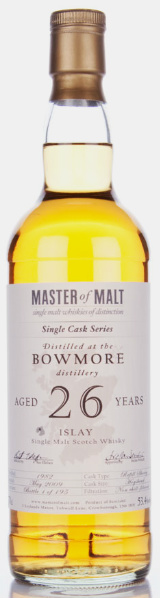
Color: Gold

Nose: Powdery and sweet. Not very Islay to be frank, hardly any peat or smoke. Lots of flowers though, soap, also some clay and thick, so it seems to have body. When freshly poured it is very closed. After a while some smoke trickles trough. Hey, waiting even longer there is peat too. All in minute quantities. Again not very Islay-ish. Is this really a Bowmore? Wet paper and a small hint of licorice. It’s not bad, but not very balanced either. Now we have sour oak. It’s fresh, fruity and floral, luckily not over the top lavender-soap eighties Bowmore.

Taste: Sweet and syrup, with ash and some wood. It actually attacks you in the beginning. The sweetness disintegrates quickly into something acidic. It’s like a syrup that shows, when stripped from your throat, some lemon. The attack is nice, and the middle is also quite nice, but bold tastes fade and leave you with a fairly dull and anonymous finish. What can this be, a strange and unusual Bowmore distillate in a Fino Sherry cask? Well, let’s leave it at that.

In the end it’s not a FWP-Bowmore from the eighties, but it also isn’t recognizable as a Bowmore either. It’s ok on the nose and when it enters your mouth is shows some promise. Halfway through though and especially the finish are a bit weak, which is a surprise after the bold body. But the most remarkable achievement is making and finding a Bowmore that has nothing to do with…Bowmore!

Points: 84

Glenfiddich 32yo 1974/2006 (47.3%, OB, Private Vintage, for La Maison Du Whisky, Cask #10260, 198 bottles)

Let’s continue with Glenfiddich. Known for their big out turn and fairly priced Whiskies. No cheap entry-level Glenfiddich this time, like the 12yo “Special Reserve” I reviewed earlier, but a super-duper premium Glenfiddich that costs a fortune these days. Cask number 10260 was bottled for the 50th anniversary of La Maison du Whisky. Who hasn’t visited one of their fabulous shops in Paris & Saint-Denis (France) or Singapore? There are a few pretty great 1974 Glenfiddich bottled, even one for Playboy (Cask #10245) and H.M. Queen Elizabeth II (of U.K. fame). So not a bad club to belong to. Here Majesty’s Cask was #2336 (not quite a sister cask of the Playboy one, I would say). Or maybe Glenfiddich filled a lot of casks in 1974. Who knows?

Color: Full and dull gold.

Nose: Old bottle. Oceanic and creamy. Wow. Musky and organic, with fatty old wood (not dry wood) mixed with newer plywood. Clay. Absolutely stunning wood smell. Smelling this you know you have something special on your hands. When smelling this for a prolonged time, you get in the territory of cardboard that has been added to the wood that is more upfront. Through the wood and the cardboard is also something clean, fresh and lively like lemongrass, cola, mint and old lemon skins, but also the more heavy shoe polish and clean wax. Great complexity and balance.

Taste: Again old bottle. Spicy toffee with clay. It’s sweet and has hardly any wood at first! Full mouth. Chewy and waxy. Fantastic. Slightly sour, somewhat thin and papery finish, and the wood came in late, but it is there. It’s more the spice from wood, than the wood itself. Clean and elegant.

Well, obviously you can’t really compare the über-standard 12yo to this, can you? Because all the time when I was trying this, you can clearly see where this is coming from, and it does have a big family resemblance. This definitely is the father of the 12yo.

Points: 91

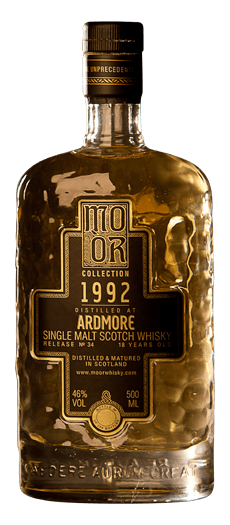
Ardmore 18yo 1992/2011 (46%, Mo Ór, Bourbon Hogshead #5013, 286 bottles)

Three months ago, I reviewed two Ardmore’s, and was very pleasantly surprised, not to mention impressed. At a certain moment I even called it the present day’s Brora, or something of that nature. First a 1992 bottled by Domiek Bouckaert a.k.a. The Whiskyman, that scored a nice 89 points, and second a 1993 by the omnipresent Gordon & MacPhail. G&M’s version still got a very nice 87 points. Both malts were available for (much) less than 100 Euro’s, and that’s a steal in today’s feverish market. Today after a week’s absence, let’s have a go at this 1992 bottled by Mo Ór. Let’s hope it will do as well as the other 1992.

Color: White wine.

Nose: Nice, fresh acidic and aromatic lemon, but it has a lot more going for it. The wood comes across as pretty sweet with lot’s of vanilla. A storm of fresh air, as I said, very fresh and quite clean. Barley. I remember the other Ardmore’s as more dirty versions of Ardmore. I can hardly detect any peat in this and the smoke does need some time to manifest itself. Perfumy it is and slightly buttery (hot butter). Actually this is a lovely whisky on the nose. Not very complex, but it does have a well-balanced nose.

Taste: Hmm, licorice, clay and the (earthy) grains from the nose return. I expected a bit more of an attack, but it stays a bit back. Well don’t underestimate the smoke now! That’s here in abundance, but there isn’t a lot more coming from this. I guess this one was quite clean and lovable from the start, but I feel the reduction to 46% ABV didn’t benefit the Whisky this time. It has a late and mild fruitiness to it, pineapple and the fatty, sweetish smokiness is quite nice. Still as with the nose, the palate is undemanding and of average balance. The finish is of medium length.

This time around, the cask didn’t do much for the whisky, probably second or third refill considering the color and age. Still a well-earned…

Points: 84

Highland Park 12yo 1997/2010 (56.2%, G&M, Reserve for van Wees, Refill Sherry Hogshead #5823, 271 bottles)

In this day and age of battles, battles for oil, battles in politics, and even dance battles, now there are also battles in Whisky. The guys in the picture are Jan Beek (right) and Dennis Mulder (left). They do tastings/battles to see who bottles the best Whisky, the distilleries themselves or the Independent bottlers. Jan represents the independent bottlers and Dennis the official bottlers. Time for my own battle. Well not a battle with axes and swords. Earlier I reviewed an official Highland Park 12yo and scored it a decent 85 points. Here we have a this independent 12yo Highland Park, bottled by Gordon & MacPhail and selected by Van Wees, so mostly sold in the low counties. Let’s see if this Gordon & MacPhail 12yo can beat the official 12yo, and score more than 85 points…

Color: Lively orange brown.

Nose: Extremely sweet, spirity, spicy and woody. Raisins, lots of raisins. This smells exactly like a PX-Sherry. Apart from the thickness of it all, it does smell dryer later on because of the wood and spice. Gravy and meaty, something that fits the Sherry profile too. Definitely some honey and heather in the nose. Which surprises me since the Sherry cask might be very overpowering. Tar and sulphur come late into the mix. I love the coal and tarryness of sherried single cask Highland Parks. Burnt wood. Bonfire from a distance at night. The opposite of elegant I would say. The longer it breathes in the glass the better this gets. It reminds me of some of the better early seventies good sherried Whiskies.

Taste: This is sweet PX-Whisky with a bite. It starts out sweet and quickly turns into spicy wood. Syrupy sweet. But the initial sweetness terns into dryness because of the woody attack. Again coal, tar and even some licorice. Fireworks and a cold freshly half burnt log. Demerara Rum with a lot of smoke. It’s sweet but not quite honeyed. And no heather to be tasted too. Some dark chocolate and cola. Do I really taste a hint of soap?

OK, it’s a 12yo Highland Park all right, but this version has nothing to do with the official 12yo of today or any day for that matter. It’s a beast, but a lovely beast. If you can handle heavy Sherry, than this is one for you (and me). In the end I like this one better than the official 12yo, so this battle is won by Jan Beeks axe. But the whiskies are completely different and both have their moments. One is elegant and light(er), the other a beautiful beast at high strength. Still, I like the older official bottlings of Highland Park.

Points: 87

Inverleven (Dumbarton) 18yo 1987/2006 (57.9%, Cadenhead, Closed Distilleries, Bourbon Hogshead, 276 bottles)

And here is another Cadenhead’s, from the same kind of cask, from the same year 1987, with three years more ageing. Cadenheads call this Distilled at Dumbarton, made with Inverleven stills. Everybody else calls this whisky just Inverleven. To clear things up. The Single malt whisky that was made this way, was called Inverleven. Inverleven was made untill 1991. This was made with the ‘normal’ type stills. In the same building was also a Lomond type still that was installed in 1959 at the Dumbarton distillery and ran untill 1985 (With the malt being called “Lomond”, not Loch Lomond). Loch Lomond lies close by to the north. Only a few kilometres away, still Loch Lomond is a Highland Whisky, and Inverleven a Lowlander.  To wrap things up. The Dumbarton Distillery was the spiritual home of the Ballantine’s Blend.

Color: Light gold. (Darker than the 15yo Cadenhead).

Nose: Grassy and clean. Balanced, fresh and citrussy. Not sharp fresh lemons, but more deepness to the citrus. It not quite grapefruit. Old very ripe lemons maybe? Toffee and syrup. Candied old lemons, that’s it! In the back some nice elegant wood. This nose is definitely nicer than the 15yo, it’s more mature and balanced. Still the nose of the G&M was even more elegant, and woody. If you look for it carefully, in the depths of this Whisky you can smell a little bit of ether and acetone.

Taste: Sweet and spicy. Ok, the wood plays a role, but in no way like that of the G&M. The sweetness is also a bit more laid back compared to the 15yo Cadenhead. Great balance, fantastic balance actually. There is this perfect balance between the sweetness, the caramel, (more caramel than toffee) and the spiciness of the wood. Also some austere waxiness. Having said this, it still seems to lack a bit of complexity. The G&M seems to have more of that, yet every time I return to this Whisky is get better and better. Allow this to breathe and you’ll be rewarded. It could have remain a bit thicker in the finish, but still this is a stunner.

This version is definitely better than the 15yo, so maybe the extra ageing did some wonders, but you’ll have to allow for cask variation. It’s also better than the Gordon & MacPhail version. But both definitively have earned their place on anybody’s shelf. All of these Inverleven’s are Whiskies like no other. Quite a unique nice Lowlander. Highly recommended.

Points: 88

Inverleven (Dumbarton) 15yo 1987/2003 (58.1%, Cadenhead, Bourbon Hogshead, 294 bottles)

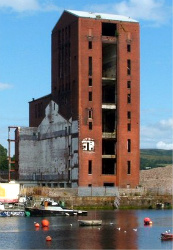
I ended the last post about Gordon & MacPhail’s Inverleven with the hope that they wouldn’t reduce the next issue (so much). Frolicking around in my stash of samples I unearthed this unreduced Inverleven bottled by Cadenhead’s. It’s from another year, so this may have a different profile, but still worth checking out. Dumbarton was foremost a Grain Distillery. The distillery was built in 1938. In 2002 the distillery was closed and demolition commenced in 2005. I’ve added a picture here, because I have always liked the big red brick industrial complex on the river. By the way, after stopping the production of the Inverleven malt, the Stills went on to Islay to produce Port Charlotte at Bruichladdich.

Color: White wine.

Nose: Grassy and murky, like sitting next to a ditch in summer, not bad, but certainly not lovely as well. A lot of citrus fruits. Lemon, lime, tangerines, but over this a lot of dried grass and hot butter. A slightly meaty or gravy like component emerges from all this. Quite fresh and slightly estery. Hints of mint when nosed vigorously.

Taste: Sweet and fresh. Lively, leafy, slightly woody and again lemons. Some underlying caramel and this type of whisky at this strength makes this hot, but that’s not a bad thing. Caramels, vanilla and toffee, are the main markers here. Not very complex. After some breathing, the bite of the wood enters, but luckily not a lot of bitterness.

Compared to the 1991/2012 G&M, this has even less than half of the wood the G&M. So this is more grassy, lemony and much sweeter to boot. This one lacks complexity, and even though the G&M was on the brink of becoming a log of wood, that one was more complex and therefore more interesting. This Cadenheads is easier to drink (as long as you like cask strength whiskies), sweeter and fresher. Still I like this type of Lowlander profile. Sadly gone.

Points: 84

Inverleven 1991/2012 (40%, Gordon & MacPhail, AB/JDAD)

This is the latest Inverleven bottling of the now defunct Inverleven Distillery by Gordon & MacPhail. Gordon & MacPhail still have casks of Inverleven lying around, but have told me since Inverleven is a closed distillery, and the whisky more and more rare, this is the last time Inverleven was bottled in this series. Next time it will be issued in a ‘higher’ series (and hopefully at a higher strength). Inverleven is a whisky made in two Copper Pot Stills on the premises of the Dumbarton Grain Distillery. Whisky was made in these stills between 1938 and 1991, when the Stills were removed. Grain Whisky is still made here in a Column Still. For a while even a Coffee Still was in operation making the very rare “Lomond” Whisky (from 1959 to 1991). By the way, this is not Loch Lomond Whisky, that actually is only a few kilometres away, far enough to be a Highland Whisky. Dumbarton is the home of Ballantine’s blended Whisky.

Inverleven 1991/2012 (40%, Gordon & MacPhail, AB/JDAD)Color: Gold.

Nose: Very fresh, citrussy and creamy. Dry leaves in the autumn. So, lots of lemon and vanilla ice-cream. Very nice, slightly sour and spicy wood. Wood in wet earth. Never overpowering. Elegantly spiced, but all the spice is from the wood. Fresh air. This seems to me, based on the nose alone to be a great summer or autumn Whisky. For a Lowlander ánd a Whisky at this strength, this has a very rich nose and very good balance. I can only hope the whisky tastes as great as this nose does.

Taste: Well the first sip I took was quickly gone. So quick that the only taste that came to mind was sweet pineapple and after that I already tasted the spicy bite of the wood, which again is not overpowering, but firmly present. From the second sip I have some vanilla, caramel and even later on a dried grass element. It’s not quite hay.  The initial sweetness, dries out quickly. Malty.

Quite a lot of wood in this one. And the first time around I found the finish to be short. Second time around, when the Whisky had some time to breathe the finish became a wee bit longer. Still, the nose is very nice and the wood shows itself in the nicest of ways. After breathing the woody part got bigger as well, but the finish got a little bit unbalanced. Maybe this got reduced too much? Let’s hope that the next 1991 Inverleven get’s a better chance at 46% (and maybe more…).

Points: 85

Thanks to Stan and Alistair for the sample.