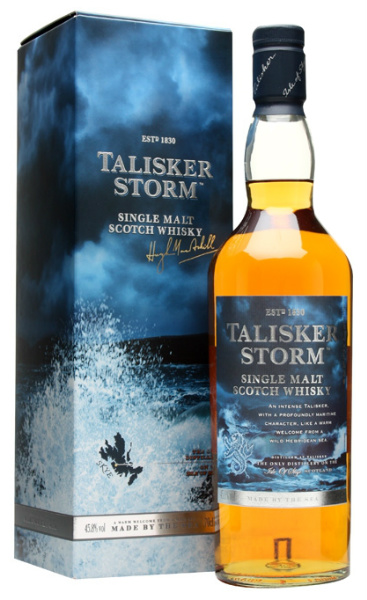
Talisker “Storm” (45.8%, OB, 2013)

Time for another Talisker, and quite a controversial one. Talisker have a very competitive 10yo on offer. One that did change over time. Just compare recent ones to those of ten years ago or twenty, or thirty… Nevertheless, it’s always good and always affordable. Then the time arrived for the NAS expressions, and for Talisker, this Storm was one of the first, and certainly the first that got some big marketing behind it. I remember you could go to your local Port where you could get a dram of “Storm” for free and whilst you were trying it, they aimed their wind-machine at you and threw buckets of water in your face. Talisker is probably the biggest Single Malt brand Diageo own, so a lot seems to be riding on this.

When in 2013 “Storm” arrived, as did “Dark Storm” in travel retail and The Port finished “Port Ruighe”, fans of Talisker were fearing for their beloved 10yo. Surely it would be discontinued? But the faithful 10yo soldiered on. In 2015 Talisker “Skye” arrived, yet another NAS offering, again priced slightly above the 10yo. Are they now going to kill off the 10yo? Nope, it’s still around, although I do still fear for it a bit, and occasionally buy the odd 10yo that is even  on sale quite often. Quite strange, considering discontinuing it would be caused by scarcity. Nevermind.

Earlier I reviewed ‘Neist Point”, a travel retail expression that wasn’t very cheap in some markets. Out came a rant against NAS, but I finished the bottle rather quickly and I have to say I liked it a lot, although a bit overpriced.  “Storm” got a lot of heat from Whisky-drinkers for being more expensive than the 10yo and definitely worse overall. Some even called it the worst whisky they have tasted in a particular year. Today I’m going to have a look at the first batch of “Storm” bought just when it was released. Often first batches tend to be the best…

talisker-stormColor: Light gold.

Nose: Barley, whiffs of new make spirit. Only whiffs, so no cause for alarm. Not bad, but there is some youthfulness noticeable. Nice smoke mixed with some sweetness. Quite lovely. Soft, wet, green and vegetal peat. Not coastal or iodine driven peat. Not Islay. Nutty, a bit of cardboard and fresh. Sweetened black tea, with peach and fern, growing on the forest floor. Quite fruity underneath. Nope, not very complex at first, but it is appetizing and does evolve a lot with some breathing. It is less powerful than the 10yo, although that one also lost some oomph through the years. Nevertheless a quite appealing storm. I like it. It may be younger than the 10yo, but it is well made and balanced. However after giving this Talisker its bold name, the brutal images of heavy waves pounding on jagged rocks and a lion with a fish-tail made of lightning, I expected something of a heavy hitter with lots of heavy young peat, but actually it could be a Talisker, you buy a dram off, at the local ballet school bar. Still beautiful and nice, but Storm? No, a warm breeze at best. Which is excellent, only different. When you smell it proper, it does tick all the boxes. Smoke, peat, fruit, sweetness, well-balanced. Nice development with air, very nice. Excellent nose.

Taste: Barley and cardboard. Sweet and mouth coating. Very nutty, fruity, nutty again and slightly peaty, band from the start, already some balance, but not as much as the nose has. Behind this, quite a lot of sweet, ripe yellow fruits and some minor cardboard again. Not heavy, but the aroma’s are quite big and warming. Just like the nose, it definitely tastes like a Whisky with a good portion of young Whisky blended in. It has an edge tasting like new make. Where the nose reached complexity after breathing and was well-balanced, towards the end of the body the balance is getting a bit, ehhh, unbalanced. Luckily the sweet and fruity aroma’s are big enough to carry it, those are the ones with staying power and make for a nice finish, but the finish itself is not very long. Yes, there is a baby-pepper attack in the finish, typical for Talisker. Especially near the end of the body, and in the finish, the NAS-element shows it’s (ugly) head. I guess it’s this some people scoff at, but calling it their worst? Please dilate your mind!

The 10yo is on offer lots of times, making it even less expensive than all other NAS offerings put on the market by Diageo. So, should you even consider buying one of these NASses? I read a lot of posts on social media of people scoffing at the “Storm”. Well for me this isn’t about winter storms it more of a Whisky for the first colder nights on the end of summer. Sure different from the 10yo, but I’m not sure if it is worse. I actually believe this is a well made Whisky. Compare this to a youthful Springbank and it is maybe just as good. However Springbank as a family owned operation, do get a lot of love from the public. I love Springbank because of its history but also because them make one of the best Whiskies in this modern age. Talisker are owned by Diageo, which is a big, very big, huge money-making drinks giant, and because of that, they don’t get a lot of love. Just look at my reviews of “Neist Point” and this “Storm”, there is a lot of sepsis. When Talisker is viewed by itself, seen apart from the marketing, just looking at the history and the place it comes from, it also is a very good distillery making good Whisky and easily another of my favorites. Both distilleries mentioned use some peat and the profile fits me just right. So I’m not going to criticize this Talisker because there is no need to. It maybe NAS (and easily recognizable as a NAS, especially if you try it after a few other and older Whiskies). It maybe Diageo and it maybe heavily marketed, but the Whisky itself is definitely worth it, especially when you drink it by itself or if it is the one to start you off, but if I had to choose, and considering the price I would prefer…the other one.

Points: 83

Springbank 12yo “Cask Strength” (52.3%, OB, Batch 8, 14/12)

I got this, put it on my lectern, opened it and drank it. That is more or less what happened to it. Sometimes when I believe a Whisky I have open will be needed for future comparison, (to other batches in this case), I take a sample from it and put it in my archive. I had a few drops left in the bottle so I already opened its replacement the 17yo Sherry Wood. When writing the review of this 17yo, I wanted to compare that one to this Cask Strength Batch 8, so I tried to pull up the review of that one, just to find out it didn’t exist. I liked this one so much, I drank it all before ik could write the review! So, out comes this sample I just drew for future reference, not knowing “the future” would descend upon us so soon!

Springbank 12yo Batch 8Color: Light orange gold.

Nose: Meaty and somewhat closed. Waxy and slightly rough. Lots of American oak vanilla. Tar and coal dust. Bourbon vanilla and custard. It also has the fruitiness Springbank gets from using Sherry casks. So its easy to detect it is a blend of both kinds of casks. No secret in this, because probably all expressions of the 12yo Cask Strength are blends of both types of cask. Meaty Sherry notes with a tiny hint of sulphur (matches), but also a breath of something fresher, to all those heavy aromas whiffs by. Nice Springbank peat is also present. Quite sweet and fruity and some paper. Bigger on its aromas, but slightly less complex than older siblings.

Taste: Initially big sweet and waxy. Nice (bitter) wood and again the paper-like quality and a tiny hint of smoke. Sugared almonds and a little sting of peat, aided by the higher ABV, than the 46% of most other Springbanks. The smoke is gone and for the rest of the journey we are accompanied by peat. Not too much though, just enough. When the first sip travels down, more vegetal notes appear. As well as a slight burnt note. The taste seems more about Sherry casks, than it is about Bourbon casks. This doesn’t have to mean that more Sherry casks were used for Batch 8, but the Sherry aromas are dominating. It has a sort of anonymous fruity profile. Red fruits, yes maybe, sugared yellow fruits, yep, probably present as well. Which fruits? Hard to tell actually. Towards the end of the body, before the finish, a slight unbalance happens. Where older Springbanks hold it together, here it shows its relative youth. Still this is a wonderful malt. This finish has all of the body and underlines the wood a bit. It comes as no surprise the finish has pretty good length, wood first, peat next, and in no way as creamy as in the start.

This comes from a now finished bottle, and I have to say, it got better over time. This is one that really needed some time to breathe. I remember being a bit disappointed when I first opened this one. I had just finished the eighteen year old also bottled in 2014, and definitely liked that one better. I really love and adore this one now, but can’t help but feel, that Springbanks need to age a while longer. Comparing this to the 17yo Sherry Wood and the 2014 18yo, you can see the older ones have more matured aromas to them adding to their complexity. With a 12yo Springbank you get a fantastic Whisky which for the quality you get is quite affordable. Sure, you pay a bit more for the 17yo and the 18yo, but you also get more imho. More aroma and definitely more complexity. Having said that, the 12yo Cask Strength series is a wonderful series especially at the prices Springbank are selling it for.

Top tip: Let this breathe, let it breathe in the bottle, (try storing it for a week or so without the cork on it), and let it breathe in your glass. Don’t be hasty with it and if you do you will certainly be rewarded.

Points: 88

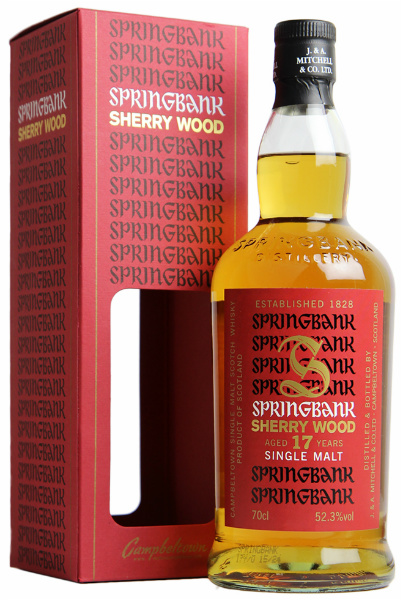
Springbank 17yo 1997/2015 “Sherry Wood” (52.3%, OB, Fresh and Refill Sherry Butts and Hogsheads, 9.120 bottles, 15/24)

When attending the Whisky Show in London last year I absolutely loved this one at the Springbank stand. Sure there were better Whiskies at the show, but also you’d almost have to take out another mortgage on your house to buy those. Nope, I mean, this was definitely one of the best Whiskies at a fair price. Still, over here in Europe this sells for well over a hundred euros. Despite this, it was really a no brainer to buy, and remember, why get only one, when you gen get two for twice the price. When I just recently finished another Springbank, (more about that next time), it was time to finally break out this one. Distilled in 1997 and fully matured in fresh and refill Sherry butts and hogsheads. Possibly, but not necessarily, a combination of european and american oak.

Springbank 17yo SherryColor: Gold.

Nose: Nice, waxy and fresh, powdered vitamin C or should we call it vitamin W from now on? Dusty and dry and definitely lots of Sherry mustiness. Hints of apples (Calvados). Slightly wet forest floor with mushrooms growing. Unripe cold banana, some sweet malts, vanilla and quite vegetal as well. Ashy and slightly smoky (more so than peat). Hints of tar and charred cask and even some new wood, although that isn’t used for this expression. Even though this is 100% Sherry, this smells like a typical Springbank, minus the big sweet creamy vanilla that is, the Bourbon part always brings. Remember, Springbank usually is a blend of Bourbon and Sherry casks. Luckily the Springbank distillate does well in every kind of cask. However, all types of casks used, bring their own flavor to the Springbank spectrum. So there is no better Whisky to try different expressions from. This one reminds me of old Springbank in a way. Coconut and quite fruity as well. Very well made and extremely balanced smell. They are definitely doing everything right. The Sherry smells unbelievably fresh and defined. It must have some casks (if not all) that contained Sherries matured under flor. Fino and Manzanilla that is. I doesn’t smell like typical Oloroso matured Whisky to me, (although very dry Oloroso could be possible). The Sherry notes also smell a bit different from the Sherry in the 12yo Cask Strength. Lovely expression, which would have been nice to compare to the 18yo I reviewed earlier. Alas, that one is already gone, so that is not possible anymore. Bugger.

Taste: Yup, Sherry (from under flor) and typical Springbank. If you love Springbank like I do, it feels like coming home again. Waxy, vanilla and lots and lots of coconut again. Sometimes a bit soapy even. Welcome back: coconut! Peat (more so than smoke) and quite vegetal and fruity. Coconut mixed with almond cookies. Cookie dough and a nice friendly sweetness to it. Toffee. It also has a bite as well. Burnt wood and some peat. On top, as with many modern Sherry casked Whiskies, a slightly acidic red fruitiness that stands out a bit, less integrated so to say. It’s this aroma that dominates the finish as well. Thus the finish is less about the cookies, coconut, toffee and dough. Nevertheless, this one has it all. Super stuff with utter balance. Springbank works very well in Bourbon casks, and although you know what some Bourbon casks would have done to this Whisky, this time I don’t miss them. Nice Sherry expression this is. Well done Springbank!

I’d like to mention, that this review is written just a few minutes after opening the bottle. Springbank is never at its best right after opening the bottle. It’s a big Whisky that needs time to breathe. If you are patient with it and it has time to breathe, wow!

Points: 90

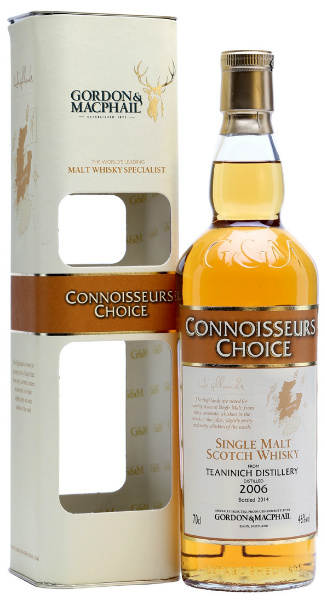
Teaninich 2006/2014 (46%, Gordon & MacPhail, Connoisseurs Choice, First Fill Sherry Hogsheads, AD/JFBG)

More than four years ago I wrote a review about another Teaninich from the Gordon & MacPhail’s Connoisseurs Choice range. That one was distilled in 1983 and bottled in 2003, so that one was bottled before this one was even distilled! Reading back I see the mindset I was in at the time. The first decade I was interested in Single Malt Whisky, I hardly ever bought something that was reduced with water to “drinking strength”. If I bought anything from an independent bottler, it was most certainly bottled at cask strength. Today I still very much like my whiskies at cask strength, but I don’t have a problem anymore buying something reduced, as long as they didn’t reduce it too much. Old malts, distilled in the 50’s, 60’s and 70’s seem to have some power left in them, when bottled at 40% ABV, but more modern malts need a higher a ABV. 43% seemed a bit of a compromise, but the 46% we see today, is doing the trick for me. So, two weeks ago I caught myself red-handed with a bag of no less than four of Gordon & MacPhail’s Connoisseurs Choice bottlings! Go figure. As I’m a fan of Teaninich, I hardly could wait opening this one, so finally I didn’t even manage to wait for 24 hours…

Teaninich 2006/2014 (46%, Gordon & MacPhail, Connoisseurs Choice, First Fill Sherry Hogsheads, ADJFBG)Color: Reddish gold.

Nose: Waxy, fruity and with a nice toasted oak aroma as well. Biscuity and a warm smell of lovely barley and cereal. Right now I already want to stop smelling this, and have a sip, but I’ll wait. The toasted aroma becomes more complex since it turns a wee bit into coal and even boasts a slightly tarry note. A breath of fresh air comes next, laced with alcohol. Reminding me of high quality and ultra soft rye Vodka. Hey, give it a break, it’s a very young Whisky. Bread and toasted bread obviously. Grassy and still waxy. Waxy, red blushed, apple skins? Slightly floral notes mixed in with coffee-creamer. Somewhat sweet and a nice note of vanilla. Since these are Sherry hoggies, I’m guessing the hoggies were made from American Oak. This is only a 7 or 8 years old Whisky, so it shouldn’t be too complex, but you don’t hear me complaining. I understand what it is, and I think it is pretty impressive already, at this age. Well balanced and I guess the casks were pretty good as well. They will do just nicely as second fill casks.

Taste: Definitely starts with a Sherry note. First fill casks all right. I guess they bottled this rather quickly, since the Sherry already starts to dominate the Whisky. My guess would be a Sherry matured under flor. Initially sweet (but not for long, because some white pepper comes to the fore). Waxy again and notes of paper and not of wood, although the paper note seems to make way for a more bitter woody note eventually. A tad funky and slightly less balanced than the nose promised. More Sherry (& flor) wood, with even some slight soapy notes. Don’t worry. Even though this is bottled at 46% ABV., it doesn’t even seem that strong. Sure its fruity, but in a more sugared kind of way. Perfumed lemon curd. Hidden behind the waxy and soapy wood. Surprisingly, the finish isn’t very long, giving away its relative youth.

Let me warn you about the new Gordon & MacPhail packaging. I had an open-topped Whisky bag and the experienced salesman, shoved the metal lids into the cartons instead of leaving them on the cartons. I would have lost them otherwise. I tried this at home and he was absolutely right. Just grabbing the carton and the lid already pops off, weakening the structure, with a possibility of dropping the lot on the floor. This is the 21st century isn’t it? Sort it out people. And it’s not only Gordon & MacPhail. Signatory have tins of which the lid comes popping off as well. The folded cardboard stuff some Diageo bottlings come in, can spontaneously unfold under your arm when carrying slightly too much Whisky at a time. That way I saw a bottle of Talisker slowly disappear from under the firm grip of my armpit onto the welcoming tiled floor.

Points: 84

16-3-2017: I just finished this bottle and I have to add that it got gradually better over time. This really needs to breathe to show all of its huge potential, even though its just a reduced young Whisky. A have a soft spot for Teaninich and this one really didn’t dissapoint me again. I Love it. I’ll give it a point more, and maybe I should have given two…

Points: 85

Glen Keith 21yo 1992/2014 (57.5%, Signatory Vintage, Cask Strength Collection, Bourbon Barrels #120566 & #120569, 271 bottles)

Whereas most of the reviews written come from samples accumulated over many years, it doesn’t mean I don’t open any bottles, because I do. Just click on “Whisky from Master Quills Lectern” down below, and in an instant you can see which reviews were written about bottles I have, or had, in my collection. Bottles I believed were worthy of buying, very often without even tasting them. Glen Keith is no stranger on these pages, which is no surprise actually. I rather like my Glen Keiths, and Strathisla, it’s sister distillery. Both reside on the same premises. Pernod Ricard, the owners, aren’t doing very much with Glen Keith (yet), so it is a bit of a hidden treasure, only known to aficionados and connoisseurs (I hate those words). Strathisla’s sister-distillery has been featured already three times before on these pages. One stellar one from the sixties, just as good as the legendary Strathisla’s from that era. Two more were reviewed, both from the nineties: 1990 and even one from 1992, just like this one.

Glen Keith 21yo 1992/2014 (57.5%, Signatory Vintage, Cask Strength Collection, Bourbon Barrels #120566 & #120569, 271 bottles)Color: Full gold.

Nose: Wonderfully creamy and appealing. Only one sniff suffices to let us know we’ll be enjoy this thoroughly. I can’t imagine anything smelling so nice being not enjoyable to taste. Bourbon barrels so yes, nice vanilla and creamy notes, as well as some tension from woody spices partly young wood. Milk chocolate. Next some nice florality emerges as opposed to fruity notes often found in ex-Bourbon barrels. Fresh, not roasted, nuts. Dusty and vibrant at the same time. Not only floral, but also some acidic fruitiness comes to the fore, just don’t smell it too vigorously, the cream overpowers it then and makes it smell sweet. Enough happening in this one, although it may not be the most complex stuff around.

Taste: Fruity and nutty. Almonds. Waxy and chewy. Delayed pepper. Again with nice chocolate sprinkled wood and just like the nose, it tastes sometimes sappy and young. As if new wood staves were added to a rebuilt barrel. This would be highly unlikely though. Sawdust as well. Plywood? People who read everything on Master Quill, know that I dislike not-so-well integrated acidity that lies on top. Abuelo 12yo comes to mind. This Whisky also has an acidic note that lies on top, only this time it works a bit. Amazing. Just like the nose, the Whisky doesn’t seem to be extremely complex. However, the body of the Whisky is so big, that it manages to deal with the acidic high note.

Sure, reduced Whisky is extremely drinkable, but Cask Strength delivers a punch, but also presents flavours to you on a silver platter. The finish has great length and lingers on, seemingly forever, in the aftertaste. Smells nice, tastes even better. Water enhances the nutty creaminess of the nose and at the same time downplaying the woody aromas, making it even bigger and creamier, but also less sophisticated. In the taste, the acidity is given a lager role to play, which in the end alters the balance of the Whisky, making it less balanced in fact. It also adds some complexity with chili pepper and some mint. The finish is more about milk chocolate than it was before adding water. So it might be fun to experiment a bit with water.

For me, something like this is a no brainer. Its more than 20 years old, came from nice active barrels, and gives you heaps of flavour, and a lot of alcohol to boot, so you can play around with it, adding some water with a pipette. If you can’t find this particular bottling, don’t hesitate buying one by another bottler, or one of it sister casks bottled by Signatory Vintage instead, I understand they are all good, and some even better! Some are still available, so what are you waiting for?

Points: 87

Caol Ila 1991/2000 (46%, Wilson & Morgan, Barrel Selection)

This Caol Ila is one I just cracked open, literally. It is an oldie I bought some 15 years ago. Sure it is a reduced independent bottling, and it didn’t cost much, but its a Caol Ila and its bottled by Wilson & Morgan, who have bottled a lot of good Caol Ila’s, just have a look at this 24yo expression distilled in 1975, to name but one. The cork broke on this one. This time it didn’t only just break off, it seemed to disintegrate completely. Vaporized into thin air, so to speak. Luckily most of the crumbs were easy to fish out of the bottle and hardly anything sank to the bottom. Just a few weeks ago I wrote an ode to the screw cap, now you know why… Karma strikes again.

Caol Ila 1991/2000 (46%, Wilson & Morgan, Barrel Selection)Color: Pale gold.

Nose: Ahhh, right after pouring the room filled with the smell of beautiful peat. Nothing harsh and rough, but smooth and refined. Nice, clean and soft and aromatic peat. Helped along with a citrussy fruitiness. Well-balanced and much nicer to smell than the Kilchoman Spring I reviewed (much) earlier. Smells quite sweet. Leafy and chewy. Dry vanilla powder, maybe even some powdered coffee-creamer. Some hidden tar, but also an expansion on the fruits. We have hints of sweet, ripe pineapple, mango and banana, mixed with vanilla from the wood, and the wood itself somehow didn’t make it. Crushed beetle and some distant dried basil in the background. Remarkable. Ohhh yes, and some bonfire smoke. I nearly forgot to write that down! I have to say it again, well-balanced stuff and remember, this isn’t even ten years old, which today has become standard.

Taste: Quite sweet on entry. Sugar water. Syrup. Very fruity and a little hoppy bitterness. Big and chewy. Sweet, funky and nutty peat. Not at all earthy. Nice touch of smoke, but not much. It’s like all the aromas are fighting over front row seats. As mentioned, there is a lot of sweetness, that exerts itself right from the start, but these is a lot of fruitiness as well. The Whisky is also nuts. I mean, full of nuttiness. All big and all upfront. I always get some coffee in good Caol Ila’s, and this time is no exception. Sweet coffee, with a tad of toffee in the coffee. It’s not stong black coffee but rather a sweet Cappuccino or Latte Macchiato. Underneath a nice, herbal and lightly bitter undertone (from oak). Long finish and similar aftertaste. Leaves me behind with salty lips. Good Whisky! I hope todays young Caol Ila’s are just as good and affordable.

Ohhh these were the days, where young Whisky seemed better than it is these days, or maybe I’m biased.  This is a very tasty Caol Ila, not overly complex and one I’ll come back to again and again. This will not take years to empty, which it usually takes me, since there are lots of open bottles around the place…

Today there is much ado about young Whiskies, especially NAS Whiskies. It seems NAS isn’t really accepted by everybody. It sometimes is viewed as a devilish plan selling us inferior and immature Whisky (sometimes at a premium price). On the other hand, when distilleries and independent bottlers alike, just mention an age statement of a young whisky there doesn’t seem to be much of a problem anymore, since you know what you’re getting. Just look at the recently released Lagavulin 8yo and compare that to the plethora of NAS Taliskers (also owned by Diageo) and NAS Laphroaigs (not owned by Diageo), which seem to be under par and the fantasy names do not help the acceptance process of the (educated) public, or those who have seen different times buying Single Malt Whiskies.

For the fun of it, let’s compare this “9yo” Caol Ila to the NAS Talisker ‘Neist Point’. Smelling the Talisker after the Caol Ila, it is remarkable how much the Talisker smells of grainy immature Whisky and even shows some whiffs of new make! Much more than when smelled by itself alone. Although having new make in the mix is illegal, since Whisky must be at least 3 years old, there must be a big component of very young Whisky in the Talisker. The Caol Ila behaves like a 9yo, nice, well made, good cask, but lacking some of the complexity often brought to a Whisky by extensive maturation. In the taste it is noticeable that the Talisker has some more happening than just the new make, and young Whisky, alone. Thank God almighty. The Talisker needs some air to get the new make out, after that it is not bad, not bad at all. Sweet as well and buttery. The taste of the Talisker grows on you, even though the new make never really leaves the scene. A draw, or is it? Considering the amount of money Diageo wants for the Talisker (in some markets), the jury made a unanimous decision in favour of the Caol Ila. [sound of judge’s hammer on wood]

Points: 85

Lagavulin 12yo 1995/2008 (48%, OB, European Oak, for the Friends of the Classic Malts)

So with the longest day of the year at hand, some would say that this isn’t the time for Peat. Peat needs rugged shores, strong gale force winds and driving rain to be thoroughly enjoyed, doesn’t it? Why not take a light, grassy and lemony Lowlander instead, or even some tropical stuff? Well what can I say, I just felt like it, that’s all.

A week ago I hosted a Whisky-tasting centered around the indie bottler, Signatory Vintage. I opened some bottlings of them, which will feature on these pages soon. Of course a good tasting needs an even better after-tasting, like a good party needs an even better after-party. The after-tasting, yes you’ve guessed it: Lagavulin. The distillery that’s celebrating its 200th anniversary this year, with the release of a 8yo, which will also feature on these pages shortly.

But first this oldie (but goldie). Relatively speaking of course. This Lagavulin was released in 2008 and it took well into 2015 to sell out. It was available in shops for a whopping 7 years! Now that its gone, prices are soaring. It was available for such a long time, because there may have been a lot of bottlings around, but it also gained a bit of a reputation. A lot of people, including fans of Lagavulin weren’t very fond of this particular bottling. I consider myself a fan of Lagavulin, so I just has to open it, and try for myself! But first a thought…

Bottlings like this, baffle me to the max. All this time we hear the industry explaining to us, that colouring is done to ensure consistency in colour from batch to batch. Also, the public, when buying Whisky, or any other brown spirit, may be put off when the aforementioned spirit is too light in colour. So why then is this one-off Lagavulin, bottled in a brown glass bottle, coloured with E150, when we, the public can’t even see the colour of the spirit untill after the purchase? Boggles the mind, and mind you, don’t go around thinking that caramel colouring doesn’t affect the taste, because it does, just read Michel’s article back from the day I used to be in the “Coloured Gang”. Sure, it may be a bit lengthy, but it definitely worth it.

Lagavulin 12yo 1995/2008 FFOTCMColour: Orange brown, just like a Bourbon.
Nose: Excellent smoky nose. It starts with more smoke than peat. Sure peat is next. Earthy, sweet and fatty clay. Ashes. Nice wood, accompanied by red fruity notes and some Italian laurel licorice as well. The fruity bit smells more yellow than red. Funky chewy sweetness. Cream Sherry. Mocha cream, cookie dough and light chocolate powder. Leather. Milk chocolate shavings on vanilla ice-cream held up by the wood. Again a lovely smelling Lagavulin, which always works well when it’s matured in Sherry casks. Hints of tar and also some spices. The creamy Sherry notes overpower the spices a bit, so its hard to tell them apart. If you have read the article I mentioned above, you might remember my comments about mellowing out the aroma’s by E150. I feel that is the case here also. This Lagavulin has a nice, very nice actually, but rounded out smell.

Taste: Quite sweet and creamy on entry, quickly followed by peat and toasted cask. Small vegetal bitter note. Very nice. Lots of sweet licorice, almonds and black and white powder. Pepper & salt and definitely some smoke and nuts. Smoked nuts? Smoked sweet almonds (not the salty ones). Red cocktail cherry and a whiff of artificiality in the fruit department. The sweetness is of the typical sugar-water kind. Its fantastic on entry, but the body is losing it at bit already. Falling apart and being quite simple. In no way, has the finish the length of other Lagavulins, but the one big taste lingers on for a while in the aftertaste. However, it’s more the sweet and fruity bit, with only a hint of smoke, than the peat.

This Lagavulin has matured in first fill Sherry casks, not made with American oak. There was a time when (probably) all Sherry matured in European oak butts and puncheons, which are quite large casks. Today a lot of Sherry casks are made from American oak, impairing vanilla and giving off a more creamy feel. Also the casks made today (hogsheads) are smaller than the butts and puncheons, thus allowing for some quicker maturation.

Let me start by saying this is a good Lagavulin. It drinks easily and there is more than enough happening. I like it a lot. However, if I compare this to other Lagavulins, it isn’t the best one out there. I believe the colouring did its part in mellowing out the aroma’s and blending them together into one big (nice) taste. Nothing sticks out really. Apart from the E150, the casks themselves probably weren’t the best money could buy as well, as well as its previous contents. So for a Lagavulin its good, but nothing more than that, but it’s also a Whisky most others can only dream of producing. Lagavulin has stiff competition from… itself.

Points: 88


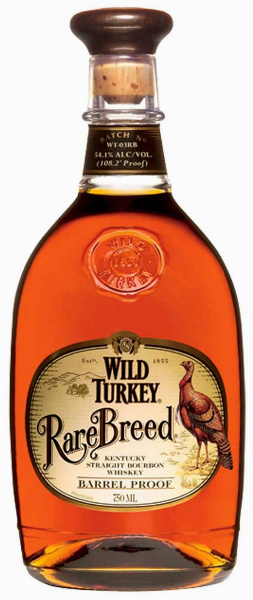
Wild Turkey “Rare Breed” (54.1%, OB, WT-03RB)

The story of Wild Turkey starts with two Irish brothers called James and John Ripey. In 1855, they came to America from Tyrone, Ireland to start a store, selling general goods. They settled on the banks of the Kentucky river near Lawrenceburg, underneath some limestone cliffs. They named their plot “Tyrone”. In 1869 they opened their first distillery. The first distillery quickly became too small, and a new facility was built in 1873, which expanded quickly. The whiskey they made had quite a reputation and was chosen to represent Kentucky at the World Fair.

During prohibition, the distillery still made some Whiskey, for medicinal purposes, and was sold by Austin, Nichols a wholesale grocer specializing in tea, coffee and Spirits, but concentrated solely on Wines and Spirits by 1939. By the way, even in 1939, there was no Wild Turkey in sight. Not the brand anyway, but there seemed to be a bird, yes, a wild turkey.

In 1940 Thomas McCarthy from Austin, Nichols took some samples of 101 proof Whiskey with him on an annual shooting trip to South Carolina, shooting wild turkeys. Since then the party asked for that “Wild Turkey Whiskey”. In 1952 the Ripey family sold the distillery to the Gould brothers, which in turn, sold it off to Pernod Ricard in 1980. By 2009 The Campari Group took ownership of the distillery.

Wild Turkey Rare Breed (54.1%, OB, WT-03RB)Color: Orange brown.

Nose: Wonderful fresh and slightly floral. Just the right amount of wood. Development starts quickly when it gets some air. Becomes very nutty and a bit funky as well. Definite aroma’s of clear glue. Velpon. Dumbed down fresh leather with cookie dough. With even some more air, the nutty part transforms into oak, with still some funky organics going on. It’s not a particular sulphury smell, but it does smell like a compound with sulphur. In the end it settles down, giving off a nice and silky smooth smell. Soft with some obvious vanilla and hints of honey.

Taste: Sweet on entry, but also with quite a white pepper attack. Lots of wood is noticeable now. With the wood the sweetness is almost gone, drying out the whole. Lots of rye florality with powdery and silky smooth vanilla with some tannins. Thin corn sweetness, definitely made with a high rye mashbill. The more this breathes, the more pronounced the rye gets. In fact, one can say the rye takes over. Especially the finish is dominated by the rye florality. The finish is multi layered because even when dominated by the rye, (for a while the rye even gets a bit soapy), the longer you wait the more the wood gets to play a role, although never the lead.

The WT-03RB batch ended somewhere in 2014, and is replaced by a new batchless Rare Bread. I’m told the new batch is younger and lighter, even in color. So the advice would be, get one of the older batches if you get the chance.

Points: 82

Amrut 4yo 2009/2013 (60%, OB, Single Cask, for Europe, Virgin Oak & First Fill Bourbon Barrel #3445, 172 bottles)

Maybe Amrut is a true Malternative, because it’s another Malt Whisky. If you love Scottish Single Malts best, why look at other distillates? They are just different. Other distillates can broaden your horizon, but will not replace your Single Malt that has become too expensive. For instance look outside of Scotland.

Looking back I seem to like Amrut. This is now the third review, and after the Intermediate Sherry (87 points) and the Portonova (88 points), this is something of a speciality. Maybe I should take that back. Most Amruts are in fact specialities. Something out of the box is often done. Maturing on two continents, or blending many different casks together, to name but a few of things Amrut does.

This time a single cask bottling. Often, you will have a Whisky that has matured in a first fill or second fill Bourbon cask, barrel or hogshead, but no, Amrut had to do it differently. This particular example was first matured in charred virgin oak and then transferred into a first fill Bourbon barrel. Barrels being the original casks Bourbon matures in, where hogsheads are remade casks from the staves of barrels. Hogsheads are bigger than barrels. Most barrels are shipped in staves anyway.

There is some additional useful information on the label as well. I like that. In the four years this Whisky has been maturing, 42% has evaporated over time, as compared to around 8% in that evaporates is Scotland over the same period of time. By the way, unpeated (six row) Indian barley was used.

Amrut Single Cask #3445Color: Gold.

Nose: The first whiff that enters my nose is of virgin oak. Creamy sawdust and vanilla. Although only four years old, at the fast forward maturation rate, this can be called a woody Whisky. The typical American oak notes are here, but I actually miss the typical Amrut spiciness. Amrut is indian, and Indian Whisky should be a bit exotic, not just another copy of Scottish Whisky. This Amrut does hide it Indian. After some vigorous movement in the glass and some patience, there is exotic spice emerging and apart from that the Whisky becomes a bit dusty.

Taste: Initially hot and then an explosion of sweet Vanilla. When the thick vanilla, travels down, quite some (virgin) oak, emerges here in the taste as well. So we have wood and vanilla. What else? Over the top vanilla combined with hot butter. Just as with the nose this needs air to show some exotic spices. Luckily it’s Indian-ness is here at last. Spicy hot sawdust from Massaranduba. A very hard tropical wood. It’s so hard in fact that you can’t cut it without the saw charring the wood. This slightly sour odour is very similar to the spiciness of this Whisky, especially in the taste of it.

I mentioned decanting Whisky before. This Amrut is one that needs a lot of air as well to fully blossom. This is still a pretty full bottle, but already there is a difference to the first taste of the freshly opened bottle. I will score it now (after lots of air in the glass), but I feel this will grow even better and more balanced over time. This may very well be an example of a Whisky where the last drop from the bottle will be the best drop.

Points: 88

The initial score was 86 points, but as I expected, this got only better over time. The bottle is gone now, but the last third scored an easy 88 Points. Again lesson learned. Give it time to breathe…

Talisker “Neist Point” (45.8%, OB, for Travel Retail)

Just a few weeks ago this new Talisker was released, not by Diageo, but by Diageo Global Travel and Middle East (GTME). What? I don’t know why, but why do I have the feeling I’m being more and more conned? First, lets back up a bit. Not so long ago you had Talisker’s with age statements like 10yo, 12yo, 20yo, 25yo and 30yo, I said, not so long ago. Longer ago we had a stellar 8yo as well. At a certain point, again, not so long ago, the 18yo was released. All of a sudden, the stocks were depleted and the owners saw that Whisky was fetching silly money all across the board. I get that, because you’re in business to make a lot of money, hopefully, so I get the prices that are asked today. It’s a question of simple economics, supply and demand. Supply, somewhat unknown, the demand high.

Screen-Shot-2015-04-09-at-9.59.34-AMConned I said. Now, we are getting NAS Whiskies, and I tell you why. We need a lot of stock of older Whiskies to make high-priced Whiskies with an age statement again for the future. Well the price I mention is uncertain, because you never know what we the public are willing to pay for our Talisker 18yo in ten years’ time. Thus a lot of young Whisky must be released with some added older Whiskies for taste, because Diageo found out that the traveller is mainly concerned with taste and not age.

So we saw a lot of young Whiskies enter the market place and top money is spent to convince us that it’s all about taste and not age, well, we are made to forget that age matters a lot when it comes to taste! As I said above, I understand that I have to shell out some serious money for my Talisker 18yo, 25yo and 30yo, but that’s my choice, since I do love those expressions, but I can decide myself if I want to spend that kind of money, now or in the future. Diageo doesn’t really care because if I won’t spend that money, someone else will, because we see a lot of people paying a lot of money for Whiskies these days. And it’s almost no use looking elsewhere (other distillates), since those prices are soaring as well.

So conned I feel (Yoda speak), because the latest Taliskers don’t have numbers anymore, but names. Storm, Skye, Dark Storm and now Neist Point. As I said before, there used to be a stellar 8yo, a stellar (Tomatin) 5yo, etc. Today those numbers are not wanted, not because they are low, lower than the modern standard, the 10yo, no. Those numbers are unwanted because they are still too high and still too much a restriction. And since we already made a leap in yield per field of barley, today’s young Whisky can’t be compared to the 5yo of yesteryear. The quality od Sherry cask today is also different from the old ones. So lots and lots of young Whisky is sold to us through NAS bottlings. Yes it’s about taste, but no, not that much young Whisky can be so good as is claimed, and that’s my conned feeling right there. I’m indoctrinated and I’m made feeling stupid by claiming that age doesn’t matter (never did) and hiding behind the statement that only taste matters.

Conned some more I say: Why the mystery? Making up a name, fine, give your Whisky the name of a lighthouse or a Hyundai car. It’s fine, I like the names and I like the screen printed lighthouse on the Neist Point bottle. We all know it’s mostly young Whisky, with some added older casks to meet a desired flavour profile. Diageo claims that the traveller doesn’t care for age, but does care for taste, but the traveler speaks some more, the traveller also wants smooth Whisky, the traveller wants smooth Talisker. But why? Talisker smooth? Laphroaig is also being made smooth. Why? Can’t we have anything not smooth anymore? Didn’t we like Talisker and Laphroaig rough? wasn’t Talisker called the lava of the Cuillins? Lava as in not smooth? Hot and peppery!

Even more conning: It was said that Neist Point (The Whisky, not the lighthouse) has a huge depth of flavour and showcases a wider range of Talisker characteristics. Combining precisely selected flavoured Whiskies with some of Talisker’s rarest and smoothest mature stocks. Yeah right. Will those of you that believe this raise their hand? Am I really to believe the rarest of all Talisker stock went into this and are not released as super-duper premium Whiskies now and especially in the future?

So instead of a nice rambling about the new Talisker I started ranting, sorry for that, it never happened to me before. Critical yes, ranting, nope. Why not try this new expression of Talisker and see if it still has some lava in it. By the way, in the past Douglas Laing bottled some smooth Talisker’s. Back then, these casks didn’t match the Talisker profile and were sold off to be used in blends, now they are especially sought out and used for Talisker Neist Point… [fanfare music is playing and curtain rises…]

Talisker Neist Point (45.8%, OB, for Travel Retail)Color: Gold.

Nose: Some light smoke. Barley sweetness, and some old Sherry wood. Tiny hint of cask toast, but very mellow altogether. Hints of citrus. There is some sweetish freshness in the back, lemon and unripe tangerines. Crushed fresh almonds, mixed with some sweet and fatty peat. Mind you not a lot. When you close your eyes and someone pulls the glass away, a more fruity note stays behind and not a peaty one. Slightly warming.

Taste: Sweet, barley and nutty, again lots of almonds. Sweet lovely peat. (Springbank style). Extremely drinkable, but even after the first sip it is lacking some power and doesn’t hang around in the mouth for too long. Fruity, but more about yellow fruits. Dried apricots and pineapple. A little bit of toasted wood. Thick clay in the finish, which is nice, but the rest of the finish is about immature and young Whisky. Young can be mature, immature just isn’t mature. No pepper attack, so how’s this a Talisker? Short and a bit unbalanced finish, with a beer like note and fresh barley as the last of the aroma’s.

After the rant above, some of you maybe expected I would hate this Talisker, but in fact I wrote the piece above before even tasting Neist Point. It is how I feel, maybe I’m wrong, who knows. Neist Point is what I thought it would be, nice, smooth, extremely drinkable, but also a bit immature, and the rarest of Talisker casks didn’t hide that. Maybe more of those casks should have gone in?

In the end it’s not bad, but not spectacular either. If they really want to sell this for 150 euro’s, pounds or dollars, I feel it’s too expensive. I paid half of that for my bottle and that would seem more than enough. Sometimes it reminds me of Springbank 18yo and obviously the smooth 1980 Tactical from Douglas Laing. Both are better Whiskies with much longer finishes. Spend your money on that I would say, although the Tactical is hard to get these days.

Points: 85