Lagavulin 12yo 1995/2008 (48%, OB, European Oak, for the Friends of the Classic Malts)

So with the longest day of the year at hand, some would say that this isn’t the time for Peat. Peat needs rugged shores, strong gale force winds and driving rain to be thoroughly enjoyed, doesn’t it? Why not take a light, grassy and lemony Lowlander instead, or even some tropical stuff? Well what can I say, I just felt like it, that’s all.

A week ago I hosted a Whisky-tasting centered around the indie bottler, Signatory Vintage. I opened some bottlings of them, which will feature on these pages soon. Of course a good tasting needs an even better after-tasting, like a good party needs an even better after-party. The after-tasting, yes you’ve guessed it: Lagavulin. The distillery that’s celebrating its 200th anniversary this year, with the release of a 8yo, which will also feature on these pages shortly.

But first this oldie (but goldie). Relatively speaking of course. This Lagavulin was released in 2008 and it took well into 2015 to sell out. It was available in shops for a whopping 7 years! Now that its gone, prices are soaring. It was available for such a long time, because there may have been a lot of bottlings around, but it also gained a bit of a reputation. A lot of people, including fans of Lagavulin weren’t very fond of this particular bottling. I consider myself a fan of Lagavulin, so I just has to open it, and try for myself! But first a thought…

Bottlings like this, baffle me to the max. All this time we hear the industry explaining to us, that colouring is done to ensure consistency in colour from batch to batch. Also, the public, when buying Whisky, or any other brown spirit, may be put off when the aforementioned spirit is too light in colour. So why then is this one-off Lagavulin, bottled in a brown glass bottle, coloured with E150, when we, the public can’t even see the colour of the spirit untill after the purchase? Boggles the mind, and mind you, don’t go around thinking that caramel colouring doesn’t affect the taste, because it does, just read Michel’s article back from the day I used to be in the “Coloured Gang”. Sure, it may be a bit lengthy, but it definitely worth it.

Lagavulin 12yo 1995/2008 FFOTCMColour: Orange brown, just like a Bourbon.

Nose: Excellent smoky nose. It starts with more smoke than peat. Sure peat is next. Earthy, sweet and fatty clay. Ashes. Nice wood, accompanied by red fruity notes and some Italian laurel licorice as well. The fruity bit smells more yellow than red. Funky chewy sweetness. Cream Sherry. Mocha cream, cookie dough and light chocolate powder. Leather. Milk chocolate shavings on vanilla ice-cream held up by the wood. Again a lovely smelling Lagavulin, which always works well when it’s matured in Sherry casks. Hints of tar and also some spices. The creamy Sherry notes overpower the spices a bit, so its hard to tell them apart. If you have read the article I mentioned above, you might remember my comments about mellowing out the aroma’s by E150. I feel that is the case here also. This Lagavulin has a nice, very nice actually, but rounded out smell.

Taste: Quite sweet and creamy on entry, quickly followed by peat and toasted cask. Small vegetal bitter note. Very nice. Lots of sweet licorice, almonds and black and white powder. Pepper & salt and definitely some smoke and nuts. Smoked nuts? Smoked sweet almonds (not the salty ones). Red cocktail cherry and a whiff of artificiality in the fruit department. The sweetness is of the typical sugar-water kind. Its fantastic on entry, but the body is losing it at bit already. Falling apart and being quite simple. In no way, has the finish the length of other Lagavulins, but the one big taste lingers on for a while in the aftertaste. However, it’s more the sweet and fruity bit, with only a hint of smoke, than the peat.

This Lagavulin has matured in first fill Sherry casks, not made with American oak. There was a time when (probably) all Sherry matured in European oak butts and puncheons, which are quite large casks. Today a lot of Sherry casks are made from American oak, impairing vanilla and giving off a more creamy feel. Also the casks made today (hogsheads) are smaller than the butts and puncheons, thus allowing for some quicker maturation.

Let me start by saying this is a good Lagavulin. It drinks easily and there is more than enough happening. I like it a lot. However, if I compare this to other Lagavulins, it isn’t the best one out there. I believe the colouring did its part in mellowing out the aroma’s and blending them together into one big (nice) taste. Nothing sticks out really. Apart from the E150, the casks themselves probably weren’t the best money could buy as well, as well as its previous contents. So for a Lagavulin its good, but nothing more than that, but it’s also a Whisky most others can only dream of producing. Lagavulin has stiff competition from… itself.

Points: 88
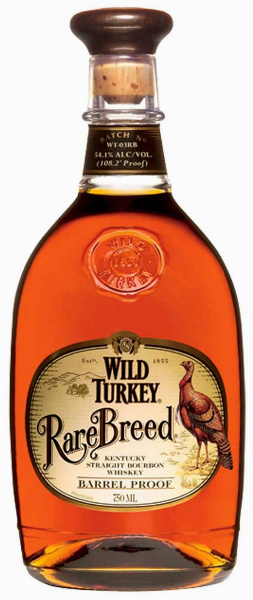
 

Wild Turkey “Rare Breed” (54.1%, OB, WT-03RB)

The story of Wild Turkey starts with two Irish brothers called James and John Ripey. In 1855, they came to America from Tyrone, Ireland to start a store, selling general goods. They settled on the banks of the Kentucky river near Lawrenceburg, underneath some limestone cliffs. They named their plot “Tyrone”. In 1869 they opened their first distillery. The first distillery quickly became too small, and a new facility was built in 1873, which expanded quickly. The whiskey they made had quite a reputation and was chosen to represent Kentucky at the World Fair.

During prohibition, the distillery still made some Whiskey, for medicinal purposes, and was sold by Austin, Nichols a wholesale grocer specializing in tea, coffee and Spirits, but concentrated solely on Wines and Spirits by 1939. By the way, even in 1939, there was no Wild Turkey in sight. Not the brand anyway, but there seemed to be a bird, yes, a wild turkey.

In 1940 Thomas McCarthy from Austin, Nichols took some samples of 101 proof Whiskey with him on an annual shooting trip to South Carolina, shooting wild turkeys. Since then the party asked for that “Wild Turkey Whiskey”. In 1952 the Ripey family sold the distillery to the Gould brothers, which in turn, sold it off to Pernod Ricard in 1980. By 2009 The Campari Group took ownership of the distillery.

Wild Turkey Rare Breed (54.1%, OB, WT-03RB)Color: Orange brown.

Nose: Wonderful fresh and slightly floral. Just the right amount of wood. Development starts quickly when it gets some air. Becomes very nutty and a bit funky as well. Definite aroma’s of clear glue. Velpon. Dumbed down fresh leather with cookie dough. With even some more air, the nutty part transforms into oak, with still some funky organics going on. It’s not a particular sulphury smell, but it does smell like a compound with sulphur. In the end it settles down, giving off a nice and silky smooth smell. Soft with some obvious vanilla and hints of honey.

Taste: Sweet on entry, but also with quite a white pepper attack. Lots of wood is noticeable now. With the wood the sweetness is almost gone, drying out the whole. Lots of rye florality with powdery and silky smooth vanilla with some tannins. Thin corn sweetness, definitely made with a high rye mashbill. The more this breathes, the more pronounced the rye gets. In fact, one can say the rye takes over. Especially the finish is dominated by the rye florality. The finish is multi layered because even when dominated by the rye, (for a while the rye even gets a bit soapy), the longer you wait the more the wood gets to play a role, although never the lead.

The WT-03RB batch ended somewhere in 2014, and is replaced by a new batchless Rare Bread. I’m told the new batch is younger and lighter, even in color. So the advice would be, get one of the older batches if you get the chance.

Points: 82

Amrut 4yo 2009/2013 (60%, OB, Single Cask, for Europe, Virgin Oak & First Fill Bourbon Barrel #3445, 172 bottles)

Maybe Amrut is a true Malternative, because it’s another Malt Whisky. If you love Scottish Single Malts best, why look at other distillates? They are just different. Other distillates can broaden your horizon, but will not replace your Single Malt that has become too expensive. For instance look outside of Scotland.

Looking back I seem to like Amrut. This is now the third review, and after the Intermediate Sherry (87 points) and the Portonova (88 points), this is something of a speciality. Maybe I should take that back. Most Amruts are in fact specialities. Something out of the box is often done. Maturing on two continents, or blending many different casks together, to name but a few of things Amrut does.

This time a single cask bottling. Often, you will have a Whisky that has matured in a first fill or second fill Bourbon cask, barrel or hogshead, but no, Amrut had to do it differently. This particular example was first matured in charred virgin oak and then transferred into a first fill Bourbon barrel. Barrels being the original casks Bourbon matures in, where hogsheads are remade casks from the staves of barrels. Hogsheads are bigger than barrels. Most barrels are shipped in staves anyway.

There is some additional useful information on the label as well. I like that. In the four years this Whisky has been maturing, 42% has evaporated over time, as compared to around 8% in that evaporates is Scotland over the same period of time. By the way, unpeated (six row) Indian barley was used.

Amrut Single Cask #3445Color: Gold.

Nose: The first whiff that enters my nose is of virgin oak. Creamy sawdust and vanilla. Although only four years old, at the fast forward maturation rate, this can be called a woody Whisky. The typical American oak notes are here, but I actually miss the typical Amrut spiciness. Amrut is indian, and Indian Whisky should be a bit exotic, not just another copy of Scottish Whisky. This Amrut does hide it Indian. After some vigorous movement in the glass and some patience, there is exotic spice emerging and apart from that the Whisky becomes a bit dusty.

Taste: Initially hot and then an explosion of sweet Vanilla. When the thick vanilla, travels down, quite some (virgin) oak, emerges here in the taste as well. So we have wood and vanilla. What else? Over the top vanilla combined with hot butter. Just as with the nose this needs air to show some exotic spices. Luckily it’s Indian-ness is here at last. Spicy hot sawdust from Massaranduba. A very hard tropical wood. It’s so hard in fact that you can’t cut it without the saw charring the wood. This slightly sour odour is very similar to the spiciness of this Whisky, especially in the taste of it.

I mentioned decanting Whisky before. This Amrut is one that needs a lot of air as well to fully blossom. This is still a pretty full bottle, but already there is a difference to the first taste of the freshly opened bottle. I will score it now (after lots of air in the glass), but I feel this will grow even better and more balanced over time. This may very well be an example of a Whisky where the last drop from the bottle will be the best drop.

Points: 88

The initial score was 86 points, but as I expected, this got only better over time. The bottle is gone now, but the last third scored an easy 88 Points. Again lesson learned. Give it time to breathe…

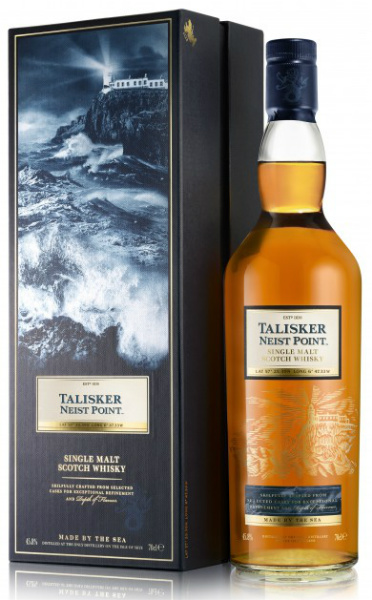
Talisker “Neist Point” (45.8%, OB, for Travel Retail)

Just a few weeks ago this new Talisker was released, not by Diageo, but by Diageo Global Travel and Middle East (GTME). What? I don’t know why, but why do I have the feeling I’m being more and more conned? First, lets back up a bit. Not so long ago you had Talisker’s with age statements like 10yo, 12yo, 20yo, 25yo and 30yo, I said, not so long ago. Longer ago we had a stellar 8yo as well. At a certain point, again, not so long ago, the 18yo was released. All of a sudden, the stocks were depleted and the owners saw that Whisky was fetching silly money all across the board. I get that, because you’re in business to make a lot of money, hopefully, so I get the prices that are asked today. It’s a question of simple economics, supply and demand. Supply, somewhat unknown, the demand high.

Screen-Shot-2015-04-09-at-9.59.34-AMConned I said. Now, we are getting NAS Whiskies, and I tell you why. We need a lot of stock of older Whiskies to make high-priced Whiskies with an age statement again for the future. Well the price I mention is uncertain, because you never know what we the public are willing to pay for our Talisker 18yo in ten years’ time. Thus a lot of young Whisky must be released with some added older Whiskies for taste, because Diageo found out that the traveller is mainly concerned with taste and not age.
So we saw a lot of young Whiskies enter the market place and top money is spent to convince us that it’s all about taste and not age, well, we are made to forget that age matters a lot when it comes to taste! As I said above, I understand that I have to shell out some serious money for my Talisker 18yo, 25yo and 30yo, but that’s my choice, since I do love those expressions, but I can decide myself if I want to spend that kind of money, now or in the future. Diageo doesn’t really care because if I won’t spend that money, someone else will, because we see a lot of people paying a lot of money for Whiskies these days. And it’s almost no use looking elsewhere (other distillates), since those prices are soaring as well.

So conned I feel (Yoda speak), because the latest Taliskers don’t have numbers anymore, but names. Storm, Skye, Dark Storm and now Neist Point. As I said before, there used to be a stellar 8yo, a stellar (Tomatin) 5yo, etc. Today those numbers are not wanted, not because they are low, lower than the modern standard, the 10yo, no. Those numbers are unwanted because they are still too high and still too much a restriction. And since we already made a leap in yield per field of barley, today’s young Whisky can’t be compared to the 5yo of yesteryear. The quality od Sherry cask today is also different from the old ones. So lots and lots of young Whisky is sold to us through NAS bottlings. Yes it’s about taste, but no, not that much young Whisky can be so good as is claimed, and that’s my conned feeling right there. I’m indoctrinated and I’m made feeling stupid by claiming that age doesn’t matter (never did) and hiding behind the statement that only taste matters.

Conned some more I say: Why the mystery? Making up a name, fine, give your Whisky the name of a lighthouse or a Hyundai car. It’s fine, I like the names and I like the screen printed lighthouse on the Neist Point bottle. We all know it’s mostly young Whisky, with some added older casks to meet a desired flavour profile. Diageo claims that the traveller doesn’t care for age, but does care for taste, but the traveler speaks some more, the traveller also wants smooth Whisky, the traveller wants smooth Talisker. But why? Talisker smooth? Laphroaig is also being made smooth. Why? Can’t we have anything not smooth anymore? Didn’t we like Talisker and Laphroaig rough? wasn’t Talisker called the lava of the Cuillins? Lava as in not smooth? Hot and peppery!

Even more conning: It was said that Neist Point (The Whisky, not the lighthouse) has a huge depth of flavour and showcases a wider range of Talisker characteristics. Combining precisely selected flavoured Whiskies with some of Talisker’s rarest and smoothest mature stocks. Yeah right. Will those of you that believe this raise their hand? Am I really to believe the rarest of all Talisker stock went into this and are not released as super-duper premium Whiskies now and especially in the future?

So instead of a nice rambling about the new Talisker I started ranting, sorry for that, it never happened to me before. Critical yes, ranting, nope. Why not try this new expression of Talisker and see if it still has some lava in it. By the way, in the past Douglas Laing bottled some smooth Talisker’s. Back then, these casks didn’t match the Talisker profile and were sold off to be used in blends, now they are especially sought out and used for Talisker Neist Point… [fanfare music is playing and curtain rises…]

Talisker Neist Point (45.8%, OB, for Travel Retail)Color: Gold.

Nose: Some light smoke. Barley sweetness, and some old Sherry wood. Tiny hint of cask toast, but very mellow altogether. Hints of citrus. There is some sweetish freshness in the back, lemon and unripe tangerines. Crushed fresh almonds, mixed with some sweet and fatty peat. Mind you not a lot. When you close your eyes and someone pulls the glass away, a more fruity note stays behind and not a peaty one. Slightly warming.

Taste: Sweet, barley and nutty, again lots of almonds. Sweet lovely peat. (Springbank style). Extremely drinkable, but even after the first sip it is lacking some power and doesn’t hang around in the mouth for too long. Fruity, but more about yellow fruits. Dried apricots and pineapple. A little bit of toasted wood. Thick clay in the finish, which is nice, but the rest of the finish is about immature and young Whisky. Young can be mature, immature just isn’t mature. No pepper attack, so how’s this a Talisker? Short and a bit unbalanced finish, with a beer like note and fresh barley as the last of the aroma’s.

After the rant above, some of you maybe expected I would hate this Talisker, but in fact I wrote the piece above before even tasting Neist Point. It is how I feel, maybe I’m wrong, who knows. Neist Point is what I thought it would be, nice, smooth, extremely drinkable, but also a bit immature, and the rarest of Talisker casks didn’t hide that. Maybe more of those casks should have gone in?

In the end it’s not bad, but not spectacular either. If they really want to sell this for 150 euro’s, pounds or dollars, I feel it’s too expensive. I paid half of that for my bottle and that would seem more than enough. Sometimes it reminds me of Springbank 18yo and obviously the smooth 1980 Tactical from Douglas Laing. Both are better Whiskies with much longer finishes. Spend your money on that I would say, although the Tactical is hard to get these days.

Points: 85

Jim Beam “Black” 8yo (43%, OB, Circa 2004)

Jim Beam white was my first Bourbon ever, in fact is was my first Whiskey ever! Especially for the money I always considered the bulk produced White quite decent. Later in my “career” I bought this Black label, which looks more serious and brooding. Just like a bride stands out next to the Terminator. This used to be 8yo, and it said so on the label, but todays version became a NAS. I don’t think it got much younger, but this way, I guess, the company has the possibility to mix in some 6yo and 7yo Whiskies.

Jim Beam BlackColor: Light copper orange.

Nose: Honey, and lots of it. Nice creamy wood. Vanilla. Very friendly and appetizing. Whiffs of burning newspaper, and sometimes a tiny, tiny whiff of fireworks. Toasted cask, but again, not much. The honey never takes a step back, its omnipresent. The more time you are able to give this the more the wood comes to the front. At twice the age of the “White” that should hardly come as a surprise. Well balanced stuff. Still, after the wood, caramel and toffee show themselves more as well as some white pepper and some, wait for it… rural organics. This is pretty good, considering the price and the industrial amounts that are made of this.

Taste: Quite light. Floral. Honey again. After a short delay that warm honey runs down my throat, quickly turning into slightly burnt sugar and oak. Very friendly and not the big hitter the label seems to promise. Definitely family of the White label, with more of everything, just maintaining the friendliness of it all. Extremely easily drinkable. Creamy vanilla and honey again. Quite sweet and lovely, with nice woody characteristics. Oak stays behind after you swallow. Not very complex, but very well-balanced. Especially when given some air and time. Mellow stuff.

The profile of Jim Beam Black fits that of Evan Williams Single Barrel, but half the price. I have to say I don’t know how a more recent “Black” will perform, but this 2004 bottling performs just nicely. Compared to Binny’s Buffalo Trace, the “Black” has way more honey, and seems soapier, which is something I haven’t picked up on, trying it by itself. The Buffalo Trace is more strict and in a way more fruity and even better balanced. I guess now it becomes a comparison of yeast strains. Jim being more floral and the Buffalo being more fruity.

Points: 80

Four Roses “Single Barrel” (43%, OB, H294D, 2003, 70 cl)

After the Four Roses in disguise, called Bulleit, let’s compare it to a true Four Roses (with a similar profile). In 2012 I reviewed the current 50% ABV version of the Four Roses Single Barrel and I refered to this discontinued 43% ABV. version, calling it: “Too weak, very light and too floral and girlie for my taste”. At the time of writing I thought I finished the bottle, but as luck would have it, I found a box of archive sample bottles filled with different Bourbons I used to have. I guess it pays to save something for later! So many years later, let’s find out if this 43% ABV version is as hideous as I seem to remember it! By the way, this one is said to be 8yo and was bottled on 12 April 2003.

Four Roses Single BarrelColor: Orange gold.

Nose: Yup it’s the floral rye again. Lilac and Lily of the valley. Easily recognizable and even more pronounced than the new 50% ABV version, the only bottle I had, I forgot to fill up an archive sample of, so no direct comparison is possible, only from memory and notes. Fruity and floral, it’s almost a perfume. Powdered vanilla and coffee creamer. Almonds and fresh cookie dough. With air dusty wood comes into the fold. Elegant and perfumy. Not a lot of wood actually. Well integrated. A lot of honey is starting to emerge too as well as some turkish Delight and licorice, and anise. Don’t like how the honey and floral aroma’s turn out together. Add to that a slightly acidic fruit note, and you’ve lost me a bit. No notes of toasted cask. It comes across as a designed Bourbon. A Four Roses for people who wear a bow-tie, not for rugged lumberjacks. It is actually a Bourbon for the metro man. Although it’s not quite clear what I am, this is my least favorite Four Roses expression to date, but wait, I still have to taste it again after all those years. The nose is something I don’t always like, although I do recognize the quality.

Taste: Paper and wood, pencils (cedar). Quite a lot of waxy notes. Lightly sweet, but the sweetness washes away with the added water to be replaced with some sour, and slightly bitter oak. Honey and creamy sweetness, but here these two do a better job at integrating with each other. A bit weak on entry and not so long a finish, built around the paper and weak woody note, especially when compared to its stronger brother. Good aftertaste though, nice aroma’s return and a great creaminess is added to the aftertaste. Nice delayed effect. The aftertaste even seems stronger than the finish itself, nicer too. The move to 50% ABV was a good move. Alright, this isn’t my least favorite Four Roses anymore. Now it is the “Yellow Label”…

Even though I prefer the 50% ABV “Single Barrel”over this one. Both are well made and do resemble each other. This 43% ABV has some exaggerated floral Rye and doesn’t combine all that good with the honey and fruity notes. The 50% ABV is the same, but for me is better balanced. Having said that, this may be a tad more special, more unique, so it is definitely worth seeking out.

Points: 83

Bulleit 6yo “Frontier Whiskey” (40%, OB, Circa 2010)

Bulleit is a brand owned by Diageo. Diageo is the biggest drinks company in the world and they are known for loving to make a buck. Nothing wrong with that. Making booze is not a charity you know. In 1983 sensible economics made Diageo close a lot of distilleries in Scotland, and Diageo are also the ones who closed the legendary Stitzel-Weller distillery, their only distillery in the US, correct me if I’m wrong. Why then put out a Bourbon Brand? Economics, getting a foot in the door? The regret closing Stitzel-Weller? Who cares what the reasons are. They decided to put out a brand of Bourbon and had it made by Four Roses. The mashbill contains around 28% Rye, which is right in the middle of Four Roses’ own B (35% Rye) and E (20% Rye) mashbills. And at Four Roses they know what they are doing. By the way, The old Stitzel-Weller distillery is now a centre for promoting Bulleit.

Bulleit BourbonColor: Light orange gold.

Nose: For me, Rye Whiskies always smell a bit floral, even though they (should) have a taste with a bite. I don’t know how to describe it differently. This isn’t a Rye Whiskey, but it does smell like it, sort of. High Rye mashbill it is. Dusty, floral and vegetable. Buttery with dry leather. Delayed mint. Funky stuff like crushed beetle and cold dishwater. Old honey and do I detect a wee whiff of urine in there? Well, don’t be fooled, this smells rather nice, but we already know, Four Roses know what they are doing, but i might have said that already. Powdery and dry with some charcoal. Well balanced, especially considering its age.

Taste: Smoother than the nose led me to believe. Slight dryness, but also quite sweet. Sugar water. Funky rural toffee and a bit of leather. Some toasted oak, but the focus lies more on the toast then the oak. Nevertheless, the oak is there, but it’s hardly woody at all. Creamy, but a bit too thin. I believe 40% ABV. is a bit too low. Spicy and chewy Rye. Light, but good. Medium to short finish, with a slight bitter edge towards the aftertaste. I do believe the distillate to be promising, but it is a bit killed by the low ABV.

I didn’t like it when I first opened it, but I warmed up to it now. I remember I didn’t like the pronounced florality of it, and it may have been slightly soapy when it was freshly opened. In the end Four Roses make a pretty good Whisky, even if they do it for Diageo. I would ditch the 40% ABV version and get the 45% ABV version if you have the chance, but it isn’t available in all markets.

Points: 81

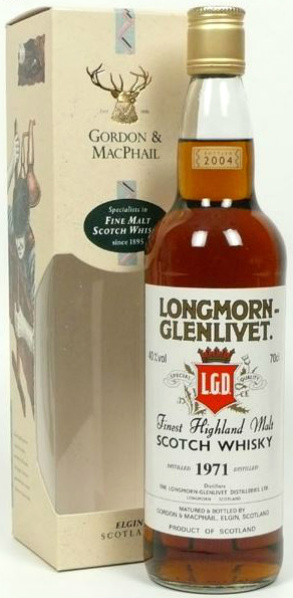
Longmorn 1971/2004 (40%, Gordon & MacPhail, Distillery Label, JD/AII)

The old Jameson opened my eyes for old bottles. Not true actually. I’ve known it all along. I just needed a kick in the bee-hind, to open some more, before I one day, kick the bucket. Luckily I had a birthday two months ago, and that is always a good reason to pick a nice one from the collection and “because you’re worth it…”. Of course, “Thursday” is also a good reason in my book. 1971 is quite a legendary year for Longmorn. At Longmorn nobody will concur, because they haven’t done anything different in the years before and since 1971. However, there somehow are a lot, very good sherried, and otherwise matured, Longmorns from around 1971. I particularly love the 1971 from Scott’s Selection, although true Longmornado’s tell me there a many better ones. Great!

Longmorn 1971/2004 (40%, Gordon & MacPhail, Distillery Label, JD/AII)Color: orange gold.

Nose: Waxy. Old black fruits and just like the Jameson I reviewed last a bit of steam. Buttery and beautiful Sherry and black coal. It doesn’t leap out of the glass and I believe that is due to the reduction to 40%. I’m not worried yet, because these old distillates can handle a lot of water. Today’s Malts do need a higher strength. Nevertheless it seems the nose suffered a bit in power. Maybe this is one for a Cognac copita (the big balloon glass). Luckily I have a whole bottle of this, so I can experiment a bit. Slightly tarry but right after that a fresh note of faint menthol/mint. Way down deep into the nose some licorice pops up, well hidden in the dark fruitiness. Again, a wonderful old bottle.

Taste: Sweetish black tea, and again pretty fruity. Raspberry hard candy, and some cherries. The whole is quite soft, so again, maybe this was reduced too much. It’s great as it is, but I can’t shed the feeling, a lot was taken away from this Malt as well. Now it’s too damn drinkable, so I don’t think this will last me a long time. I’m sorry the body isn’t a bit bigger. I’m accepting this now and I move on. This is great stuff extremely well-balanced. A nice nuttiness comes to the fore and then even some honey. Hurray for air, breathing and developing Whisky. Great combination of fruit and the hints of tar and black coal. Tiny hint of burnt Sugar towards the end. The finish could be longer, but we’re rewarded with a wonderful aftertaste. It even reminds me a bit of some Rhum Agricole in the finish. Be patient and give it time to breathe. It opens up. wow!

I’m a sucker for Sherried Longmorns from the second half of the sixties through the first half of the seventies. These Whiskies are so good. Sure there are a lot of Longmorns around that are better than this one, but there are not a lot of Whiskies better than Longmorns like this. Give it time to breathe, it will open up and become bigger than it initially was.

Points: 91

This one is dedicated to David Urquhard (1952-2015) who passed away on 30 November 2015, aged 63.

Caol Ila 13yo 1990/2003 (55.6%, Gordon & MacPhail, Reserve, Cask #1114, 283 bottles, JC/GF)

I got up this morning seeing that it is a nice and sunny day, just with a chill in the air. Ice on the windscreen, and couldn’t be bothered de-icing the car, so I did the school run on foot. Luckily no wind so it wasn’t so bad. Walking towards the winder I did pick up the inspiration to review some Islay Whisky. Yeah! Rummaging a bit in the sample bank I dug up two Islay babies, that will together well, or make for interesting comparison. Once not so readily available, today impossible to miss. Caol Ila is the name and peat is the game. I love Caol Ila because it ages really well. So lets educate myself and have a look at a younger example of Caol Ila. This 1990 Caol Ila was bottled by Gordon & MacPhail in 2003. The outturn was 283 bottles at cask strength, and considering the color and wood management policies at G&M, I would be surprised if this wasn’t matured in a remade Bourbon Hogshead although a Fino or Manzanilla Sherry hogshead is also possible. Two of its sister casks were also bottled in 2003: #1115 (JC/AEG) and # 1116 (JC/CEB). More sister casks exist. In 2011/2012 at least three more were bottled: #1120 (for La Maison Du Whisky, France), #1121 and #1122 (both for Van Wees, The Netherlands).

Caol Ila 13yo 1990/2003 (55.6%, Gordon & MacPhail, Reserve, Cask #1114, 283 bottles)Color: White wine.

Nose: Dry and smoky peat, with an underlying sweetness. So it’s not the fatty peat you sometimes get. This is drier and a wee bit more spicy. Cow organics in cold weather. With hints of hay and quite some buttery and lemony notes as well as hints of shiny aromatic apple skin (not acidic). Some flowery elements were present in the peat, lavender as well as there is some crushed beetle (sounds strange doesn’t it?). Vanilla and more creamy, fresh buttery notes. The wood smells a bit meaty and well aged, so not young and sappy. Hints of cured meat. Smells a bit toned down and maybe older than it actually is. Very well-balanced. More about fresh and fruity notes than heavy peat. Accessible. Garden bonfire burning off old branches combined with powdered vanilla and powdered coffee creamer. It’s not really a big Whisky, but a well constructed one. Wonderful nose, especially by the wonderful vanilla and floral nose. I would say Fino Sherry hogshead. made from American oak.

Taste: More peat and quite sweet, which works quite well this time. There is enough going around to balance the sugary sweetness out. Burned leaves and a lot of vanilla and clotted cream, custard, pudding. These notes are quite big and it takes a while for those to pass, to let a more paper and (spicy) wood note through. Distinct hints of soap. It breaks down a bit in the finish, with a creamy note that goes down my throat, but in the same time a more acidic wood note stays behind in the roof of my mouth, the soap also has some staying power under my tongue. These flaws are easily forgivable, looking at the whole. Good Caol Ila.

This went under the radar a bit when it came out, as well as its sister casks, but what a treat this is. Definitely American oak and probably Sherry that aged under flor instead of Bourbon. All aroma’s work together well. I wish I had more of this, but at least I had the experience of a whole bottle of this. Worth seeking out at auctions, but a lot of it was probably drunk back then.

Points: 87

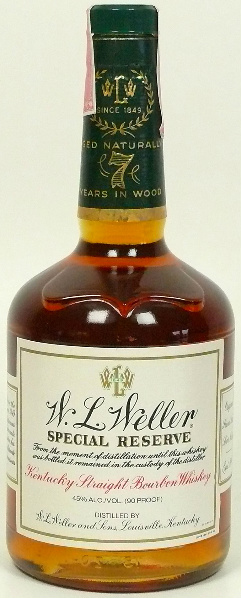
W.L. Weller 7yo Special Reserve (45%, OB, Circa 2007)

Just like the Old Fitzgerald, W.L. Weller is a Wheated Bourbon that used to be made at Stitzel-Weller Distillery.  When that closed down, the Old Fitzgerald brand was sold to Heaven Hill and W.L. Weller was sold to Sazerac, owners of Buffalo Trace. The W.L. Weller 7yo “Special Reserve” is no more. After this one, a similar looking bottle was released, but without the 7yo age statement. Later the look was altered altogether. It’s still called “Special Reserve” and it still lacks an age statement. Other Wellers that are still around are the W.L. Weller “Antique” bottled at 53.5% ABV. and a 12yo, which is bottled at 45% ABV, just like our 7yo. Finally there is a William Larue Weller that is part of the Buffalo Trace Antique Collection (BTAC), which is bottled annually at barrel strength, something in between 65 and 70% ABV.

W.L. Weller 7yo Special Reserve (45%, OB, Buffalo Trace)Color: Medium orange brown.

Nose: Lots of cream and toffee, very appetizing. Honey, vanilla and wood, nutty and dusty. Again toffee and warm runny caramel. Nice spicy wood in the distance even reminiscent of a dry (salty) meaty aroma, beef jerky or polish kabanosy. Sappy charred oak. Savvy and supple. Sawdust, perfumed caramel and chocolate bonbons. A hint of sweet corn and charred cask, and dare I say it, minute amounts of smoke and ashes, probably from the toasted cask. This smells like it owns it. Very well made, interesting and nice. Love how this smells.

Taste: Sweetish, nutty, fresh and well-balanced. Quite some wood influence as well as paper. Sawdust I would say. Bassetts Liquorice Allsorts and lots of vanilla ice-cream with caramel sauce on top. Small hint of dry bitter wood trailed by some, but not much, vanilla sugar sweetness. This works well and gives the Bourbon some backbone. Again, this is a very appetizing Wheated Bourbon. This is a perfect example where all the aroma’s come together nicely, but having said that, this doesn’t seem to be your most complex Wheated Bourbon. It’s very tasty in an almost simple kind of way, but I don’t consider this a daily drinker. It pack a wee bit too much for that and it deserves to be savoured.

Who said that Wheated Bourbons are light and dull? After this one I’m curious if the new “Special Reserve” comes near this one, because this 7yo is quite the winner for me. I like it a lot. I compared it to the Old Fitzgerald 12yo I reviewed earlier, but that one almost seems soapy compared to this one.

Points: 86