 The other day, I reviewed a reduced Tormore by indie bottlers Mo Ór, that I called feminine. It was Floral and fruity, very easy accessible. I said other Tormores were more metallic and industrial. Luckily Master Quill has a vault where a whisky archive is kept, so I was able to find a Tormore fit for comparison. Here we’ll have a look at this Tormore bottled by Cadenhead. This particular offering was bottled for the good people of the U.S. of A. Hence the 750 ml bottle from 1997. 1997,
  that means this Tormore was bottled around the time previous reviewed Tormore was distilled (1996). Both Tormore’s are about the same age too. Let’s see if thís Tormore is any feminine.
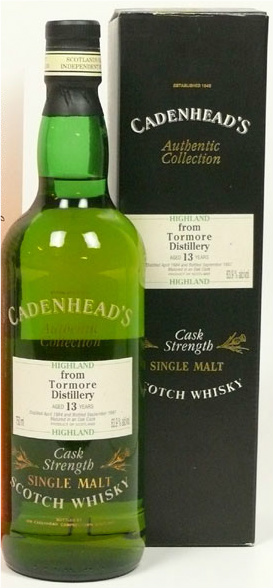 Color: White wine.
Nose: Well this does start floral again. How consistent, but soon caramel and wood and yes, a metallic touch. Clean and very toffee like. Compared to the Mo Ór this isn’t all that fruity. Dry. Still very floral and sweaty maybe. Great stuff.
Taste: Well strong, it’s almost 64% ABV. Half-sweet, and the metallic part returns. Still that’s no bad thing here. Lots of caramel and toffee notes. This finishes a bit sour, from the oak, but no big problems here. Otherwise quite un-complex.
Tormore’s are definitively the odd ones out. Rather unpopular and who is surprised when you taste the official 12yo. But when you get your hands on a clean ex bourbon cask at cask strength, you might be in for a pleasant surprise. Even though they may not be the high scoring Whiskies, they do have something in them I particularly like. There’s a potential here that isn’t used. The stills have purifiers on them, that makes the spirit very clean. Most of the Tormore spirit is put in Refill Bourbon barrels and hogshead and most of it doesn’t even age on site. So you’re bound to have something ultra clean.
Still I consider myself lucky I got my hands on a second bottle of this. Great stuff.
Points: 86
 Kilchoman then. The newest addition to the immensely popular Islay Whisky family. This new small farm distillery was built in 2004 near Kilchoman in the west of Islay, and therefore named Kilchoman. Operations started in 2005 and their first disaster struck in 2005 also. No distillery can call themselves a real Scottish distillery without a big fire. Well history was in the making so let’s do the fire thing quickly, they might have thought. Not hinting at any foul play of course. In 2005 the kiln burned down. Rebuild in 2006 and operations recommenced. As of 2009 but foremost 2010, Whisky started to be released. In 2009 the first release in the new core range was the “Inaugural Release”. Next up was “Autumn 2009” Let’s try our “Spring 2010” that was the third release.
 Color: Gold
 Even though it’s supposed to be summer, looking outside you could have convinced me of something different. I see people outside wearing coats and jackets. Yesterday I reviewed an Islay malt,
  …and here is my second entry for our Genietschap gathering. Yesterday I reviewed an older expression of the ‘standard’
  Color: Copper Brown.
 One of the other gems he found there, was a very old 20yo Sestante Mortlach, so the theme for this year soon became Mortlach. I have to admit, I really love a tasting with a single distillery theme, especially when a lot of bottles are brought in. Strange enough that was not the case with Strathisla, but with Mortlach we had 14 of them, and an extensive aftertasting with some other gems. (Laphroaig 10yo unblended bottled in the mid 70’s!).
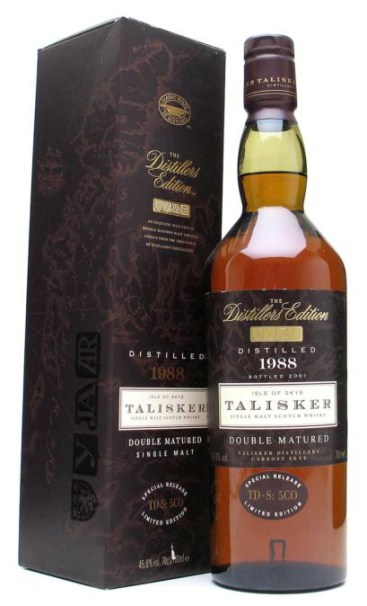 We’re on a roll with those Taliskers, so why not continue the saga with another one. Maybe this less recent Distillers Edition? The Distillers Editions are finished expressions of the ‘normal’ Classic Malt line and was introduced in 1997. Then Cragganmore (Ruby Port), Dalwhinnie (Oloroso Sherry), Glenkinchie (Amontillado Sherry), Lagavulin (Pedro Ximinez Sherry), Oban (Montilla Fino Sherry) and Talisker (Amoroso Sherry) got treated to a happy marriage with a Sherry or Port. All said to be complements to the original style of the distillery, not overpowering it. Due to the success of the new range, expansion was to be expected. In 2006 a Distillers Edition of Caol Ila (already in european oak!) finished in Moscatel and Clynelish finished in Oloroso Sherry was issued. And last but not least in 2008 Royal Lochnagar finished in Muscat was issued. We’ll probably see more expressions released in the near future.
 It’s not mere months the whisky was finished, but probably longer if not a few years. The oak is in the same spot where normally the pepper attack would be. I for one can’t detect the pepper anymore in this, and that’s a bit of a shame. Thick round body with a floral touch, violets maybe. I know that added caramel rounds out a body, but it seems to me the Amoroso does that trick here. Compared to the 10yo, this is more…ehhh round. All the extremes are toned down. Chewy and sweeter than the usual 10yo. Just a tad less balance in the finish.
 For those of you who have read my
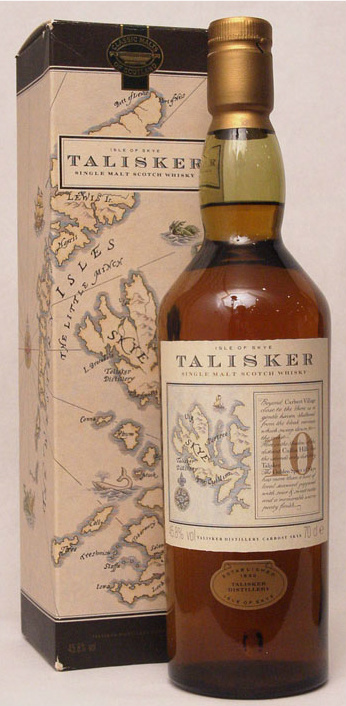
  This profile is great and if you want this, you’ll have to pay some serious cash to buy yourself an old Islay whisky or even Brora. I know, an older expression of the standard 10yo Talisker is getting more pricey lately, but still nowhere near to the prices asked for the aforementioned bottles. Do yourself a favour and get it while you can, and beware, this is dangerously drinkable. This will be empty before you know it. I left myself a 125 ml sample of this, but I almost drank it all writing this! Stay away, just drink milk instead, its good for you, unless you are lactose intolerant I guess.
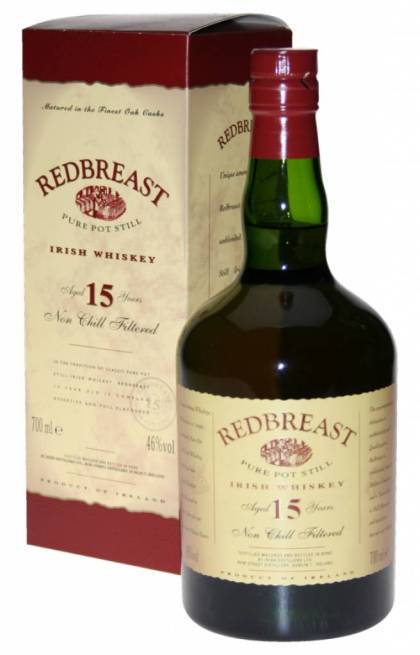 Redbreast ia a triple distilled pure pot-still Irish whisky from the New Middleton distillery from County Cork, owned by Pernod Ricard. This bottle is from a 2005 batch when it was still called “pure”. Due to new rules for whisk(e)y, “pure” was deemed to be a very confusing word, so now it is called a single pot still Irish Whiskey instead.
 Taste: Red fruit and blueberries, blueberry candy. Unique. It’s something we like in 60’s Bowmores (just a 100 times cheaper). Very smooth. Mocha and a hint of caramel or toffee. Some tree sap, and slightly bitter oak, or maybe bitter chocolate. Again, are there some older casks in here? Besides the dark fruits, I guess I am tasting banana and some coconut too. After some oxidation, the woody part is enhanced and the fruityness is a bit more subdued.
 Sadly the Bourbon week is almost over. I had a lot of fun with it and (re)discovered some true gems of American Distilling. I’ll definitively do another Bourbon Week again. So, to close this week off, here is the first edition of the Parker’s Heritage Collection of Heaven Hill. Distilled in 1996 the year of the fire, so we can’t be sure where this is distilled. If it is from before the fire, than it’s from the original distillery in Bardstown. If it is from after the fire it can be sourced from anywhere or even distilled by Heaven Hill distilled in another distillery where they rented time to distill. It’s not from the new plant (the old Bernheim plant in Louisville), since they started to distill there from 2000 onwards.
 Color: Brown
 smells. Also a food-like sourness that seems to be partnered with the gravy and the Hopjes.
 This is one where the word savoring was invented for. Just give this a lot of time, and you’ll thoroughly enjoy this. Just drink this when you have a moment alone for some contemplation. Don’t let it be interrupted by noise or by the feeling you still have to do something. A bedtime dram, when you’re the last one to go to bed. Top, have fun with it!
 Master Quill