 Penultimate day of Master Quill’s Laphroaig week and just as yesterday, another Douglas Laing Laphroaig. Seeing a pattern here? So which one will finish this series off tomorrow?
As luck would have it, we have another 1987 Douglas Laing today. Judging by the looks of it, probably a very different one. Yesterday’s Laphroaig was pretty pale at best, but this one boasts a nice and healthy colour. It’s like summer and winter, Jekyll and Hyde, night and day, Sherry and Bourbon. Still something strikes me as odd here. The label states this is from a Hogshead, but even with the slightest of reductions to 50%, this still yielded 439 bottles. Surely this was a Butt or a Puncheon, or was is a big hoggie?
 Color: Copper brown
Nose: Nice chocolaty Sherry. Sea wind at night, but in summer, so a chilly night after a warm Sunny day. Clay and very toned down peat. Sugared onion. Not very expressive. This one is a bit shy, even considering it’s heritage. It doesn’t leap out of the glass at you. Sherry influence is quite obvious, but it’s not very peaty just like yesterdays 1987. Smoke? Hardly. Cold black tea and some meaty notes, dried meat and almost cold gravy. Nice and restrained. All the aroma’s do fit well together. Not fruity.
Taste: Sweet with burnt sugar. Definitely a more bonfire aroma. Powdered sugar and some wood. Late licorice, just as yesterdays 1987 Laphroaig. Wood stripped of old paint, of which the dust is still flying in the air. The slightly burned note stays on throughout and makes it into the finish. When working on it, it does show some fruit, but not much. No fresh fruits, but something dried like dates and raisins. PX-Sherry? All in all elegant stuff, but with dirt under its fingernails. Not without flaws in its character too.
This is the second 1987 Douglas Laing Laphroaig and there are similarities and there are differences. Both expressions aren’t very expressive and are toned down. No heavy hitting peat and not much smoke (if any) a Laphroaig light so to speak. This 2009 bottling has the added Sherry, and by the taste of it, this wasn’t a top (PX) Sherry cask or it may have been a treated cask. I somehow can’t imagine this to have aged its whole life in the same cask. Having said that the combination of the two does work somehow.
Points: 87
 Color: Light gold, almost white wine.
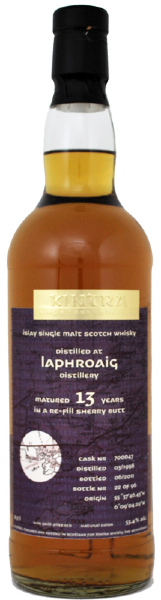 Color: Gold.
 Color: Orange brown gold.
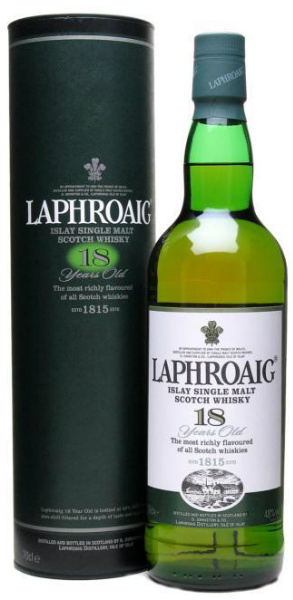 Color: Light gold.
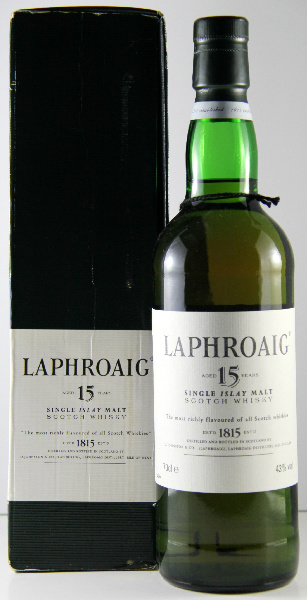 Color: Ocher gold. Nose: Ahhh great fruity peat. Yellow and red fruits. Black coal. Coal dust and ever so slightly tarry. Small hints of vanilla ice-cream. A truly fantastic nose. Just the nose alone shows you that Whiskies like this can’t be made anymore. Maybe this is an older expression of the 15yo (bottled before 2005)? Slightly burnt wire and steam. Hints of cooked vegetables emerge over time. Taste: Sweet, clay and fruity again. Not very peaty and the taste is much simpler than the nose was. Hints of almond shavings and a kind of delayed warming sensation. Elegant and pretty old tasting peat. Part of this Whisky must come from older casks. Crushed beetle, and cask toast in the finish. Burnt wood. Almonds ánd Amaretto combined with some sugared yellow fruits. Cancel my remark about (the lack of) complexity. Not true. It needed some time to develop. Given even some more time the fruitiness develops more and more into Amaretto and the peat develops into a wonderful kind of peat, ashes and a little bit of smoke. Top notch! Extremely different from my first love from around that time, the 10yo at export strength (43% ABV). Remember the 20cl hip-flask bottle? This 15yo is a lot more elegant and nicely crafted. Utterly complex and a wonderful companion to that 10yo. I haven’t even mentioned the cask strength version of the 10yo from that time. What a trio that was. Life was good back then! By the way, Laphroaig will be releasing several one-off special bottling commemorating their 200th anniversary and supposedly one of them will be a 15yo. Hope it is anything like this boxed 15yo.
 Color: Full gold
 Franschhoek Valley is a broad valley in the south-east corner of Paarl, Western Cape. Franschhoek is warm and produces robust red wines (and fruity whites). The surrounding mountains (Wemmershoek to the north and Groot Drakenstein & Franschhoek to the south) cast shadows which help reducing the temperature and hours of sun the grapes get. They also reduce the influence from the sea. On the other hand, the mountains also hold the cooler winds from the south. Terroir is alluvial sandstone (doesn’t hold water well) and in the north some granite (in the mountains). On the hillsides there is some clay to be found.
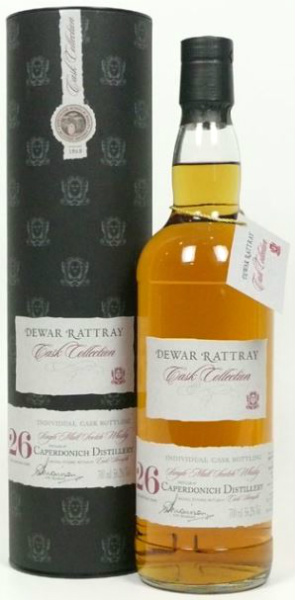 Color: Dark gold.
 Color: Light gold with a pinkish hue. Sherry all right.
 Master Quill