Asparagus season isn’t over yet, so we decided to do another round. Last time around I decided to accompany the asparagus with an Austrian Riesling, but there was another Austrian wine lying around, so I decided to open another Austrian white wine. This time a Grüner Veltliner from Wachau by Domäne Wachau.
 Grüner Veltliner is a white wine grape variety that stems from Savagnin and further down the line, Rotgopfler and Pinot Noir. Despite of the name Veltliner, the grape isn’t related to Roter Veltliner and Frühroter Veltliner. Most Grüner Veltliners are planted in Austria and to a lesser extent, Slovakia and the Czech republic, but more recently also in the United States and Australia. One-third of all the grapes planted in Austria is Grüner Veltliner. In Slovakia one-fifth and in the Czech republic “only” one-ninth of the planted grape varieties is Grüner Veltliner. Most Grüner Veltliners age well and accompany food excellently.
 Especially in the Wachau wine region on of the following terms can be found:
- Steinfeder: lightest version with up to 11.5% alcohol,
- Federspiel: a slightly more powerful version with 12.5% alcohol,
- Smaragd: the most rich and powerful Grüner Veltliner with 12.5% alcohol and often more. (Smaragd can be compared with the german term Spätlese, the grapes are harvested late and often ripen for a prolonged time on stainless steel or large casks). (This Smaragd is 13% ABV).
Finally, Weissenkirchen is one of Domäne Wachau‘s village-bottlings. Besides Weissenkirchen itself, it comprises of the villages of Joching, Wösendorf and St. Michael. The wines are elegant, full-bodied, fruity and quite mineral.
 Color: Straw
Nose: Lemony and acidic. Smells very fresh and refreshing with whiffs of alcohol. You can already smell the balance between the sweetness and the acidity. Nosed blind this could have easily been from Alsace. Nice yellow fruits. Hints of peach and dried apricots, but also some sweat! (No that’s not a bad thing, in this wine). All in all, light and fresh, but with body.
Taste: Definitively more spicy. Fruity syrupy sweetness (high iron content). Apple treacle, raisins, tree sap with the slightest hint of licorice. Green apple skin. Some hints of wood, although this probably never came in contact with wood. Some unbalance when near the finish. Short, slightly sugary, finish. The sweetness in the finish is a bit “strange”.
Of the two Austrian wines we recently had with Asparagus, we liked the Riesling Better. Having said that, on its own, this one isn’t bad either.
Points: 81
 Returning from my vacation, a blank white box was waiting for me. Inside this rather large sample (70cl !), wrapped in a black velvety cloth, of the new Glenlivet Alpha or α (being the first letter of the greek alphabet). Alpha is also used as a synonym for first (of a series) or simply meaning “the beginning”. If this Glenlivet is the first of a series, then there are 23 more letters in the greek alphabet. Bring on The Glenlivet Iota and Omega! (The 9th and the 24th letter of the greek alphabet).
 It therefore has become more common practice to bottle Whisky without an age statement (or NAS), and give it a name. Just have a look at a lot of recent Ardbeg’s or some of the newest Macallan’s, but also Tomatin Legacy and Talisker Storm to name but a few, almost all with extensive add-campaigns to explain what kind of Whisky it is and what’s inside the bottle.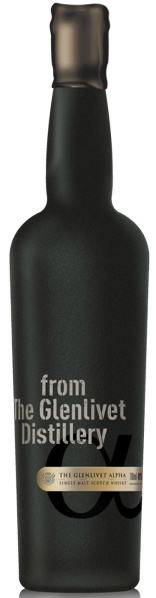
 Looking back, I see that two of the last four posts are old Clynelishes. One from
 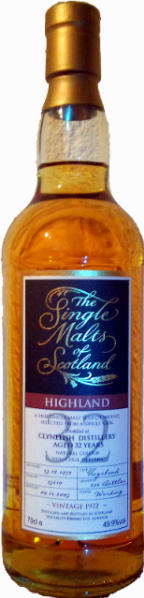 But that’s Brora, here we have a 1972 Clynelish, so it’s distillate from the then newly built distillery next to Brora…
 Here in Holland the Asparagus season has started and nothing goes better with that, than a nice fresh white wine. This Berger Riesling was ogling at me for quite some time, since all Austrian wines have the Austrian flag on top, it is easily recognizable.
 This Riesling (12.5% ABV), is wine from
  They are on a stony soil dating from prehistoric times. From these parts you can have a dry, minerally Riesling or Grüner Veltliner. Second on the south of the Krems Valley on the south bank of the Danube, small vintners in ancient villages make local wines in their own old-fashioned way. Third, to the east of Krems, towards Rohrendorf and Gedersdorf, there is löss in the vineyards which is noticeable in the wine, its softer and more lavish in style. The best wines from this region are called reserves.
 Color: White wine.
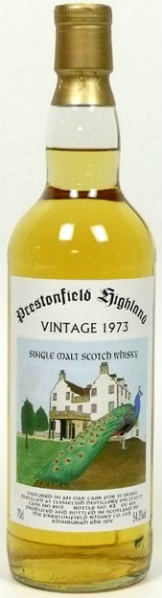 This Clynelish was distilled July 23rd 1973, a year Brora was still open but not very active, if active at all. As we all know, 1972 was Brora’s finest year, or so it seems. Time to find out what they did one year later at Clynelish…
 Color: Copper Gold
 After the
  Color: Gold
 Yet again we have one of the many 1991 Lochsides, and one of the many that were issued as a Gordon & MacPhail Reserve. This one was picked by Dutch retailer Van Wees. Gordon & MacPhail code for this one is JI/ACAC. The spirit was distilled on September 18th, 1991 and eventually bottled on October 15th, 2009. Picked by Van Wees in July 2009. Those of you that meticulously read this blog probably had a Deja Vu experience. We know this bottle, we know this lay-out. Well yes and no. February 4th 2013, I published a review of quite a similar Lochside, opened by Master Quill’s Apprentice (like this one). That was
  Color: Gold (ever so slightly fuller in color)
 Last time around we had a stellar but also antique
  Color: Straw
 Most of us would have thought of the Beatles, but this time it about another submarine. One owned by the Royal Navy of Great Britain.
 Still fisherman Baker wouldn’t budge and the coast guard called the Royal Navy, but they denied it’s existence!
 Color: Light Gold.
 Master Quill