 First of all, the picture below is a picture of a similar bottle that was bottled at Cask Strength for Switzerland a year later. The picture is for cask #4726. Glenfarclas is great, it’s family run and most of the make is going into Single Malts, so no room for error, everything must be good. Second, it’s at its best as a Sherried Whisky and even in these times the Grants are able to make a very good Sherried Whisky. The self-proclaimed kings of the Sherried Whisky, namely The Macallan, gave up on this practice. For reasons only the marketing department will know. Good luck to them, Glenfarclas may very well be Speyside’s finest!
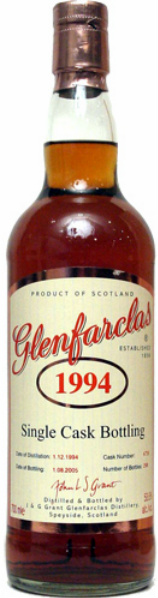 Color: Lively orange brown (like a Bourbon)
Nose: Nice creamy Sherry with quite some wood, of which more than half smells like new oak. Cappuccino or Tiramisu. Meaty like gravy. The longer you nose it the dryer it gets. Spicy, lavas and white pepper. Cardboard and ice cream. The wood is pretty raw as opposed to elegant. It’s new untreated wood (maybe some toast). Still I wouldn’t call this overly oaked. A sort of rural Sherried Whisky.
Taste: Initially it’s syrupy sweet that coats your mouth. When that coating is removed from your mouth by the alcohol, just as in the nose, a lot of wood emerges. Dried leaves. Apart from the wood, there is diluted licorice, with added bitterness. For the bold body this has , you could even say that the finish is rather mild. Also the wood makes the finish a bit sour and not of perfect balance. Nice coffee in here too. It does dry your mouth quite a bit, o there definitively is some wood influence. No sulphur.
Actually this is quite good. It’s not complex, but it does have character. It’s a nice young Sherried Whisky. It’s a bit on the edge considering the wood that’s in it, but I still do like it. It’s not over the top.
The best way is to drink it quickly after you pour it, since the mouth coating sweetness hides the wood a bit and makes it less dry and bitter, it gets when you take your time with it. When you are a quick sipper, than the score is even higher than mentioned below 🙂
Points: 86
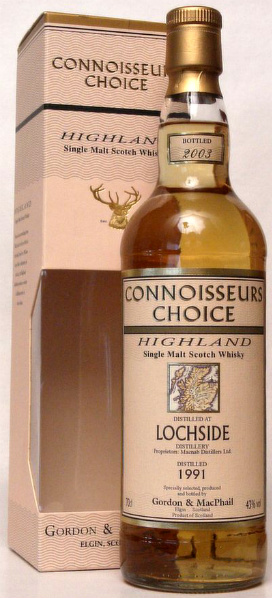 Color: Light Gold.
 Solera is an ageing system for Sherry (and other fortified wines), in which younger wines in upper rows of casks are used to top up casks of older wines stored below. Every time a batch is bottled, the wine is taken from the bottom row. Not everything though, usually up to 30% of the cask is bottled. After this, the casks in the bottom row are topped up with the wines from the casks in the row directly above, and that row is topped up with wines from the row directly above that, and so on. After a startup period this system gives wines of a consistent age and quality, even if one particular vintage is weaker than the others.
 Color: Light copper gold.
 This is number three in Tomatin’s true affordable core range. If you’re new to Tomatin and don’t want to break the bank, Tomatin offers you the 12yo, 15yo and this 18yo. This 18yo is matured in Refill Bourbon Barrels and finished in Oloroso Butts (and maybe even some Puncheons and/or Hogsheads, who knows). A Oloroso Sherry cask used to be thé cask to age your whisky in, but here the whisky was only finished in Oloroso casks.
 Color: Gold with a slight pinkish hue.
 And then there is Glen Keith. Glen Keith lies a stone’s throw away from Strathisla. The spirit from Strathisla was pumped to Glen Keith for filling into casks, but also the boiler at Glen Keith warms water for Glen Keith’s production. Glen Keith’s production started in 1958 with three stills (triple distillation). In 1970 the first two stills in Scotland that are heated by gas were installed. Soon after that, the distillery stopped the triple distillation. In 1983 a sixth still is installed. The distillery is mothballed since 1999, but plans are to restart the distillery next month (April 2013).
 Color: Copper, cloudy.
 This is now my favorite Christmas malt. Just smell that dried Orange in combination with the cloves. It’s not a perfect old bottle though, but it’s so clearly a time capsule. It’s impossible to not love this. I was always a big fan of Strathisla of the sixties and seventies and this Glen Keith is therefore really no surprise at all. Merry Christmas everybody!
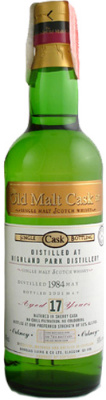 Color: White wine.
 Color: Light Copper Gold.
 So it’s time to celebrate the first anniversary of Master Quill and I’ve picked this bottle of 1979 Scapa, bottled in 2002. Well, things got off really good! Like I said, I would rip open this bottle and so I did accidentally. I broke off the cork! Bugger!
 Color: Copper
 it’s not completely balanced, but it will get there in the end. Complex, well, not exactly. It shows some sourness from the oak, but after half an hour it is pulling together, and it has a great and long finish. This again is a stunner!
 Master Quill is already one year old, well, the web version anyway. This first year of blogging passed very quickly and doesn’t feel as a whole year to me. It started out with the first “Hello Whisky World” post, that saw the light of day on the 4th of march 2012. Immediately followed by two reviews of Miltonduff and Macduff Mo Ór bottlings on the same day and a Lagavulin 12yo a day later. These first four posts were merely a test, to see how it would look.
 And here is another Master of Malt bottling. Earlier I reviewed a reduced
 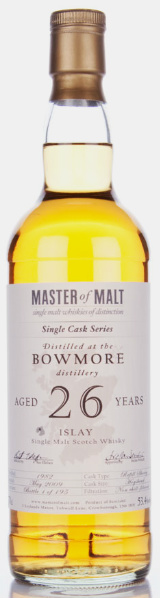 Color: Gold
 Master Quill