 A few days ago my whisky club had a tasting of Aberlours. Quite a unique one to boot since these were almost all exclusively official bottlings. We only had one independent Aberlour. It was from a Bourbon Cask and did show the distillery profile for a while, but that was quickly gone. We had a few out of the standard range and a few from the standard ranges from the past. A few bottles stood out. We liked one old 12yo double cask matured for its high dark Oloroso Sherry content (and costing next to nothing). An old 21yo from 2000 was very good and this odd one out. The 1988 Distillers Selection, that was released exclusively in Spain. After this one 1988 came only one other Distillers Selection, the 1989. Again for Spain only. For Aberlour this is quite special. It is said that instead of the usual Oloroso, for this bottling Fino and/or Manzanilla is used!
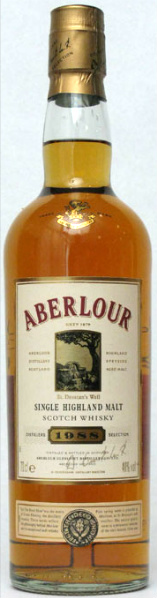 Color: Full Gold
Nose: Wood, caramel and spirity. Perfumed hay and a little bit of rot. Rotting leaves. It’s grassy and somewhat sherried. Malty with murky water. Very malty actually. Earwax and cream. Still the wood plays also a big part in the profile of the nose. Although the whole is pretty raw and dirty, there are some clean spots to it too. It’s a bit like the different markers come in and go out of the profile. Just like a blinking traffic light. Quite an experience. This definitely has to breathe for a while.
Taste: Thick and wood spice. Malty and sweet. Quite creamy at first, but it suffers a bit here of the low ABV of 40% (not much though). A whisky not to be taken moderately. Big sips are the way to go here. Some bread and mocha in the aftertaste, also a slightly bitter and sour woody note. The longer gone the more woody and bitter. When your palate is a bit tired (late in the day and evening), the wood isn’t such a big problem anymore, and the whole gets more toffee sweet.
As said above, we had this amongst a lot of other Aberlour official bottlings and it did stand out a bit. It’s not the usual Aberlour. It does seem to be more malty and does have some more wood. I’m very curious what’s the story behind this version. Still, I enjoyed it. And considering the Original price a very good bang for your buck, als with most official Aberlours actually.
The 10yo is an entry-level, hotel bar kind of Whisky. If you skip this and pick any other one from the range, like the 10yo Sherry version, you’ll have a good malt at almost no cost. Very interesting distillery with interesting bottles and marketing to match.
Points: 84
Thanks to Jose Juan for finding me this bottle. Thanks also go out to Heinrich and Ralf for the info!
By the way, here is Heinrich’s very nice site about Aberlour.
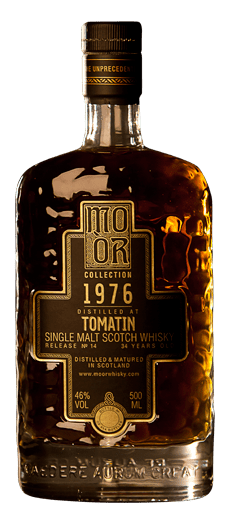 Color: Copper Gold.
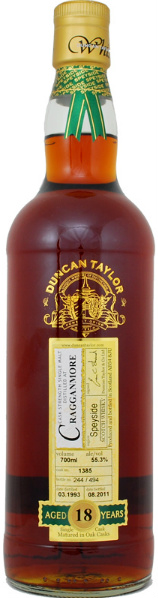 oday I have the chance to give this another go. First of all, I can look at this by daylight and I can’t see the red lemonade anymore. It has this orange brown color most Bourbons have.
 Happy new year! I wish all my readers a great year full of fulfillment, health and great drams. please don’t settle for mediocrity. Try to broaden your horizons for true beauty that can be put in your mouth, but do it in moderation, we don’t want to create modern drunks.
 Well what would be a better start, than with an old Strathisla! In the past I tried some nice old Gordon & MacPhail Strathisla’s from this series. The review for the 25yo can be found here, but together with this 25yo I tried the 21yo and that was similarly spectacular. Mind you these are the old 80’s bottlings for the italian market, and whiskies with these labels were issued for a couple of decades, so every batch will differ (massively). The 21yo and the 25yo were quite dark, and hopefully not colored, and being from the early eighties, the distillate is early sixties or maybe even late fifties.
 Short finish. The 21yo and the 25yo performed better in that respect. Treat this elderly Whisky with respect, but be bold and take bigger gulps. The whisky itself, maybe is a tad fragile and subdued, but hey, the stuff was made some 55 years ago and along the way was reduced to a mere 40%, so give it a break will you?
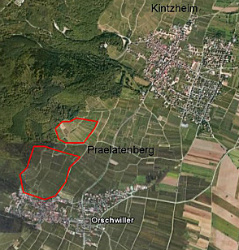 Above Praeatenberg towers the Koenigsbourg castle, built in the 12th century. The altitude of Praelatenberg slopes ranges from 250 to 350 metres and has an east-south-east orientation with a size of 18.7 Ha. The granite bedrock that underlies all Alsace vineyards is very close to the surface. The soil is heavy, covered with loose schist, and is rich with silicium. Dotted with stones rich with iron, quartz and other minerals. This helps the warming of the ground and lets water through easily.
 Color: Straw Yellow.
 Quite hard to figure out how to call this malt. On the label is stated: Säntis Malt, Swiss Highlander, Appenzeller Single Malt, Matured in Old Oak Beer Casks. On their
  Belgium’s own, Bert B. came into the Cadenhead’s shop in Amsterdam (The Netherlands), with a tale of buying the ‘Winkeldochters’ in an old liquor store in a long forgotten town, near the coast. Howling wind and rolling bushes through the streets. Winkeldochters translates into shop’s daughters. It’s a great Flemish word for those items that are around for a long time in a shop which in fact never get sold.
 Well one of these bottles he bought was this Dufftown from Cadenheads. He opened it in the shop and we tried this. He didn’t like it then and exchanged it with Andries (The Cadenhead’s Shop owner) for a wedge of cheese, a cup of coffee and a wooden clothes pin. Andries was kind enough to pour me a nice sample of this (100ml) to take home with me. Cleaning out the closet, I stumbled across this sample, so here it is…
 Color: On the edge between copper gold and copper brown.
 Points: 92
 So there are quite a lot of official Wine finishes by Glen Moray themselves. Now Ian MacLeod decided to add their wine finish of their own, or maybe bought it straight from the distillery.
 Langhe is a hilly area to the south-east of the Tanaro river in the Cuneo province in Piedmont, northern Italy. The black grapes used for this wine is the Dolcetto grape that is widely used in this region, where wineries favour Nebbiolo or Barbera. These wines need a long time ripening. Dolcetto on the other hand is one that doesn’t require a long time ageing, two years will suffice.
 Color: Dark ruby-red.
 I caught a cold last week, which is very unfortunate when you try to write tasting notes. Fortunately my nose is back in business now, and in the process ‘got a rest’. Let’s start whisky reviewing again, with an example of a whisky that should be light and is ‘low’ in ABV.
 Master Quill