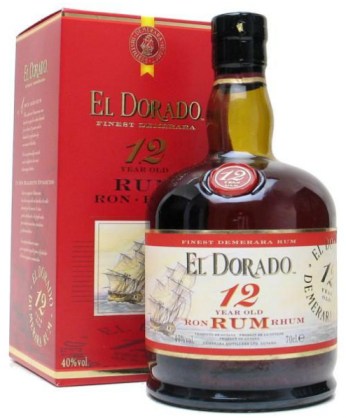
Rum Week – Day 4: El Dorado 12yo (40%, Guyana)

Next up a true Demarara Rum from Guyana. Guyana is a south-american country next to Surinam. Guyana had a lot of great Demerara distilleries. One by one they got closed, but most of the equipment was saved and moved to the next distillery that was kept open for a while, and when that one was closed this all happened again. Today, all the stills that survived are in one place. Diamond. So rums distilled in a few of these stills find their way into El Dorado Rum. In this 12yo, I’m happy to report, are Rums made in the original wooden Enmore Coffey still and predominantly, the original Diamond two column metal Coffey still. All the El Dorado Demerara Rum is aged in American Bourbon barrels.

Color: Copper.

Nose: Very perfumy and very mature. Hints of caramel and burned sugar. Leafy and tarry. Heavy organics and crude oil. Wow, such a lot of character and so thick. A stunner this! Licorice all sorts. Lots of it! It takes a while to let the wood take a little spot in the whole. Utter balance in the nose which keeps on developing. If the taste will be anything like the nose, we’ll have a winner!

Taste: Well this is pretty sweet, but not as sweet as I seem to remember. At first opening this was extremely sweet and I didn’t like it for it. It’s more or less the nose in a toned down version, with added sweetness. Cough Syrup and syrupy altogether, with a very nice acidity that comes through the sweetness. For me this is a bit too sweet.

Again we have a rum that has a fantastic nose, but doesn’t seem to put that quality into the taste as well. Still this is a very good rum, and compared to a lot of Single Malts, this is dirt cheap. Having said that is this a replacement for overpriced Single Malts? No, not really, this is a completely different kind of sport. It should be added to your palate not to replace something else.

Points: 85

Rum Week – Day 3: Barbancourt 8yo (40%, Haiti)

Barbancourt was founded in 1862 by Dupré Barbancourt on the Island of Haiti. Haiti was struck by a massive earthquake that all but demolished the Island in 2010. If you want to help by donating funds please have a look here.

Dupré started to make Rums as one would make a Cognac. Barbancourt is made from cane juice that is distilled twice. First distillation happens in a column still and the second distillation is done in a Pot Still. Ageing happens in cask made of French Limousin oak.

Color: Full Gold

Nose: Yeah, that’s more like it. This has body and a very interesting nose to boot. It already shows incredible depth. Not the usual sweetness, but a more ‘dry’ nose. It’s leafy and acidic, also toast that goes beyond toasted wood. It also has a petrochemical edge to it. And that’s great! But wait, there is some fruit in this too. Apricots. And what’s that, woody gravy? I’ll stop now, because this doesn’t seem to end here. This is a very nice and complex nose.

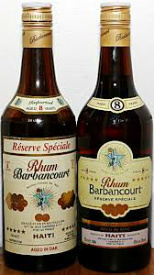
Old and new packaging

Taste: Wow, isn’t this a nice restrained sweetness. It’s sweet, but not in a way if you have a spoon full of syrup in your mouth, Here too shines the wood, but not in a toasted manner. Not very cloying and the whole is nicely balanced. Again an Industrial note of steam, coal and maybe a little tar or licorice.

Very nice rum, with an Industrial edge to it. In my mind it takes me back a 100 years plus. Also for the Single Malt Whisky drinker this is a fine rum. Very much recommended!

On the right you can see the old (left) and the new (right) looks for this rum.

Points: 84

Rum Week – Day 2: Angostura 1919 (40%, Trinidad & Tobago)

On the site is this snippet of a great story: “After a fire in 1932, which destroyed the Government Rum Bond, the master blender of Fernandes Distillers, J.B. Fernandes, bought the charred casks, only to discover they had been filled in the year 1919.” but also this: “Our rums are 100% Trinidadian, made in one distillery on one Island. Much like a single malt only better” – John Georges, Angostura Master Distiller.

WOW that’s quite a statement! I know a lot of maltheads or connoisseurs of single malt whisky are looking around for something beyond malts, since the original product is getting, more and more outrageous in price. yet, most will tell you that it is to broaden their horizons. Well I’m broadening my horizon here and am very curious how (this) rum will do.

Color: Gold

Nose: Sweet, but not overly sweet. A lot of creamy components. Enormous amounts of vanilla, toffee and custard. Also a little hint of smoke and there is a little bit of wood. Also a little bit of varnish or thinner, and a lot of toffee, caramels and such. Clay. (The blocks they make for children), but otherwise quite simple.

Taste: Sweet and thick. Caramel and woody toffee. The varnish or thinner component is here at the front of the taste, but dissipates with some air. After the initial sweetness, comes a more dry spell. Definitely more woody, like chewing on grand dad’s cedar cigar box. With that it also becomes more thinner and reduced. The finish is the part I liked the least. It has a little burned component to it, that would be great if there was any more, but the rest of the finish is rather thin, and more or less quickly gone.

In essence this is an eight year old blended rum from Trinidad (West Indies). Comparing it to the Diplomatico offering, there is no doubt about it this is the more interesting rum from a single malt point of view, but in all honesty I like the more aromatic and more complex Diplomatico better. Somehow, this 1919 is not my Rum, not for sipping anyway. I’ve drank a whole bottle of this and I think I’m allowed to say so.

Points: 75

Rum Week – Day 1: Diplomático 12yo Reserva Exclusiva (40%, Venezuela)

Let’s finish off this first month of the year with another Master Quill week. I like doing these weeks and the theme can be almost anything. This third week will be all about rum. Isn’t that a surprise, since I never reviewed rum on these pages before. So time to pull up the drawbridge, leave the moat alone and lock myself between the thick walls of Master Quill’s castle.

Diplomático is a Venezuelan rum. Just click on the link and you’ll see how many awards this baby got in its life. It should be pretty good then…

Color: Copper Gold

Nose: Half sweet and very aromatic rum. Vibrant and lively. Hints of sharp dry wood. Not thick nor cloying. Grassy with oranges, and raspberry syrup. Fruit liqueur. There are some more wood influences and do I detect the smallest hint of smoke? Probably the cask toast. Also some pastry in it, cookie dough, cake with raisins. Toasted bread. Cocos and sappy oak again. Lots going on in here. The nose is lovely although I do feel it is covered under a sugar blanket. An effect similar to adding caramel coloring to Single Malt Whisky. Homogenizing the smell.

Taste: Sweet. Very sweet. Heaps of chewy toffee with quickly a hint of wood. Strange enough a very thin texture, nothing syrupy as you might have expected. Very much about toffee, caramel and fudge. Actually pretty clean this one, but it has a bit of a disturbed balance by something sour that doesn’t fit this type of sweetness. I feel the sweetness and the acidity are in a constant fight with each other, but obviously the sweetness wins since this is über-sweet. Cold chocolate sauce on vanilla ice cream. This is actually so sweet that it hides a lot of the aroma’s that must be there. The finish is also dominated by sugar, and burned sugar, (and a fruity note), making the finish fall flat on its face.

I poured this once over vanilla ice with warm chocolate sauce and it worked wonders. This rum is a dessert in its own right. It has a fabulous nose a somewhat less complex taste. I think there is a lot of potential to this, and I feel a well aged rum at a higher ABV with more wood ageing and less sweet and ‘thin’, should be pretty spectacular.

From a single malt point of view, I wouldn’t recommend this, and that is pretty strange. Venezuela is a good market for single malt scotches, so one would expect… Well it has its uses, but I don’t feel it’s a sipping rum. For me this is more a rum you should ‘do’ something with. Mix it, Cocktail it, or put it on your dessert. It’s good never the less, the super-sweet style is just not so much for me.

Points: 75

Château Les Tresquots Médoc 2003

Very typical Bordeaux blend. This one comprises of 70% Merlot and 30% Cabernet Sauvignon. The ABV is 13.5%. The grapes were harvested by hand and the wine was put on oak casks for one year.  The grapes that grow on vines are 30 to 40 years old. grow in the heart of the Médoc region near Bégadan, where the D3 crosses the D103 (for those who were there). Saint Estèphe is just up river.

For what I read, people weren’t too happy about this one when is was younger, so it was no problem to let this lie for a couple of years. I left it for almost 10 years, but now it was time to have a look how it is doing.

2003 was a very special year for the region. The 2002 harvest was very dry and the winter that followed was cool and wet. In march it was already warm (and dry) so growth started early. The following period stayed dry which means low yields. The summer, well, heat wave! So in June, July and August, the grapes got roasted.

Color: Very dark, with deep sparkling red. Almost doesn’t let light through.

Nose: It might be heavy, according to the text above, but for me this is quite lively. Grape skin, hot earth, dry but with a lot of depth. Elderberries with some acidity. Yeast and a little hint of sterile wood. Altogether very balanced. I might be biased by now, but this oozes hot weather.

Taste: Deep, this has some tannins. Thick grape skins and plums. Lots of ripe cherries. Not the red ones but the sweetish black ones. It’s not bitter nor woody, but it does dry the mouth quite a bit. The fun is to be had taking big gulps and the effect this has on the palate. Finish is quite short and a bit anonymous. This is very much recommended with food (meat).

In the end not very complex, but with a lovely nose. And I like the shift toward the black cherries. Especially the taste is ‘simple’ but it doesn’t overpower you, nor does it have any other flaws, apart from the tannins that dry your mouth extensively. Considering early report about this wine, I can say that ageing this is a good idea.

Points: 81

Fattoria La Vialla Passito 2009

Fattoria La Vialla Passito 2009Here is another bottle from Fattoria La Vialla that found its way into my castle. Click here for the review of the NubeRosa 2010. This is exactly why I keep the draw-bridge down a lot, so things like this come my way. It was brought in to accompany dessert. This Moscato di Sicilia is a dessert wine @ 14.5% ABV. The bottle here is a 375 ml. which is a fine size for many über-sweet wines. The bottle I’m about to review is from lot 29 17082011.

Color: Copper

Nose: Sweet (obviously). Musty, but also has a distant acidic freshness to it. Gravy, with a little bit of smoke and cold tea. Some small hints of peaches. The nose is nicely balanced. Over time it becomes less sweet and maybe somewhat more acidic.

Taste: Not as syrupy or sweet as I’m used to. Again nicely balanced between the sour and the sweet. Dried apricots, but no sign of raisins. Due to the acidity, the whole is rather fresh.

It’s a dessert wine, but less sweet as one might think. Absolutely better than I thought. The whole comes across as being honest.

Points: 80

Thanks go out to Nicole for bringing the wine!

Tomatin 25yo (43%, OB, 2010)

This is the last of the Mohicans. Tomatin updated the label in 2009 and shortly after, by 2011 replaced it with the excellent 30yo. So now there is a gap between the 18yo and the 30yo. Surely Tomatin will fill this in with something else? What about a new style 25yo? Maybe at a higher proof? Nudge nudge, wink wink Stephen. The reason behind the axing of the 25yo is that they aren’t confident in making a whisky like this in a constant manner anymore. This 25yo is solely matured in Bourbon casks. Shortage of bourbon casks from the first half through the second half of the eighties? Now I know why Macallan has a shortage of good Sherry casks… Having tried a lot of Tomatins recently I was wondering where the (tropical) fruit comes from. Is it from the Sherry casks? No better place than this bottle to find that out…

Tomatin 25yo OBColor: Full Gold.

Nose: Very waxy, and Peter Gabriel’s “Here comes the fruit”. Already some wood and toast. yes there’s the tropical fruit again, but in a different style than the new 30yo. This is darker, less obvious sparkling, happy fruit. No this has some added flavors. It has some smoke, toast and saltiness. Hidden wood. But through this darkness comes the estery and waxy fruit. It’s still the tropical stuff, just more heavy in style, maybe more masculine. After some breathing, the fruit is almost gone and it is more woody (cedar) and estery (and malts with a little smoke).

Taste: Pretty sweet at first with a lot of creamy chocolate, and perfect wood that has an aura of crisp fruits. In the background a little bit of acidity that gives this some liveliness. Passionfruit and mint in the finish. It’s passionfruit ice-cream to be exact. Also a slight hint of dried apricots and pear. Very elegant.

They were right to give this the black label, where the 30yo has a white label. It is a bit a stand-off between a devil (the 25yo) and an angel (the 30yo). This is a well-made, beautiful and very interesting brooding Tomatin. I’m very, very sorry to see this go, but at the same time I’m very happy to see the new 30yo coming. Still, I rather had them both into the fold.

Points: 89

Langa Calatayud Rosado (Syrah/Cabernet Sauvignon) 2009

Bodega Hermanos Langa was founded in 1867 by Mariano Langa Gallego, and is located near the city of Calatayud in Aragón, Spain. Best known city in Aragón is Zaragoza. Today the fifth generation is at the helm of the company. Combining knowledge with respect for nature is the recipe for making good wines. The Bodega works 100% ecological. The region where the grapes grow is known as “Los Yermos”. The grapes grow on extremely dry soil that lies 600 metres above sea-level.

Langa Rosado 2009This is the Rosé wine Langa makes. This 2009 is made of Syrah and Cabernet Sauvignon. The newer versions are made with Merlot rather than Syrah.

Color: Ruby red rosé.

Nose: Slightly acidic and fruity, very fresh ánd warming. Lots of red fruits. Sweet raspberry, but also meaty. Not your regular extra-easy Rosé. It seems as a Rosé with character. A little hint of vanilla and wood. Nicely balanced and it smells like something you’ll drink in a few minutes (and want another bottle).

Taste: Nice. Just the right combination of sweet and sour. Again some vanilla. It’s creamy and it tastes like vanilla to me, not much, just a hint. A lot of red fruits again and very easy drinkable.

I know people think of Rosé’s to be the perfect summer wine. This is precisely that, bu in the middle of winter with typical italian food, this Rosé is perfect too. Not to complex, as the food, but a very good companion. It’s also very nice and easy when you drink this by itself, not to mention it’s quite cheap too. That’s a bg plus today with spanish wines. Now the Syrah got replaced by Merlot, I’m keen to try that one to. I hope they did that to improve the wine. Well I already like this one, so the Merlot version should be great. Recommended!

Points: 81

Ledaig 8yo 2001/2010 (50%, Kintra, Single Cask Collection, Bourbon Hogshead #800124, 36 bottles)

We took the peat road last time and when I look outside I can understand why. let’s get off that beaten path and tread not to Islay, but this time to the Isle of Mull. Being Dutch myself, let’s have a look at another indie Dutch bottler Kintra. Erik Molenaar is the boss of this outfit. Did Erik source a tiny Hogshead of Ledaig? “Honey. I shrunk the Hogshead” maybe? Nope, Erik shared a cask with a shop in Maastricht. Slijterij Bams. The share of the shop was 218 bottles, Erik’s share was only 36. Funny enough the label of ‘the other’ bottle states 50.6%. The humor doesn’t stop here. Bams don’t have it on their list anymore. Sold out? But The Kintra version is still available! So I can’t wait to try this. I hear that modern Ledaigs can be pretty good…

Color: White wine.

Nose: Warming. Light peat and grassy. Citrussy (fresh) and muddy. Great combination. Non-offensive. Cold wet black tea leaves. Oily old machine. Very nice nose. Perfumy, smoky and quite elegant for a heavily peated whisky. Almost burnt out fireplace on a freezing cold day or evening. Beauty and beast in one. Sour sweat and I do smell a stew in here.

Taste: Sweet with licorice. Soap. Black and white powder. Succulent grass, but also some hay. Burnt cables and lemon. Alas this isn’t as balanced as the nose, nor is it as likeable. It’s sweet at first with a sort of acidic licorice attack. Lot’s of ash in the finish. The lack of balance is a bit disturbing. There is also a bitterness like earwax and a hint of crushed bugs.

It seems simple, but especially the nose shows great balance. The youth shines through on the palate and seems to me to be less balanced. Here the sweetness and the laid back acidity do not match. The more air the whisky gets, the more the balance loses out on both the nose and the palate. Very strange to get this from, what should be a powerful heavily peated Whisky, at this age. What can I say. Maybe Erik made a wise decision to have such a small cask share? Well, totally bad this is not, it just deteriorates rather quickly with air (I used no water to achieve this).

Points: 82

Caol Ila 16yo 1977/1993 (58.6%, Cadenhead)

Almost a month ago I reviewed one of those beautiful tall green glass Cadenheads bottles. A Dufftown to be precise. But there were more of those on these pages. I remember a Tormore and a Pulteney. In the dungeons I found another one of those! So today it is time to do another one from the same series. I guess I have a soft spot for them. This time a Caol Ila from 1977 that they already decided to bottle in 1993.

Color: Gold

Nose: Ahhhh, nice creamy peat. Very vegetal and coastal and slightly fishy. Salty fish. It is sea spray in heavy winds. Very clean and warming. Not very animalesk as they (and I) tend to say. It does have a lot of peat but still I wouldn’t say that it is in your face peat. Tar, not so much, but I do get some rubber. Some cold dry smoked tea leaves (Lapsang Souchong). Lots of smoke actually and extremely nice salty driftwood that finishes off in toned down Coleman’s mustard powder. Classic Islay.

Taste: Very smoky attack and half sweet (perfect sweetness). Meaty, roasted pork maybe. It comes across as powdery and slightly soapy. Fruity, hints of peach and banana. Here the sweetness seems to me to be a little wild, animalesk. The taste is very typical for a Caol Ila. This was recognizable blind. This has a nice full body with a perfect sweetness (slightly acidic) that matches the toned down peat a lot, combined with the smoke…a winner. Macaroons (made with almonds) and a slightly bitter finish (from the wood) and overall a tad too simple for a score into the 90’s.

Well if you like your Islay Whisky smoky, that this is for you. It may look like something different but actually this is very smoky, very very smoky. The smoke is able to push the peat to the background. Last piece of advice, give it some time to breathe…

Points: 88