 Early November I started a series to support the drinking of sherry to get more good sherry casks for the whisky industry. For reasons not even science can wholly explain, I picked PX Sherries as a starting point. As mentioned before, PX or Pedro Ximénez is the most syrupy and sweet Sherry around, and is considered an after dinner Sherry or one to accompany a nice (sweet) dessert. Goes well with ice-cream.
 Emilio Lustau was founded in 1896 by Don José Ruiz-Berdejo who was an Almacenista himself. He made Sherries and stored them for a while, after which he sold them off to larger companies, thus adding value. In 1940, his son-in-law and name-giver for the company, Don Emilio Lustau Ortega moved the Bodega to the old quarter of Jerez. Since then the company wanted to be the best and expanded by offering high quality Sherries.
This “San Emilio” PX (17% ABV) is from the Solera Reserva range which has it’s heritage in the original Stocks of Don José Ruiz-Berdejo. His stocks were combined with special Sherries from different “Almacenistas”, small independent wine-producers. Besides this Solera Reserva range, where casks of the same type of Sherries are blended, there is also a very interesting Almacenista range. In this series, Lustau selects small batches of high quality sherries which have been made and matured by small independent producers, or “Almacenistas”, who often make Sherries as a hobby.
Color: Almost black mahogany.
Nose: Very elegant syrupy Sherry which has a nice dry whiff of paper over it. Grassy with cloves. Dried apricot and raisins, also a more spicy element which you get when putting parsley in broth. A hint of yeast and/or flor (Marmite), so not only syrupy and sweet. For me also hints of lavas.
Taste: Sweet (sometimes sugary), but accompanied by a nice acidic touch, which is a great effect on the palate. The acidity reminds me a bit of the lemon part of cola.  Yes the apricots are there and some vibrant freshly made raisins and maybe some dates. Very lively and never dull, heavy or dusty.Very well balanced. Actually, this is blended so well to a nice harmony, that it’s almost hard and not even fair to look for separate markers or hints of it. The sum is so great.
Easily a favourite of mine when looking at PX Sherries. Excellent and an easy recommendation. Oops, another “San Emilio” finished…Next bottle!
Points: 89
 Lou Reed’s Transformer on the record player and the new Tomatin 30yo OB in my glass, what can go wrong? As I already mentioned
 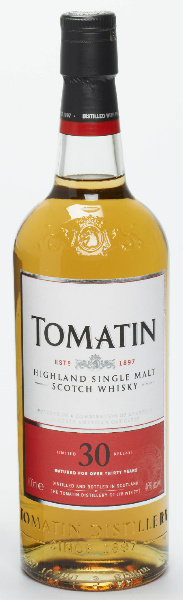 The new 30yo was introduced in 2011, replacing the 25yo that still can be found. It’s reduced to 46% ABV, to fit neatly in the ‘standard’ range which now comprises of the 12yo, the 15yo, the 18yo and now the 30yo. The 21yo I reviewed earlier is a limited release and higher in ABV (52%), so it’s not part of the standard range. Still it looks like a huge gap to me between the 18yo and the 30yo. And a new 21yo or 25yo would be nice. For now, mind the gap…
 Can’t imagine this was colored. It’s so light in color. That would be great, since we don’t like people messing with our drams, don’t we? Both the nose and the palate are neatly balanced. I really love these kinds of whiskies. One I thoroughly enjoyed. Imagine a great 30yo whisky and what they ask you to dish out these days. Considering this, this one is a steal (in some markets) and deserves a following. It’s 46% ABV and very nice, this makes it almost too easily drinkable and there is a possibility that this bottle will be empty in no time, so beware. The 2011 batch was also very good, still this one from 2012 scores one point higher, since it’s even more fruity.
 Next up Glen Scotia, also a first on these pages. Glen Scotia hails from Campbeltown, once a big place for whisky with regional status (again). Try to imagine a place that has almost 30 distilleries working at one time in the 19th Century. Not so long ago this Glen Scotia was the ‘other one’ from Campbeltown after the well-known Springbank. Today Springbank makes also Longrow and Hazelburn. And from the same owners the recent ‘addition’ that is Glengyle Distillery (Kilkerran). Let’s say that Glen Scotia is the only Campbeltown distillery not owned by the people of Springbank. Owner today is Loch Lomond Distillery Co. and the place is fairly run down. When the distillery was mothballed in 1994, the staff of Springbank restarted intermittent production in 1999, not to lose the regional status of Campbeltown. A status lost eventually, but eventually reinstated.
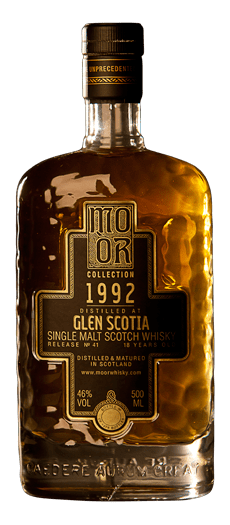 The distillery was founded in 1832 by the Galbraith family. For one reason or another the label on the bottles state 1835. Lots of changes of ownership during the years and even some closures in 1928 and 1984. Since 2000 Loch Lomond has taken over Glen Scotia and runs the distillery with its own staff.
 I was asked to keep an eye out for sulphur in this one. It’s there slightly on the nose (as a burning match). But it is more pronounced on the palate (the bite here comes not only from the wood, but also from the sulphur. Usually there is some sulphur in Sherried Glen Scotia’s. Lots of it in a 1991 Cadenheads offering if I remember correctly. It’s there on the palate and even more so in the finish (late). Is it ruining the balance or the palate? Does it disturb me? No, it’s some kind of good sulphur. it’s somewhat hidden. It’s there but not in the usual obvious way. That happens sometime, that’s why I called it good sulphur. Still, overall there isn’t a lot of sulphur in this one, so don’t worry. And hey, sulphur is good for the skin!
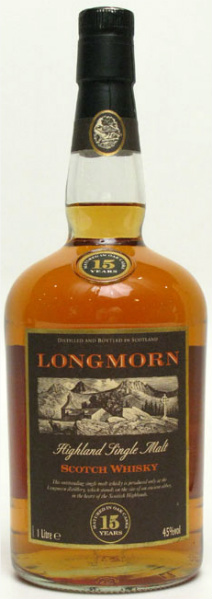 I just found out that Longmorn isn’t on Master Quill yet! Longmorn is one of my absolute favorites. Just have a go at a sixties or seventies fruitbomb or heavily sherried expressions from the days the stills were heated with coal. Sometimes it almost tastes like the coal went into the whisky too. A liquified locomotive. But no use crying over spilt whisky and let’s start-up with this old 15yo. This 15yo is no more and was replaced in 2007 by the current 16yo. So it’s off the market for five years now, but bottles are found in some shops and are still fairly cheap at auctions. Also the packaging has dramatically changed. The 16yo new bottle has metal and leather glued to it, and has an intricate box. This 15yo looks fairly simple. Surely Longmorn are capable of making a pretty good standard whisky? Lets find out how this eighties distillate behaves, and maybe we get a chance in the future to compare this to the new 16yo expression. I tasted the 16yo once in 2009, and scored it a measly 81. I hope it got better in the mean time.
 Allt-a-Bhainne is a new distillery, now owned by Pernod Ricard (through Chivas Brothers Ltd.). It was founded in 1975 to be used for the Chivas blends. Pernod Ricard bought Chivas from Seagram in 2001. The distillery was shortly mothballed between October 2002 and May 2005. Just two years before the foundation of Allt-a-Bhainne, Chivas also founded Braes of Glenlivet (Braeval) for the same purpose, and therefore is considered it’s sister distillery.
 Well living in the low-countries and doing a Auchentoshan review without pointing at the site of the A toshan man is impossible. So
  For now I will do a short intro to Auchentoshan. officially the first word of Auchentoshan is in 1823 when a guy named Thorne got a licence. But there is reason to believe that Auchentoshan started in 1800 named Duntocher. In the past the Germans didn’t like Auchentoshan too much and bombed the place already in 1941. Smart as the Scottish are they waited for the end of the war, rebuilding Auchentoshan. Just to be sure, they started rebuilding in 1948. In 1984 Stanley P. Morrison buys the place and sells his own company to Suntory ten years later. In 2008 Morrison Bowmore starts with the new packaging we know today. But first this expression by indie bottlers The Cooper’s Choice (actually The Vintage Malt Whisky Co. Ltd.) The people behind Finlaggan.
 The Fino used for this finish is commonly a clean, vibrant, straw-colored wine. It has a complex and subtle nose. Delicate notes of predominantly yeast and almonds. Sometimes also tobacco and liquorice. The taste is dry, bitter, smooth and lingering. Also very nice olive oil comes from here.
 Color: Orange gold.
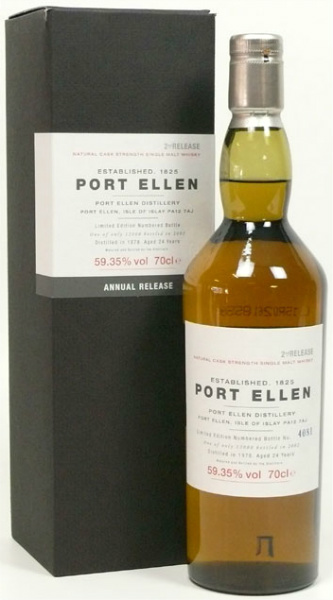 How nice it is to have another Port Ellen on these pages. This one in particular plays a strange role in the Port Ellen annual release series. First of al this strange ABV. 59,35%. New Japanese measuring equipment on loan? No it’s not that. This one is known to be a little closed. Very closed in fact. I had the chance to try this expression when it was freshly opened and it was really hard to taste this. Very hard to tell what is in there. It was nice, but nothing you’ve come to expect from such a Port Ellen. This time around the bottle is open for a while and less than half full. Is this, one of those whiskies that has to be put on the shelf without its cork, to maximize its breathing? Lets see…
 Well it does demand of you that you’ll work on it since it doesn’t give away its treasures easily, especially on the nose. Probably not the best from the series, but still it oozes Port Ellenness. It is an experience. Freshly opened bottle scored 87 Points, but after extensive breathing I’ll score this:
 Earlier I reviewed a
  A week ago “Het Genietschap” had its first ever tasting at my house. I’ve been a member for quite some time, but it took a while to get my ‘location’ added to the agenda. Well finally it was my turn. The organizer gets to choose a ‘theme’, and mine was “Talisker”. When I sent out the E-mail I got a lot of Talisker 10’s as entries, and even some replies implying that there wasn’t a Talisker in the house. Well that got me worried for a moment. My guest of the evening, Erik, asked if he could bring his
  Best bottle in the tasting was a young Port Ellen 15yo bottled by Cadenheads in 1996, Stunning! It was just a tiny bit better, or better: different, than the also stunning Talisker 20yo 1981/2002 (62%, OB, Sherry, 9000 bottles). Also the pre Classic Malts Talisker 10yo was fabulous. Even today’s 10yo is pretty good, but can’t be compared to the taste of the old bottle. This ‘Tactical’ wasn’t bad either…
 Master Quill