 Lots of times I witnessed situations where an ‘old’ bottle from Gordon & MacPhail was opened and we all started guessing how old the whisky was, since only a distillation year was printed i.e. “1970”. I fondly remember the discussions when a particular bottle was bottled because the bottle had a ‘nipple’. Another situation could be when a particular bottle was distilled and/or bottled, because only the age of the whisky was printed i.e. “30yo”. Very annoying when you taste a Strathisla 25yo by Gordon & MacPhail that was made for several decades with the same label and different batches are very different. Lots of those ‘old’ bottles don’t have such information, or do they?
Luckily for us there are some hints to be found. I’ll tell you about two of them.
- Laser Code
- Code on the bottom of the bottle
Laser Code
 In the case of Gordon & MacPhail, since 1988 a laser Code can be found somewhere on the bottle. Usually printed on the back of the front label, or on the back of the bottle, near the bottom, for newer releases. As can be seen on the picture to the left. Here an enlarged view through the back of the bottle, through the whisky. The code is IB/ABD.
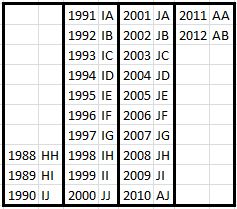
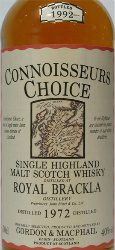 Of interest are the first two letters. IB in this case. The code used is like this: A=1, B=2, C=3, D=4, E=5, F=6, G=7, H=8, I=9 and J=0. IB therefore is 92. The bottle is very probably from 1992! The second series of letters are probably a batch code. On the right is a picture of the same bottle from the front, and indeed it is bottled in 1992.
So continuing on from this code, here above is a complete list of codes that are used up untill now.
Like with any system there are of course a few exceptions.
- There are cases known where the laser code states a particular year, but the bottling actually happened the following year (january or february). An example of this is a Longmorn 14yo that according to the label was distilled on the 30th of may 1975 and bottled on the 14th of february 1990. Code IJ would be expected, but the code on the bottle turned out to be HI/DCB, which is the code for 1989.
 Sometimes the first part of the code comprises of three letters instead of two. This is very rare and when this happens two of the three letters match the table given here.
- It seems 1991 was a year where Gordon & MacPhail were a bit inconsistent with the codes used. I’ve come across examples where the labels clearly state a year of bottling, but the laser code used on the back of the label is wrong. I’ll give three examples from the Connoisseurs Choice range:
- Convalmore 1969/1991 with the following code: HB/AJB. HB would have been 1982, but that was a year no laser codes were used. The correct code would have been IA.
- Coleburn 1972/1991 with code HG/ACD. HG would have been 1987, but that was also a year that laser codes were not used.
 In this case too there is a neck label with 1991.
 - Tomatin 1964/1991 with code HI/AAF. HI is 1989, but here there is also a neck label with 1991.
Bottle Code
On the bottom of the bottle, in the glass are a lot of codes. I’ll take two of my older G&M bottles as an example.
- Strathisla 25yo: Liquor Bottle Scotland, 750ml, 79 08*, 66 mm, SC 999.
- Strathisla 15yo: 750ml, 66mm, 49, SD 133, also some signs I can’t reproduce here.
* 79 08 doesn’t seem to mean that the bottle was produced in (August) 1979. I’ve come across SC 999 bottles that had 90 08 or even 99 08 on the bottom.
The important stuffs are the ‘model numbers’ for the bottle. Here they are SC 999 and SD 133.
Doing some research in the invaluable archives of Whiskyauction, I comprised a list of codes and the years the bottle was used for bottling. All years stated here are confirmed by a year stated on the label of the bottle:
- SC 96 (75cl): 1972, 1973, 1974 & 1975.
- SC 803 (75cl): 1975, 1976 & 1977.
- SC 99 (75cl): 1977.
- SC 999 (75cl): 1978, 1979, 1980, 1981, 1982, 1983, 1984, 1985, 1986, 1987 & 1988.
- SC 247 (75cl): 1983, 1984 & 1985.
- 4699 (75cl): 1982, 1984, 1986, 1987, 1989, 1990, 1991.
- SD 522 (75cl): 1989.
- 6436 (75cl): 1989.
- SD 133 (75cl): 1990 & 1991.
- SD 686 (70cl): 1991, 1992, 1993, 1994, 1995 & 1996.
This information is far from complete and hopefully correct. Up to this point no contact was made with Gordon & MacPhail. There is probably a lot more information to be found, so if new things do pop up, I’ll add them to this article.
 My good friend of “I think about beer” did a
  Westmalle is one of six Belgian breweries that are ‘protected’ by the Authentic Trappist Product logo. Achel, Orval, Chimay, Rochefort and Westvleteren are the others. The logo was presented to discern the trappist beers from the more and more widely available ‘abdij beers’ of Belgium and other countries. (Abdij = Monastery). Most of those beers aren’t even brewed near a monastery, but commercially brewed under a licence. Still, it’s the same style of beers. Usually with a blond beer at normal strength, a dark “Dubbel” and a heavy blond “Tripel”. occasionally a very heavy “Quadrupel” exists.
 It is not only beer that falls under this logo, and not only Belgian beer to boot. Here is a list of all products that fall under this logo.
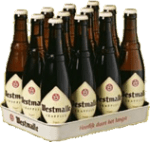 Nothing for the novice. The bitterness is quite a bit of the character. Beware because ageing makes this beer less fruity and more deep and bitter. The label, the bottle, the iconic WA-logo, the smell of it all. It breathes a time long forgotten, pré WW I. You consider yourself back in the thirties. A high score, but not necessarily your easy, every day choice. This is a classic.
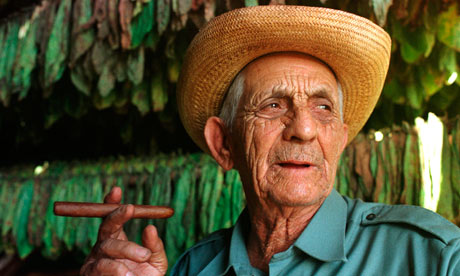
 A very new brand, established just in 1997 by Don Alejandro Robaina, one of the best tobacco farmers on the island of Cuba. Don Alejandro lived a full life and died of cancer in 2010 being 91 years old. Who said the Cigars are not good for you? The major part of his crop was used for wrappers, he was thát good. Today this multi-local brand with minor market share has only three expressions left, since two of the five expressions were deleted.
 Taste: Already after a centimetre or so, it’s obvious that this isn’t a beginners cigar. Its tarry and very spicy. Hints of petrol. Wow, heavy cigar, that goes wonderfully well with water and this made my espresso taste like something for children. I guess that if you want this to accompany a drink, you should pair this with a very heavy rum, a sweet one perhaps. Lots of smoke. Some kind of industrial grade? It’s funny it’s so heavy-duty since it smelled so elegant a cru. Ash is gray, dark grey and black, with countless tiny light grey spots. No white ash whatsoever. Some plastics and popcorn in the finish.
 Bunnahabhain is known for being the least peated of the island, still like a lot of others, raising to the occasion by answering the call of the public for more ppm’s. Burn Steward therefore started to bottle a “Moine” expression, with more peat, mimicking pre sixties Bunnahabhain.
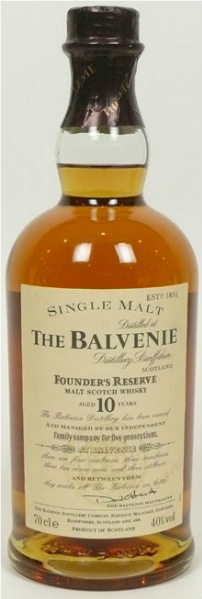 When looking around. and being new to Single Malts I almost fell in love by the shape of the bottle and really liked the way their labels looked. Not a lot to choose then. There was this 10yo (Founders Reserve), a 12yo (Double Wood), a 15yo (Single Cask), a 21yo (Port Wood) and a 25yo (Single Cask). And there was one limited oddity, the 17yo (Islay Cask). Nothing more. Today like with others there is more choice than ever. Lets have a look at the cheapest Balvenie, the 10yo “Founders Reserve”…
 Color: Gold
 Also from 2009 the second release became “Autumn 2009” next up was “Spring 2010” and after that the fourth release was this “Summer 2010”. Also in 2009 the first Single Cask releases were released at cask strength. From 2011 the Single Cask bottles were released with red labels. In 2012 a Sherry Cask release at 46% ABV was released with a black label. Also from 2012 a new addition to the core range was released called “Manchir Bay”. Last but not least there are a few releases of 100% Islay at 50% ABV, where all ingredients of the whisky were sourced form the island itself. Now it’s time for “Summer 2010” solely from Bourbon Barrels from Buffalo Trace.
 Kilchoman then. The newest addition to the immensely popular Islay Whisky family. This new small farm distillery was built in 2004 near Kilchoman in the west of Islay, and therefore named Kilchoman. Operations started in 2005 and their first disaster struck in 2005 also. No distillery can call themselves a real Scottish distillery without a big fire. Well history was in the making so let’s do the fire thing quickly, they might have thought. Not hinting at any foul play of course. In 2005 the kiln burned down. Rebuild in 2006 and operations recommenced. As of 2009 but foremost 2010, Whisky started to be released. In 2009 the first release in the new core range was the “Inaugural Release”. Next up was “Autumn 2009” Let’s try our “Spring 2010” that was the third release.
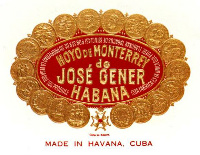 Heatwave over here, so a nice day to sit outside on the porch. I had a craving for a Robusto sized cigar and I noticed I haven’t reviewed a Hoyo de Monterrey yet. Therefore getting an Epicure No. 2 out wasn’t a hard task at all. My aged Epicure No.2 must be pre 2008, since it doesn’t have the second band that modern Epicures have. yes Epicures. The are a few around. There is an Epicure No. 1 (Corona Gorda), an Epicure Especial (Gordito) and in 2010 there was a Double Epicure (Doble) and in 2012 an Epicure de Luxe (Mágico) saw the light of day. Some of those were first a Edición Limitada. Hoyo de Monterrey was established in 1865 and is a Global brand selling lots and lots of cigars. There also is a plethora of choice, and all are known to be light yet for the connoisseur.
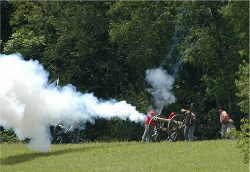 After some time with this the amount of smoke is really incredible. I’m sitting outside with a little wind and I’m still able to generate a sort of private cloud around myself. Overall this cigar could have been creamier, and for a Hoyo it has a atypical sharp and spicy edge to it. Definitively an after dinner cigar, even though it is light. You can smoke this one untill it burns your lips, isn’t that good value!
 Color: Full Gold
 Master Quill