 Well, after all those old, sometimes priceless, but always hard to get, independent bottles I reviewed recently, it’s now time for something more easy to get. A standard bottle, even sold, in some countries, in your local supermarket, at reasonable prices to boot. Add to that, it’s usually decent quality, so this is a bang-for-your-buck type of malt.
We’re talking this time about the Lagavulin 16yo. The bottle I’m reviewing is from 2006, and I guess because of the high turnover, it is probably bottled in 2006 as well. I don’t know exactly when the bottles with the royal warrant were succeeded by the “Port Ellen” ones, but this could be one of the first.
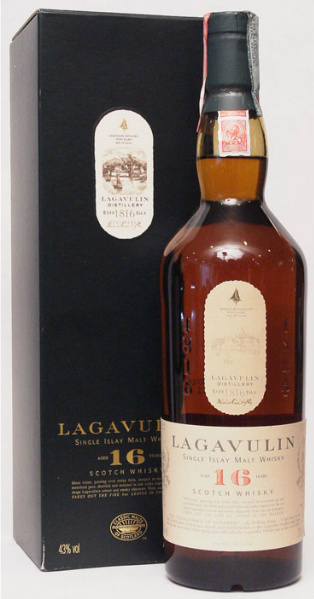 Many stories surround these Lagavulins. First of all that, when the royal warrant disappeared from the label, the quality went down. In fact the quality was dwindling even before that. Last year or maybe in 2010 I heard that the quality level is picking up again. This year I hear again that the recent bottlings are not as good as they were once before. So lot of debate about this one, and considering the interest, we know this is a popular one.
I tasted once a bottle from 1992, and scored that 92 points, so lets see how this one from 2006 will compare to that.
Color: Full Orange Gold.
Nose: Smoke and burnt wood (the next day). Black and white powder. It’s less peaty than I remembered, creamy peat. Animalesk and spicy, which makes it a bit ‘dirty’. Salty, sea and seaweed. After a while only smoke and bonfire remains.
Taste: Sweet, licorice with some peat and a slight hint of milk chocolate, almonds and wood. Sugar water. Black and white powder again. Not as rounded as earlier expressions. Smoke towards the slightly spicy and sweet finish that isn’t heavy at all. Salty sensation on the lips. In comparison, this is less complex.
I love Lagavulin, and I understand the producers statements that it isn’t true that Lagavulin 16 got worse. That memory doesn’t serve us well. Well that’s not the case. Earlier bottles are still around in big numbers so it’s not hard to do a head to head between older and more recent expressions. All I can say is they don’t make Lagavulin 16 anymore as they used to, but with all those efficiency regimes and when only the amount of alcohol yielded per tonne of barley counts, you can hardly be surprised.
 So Lagavulin 16yo isn’t what it used to be, but how does it do on its own, not compared to the older ones? Well that’s another story, even today it’s a pretty special dram, that still scores pretty high, but I like the new 12yo better, although a completely different dram.
Points: 87
 New Lochnagar was founded in 1845. New Lochnagar? Yes. First Lochnagar was built in 1823, and burnt down by “the competition” just three years later. The distillery was rebuilt, only to burn down again in 1841. So the distillery was rebuilt again in 1845 as New Lochnagar. Lochnagar became Royal in 1848 (it lies very close to Balmoral Castle). No more fires burning down the house, but still a lot of construction going on. In 1906 the distillery was rebuilt yet again and in 1963 completely renewed.
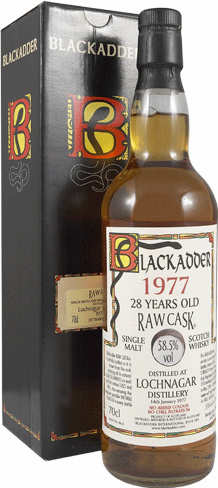 Here we will try an independent Lochnagar, again a Blackadder Raw Cask with cask sediment in the bottle. This time no powdered char, but only small chunks of charred wood.
 Balmenach was licensed in 1824, but existed much longer as an illicit farm distillery called Balminoch. Not earlier than 1992 the first official bottling is released, a 12yo Flora and Fauna. Not long after this United Distillers (now: Diageo) sold Balmenach to Inver House Distillers, with wich came an end to the Flora and Fauna bottling.
 Old Bothwell is a company from Bothwell, Lanarkshire Sur near Glasgow Scotland. It’s a company that specializes in bottling their own stock of wines and spirits with the possibility of personalized labels. In the whisky-world they became quite famous for bottling a series of great Port Ellen’s. Alas Old Bothwell just bottled their last cask of Port Ellen, so now they will move into other whiskies. First up are a Tormore 1988/2012 and Macduff 1980/2012.
 Again rummaging through my box with trophies collected on my travels, I found another Port Ellen. I like Port Ellen, so please forgive me, for yet another review. Port Ellen is the closed distillery from the immensely popular island of Islay, known for its peated whiskies. Always around in abundance, prices were ‘moderate’ for a closed distillery from Islay. Today stocks are depleting, and prices tend to rise sky-high, and it won’t be long untill there’s nothing left. Even if casks still lie around, Port Ellen isn’t getting better by ageing even longer. Maybe casks will be transferred into stainless steel holding tanks to stop ageing and fetching a lot of money when bottled is a few years’ time. Who knows. Since 2001 Diageo releases Port Ellen annually in their special release series. The first release fetching at least a 1000 Euro’s at auctions…
 Port Ellen was founded in 1825, and was sadly closed like many others in 1983. Although the distillery is dismantled, the site is still there. Today it’s home to Port Ellen Maltings. Where barley is malted and all the other distilleries of the island are customers…
 Earlier I reviewed a very old independent
  Color: Orange Gold.
 Cardhu is a very special distillery in the portfolio of Diageo, since it is their biggest selling malt (Spain and France mainly), but when talking to other enthusiasts the response isn’t all that…well enthousiastic. There is only talk of old bottles of Cardhu. Since 2006 a special cask reserve is issued, which isn’t welcomed with open arms, but since it sells so well, it must be the ultimate entry-level whisky. Personally I don’t like it.
 Founded in 1811 by the illicit distiller John Cumming, who became legal in 1824. In 1884 the old distillery is replaced. Purchased by John Walker & Sons in 1893. Then in 2002 a small revolution took place. Cardhu, the whisky was silently changed into a vatted malt. (Several single malts blended together). The bottle and the label stayed the same, just the word ‘single’ changed into ‘pure’. Well this didn’t last long, in 2004 the ‘pure malt’ was withdrawn. Luckily in 2005 this 22yo was issued.
 Time for another Lowlander. Rosebank this time. I reviewed a
  hoping for a resurrection. Who knows. For the time being, lets see if this Rosebank is any better than the Glenkinchie reviewed earlier.
 …and here is my second entry for our Genietschap gathering. Yesterday I reviewed an older expression of the ‘standard’
  Color: Copper Brown.
 One of the other gems he found there, was a very old 20yo Sestante Mortlach, so the theme for this year soon became Mortlach. I have to admit, I really love a tasting with a single distillery theme, especially when a lot of bottles are brought in. Strange enough that was not the case with Strathisla, but with Mortlach we had 14 of them, and an extensive aftertasting with some other gems. (Laphroaig 10yo unblended bottled in the mid 70’s!).
 Master Quill