 Twentieth post, so let’s get something out of the ordinary. I don’t have a lot of non Cubans lying around so I was very curious how this would be. Besides that, this cigar earned itself a 90 points score from Cigar Insider. So here it goes…
The Griffin’s are named for the Griffin’s Club in Switzerland, and are made with tobacco from the Cibao Valley in the Dominican Republic. and I guess that with Nicaragua, these are the countries to watch when thinking of good cigars to compete with the Cubans. The Cigar is made by Davidoff and that shows. It’s a very nice looking cigar, so it seems to have a good build quality. Compared to their Classic Line, this Maduro uses an aged Connecticut Broadleaf Maduro wrapper. The producers themselves describe the taste as this: Spicy, sweet aromas with medium-strong, but understated piquancy…
The Griffin’s Robusto Maduro (50 x 127mm, Robusto, Box Code Unknown)

Color and Looks: Maduro. Very nice wrapper with one larger vein. Numerous small white spots on its surface, like sand. A little tear at the foot. The whole cigar feels firm.
A cru: Deep tobacco flavor, perfumy. After cutting, it smells grassy (this cigar sat for many years in my humidor). Draw is al right and tastes like hay.
Taste: Good smoke, very appetizing, very elegant smell from the outside. It reminds me of how cigars smelled when I was a kid (when somebody else was smoking). Grey ash, straight as an arrow, with a slightly brown tinge to it. Very firm ash, good build. I’m having it after dinner, and it smokes just fine. Perfect draw. Quite mild with no soapyness or ammonia. Well aged. I have a feeling that the Maduro wrapper balances the cigar, and gives it more of an edge to it. I can imagine that the Classic version, would be mild and has to be smoked before dinner. It’s not an overly complex cigar, but still interesting enough for the connoisseur. Up to this point (1/3) a very nice surprise. If this would be a men’s fragrance, this would be a “sports” version.
 The (2/3) mark starts with more spices and wood. The overall experience is on the dry side, so not creamy. Like the Petit Edmundo, this is a cigar that does not complement coffee, but rather emphasizes some tastes. I don’t think this cigar needs more ageing. Further down the road, this cigar keeps getting spicier, woodier and adds hints of bitter dark chocolate and licorice. It’s building up its strengths. By doing so, it gets more and more one-sided which is a bit boring really. Ash fell off only twice.
The first 1/3 was very satisfying, with nice development. 2/3 down, it became “stronger” and more linear and less interesting. The last third is very disappointing, so you can say the first half is good, the rest should die out in your ashtray. The big band this cigar has, is glued to the wrapper ánd is placed nearer to the middle than the end, so be careful when shifting or removing it. Or maybe they strategically placed it there, since you shouldn’t smoke the cigar beyond the band. Now try to score a cigar that starts so well and goes downhill so fast. The first third would score something like 85 points, and beyond the halfway point it’s more like 65 points. So overall I will score this…
70 Points
 Not the best of days, due to hard wind, but still reasonably warm and I just craved a cigar, so it was time to try a Montecristo Petit Edmundo. Now that I’m sitting inside writing this, the sun came out…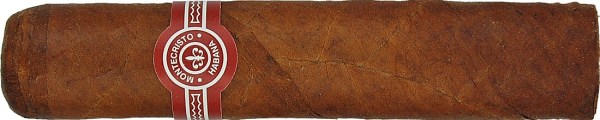
 This happy camper here is Alexandre Dumas. You might know him from “The Three Musketeers” In 1844-1845 he publicized his second most popular work titled: “The Count of Montecristo”. Hey Montecristo! The main character in this story is Edmond Dantès. Being Cubans they turned Edmond into Edmundo. End of story. Nothing more to it. Let’s move on to the cigar shall we?
 After the first 2 cm, the first signs of a lesser build quality appear, a crack near the foot of the cigar. It seems the wrapper isn’t strong enough for the growing filler. Further down the line, when the first ash fell off, some tunnelling was visible. When the second and last time the ash fell of a bigger tunnel was visible, wow. More strange phenomena occurred. After the halfway point, the cigar started to burn very unevenly and heavy corrections were needed. At the same time the wrapper started to ripple like the surface of water. It didn’t tear though. Also the cigar had a tendency to go out, so you would have to suck a bit more often to keep it lit.
 A’bunadh, as it’s called, has no age statement (NAS) on the bottle, but is believed to be between 8 and 10 years old, and comes solely from Spanish Oloroso Sherry Butts. Well, if you could smell it now, or see it’s colour you would know this is true.
 Even though it’s young, strong and harsh I still like this neat. Water takes away the little sweetness it has and makes it a bit more harsh. Drinking this at cask strength, makes me happy. It’s a bit of a drug that way. Recommended. There are a lot of batches which have their differences. More than you would have thought. So it can be a lot of fun comparing different batches from different years. Some are less harsh, or more sweet or…You guessed it, come back often to A’bunadh, and you’ll be welcomed back every time by a very nice whisky. By the way, who said there weren’t any good sherry casks anymore, and who said those sherried whiskies aren’t affordable anymore?
 I’m a big fan of old Strathisla’s. When I taste some from the 60’s or 70’s, I’m in heaven. With some old sherry cask bottles around, you can’t go wrong with Strathisla (and Longmorn, and Macallan, and…). Even 60’s bourbon casks are fantastic. So for this one, I certainly had high hopes and I paid some good money to get one. When I bought it at an auction, I thought it would be older than it turned out to be. Just look at that label with its 70° Proof and 26⅔ FL. OZS. The glass code on the bottom of the bottle (SD133) makes it from circa 1990.
 Color: Full Gold (Caramel?).
 Let’s see if this rings a bell. Are you one of those people who own some whisky books? Do you have one of those coffee table books that cover everything? Isn’t it true that almost every time you pick up the book, you skip the first part that’s about the whisky history? Usually dry and boring stuff about which you already know everything that’s written down there and in every book like this, the same things are mentioned. You know of Uisge Beatha, you know who friar John Cor was and you know everything about the collapse of Pattison Elder & Company (in 1899). If I asked you: “how many bolls of malt…?” Wouldn’t you know the answer?
 Well that’s all ancient history and well covered in almost every whisky book. But where is the modern whisky history? Where is the picking of the brains of people who made the whisky that’s in the oldest bottle you have at home? Here Gavin comes in. He talked with those people, he asked them interesting questions and writes down the answers which are even more interesting. Gavin is also the man who gathered the pictures of those times, and was brave enough to issue them in a reasonably priced book.
 I’ll come back later to review the book about the whisky memoires, where the really interesting history is (Wort, Worms and Washbacks, 1999), but first the book with the pictorial history. In fact both books work well together. Just read the one and keep the second one at hand, to get a feel for what you’re reading.
 I really like this book and I would have Gavin sign my books if I had the opportunity. I’m a fan of Gavin’s because he’s great, easy to read, has humor and is able to write a different kind of whisky book. Recommended!
 Now we move on to Inchgower, since it’s Inchgower that’s inside of the bottle. If you want to see how Raymonds operation looks like, and how this particular Inchgower was bottled, here is a
  Another fine day to have a quiet smoke on the porch. This time it wasn’t so easy to pick a cigar from one of my humidors. In the end I settled for something that I always call the “Almost Robusto”.
 Mind you, Robustos are nothing like a Behike, which looks like a tree trunk and makes you over stretch your jaws. Cigars are supposed not to be altogether healthy for you, but nobody thought it would break your jaw physically.
 After 2,5 cm the ash fell of and immediately the draw was good again and the smoke returned. The ash cone worked like a plug. No pine anymore, return of the oak and spice, but still rather linear. I smoked this with a Lavazza doppio espresso and again with some sparkling water. It was OK with the coffee, and it was just OK with the water, but nothing special. I didn’t try it with something else since probably nothing would go very well with it, but of course I could be wrong.
 Color: White wine.
 After a month, we had some sunshine with good temperatures again so I could have a relaxing moment outside. Since I don’t smoke in the house, I just will have to wait for those beautiful moments. When I opened my humidor this gold banded cigar just shouted at me; “pick me, me, me” and so I did. Boy was I in for a (floral) surprise…
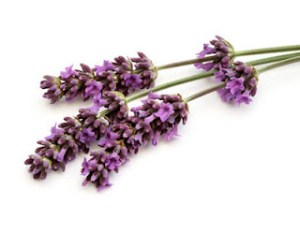 Ash alternates between gray and white streaks. Core is brown ash. Although it doesn’t seen heavy, my strong espresso tastes mild now. Almost even burn that continues throughout. No need for correction with a torch. Strangely the smoke on the outside of the cigar (wrapper) doesn’t have the lavender part. Somebody sitting next to you will not detect the lavender, but you, the smoker, most definitively will! It’s just there, lavender, soap, grandma’s clothes. Luckily this old smell is not overpowering, but just. After 3 cm the first ash falls off by itself. So maybe not so packed as I thought. The cigar by itself is not heavy, there isn’t a heavy taste that stays in your mouth for a day or so. It’s great with espresso but
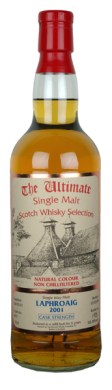
  I feel it needs a counterpart from Scotland, something salty and sweet from Islay. I poured myself a Laphroaig 2001/2009 (57%, The Ultimate, Hogshead #2927, 324 bottles). Well I was right, this type of whisky goes very well with garandma’s lavender scented knickers. It pulls out more deep spices into the equation to balance the lavender even more. Wow even this cask strength Laphroaig tastes mild with this Por Larrañaga. near the end, the thin wrapper let go, so it was time to let it rest.
 Again a wine I had with dinner yesterday. This time a copious swiss cheese fondue in classic style. Into the fondue went a very nice Alsatian Vorburger Pinot Gris 2008. The Vorburger is a biological wine with a great combination of acidity (needed for the fondue) and sweetness.
 Master Quill