Next up an oldie from 2005. A cask strength Glenmorangie. We don’t see many of them these days, especially one that isn’t touched by any special cask. The back label mentions that this unchillfiltered Whisky came straight from the cask made from mountain oak. So what kind of wood is this? My guess is American Oak from the Ozark Mountains, Arkansas USA. Hinting that this is a 10yo Glenmorangie fully matured in Bourbon casks and bottled at cask strength. Nothing more and nothing less. My most avid readers will know that I am not a very big fan of Glenmorangie but got quite a surprise when I reviewed a recent 18yo…
 Color: Light gold.
Nose: Aromatic and spicy yet closed, or maybe there isn’t a lot going on? Vanilla and typical bourbon cask notes. Slightly soapy and fresh and obviously high in alcohol. Vegetal and woody. It almost smells like it looks. It does smell a bit of sackcloth and oak. Dusty and powdery. Not very complex.
Taste: Sweet. Vanilla and pudding. Sweet alcohol. Mocha and vanilla pudding. Hints of Cappuccino and vanilla ice-cream. A woody bite, almost cigarette like, but also a short-lived fruity sweetness. Sugared raspberries and half-ripe forest strawberries. Thick toffee to hold it all together. Nice coffee-ish finish. Well balanced. This reminds me a bit of a young Bladnoch. That one has more butter, is softer and is a bit more vegetal, but that may very well be the only difference.
At first, a simple Whisky, but it grows on you. Give it time to breathe and it develops nicely. Nevertheless, this is actually an example of why I didn’t like Glenmorangie back in the day. (Let’s say, 10 years ago). It looks great, promises a lot, but this particular Whisky is simple and un-rewarding on the nose. It may very well be the reason I stopped buying Glenmorangie for a whole decade. The taste is a lot better though. I only picked up the fruity bits, when tasting this in the morning before breakfast. Last night after a very tiresome day, I didn’t pick up on the raspberry and strawberry at all.
The recent and “extremely rare” 18yo I tasted a while back, somewhat restored my faith in Glenmorangie and made me buy that very 18yo. Today, and tomorrow can be different, you can get three of those 18yo’s for the price of this cask strength Glenmorangie. A no brainer if you ask me.
Points: 83
 Not long after the revamped 10yo, Benromach released this 10yo 100 proof. As I mentioned before, with the new cleaned up look, the range as well was sort of “cleaned up”. There won’t be another Origins. Origins batch five (Golden Promise Barley) will be the last one. Also the Traditional has been replaced by the new 5yo. The first fill Bourbon Cask Strength bottlings are thus replaced by this 100 Proof, that by the look of it, isn’t only from first fill Bourbon casks anymore. What did survive the clean up are the Organic, the Peat Smoke and last but not least, the Wood Finishes. All are now vintages, including the year of distillation (and bottling). The two new wood finishes that were released in 2014 are the 2005 Hermitage and the 2006 Château Cissac. I really liked the Cask Strength version mentioned above, so let’s see if this new 100 Proof is an improvement…
 Color: Copper gold
 Springbank, the strongest survivor of Campbeltown, and one of the few family owned distilleries. Once a great center for whisky, and once a region of its own, it still is, but barely.
 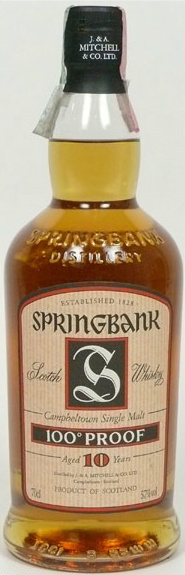 The people behind Springbank do their utmost best to let Campbeltown survive as a region. Glen Scotia is intermittently operated by the crew of Springbank, and of course Springbank themselves are responsible for Longrow, Hazelburn and Kilkerran (Glengyle Distillery). All names from a distant Campbeltown past. Founded in 1828 by the Reid family, who were married into the Mitchells. In 1837 the Mitchell’s bought the distillery. In 1897 J. & A. Mitchell Company Ltd. is founded, the company that is still on the label today. Since 1969 J. & A. Mitchell is also owner of Cadenhead’s. Between 1979 and 1987, Springbank was closed. And since 1989, production is again as it should be. Almost nobody malts themselves these days, but Springbank take the remarkable step to reopen the maltings in 1992. Springbank is a cult malt has a great following, and is by far the most popular malt on Wall Street.
 Yes it’s “Snickers” in a bottle. Slightly unbalanced by the soury woody, and peaty, finish. The finish also leaves a minty sensation on the tongue. Sweet mint as in “After Eight”.
 Glengoyne then. Glengoyne got my interest because they were one of the first to specifically state, ‘unpeated malt’ on their labels. Also, I like the looks of the bottle ánd for still using Golden Promise amongst other barley’s of course. Golden Promise is somewhat of the holy grail of grains, because it is supposed to be very flavoursome. But the yield is not so good, compared to the favorites of today (which make all whiskies taste the same, to come out bluntly). So lets see if this one, and remember this is a fairly priced bottle, makes a golden promise.
 Taste: Toasted wood, but still a lot of yeast. Can’t shake the Sherry here. High proof, so it makes an impression. Although this has bold flavours, the quality of the spirit shines through. Very Ahorn syrupy sweet, and corn sweetness, that’s totally different from the Ahorn. It almost tastes like a wheater! This could be a Weller, with some sherry musty and creamy yeastyness. It’s a picture with thick broad strokes. It is thick.
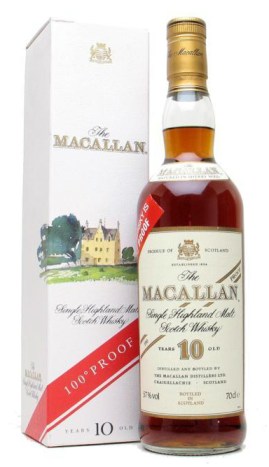 So for my generation, The Macallan was something like the bottle you see here. Nice brown/orange whisky made from Oloroso Sherry (and who knows some PX).
 Well this is old skool whisky. This may not be very complex, but just try to ‘get’ the steam locomotive in these kinds of whiskies. The tar, the coal and the steam. I’m very sorry these Macallans aren’t around anymore. They were very classy, and if you can find them now, they are very expensive. If you have a chance, try this, it’s a piece of history.
 Master Quill