And here is another entry-level whisky by the same owners as Glenfiddich. I guess Glenfiddich was (not anymore) the poor man’s Single Malt Whisky and The Balvenie is the more posh one. Even Glenfiddich started to churn out Vintage Releases from the seventies, that have a heft price tag. Balvenie makes about half the amount of Whisky Glenfiddich makes and with that still is a top ten seller. So William Grant & Sons have two golden goose’s on hand.
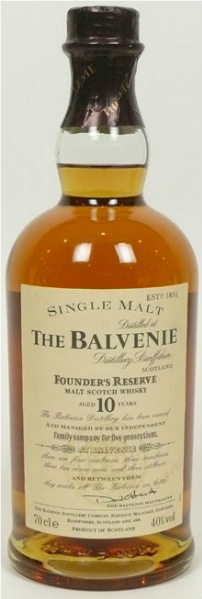 When looking around. and being new to Single Malts I almost fell in love by the shape of the bottle and really liked the way their labels looked. Not a lot to choose then. There was this 10yo (Founders Reserve), a 12yo (Double Wood), a 15yo (Single Cask), a 21yo (Port Wood) and a 25yo (Single Cask). And there was one limited oddity, the 17yo (Islay Cask). Nothing more. Today like with others there is more choice than ever. Lets have a look at the cheapest Balvenie, the 10yo “Founders Reserve”…
Color: Gold
Nose: Perfumy and powdery. Almonds and lemons. Apple pie. Hint of wood. Creamy. banana and cookie dough. Syrupy. Sweet and light.
Taste: Sweet and very fruity. Cardboard. Very short finish. Sweet but very light. Hints of smoke? Hints of wood and wood-shavings that give it just a little bit of character. Vanilla ice-cream.
First of all I have to admit it was a very long time since I’ve had those standards like this one and Glenfiddich 12yo. I almost never have a whisky that’s 40% ABV, or it has to be a very old Gordon & MacPhail bottling. So I’ve become very much detached of these standards. With that I may become a bit decadent and in memory unappreciative of these whiskies. Having said that I have to admit that these two whiskies surprised me a lot with their quality and taste. Nice stuff. There is one big if. These type of malts seems to me are so easily drinkable, that you would drink them the way you drank lemonade when you were a kid. These types of malts make alcoholics out of us 😉
Compared to Glenfiddich 12yo “Special Reserve”, both are different styles. This is sweet and fruity. Nothing more. Glenfiddich is more honest in style, more of a Lowlander I would say. I thought Glenfiddich was better.
Points: 77
 …and here is my second entry for our Genietschap gathering. Yesterday I reviewed an older expression of the ‘standard’
  Color: Copper Brown.
 Springbank, the strongest survivor of Campbeltown, and one of the few family owned distilleries. Once a great center for whisky, and once a region of its own, it still is, but barely.
 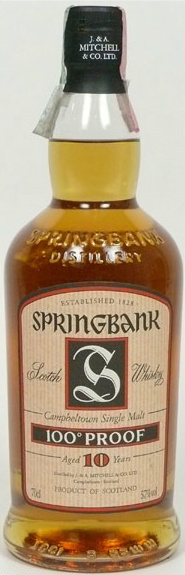 The people behind Springbank do their utmost best to let Campbeltown survive as a region. Glen Scotia is intermittently operated by the crew of Springbank, and of course Springbank themselves are responsible for Longrow, Hazelburn and Kilkerran (Glengyle Distillery). All names from a distant Campbeltown past. Founded in 1828 by the Reid family, who were married into the Mitchells. In 1837 the Mitchell’s bought the distillery. In 1897 J. & A. Mitchell Company Ltd. is founded, the company that is still on the label today. Since 1969 J. & A. Mitchell is also owner of Cadenhead’s. Between 1979 and 1987, Springbank was closed. And since 1989, production is again as it should be. Almost nobody malts themselves these days, but Springbank take the remarkable step to reopen the maltings in 1992. Springbank is a cult malt has a great following, and is by far the most popular malt on Wall Street.
 Yes it’s “Snickers” in a bottle. Slightly unbalanced by the soury woody, and peaty, finish. The finish also leaves a minty sensation on the tongue. Sweet mint as in “After Eight”.
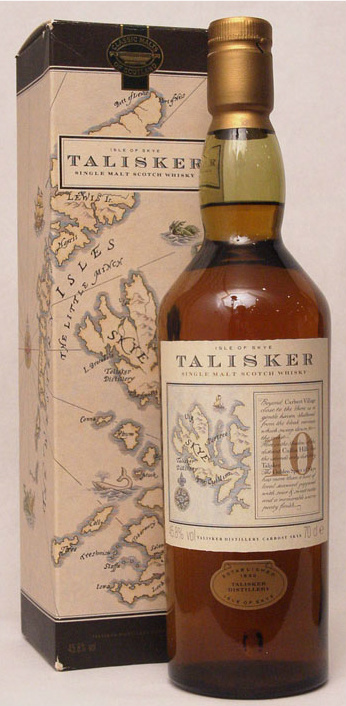 For those of you who have read my
  This profile is great and if you want this, you’ll have to pay some serious cash to buy yourself an old Islay whisky or even Brora. I know, an older expression of the standard 10yo Talisker is getting more pricey lately, but still nowhere near to the prices asked for the aforementioned bottles. Do yourself a favour and get it while you can, and beware, this is dangerously drinkable. This will be empty before you know it. I left myself a 125 ml sample of this, but I almost drank it all writing this! Stay away, just drink milk instead, its good for you, unless you are lactose intolerant I guess.
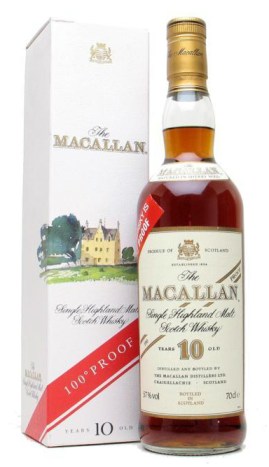 So for my generation, The Macallan was something like the bottle you see here. Nice brown/orange whisky made from Oloroso Sherry (and who knows some PX).
 Well this is old skool whisky. This may not be very complex, but just try to ‘get’ the steam locomotive in these kinds of whiskies. The tar, the coal and the steam. I’m very sorry these Macallans aren’t around anymore. They were very classy, and if you can find them now, they are very expensive. If you have a chance, try this, it’s a piece of history.
 Master Quill