Here at Master Quill, when writing about whisky, we foremost are keeping up busy with the Scottish version of the tipple. However in the early 19th century lots of Scots moved across the world and settled in New Zealand. Finding a lot of Scottish (Whisky) heritage in New Zealand is not all that unusual. Even today a lot of small or micro-distilleries do pop up in the country. (like Southern, Hokonui and Thomson, to name but a few).
 This time we’ll concentrate on the biggest and best known of the New Zealand Whisky producers, al be it under a lot of different names, and also under quite some different management.
In December 1969 the Baker family started distillation in Dunedin (on the south Island, to the south of Oamaru). They named their distillery “Willowbank”. The Whisky was released under their Wilson’s brand name since 1974. By 1974 The distillery was named after it’s Whisky “Wilson Distillery”. In 1981 the giant Seagram’s bought the distillery. Seagrams made a “minor” contribution by replacing the copper necked stainless steel stills for more traditional whole copper stills. Seagram’s released their Whisky as Lammerlaw. Lammerlaw being a nearby mountain range, but also the source of water for Whisky production. The distillery was mothballed in 1995 and Seagram’s sold the distillery to Foster’s in 1997, who had it untill 2002. The two copper stills and the four column grain still were eventually sold to Fiji to distill rum, but the gin still remained in New Zealand. It is now located in pieces at the McCashin’s Brewery in Nelson, and may be used again in the future.
 First Warren Preston bought the Distillery and some 600 ageing casks of amongst others Lammerlaw Malt Whisky and starting a firm called The New Zealand Malt Whisky Company (NZMWC). The Casks were laid down in Oamaru. Some 150 of those casks were bottled (under the Milfort brand name, but also Blended Whisky under the Preston’s brand name). Alas NZMWC went bankrupt and in 2010 the Forward looking entrepreneur Greg Ramsay (leading a consortium of investors) took over and renamed the firm The New Zealand Whisky Company (NZWC). Mr. Ramsay bought the last 450 casks of Whisky of which half were Lammerlaw Malt Whisky (18 to 24yo) and the other half Wilson’s Whisky (at least 12yo). By 2012 some 90 casks were bottled for the current range, so by now only 360 casks are left. In the grand scheme of things and the good promotion for the Whisky being carried out, I guess that the whole stock will be sold by the end of 2016. So be quick, because, this New Zealand whisky is rapidly becoming extinct!
Plans are to build a new distillery (or two). Obvious choices for new sites are Oamaru, but also Dunedin. Less obvious choices would be Auckland and Nelson, both Auckland and Nelson showed more interest than Oamaru and Dunedin in being the home of a new New Zealand Whisky distillery.
 Color: Red copper.
Nose: Fresh and woody at first, and a little bit winey, well that’s a surprise! Spicy and a little bit of sweet, toffee-like wood. It does have a sweet side to it, but overall pretty dark, with already hints of grain whisky. Maybe some cask toast and influences (tannins) from the wine. Spicy Syrah? Next, the grain whisky starts to play its part. This is spicy and definitely smells like a volcanic red wine, so I got even some terroir in this (Syrah again). That’s not completely strange since the Red Wine finish was done for a whopping 4 years, whereas others finish their whiskies for mere months. (I understand that there also is, or was, a 15yo Double Wood that was finished for 10 whole years in Wine casks!) This one is dark and brooding after the initial freshness right out of the bottle. Very appetizing.
Taste: Less woody than one might think, half-sweet cookie dough and nicely fruity. Slightly acidic at first, but quickly taken over by the sweet red fruits. Not even a lot of Wine to this, so the 4 years in Wine barrels didn’t do the Whisky any harm. Maybe the grain balances the Whisky out? That said, it doesn’t mean the wine didn’t impair a lot of taste onto the Whisky, because it did (sweet fruits, red fruits, plums, Merlot?), especially after some breathing. The Whisky just doesn’t taste like Wine, although some markers are definitely there. Seems to me that the 70/30 ratio of malt and grain is pretty much spot on. Nice and half-long, warming and sweetish finish, with some hints of oak. Very well made, likeable and drinkable blend.
Yes, this is a blended Whisky, the NZWC itself calls it a Master Blended Whisky. With 70% Single Malt this really is a sort of super premium luxury blend. Stuff that the Scots these days put into expensive crystal decanters. Nice aroma’s and pretty different and bold. For the Whisky it is, this is bottled at the right ABV. Recommended!
Points: 84 Points
Thanks go out to Cyril and Greg for the Whiskies and the additional info!
 Color: White wine.
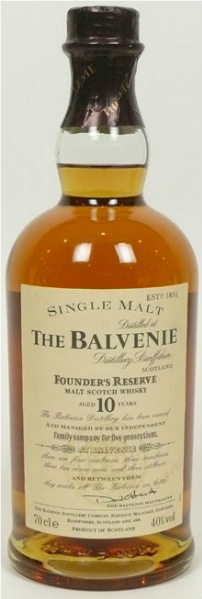 When looking around. and being new to Single Malts I almost fell in love by the shape of the bottle and really liked the way their labels looked. Not a lot to choose then. There was this 10yo (Founders Reserve), a 12yo (Double Wood), a 15yo (Single Cask), a 21yo (Port Wood) and a 25yo (Single Cask). And there was one limited oddity, the 17yo (Islay Cask). Nothing more. Today like with others there is more choice than ever. Lets have a look at the cheapest Balvenie, the 10yo “Founders Reserve”…
 …and here is my second entry for our Genietschap gathering. Yesterday I reviewed an older expression of the ‘standard’
  Color: Copper Brown.
 Springbank, the strongest survivor of Campbeltown, and one of the few family owned distilleries. Once a great center for whisky, and once a region of its own, it still is, but barely.
 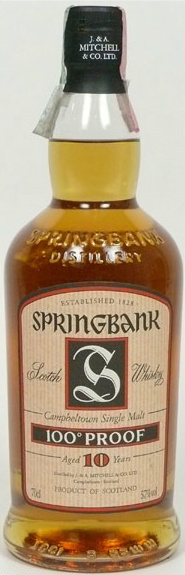 The people behind Springbank do their utmost best to let Campbeltown survive as a region. Glen Scotia is intermittently operated by the crew of Springbank, and of course Springbank themselves are responsible for Longrow, Hazelburn and Kilkerran (Glengyle Distillery). All names from a distant Campbeltown past. Founded in 1828 by the Reid family, who were married into the Mitchells. In 1837 the Mitchell’s bought the distillery. In 1897 J. & A. Mitchell Company Ltd. is founded, the company that is still on the label today. Since 1969 J. & A. Mitchell is also owner of Cadenhead’s. Between 1979 and 1987, Springbank was closed. And since 1989, production is again as it should be. Almost nobody malts themselves these days, but Springbank take the remarkable step to reopen the maltings in 1992. Springbank is a cult malt has a great following, and is by far the most popular malt on Wall Street.
 Yes it’s “Snickers” in a bottle. Slightly unbalanced by the soury woody, and peaty, finish. The finish also leaves a minty sensation on the tongue. Sweet mint as in “After Eight”.
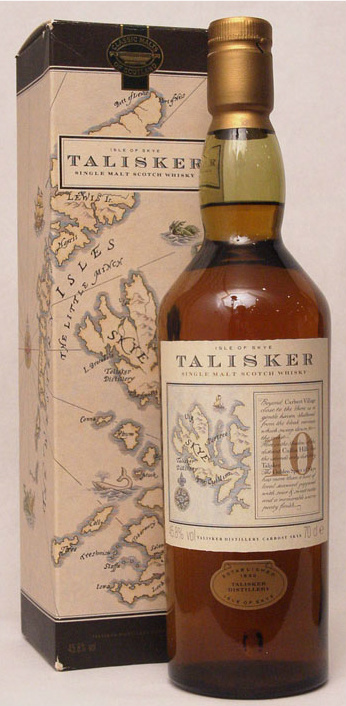 For those of you who have read my
  This profile is great and if you want this, you’ll have to pay some serious cash to buy yourself an old Islay whisky or even Brora. I know, an older expression of the standard 10yo Talisker is getting more pricey lately, but still nowhere near to the prices asked for the aforementioned bottles. Do yourself a favour and get it while you can, and beware, this is dangerously drinkable. This will be empty before you know it. I left myself a 125 ml sample of this, but I almost drank it all writing this! Stay away, just drink milk instead, its good for you, unless you are lactose intolerant I guess.
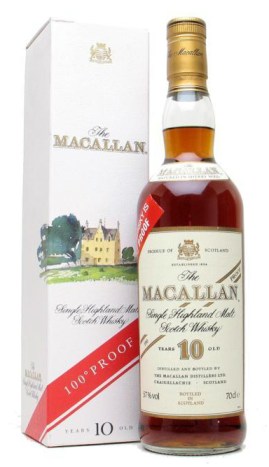 So for my generation, The Macallan was something like the bottle you see here. Nice brown/orange whisky made from Oloroso Sherry (and who knows some PX).
 Well this is old skool whisky. This may not be very complex, but just try to ‘get’ the steam locomotive in these kinds of whiskies. The tar, the coal and the steam. I’m very sorry these Macallans aren’t around anymore. They were very classy, and if you can find them now, they are very expensive. If you have a chance, try this, it’s a piece of history.
