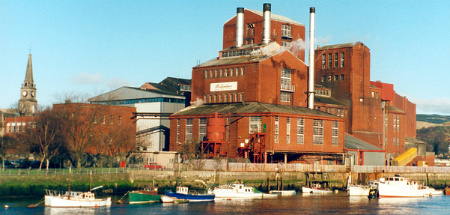
 I ended the last post about Gordon & MacPhail’s Inverleven with the hope that they wouldn’t reduce the next issue (so much). Frolicking around in my stash of samples I unearthed this unreduced Inverleven bottled by Cadenhead’s. It’s from another year, so this may have a different profile, but still worth checking out. Dumbarton was foremost a Grain Distillery. The distillery was built in 1938. In 2002 the distillery was closed and demolition commenced in 2005. I’ve added a picture here, because I have always liked the big red brick industrial complex on the river. By the way, after stopping the production of the Inverleven malt, the Stills went on to Islay to produce Port Charlotte at Bruichladdich.
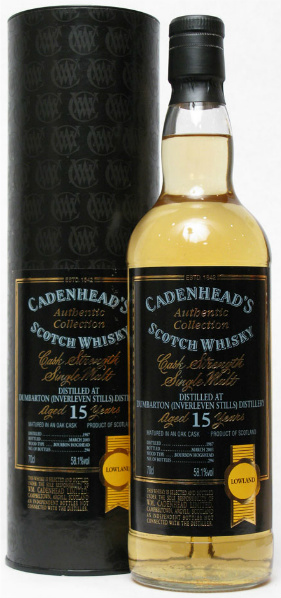 Color: White wine.
Nose: Grassy and murky, like sitting next to a ditch in summer, not bad, but certainly not lovely as well. A lot of citrus fruits. Lemon, lime, tangerines, but over this a lot of dried grass and hot butter. A slightly meaty or gravy like component emerges from all this. Quite fresh and slightly estery. Hints of mint when nosed vigorously.
Taste: Sweet and fresh. Lively, leafy, slightly woody and again lemons. Some underlying caramel and this type of whisky at this strength makes this hot, but that’s not a bad thing. Caramels, vanilla and toffee, are the main markers here. Not very complex. After some breathing, the bite of the wood enters, but luckily not a lot of bitterness.
Compared to the 1991/2012 G&M, this has even less than half of the wood the G&M. So this is more grassy, lemony and much sweeter to boot. This one lacks complexity, and even though the G&M was on the brink of becoming a log of wood, that one was more complex and therefore more interesting. This Cadenheads is easier to drink (as long as you like cask strength whiskies), sweeter and fresher. Still I like this type of Lowlander profile. Sadly gone.
Points: 84
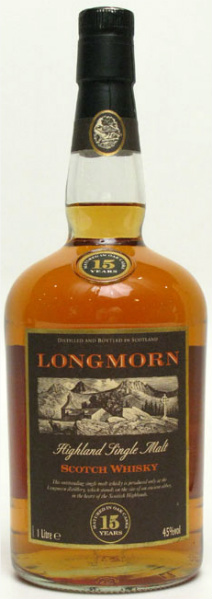 I just found out that Longmorn isn’t on Master Quill yet! Longmorn is one of my absolute favorites. Just have a go at a sixties or seventies fruitbomb or heavily sherried expressions from the days the stills were heated with coal. Sometimes it almost tastes like the coal went into the whisky too. A liquified locomotive. But no use crying over spilt whisky and let’s start-up with this old 15yo. This 15yo is no more and was replaced in 2007 by the current 16yo. So it’s off the market for five years now, but bottles are found in some shops and are still fairly cheap at auctions. Also the packaging has dramatically changed. The 16yo new bottle has metal and leather glued to it, and has an intricate box. This 15yo looks fairly simple. Surely Longmorn are capable of making a pretty good standard whisky? Lets find out how this eighties distillate behaves, and maybe we get a chance in the future to compare this to the new 16yo expression. I tasted the 16yo once in 2009, and scored it a measly 81. I hope it got better in the mean time.
 Next up in our Japanese Whisky Week is one of the two components of the previously reviewed Taketsuru Pure malts. Miyagikyo. Miyagikyo was built by Masataka Taketsuru in 1969. Miyagikyo is also known as the Sendai Distillery and is located in northern Honshu. Quite close to the Fukushima nuclear power plant (30 minutes by car).
 Color: Orange gold.
 Time for another Lowlander. Rosebank this time. I reviewed a
  hoping for a resurrection. Who knows. For the time being, lets see if this Rosebank is any better than the Glenkinchie reviewed earlier.
 I’m a big fan of old Strathisla’s. When I taste some from the 60’s or 70’s, I’m in heaven. With some old sherry cask bottles around, you can’t go wrong with Strathisla (and Longmorn, and Macallan, and…). Even 60’s bourbon casks are fantastic. So for this one, I certainly had high hopes and I paid some good money to get one. When I bought it at an auction, I thought it would be older than it turned out to be. Just look at that label with its 70° Proof and 26⅔ FL. OZS. The glass code on the bottom of the bottle (SD133) makes it from circa 1990.
 Color: Full Gold (Caramel?).
 Color: Light Gold
 Master Quill