Why not make it a double bill, and review our third Glencadam. Both Glencadam’s I reviewed earlier managed to score a nice 85 Points, so let’s see if this one does better. This particular on is 30 years old, and by itself it’s older than both previous examples put together. This is another one from the attic, since it was released back in 2006. The difference couldn’t be greater when comparing it to the Glencadam I just reviewed. It is twice the age and this one comes from a Bourbon cask, surely it will do better?
 Color: Full gold, and only slightly lighter than the 15yo.
Nose: Half sweet and nice biscuity barley. Slightly spicy and reminds me of old Dutch Jenever. Definitely some Bourbon influences. Some waxy elements, but not much. In fact the Whisky smells quite young and vibrant and not at all would you expect it to be 30 years old. Fresh, hints of citrus and only mere hints of vanilla. Dusty wood completes the nose. That’s it, not much more is happening. After a while more fruit comes to the fore. Sweetish yellow fruits. Some unripe banana skin. Adding to the structure of banana comes powdered coffee-creamer, in the smell a creamy variant of vanilla. Dusty and slightly dried out ice-cream after you spilled it and didn’t clean it right away. Given some time the freshness takes a back seat and the whole is nice but also rather dull. Not a very active cask I’m afraid. Having said that, it does smell like something from the past.
Taste: Wood, paper and cardboard and after that a short, sharp attack, quickly followed by a short sweet note. After the sweetness comes some woody bitterness. Distant dull vanilla. Waxy again. Cold candle wax. So the body is present and almost chewy, yet surrounded by dry paper and woody notes. A nice old Bourbon matured Whisky, but not a stellar one like 1972 Caperdonich or 1976 Tomatin, to name but a few. Here also some fruit emerges, but again a bit dull. Dried bits of pineapple and some old broken almond bits, you sometimes find in the couch. Luckily the sweetish and fruity note dominate the body, not leaving much room for the woody bitterness. The finish has medium length, but there isn’t much happening afterwards. What stays around for the longest, apart from general (cardboardy) creaminess, is a sour note you get from (new) oak.
Not bad, quite nice, but also not spectacular as well. No real off notes and nothing (bad) overpowering the whole. Still a nice one to pick up when all of its distant relatives are sold out. Definitely a lot better than most of the modern Whiskies though. I’ll have fond memories of this nevertheless.
Points: 85
 Color: White Wine.
 Even though it’s supposed to be summer, looking outside you could have convinced me of something different. I see people outside wearing coats and jackets. Yesterday I reviewed an Islay malt,
  Well here is an example of the mother of all Single Malts. No it’s not the oldest distillery in Scotland, nor is it the first in anything. The oldest being Ferintosh at Ryefield (from 1689). The oldest still working distillery is Glenturret (1775). But once there was a time a lot of others added the “Glenlivet” to their own name to benefit from the success, and the known quality of Glenlivet, and who doesn’t know Glenlivet? Started in 1817 and ‘founded’ in 1824 when George Smith was one of the first to obtain a licence for his distilling. All of his illicit distilling neighbours, wanted him dead for it. Traitor!
  In 1845 George leased Minmore farm, which he bought in 1858. Minmore was renamed Glenlivet a year later and is the site of the current distillery. Funnily enough, Cadenheads also state the name “Minmore” on their Glenlivet offerings. George died in 1871. Long live George and to his health we raise the glass with this Berry Brothers & Rudd Glenlivet. Slainthe George.
 Yes! Another example from the distillery that took its water from the Penwapple Reservoir, yes say it again, the Penwapple Reservoir. This time one of the many sister casks from the last year of operation, bottled by Signatory.
 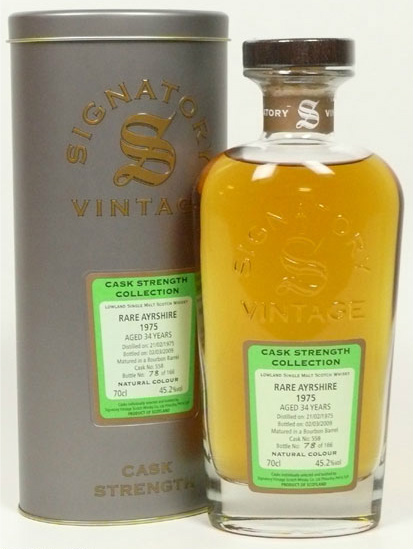 Color: Gold (slightly lighter than barrel #562)
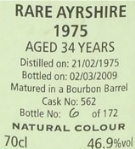 Ladyburn wasn’t long around. Opened in 1966 and already closed in 1975. It was built by W. Grant & Sons within their Girvan grain distillery complex. Not completely uncommon in those days, since there were more malt distilleries on a grain distillery site. Glen Flagler was added to the Moffat site and Ben Wyvis was added to Invergordon. All three didn’t last long and are pretty scarce these days. These Rare Ayrshire’s are still around, but there will be a time soon, they will not, and prices will soar. So is this worth your money? Lets see…
 Well officially there is no Ladyburn on the label, still it isn’t hard to guess what this must be. Out of the blue Signatory started to bottle a lot of casks from Ladyburn. Which is always nice since the place shut down in 1975 and whiskies from Ladyburn are getting more and more rare.
 I did some rummaging in my boxes with samples and found another Glen Grant. Well I actually found several of them, but I just chose this one. You know Glen Grant, the place that was the first distillery that was illuminated without burning fuel by themselves. This time we have a Glen Grant bottled in the Old Malt Cask series by Douglas Laing. Again in the new tall bottle, just like the
  Color: (Light) gold.
 Master Quill