Kilnflat was founded, by William Paul in 1810. The distillery was closed between 1870 and 1878. When it was opened again, by Charles Hay, he also renamed the place to Glenburgie, a name are more familiar with. In 1884 Alexander Fraser & Co. takes over only to go bankrupt in 1925. Again the distillery changes hands, and this time to those of James & George Stodart Ltd. In 1927 the distillery was mothballed and stays that way untill 1936, when Hiram Walker buys the distillery. In the mean time in 1930, Hiram Walker also gained a majority of James & George Stodart Ltd.
In 1958 the distillery also gets Lomond Stills to produce another SIngle Malt you might have heard of: Glencraig. This will go on for several years but finally in 1981 the Lomond Stills are removed again and replaced by conventional stills, making Glencraig a “closed distillery” and somewhat of a collector’s item. In 1987 Hiram Walker is bought by Allied Lyons. In 2005 Chivas Brothers (Pernod Ricard) buys Allied Domecq becoming the current owner of Glenburgie.
In 2003 the distillery was demolished entirely and replaced (a bit further down the premises) by a new and highly modern distillery. Only the old customs house remains and the four stills, the boiler and the mill were brought in from the old distillery. By 2006 another pair of stills were added.
Unbelievable, this is only my first review of a Glenburgie. Amazing. That’s why I stared with this brief history “lesson”. Not so long ago I was asked about great, lesser known, Malts (from Scotland) a.k.a. personal favourites off the beaten track. Glenburgie managed to get into that top 10, that’s why I’m so amazed this is just the first review of Glenburgie, should have been much sooner. Glenburgie is a distillate that works extremely well in Sherry casks.
Glenburgie might be lesser known as a Single Malt, but that’s because a lot of it goes into the Ballantine’s Blend. In 2017, Chivas Brothers released three Single Malts under the Ballantine’s name. Huh? Yes Glenburgie 15yo (the heart), Miltonduff 15yo (the foundation) and Glentauchers 15yo (the finish), were released as such, to tell the story how they make up the Ballantine’s Blended Whisky.
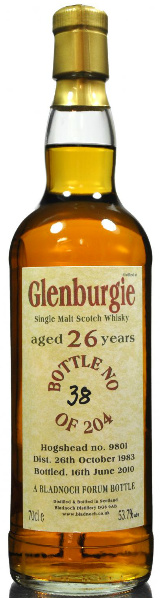 Color: Almost copper gold.
Nose: Very big aroma, this leaps, or rather, attacks you, with a soothing friendly voice, from the glass. Nutty and fruity. Meaty and dusty. Some soft old oak right after that. Dusty old oak. Quite big and holding a promise of sweetness, sweet (and meaty) apples rather than the usual Sherry notes. The oak has an aroma reminiscent of tobacco and leather and hints of old Calvados. Very fragrant Glenburgie. Nice and spicy. In fact, this holds it all. Quite balanced, and very big, it’s so big it hides the complexity a bit. Try not to forget, this is a 26yo Malt. It doesn’t show a lot of evolution over time as well, it stays more or less the same when nosing it. But with a Malt so big and nice, who needs complexity and evolution?
Taste: Yes sweet on entry, but with a lot more. Cannabis and toffee. Crushed beetle again and lots of nuts. Yes, let’s throw in some caramel as well. The start is sweet and sticky. Quite hot and the 53.7% ABV printed on the label, seems a bit low. Very fruity but grassy as well, thick fat grass notes, different from fresh-cut grass or dry grass and hay, but as mentioned above, also the grass you smoke. It’s fatty grass and cannabis. Do I detect a nice tarry edge right behind the spicy oak? Hot black tea. Dries out towards the finish. What a wonderful complexity and blend of aroma’s. This bottle is now 1/3 down, and that’s a good thing, because right after opening, this was much tighter and closed. Amazing how the nose lacked complexity and evolution, and when tasting it now, it is all but complex and shows a lot of evolution as well. One has to stop oneself writing notes, since, this keeps emitting more aroma’s from my glass…
Wonderful Glenburgie, extremely drinkable, even at cask strength.
Points: 89
 Color: Full Gold.
 Color: Vibrant full gold.
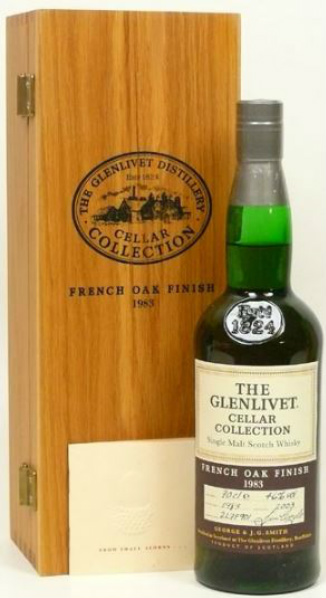 Color: Amber gold.
 It’s been a while since a bottling of Dutch indie bottlers Mo Òr graced these pages, but it certainly is the first Glenglassaugh. Last MoÒr was an old
 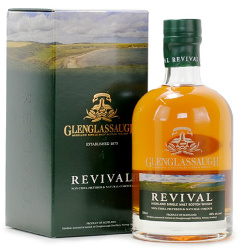 So any distillery that reasonably could be reopened is reopened, the rest is demolished, stripped bare, or otherwise made unusuable. I wouldn’t be surprised anymore if Diageo decides to cash in on the name, and reopen Brora! Besides this, more and more new distilleries are popping out of the ground like mushrooms on a forest floor…
 Color: Copper Brown.
 Balmenach was licensed in 1824, but existed much longer as an illicit farm distillery called Balminoch. Not earlier than 1992 the first official bottling is released, a 12yo Flora and Fauna. Not long after this United Distillers (now: Diageo) sold Balmenach to Inver House Distillers, with wich came an end to the Flora and Fauna bottling.
 Teaninich isn’t amongst those superstars of Single Malt Whiskies around, but it has a fanatical following with certain enthusiasts. Well I’m one of them. Almost every time I taste a Teaninich, blind or not, this always tickles my fancy. I connect with it. It suits my palate. Dare we say: “For reasons not even science can wholly explain…”
  Teaninich was founded in 1817. In 1970, yes a small jump in time, a whole new six still ‘distillery’ was built alongside the current one, consisting of four stills. The new one was called the A-side (The old stuff was therefore called the B-Side). They worked together as one distillery. In 1984 the old distillery was mothballed, and 15 years later, demolished.
 Instead of expanding into unchartered territory, let’s do something oppositional and do yet another Port Ellen, and another bottle by Douglas Laing. This time from the old series in the normal scotch whisky bottle and not from the new tall bottle. People tend to think this older look contains better whisky. Let’s see if that’s true. By the way ,I read somewhere that in the few months Port Ellen operated during 1983, there weren’t a lot of good casks around, and they filled almost anything they could get their hands on. This Port Ellen looks quite light in color. Is this from a tired butt or a normal refill Fino butt?
 Taste: Peat and rhubarb. Sweet, big, leafy and chewy. Black tea with clean refined sugar. No rubber here and it’s no monster either. The peat is very mild here and the finish is quite simple. Still it seems to be very balanced, just not very complex. It has the dryness and a bit of the spiciness of the oak, but not the bitterness, and that’s a big plus (not a Chevrolet). It has citrus with cardboard in the finish. If tasted blind, I would have thought it to be some odd ten years younger.
 It’s an end of an era, even if it was a tired cask, this is still very typical and good. Really a shame this got closed. In a way it resembles Talisker in it always being decent. This may be no high flyer, but is has a lot of fine moments to give. No I’m not sentimental, this is good in itself. A very nice Islay Whisky. As I’m sipping the last few drops: “Here’s looking at you kid…”
 Color: Light Gold
 Master Quill