Amrut 4yo 2009/2013 (60%, OB, Single Cask, for Europe, Virgin Oak & First Fill Bourbon Barrel #3445, 172 bottles)

Maybe Amrut is a true Malternative, because it’s another Malt Whisky. If you love Scottish Single Malts best, why look at other distillates? They are just different. Other distillates can broaden your horizon, but will not replace your Single Malt that has become too expensive. For instance look outside of Scotland.

Looking back I seem to like Amrut. This is now the third review, and after the Intermediate Sherry (87 points) and the Portonova (88 points), this is something of a speciality. Maybe I should take that back. Most Amruts are in fact specialities. Something out of the box is often done. Maturing on two continents, or blending many different casks together, to name but a few of things Amrut does.

This time a single cask bottling. Often, you will have a Whisky that has matured in a first fill or second fill Bourbon cask, barrel or hogshead, but no, Amrut had to do it differently. This particular example was first matured in charred virgin oak and then transferred into a first fill Bourbon barrel. Barrels being the original casks Bourbon matures in, where hogsheads are remade casks from the staves of barrels. Hogsheads are bigger than barrels. Most barrels are shipped in staves anyway.

There is some additional useful information on the label as well. I like that. In the four years this Whisky has been maturing, 42% has evaporated over time, as compared to around 8% in that evaporates is Scotland over the same period of time. By the way, unpeated (six row) Indian barley was used.

Amrut Single Cask #3445Color: Gold.

Nose: The first whiff that enters my nose is of virgin oak. Creamy sawdust and vanilla. Although only four years old, at the fast forward maturation rate, this can be called a woody Whisky. The typical American oak notes are here, but I actually miss the typical Amrut spiciness. Amrut is indian, and Indian Whisky should be a bit exotic, not just another copy of Scottish Whisky. This Amrut does hide it Indian. After some vigorous movement in the glass and some patience, there is exotic spice emerging and apart from that the Whisky becomes a bit dusty.

Taste: Initially hot and then an explosion of sweet Vanilla. When the thick vanilla, travels down, quite some (virgin) oak, emerges here in the taste as well. So we have wood and vanilla. What else? Over the top vanilla combined with hot butter. Just as with the nose this needs air to show some exotic spices. Luckily it’s Indian-ness is here at last. Spicy hot sawdust from Massaranduba. A very hard tropical wood. It’s so hard in fact that you can’t cut it without the saw charring the wood. This slightly sour odour is very similar to the spiciness of this Whisky, especially in the taste of it.

I mentioned decanting Whisky before. This Amrut is one that needs a lot of air as well to fully blossom. This is still a pretty full bottle, but already there is a difference to the first taste of the freshly opened bottle. I will score it now (after lots of air in the glass), but I feel this will grow even better and more balanced over time. This may very well be an example of a Whisky where the last drop from the bottle will be the best drop.

Points: 88

The initial score was 86 points, but as I expected, this got only better over time. The bottle is gone now, but the last third scored an easy 88 Points. Again lesson learned. Give it time to breathe…

A.H.Riise X.O. Reserve Christmas Rum (40%, 875 bottles, 2013, Saint Thomas, U.S. Virgin Islands)

Albert Heinrich Riise was born on the 11th of September 1810 on the Danish Island Ærø. In 1932 he graduated as a pharmacist in Copenhagen. In 1838 he followed his dream to work as a pharmacist in the Danish West Indies in St. Thomas. In 1842 he married Henriette Marie Worm (1821-1889) on St. Croix. The couple had 13 children. I guessed he felt at home in the Carribean! In 1843 he had his own pharmacy which he turned into a succesful business. Being an excellent pharmacist Riise used Caribbean plants and herbs for the manufacture of pharmaceutical alcohols and cosmetics. He especially was succesful in selling Riises Bay Rum, yes you guessed it, a perfume! He also started distilling Rum and bitters as medicine. Way to go Albert. In 1868 an epidemic broke out of cholera, yellow fever and smallpox. No Rum would cure that, so the family decided to go to Denmark for a year, but in the end never returned to live on St. Thomas. Albert passed away in 1882 and his wife Henriette followed him in 1889.

A.H. Riise X.O. Reserve Christmas Rum has aged up to 20 years, and was finished in PX Sherry casks. Each bottle comes from a single cask.

A.H.Riise X.O. Reserve Christmas Rum (40%, Saint Thomas, U.S. Virgin Islands)Color: Brown with an amber hue.

Nose: Nice Demerara type of Rum nose with notes of cloves in (partly dried) orange skin and cinnamon. Old wood, speculoos cookies and very festive smelling. Its like visiting and old distillery museum where a lot is done with spirits and spices or a bakery museum where all the spices are stored for making cookies. Vanilla, hot butter and fruity acidity. Very aromatic. Also hints of ginger, cardamom, dust and nutmeg. Very nostalgic, appetizing and tasty. Based on the nose alone a must-have so lets see if it also tastes as good…

Taste: Thick and sweet. Syrupy. Sugared red fruits. White pepper and some wood. Fresh cookie dough. The orange skins are present too, but without the cloves. Noticeable is the finish in PX casks. Not the longest of finishes, but warming and just right. The part that stays on the longest is the fruity acidity, but wait…the cloves return for the finish, excellent!

The nose alone puts me in a melancholic mood and puts me in a bakery or Jenever distillery where spices and botanicals are used for the spirit. It makes me feel like it’s the 1930’s again (or so I imagine, since I wasn’t born yet in the 1930’s). The nose is very nice and suits the Christmas name they use for this Limited Edition. The taste is somewhat simpler and the finish shows that 40% ABV was  a little too light for this kind of rum. On the website the claim is made, or maybe that’s just how I read it, that the typical aroma’s come from the PX casks that were used for the finish and not by added spices, so it should not be a spiced Rum. In the end that’s not entirely important, since it is a very nice Christmas Rum, and even if it was spiced, isn’t Christmas a time to forgive? Wink, wink, nudge, nudge. Merry Christmas everybody!

Points: 87

The Benriach 17yo “Septendecim” (46%, OB, Peated, 2013)

Last summer I already reviewed The 18yo Benriach “Dunder”. A peated Benriach finished in high ester Rum casks. This “Septendecim” is a 17 year old peated Whisky. Well, I may be wrong, but maybe this “Septendecim” is the basis for all those 18yo Limited production’s of late? Up untill now there are already three releases in this series. It started with “Albariza” which was finished in PX Sherry casks, the second was the aforementioned “Dunder” and last month the Benriach “Latada” was released. Again a peated Whisky finished this time in Madeira casks.

The Benriach SeptendecimColor: Gold.

Nose: Fatty, fatty, thick peat. The peat is instantly recognizable from the Dunder I reviewed earlier. Bonfire in the woods. Tiny hints of electrical fire and molten plastic. Sounds terrible, but it doesn’t harm the overall smell, so easy yourself back into your chair. Quite clean and smoky. Kippers, salty and tarry. But it’s not Islay I’m getting. I still get a secondary feeling of a forest. Clairvoyant? Who knows. After some air, the whole gets even more cleaner, smokier and shows hints of citrus. Lemon, not lime. Quite nice. I would have never given this 17 years if I had tasted it blind. Hints of coffee, but not dark roasted stuff, more Cappuccino. Last one to show itself is the wood. Fresh oak.

Taste: Sure, fatty, a bit fruity and obviously peaty, but also much lighter on aromatics. Cold chocolate milk and coffee again. It has some sweetness too, but that is more hidden. Just like the nose, I wouldn’t have given this 17 years. Even at 46% ABV. it doesn’t seem to be heavy on the alcohol, I’m actually amazed how light this actually is. The lightness (and the coffee with milk) makes this dangerously drinkable for a richly peated Malt. I keep wanting more, and want to sip it more. Having said that, It would have been nice to try this one at 50% ABV and see a bit more complexity at this age. Medium finish with a buttery, vanilla and smoky aftertaste.

The “lightness” in the taste made me believe this is the Whisky they use as a basis for the “Limited Production Series”, especially when its 17 years old and that leaves some room for finishing.

Points: 85

Evan Williams 10yo 2003/2013 (43.3%, OB, Single Barrel #654)

Whisk(e)y certainly is a very global thing. Just read back a few posts and we have already been in Speyside, Scotland, Bangalore, India, and for this review we’ll cross another big Pond to have a look at a Bourbon called Evan Williams Vintage 2003 from Kentucky. This is a single barrel bottling. The barrel was filled on the eleventh of february 2003 and bottled on the last day of July 2013. Evan Williams himself, was a character who at the time of choosing the name, was supposedly the first person to distil Whiskey in Louisville Kentucky. In the end we may never know who was the first since not a lot is known from that time. Evan Williams Straight Bourbon Whiskey is made by Heaven Hill Distillery in Louisville, Kentucky, but bottled in Bardstown, Kentucky. Today the range consists of a Black Label, a Bottled in Bond (White Label) a 1783 (small batch) and we will have a look at this 2003 vintage single barrel. In the past also a special 23yo was released.

Evan Williams Vintage 2003Color: Light orange gold.

Nose: Nicely sweet and toffeed. Good wood notes. Nutty and organic. Very spicy, balanced with quite some vanilla from the virgin oak. Pencil shavings, sawdust and quite a lot of honey and hot bees wax. It also carries hints of grass and cherries. Smells strict and modern.

Taste: Initially light and vegetal. Dry leaves, soft oak, but quickly followed by a nice mixture of wood and sweetness, with a hint of licorice. Very appetizing and likeable. Short finish, and the its way to light too. The watery finish drowns the plethora of aroma’s that are still there. Bummer. Luckily it does leave a pleasantly sweet, sawdust and honeyed aftertaste.

What baffles me the most is the strangely low ABV for a super premium bottling Bourbon, especially since there are quite a few other expressions of Evan Williams around that are also low proof. Maybe this is Heaven Hills low proof Bourbon brand? This is a very nice Bourbon, but still seems to be marketed as an easy drinking Bourbon for the masses despite its super premium status. I would like to see a single barrel bottling like this, (with this mashbill and ageing plan), to be bottled at barrel strength. Not necessarily replacing this reduced version though. I would like to see it as an addition.  I’m hoping that cask strength vintage Evan Williams can be really a stunner. Sure Heaven Hill has other brands, but I like the taste and the flavor profile of the Evan Williams and would like to try it at cask strength. Please?

Points: 84

Ledaig 16yo 1997/2013 (56.8%, Gordon & MacPhail, Cask Strength, for The Whisky Exchange, Refill Sherry Hogshead #465, AC/AEHI)

Third of October and right now the doors are opening for the 2015 Whisky Show in London, England. As many years before I’m attending this wonderful Whisky fest, the best few days of the year. Maybe not even the Whisky, but the people. I really can’t wait for it to begin. For those of you that are not there I’ll have a go here at a Ledaig (a.k.a. peated Tobermory) that was picked by The Whisky Exchange. This was a Whisky that was bottled a few weeks after the Whisky Show 2013, but luckily I got a chance to try from Gordon & MacPhail, before it was bottled. People from the Netherlands will know its sister cask #464 which was also excellent but much lighter in color.

Ledaig 16yo 1997/2013 (56.8%, Gordon & MacPhail, Cask Strength, for The Whisky Exchange, Refill Sherry Hogshead #465)Color: Copper orange gold.

Nose: Fatty peat and candy sweetness. Animalesk and organic. Wild stuff. Hints of burnt cable. Unlit tobacco and dark chocolate powder. Very vegetal. Thick and full of itself. Big. Hints of vanilla and cream. Some dried grass and yes some wet grass from a muddy field in October as well. Funky fresh fungi. This never stops giving. Great peat that is balanced out nicely by the Sherry, but the former is the more dominant in this bottling.

Taste: Excellent entry. Sweet, mixed perfectly with licorice and lots of almonds. Even the wood is almondy. Utter and perfect balance. What a great integration of flavours. Red fruits and berries and hints of Gin. Fresh at times. Sea spray and hints of blobs of fresh fatty tar. Remember Lightning McQueen? Hints of stable (cow) and a bit of wood, but not much. Strange enough, with this amount of aroma and at almost 57% ABV., this only  has a medium finish, it gone sooner that you would want. Great aftertaste though. Almonds and red fruit. Salty lips!

If this would be older (tasting), had a longer finish and had even more added depth it would score well into the nineties. If it had more notes of curry and red peppers you could eat this dram. What a near-perfect modern dram this is. Excellent stuff can still be made. I’m happy I had some prior knowledge to snap this up when it was released.

Points: 90

Karuizawa 30yo 1983/2013 (55.8%, OB, Geisha Label, for The Whisky Exchange, Bourbon Cask #8606, 350 bottles)

Every time someone in the world dares to open a bottle like this, an earthquake occurs amongst collectors. Up ’till now lots of old bottles of Scottish Whiskies, particularly from closed or classic Speyside or Islay distilleries, fetched the highest prices. Today it may very well be Karuizawa, a Japanese Whisky, which is delicious and becoming extremely rare. These bottles are bottled, and hardly anyone opens them anymore. Well not Master Quill! I’m very happy to open my less than-half sample of this Karuizawa and share my thoughts with the world!

Karuizawa 30yo 1983/2013 (55.8%, OB, Geisha Label, for The Whisky Exchange, Bourbon Cask #8606, 350 bottles)Color: Vibrant full gold.

Nose: Wow, this emits heaps of aroma. Nice rubbery notes and extremely waxy. Fresh and vibrant and highly aromatic. It oozes a typical Japanese nutty kind of smell and cask toast. Fragrant green tea combined with the more obvious creamy vanilla note we know from casks made of American oak that once held Bourbon (or Tennessee Whiskey). There is some kind of sweet sensation underneath that reminds me a bit of hot sugar-water. The wood emits fresh oak and fresh tree sap, with whiffs of powdered coffee creamer. Quite floral and fruity. The fruity part are hints of fresh (thus not over-ripe) plums. The floral part is more about fruit trees in bloom rather than any kind of flowers. Elegant stuff.

Taste: Quite hot with ashes and an old oaky bitterness. Pencil shavings and some sort of hidden fruitiness. Lovely dusty nuttiness comes to the forefront too, making this a woody Whisky. Dark bitter chocolate and (ear) wax. If you can get past all the furniture and dark chocolate, there is some candied fruit behind all that.

Never owning a bottle myself I had some kind of luck having tried this one several times. Once from a freshly opened bottle, but also the last few drops from a bottle that had some time to let the Whisky breathe. I have to say that this particular Karuizawa is stellar when freshly opened, but with that the oxidation starts. Usually oxidation is not a bad this in Whisky, but sometimes oxidation changes or even ruins the Whisky. Here we have an example where oxidation really can change the Whisky. When this Karuizawa oxidizes the focus shifts more towards the (especially in the taste), whereas the freshly opened bottle is way more fruity. I don’t have a freshly opened bottle at hand, so this review is written tasting the last drops of the bottle, but I do remember the Whisky well when it was freshly opened. The score is for the freshly opened bottle. The last drops would score around 87 points so beware!

Points: 95

Chichibu 3yo 2009/2013 (53.5%, OB, Ichiro’s Malt, Chibidaru, Quarter Cask, 3900 bottles)

Chichibu is the first new Japanese distillery since the seventies, built near the city of the same name by Ichiro Akuto. Akuto started building the distillery in 2005 and in 2008 the first spirit ran off the stills. But 2005 is not the start of this story. No, this story starts in Chichibu in 1626 when the Akuto family started brewing Sake. In 1941 Ichiro’s grandfather, Isouji Akuto, built another distillery near the town of Hanyu, for making Sake and Shochu. Five years later a licence was obtained for distilling Whisky, initially a continuous still essentially making Grain Whisky. This still was eventually replaced by a copper still.

In 1980 Ichiro’s father, Yutaka Akuto, started to make Single Malt Whisky instead of the more common Blended Japanese Whisky (Scottish Malt Whisky blended with Japanese Grain Whisky). In 1983 the first spirit became Whisky but by 2000 Hanyu stopped making Whisky due to the severe lack of profitability. Ichiro, who worked at Suntory at the time, was brought in to save the company. He had to sell Hanyu to do just that. Hanyu was dismantled in 2004, but Ichiro bought the remaining Whisky stock as well as the distilling equipment. The equipment is still stored at Chichibu, but was never used since Ichiro´s new distillery was fitted with new equipment.

Chichibu Chibidaru 2009/2013Color: Full gold.

Nose: Fresh entry, elegant and flowery. Toned down, dried Jasmin leaves (tea and soap). Slight hint of powdery and spicy oak, alcohol and quite fruity. Pear and a hint of menthol and red fruit jello. Old dried ginger and sawdust. It smells pretty mature and complex for a 3yo Single Malt.

Taste: Quite woody, good aroma and even a bit sweet. Vegetal and much less fruity than the nose. It tastes even less complex than the nose, and with this it shows its youth. It’s easy to “see” that this one does needs its higher strength. Creamy vanilla, some candied yellow fruits enter the mix after (a lot of) air. Fabulous creamy custard paper pudding aftertaste with proper length. Lovely stuff especially considering its age.

This is an excellent 3yo Japanese Whisky, but it will only show its full potential if you let it breathe a lot. This is the kind of bottle you open and leave in the closet for a week or two without its cork. In the glass just let it sit around for half an hour before you even nose it. This needs air.

Now all the Karuizawa’s and Yamazakis are gone and Nikka struggles to release even a Whisky with an age statement I give you a glimpse of the future of Japanese Whisky. This is high quality stuff with massive potential, but as long as Ichiro is releasing Malts at barely the minimum age, that taste as well as this, it will tie us over as we wait for the Japanese Whisky to mature. My only fear will be that when a Whisky will reach its adulthood, it will be extremely expensive as the Karuizawa’s and the Yamazaki’s of today.

Points: 87

Highland Park “Einar” (40%, OB, The Warrior Series, 1 Litre, 2013)

First we had a core range, after that came the special bottlings and since a short while we also have special series. Highland Park had a lot of success releasing Earl Magnus (a 15yo released in 2009), Saint Magnus (a 12yo released in 2010) and Earl Haakon (a 18yo released in 2011), one per year. Thus a series was born. Next series was the warrior series, specially released for travel Retail (airports, boats and so on). In statistical sales figures, travel retail bottlings are treated as a country! That’s how many are sold this way. The warrior series comprises of six different bottlings, all released in 2013: Einar, Harald, Sigurd, Ragnvald, Thorfinn and Svein. Next came not a “series”, but a “collection” called The Valhalla Collection. Thor (16yo, 2012), Loki (15yo, 2013), Freya (15yo, 2014) and Odin (16yo, 2015). Again one per year. Aptly named though, since those bottlings seemed to be snapped up for collections and not so much for drinking purposes. By now Whisky became a commodity for trade and not an alcoholic beverage. Not a lot of reviews exist of these bottlings, so they must be sitting on shelves of collectors, trying to sell the now complete collection of 4 to…other collectors. Yeah, this will work just nicely.

Highland Park EinarColor: Gold.

Nose: Sweet, mocha, vanilla (ice-cream) and a hint of funky Sherry, soft peat and wood. Tiny hint of cask toast and alcohol. Toasted bread and something meaty. Dried. Sweet barley, almost like corn. Sweet funky mud. This one does develop over time. Powdered sugar and a floral soap quality (not much). A likeable and un-complex nose. Not bad at all.

Taste: Sweet and candy like. Sweet, almost artificial, red fruit drops. Sugar water and vanilla. Sugar with a bite. A slightly bitter note of oak at the start of the finish, as well as a small gingery note. Also here is the funkiness I got in the nose, that seems Sherried. Too simple actually, but without off notes as well.

Very sweet and light Highland Park. Typical travel retail bottling. It’s a litre, its 40%, its light. Even a litre of this will be drunk at a fast pace, because to properly taste this you need to take this in big gulps. Not one to ponder over for many hours. A bit too plain and simple, not to say a bit dull. Is it bad then? No not really. It’s somewhat recognizable as a Highland Park and that’s no bad thing. It’s still a decent Whisky, that can only be surpassed by (a lot of) other Whiskies. Nothing to scoff about. Never the less, not something I would buy (I would buy the 18yo (if its a good batch) or even the Dark Origins).

Points: 78

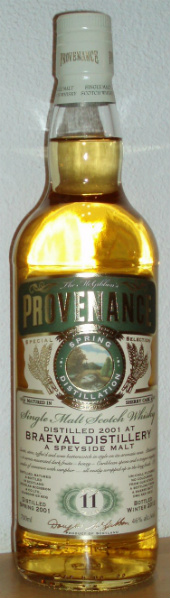
Braeval 11yo 2001/2012 (46%, Douglas McGibbon, Provenance, Spring/Winter, Sherry Cask, DMG 9312)

You don’t have to polish your glasses. So soon after the other Braeval and Braes of Glenlivet Whiskies I reviewed, yet another Braeval graces these pages. Yes, another independent bottling of Braeval. This should come as no surprise since the owners Pernod Ricard (Chivas Brothers) don’t do a lot with this brand either. More or less the same situation as Strathisla, which is owned by the same company. It seems to me all their energy flows into The Glenlivet and Aberlour and not a lot of faith exists in marketing Single Malts from these lesser known distilleries. Bacardi (John Dewar & Sons) which owns Aberfeldy, Craigellachie, Aultmore, Macduff, and Royal Brackla, have recently decided to market the Whiskies of all their distilleries with an age statement. Lets hope Pernod Ricard will follow suit.

Braeval 11yo 2001/2012 (46%, Douglas McGibbon, Provenance, Sherry Cask, DMG 9312)Color: White wine. Not too pale.

Nose: Sweet, Bourbony and malty. Sweetish and pretty clean. Vanilla and pleasant oak. Spicy and leafy. Whiffs of latex paint and even slightly perfumy. Sometimes even vanilla ice-cream and Cappuccino. Becoming grassy over time, combined with a breath of fresh air. Not very outspoken though. 46% ABV is a decent strength, and since all aroma’s aren’t that outspoken I guess this didn’t benefit from reduction. Still a very agreeable nose.

Taste: Spicy and slightly (new) woody. Sweetish and lots of vanilla. American oak Sherry cask? Good balance. Good strength, but I’m sure this would be better undiluted, maybe that way it was too hot or just to plain strong for some. After some time the new wood and leafy note stays and combines with a little bit of barley with vanilla, mocha and vanilla ice-cream. Fresh forest after a rain shower, including the wet forest floor and mushrooms. Nice, innocent and anonymous.

Unlike both other examples of this distillery I reviewed before, this one has been reduced to 46% ABV. This example is also from this very decade and a bit younger than both others, so what does that do for this distillery? Well hard to tell actually since this isn’t a very complex malt. As all other Braevals, this is pretty good, yet this example is a bit anonymous. Reduction places it into the path of maybe less experienced drinkers, who still are a bit cautious with cask strength Whisky.

Points: 82

Braeval 21yo 1991/2013 (47.7%, The Whisky Mercenary)

Some of you may have already noticed, but as of yesterday I finally managed to get MASTERQUILL.COM. Not long after I started publishing my tasting notes, someone was very quick to snap up this domain. Once I had a look around, what buying this domain would cost, but I thought the $1.800 was a bit too steep, I’d rather buy me some Whisky for that, thank you very much. Yesterday I had another look around and it was available! This time I was quick to snap it up myself, and anyone of you who have registered their own domain (that is available), know that this doesn’t break the bank. Great! Back to Whisky now, and back to Jürgen…

Time for a Whisky that hasn’t been featured before on these pages. A new name on my new domain so to speak. Braeval as it is called today, Braes of Glenlivet was its old name. Not an old distillery though, but more on that next time…

Braeval 21yoColor: Gold.

Nose: Clean buttery vanilla, caramel and lots of toffee. Promises a lot of sweetness. Dry vegetal notes. Nutty but also slightly perfumy. Sinaspril (a Paracetamol tablet for children, with a powdery orange flavour). This reminds me a lot of Sinaspril from the seventies. Somehow I don’t use it a lot today anymore. Got older you know, need veterinary strength Paracetamol now. Let’s get back to the Braeval shall we. Very creamy and dry, but not a lot of wood yet. Definitely some laid back fruity notes and cookie dough and almond paste. Orange obviously, just not the freshly pressed kind, but also succulent and with hints of over ripe kiwi. Yes that’s a first. Behind the fruits also a meaty component is present. In the end it’s all about fruit and cream. Quite complex, there seems to be happening more that I have mentioned. For instance, it takes the wood quite a long time to assert itself.

Taste: Sweet and again very fruity. Thinner than I thought with an ABV of 47.7%. Very fruity (cherry bon-bon) and nutty and yes, quite sweet, but also a nice touch of acidity to prevent this one from being overly sweet or cloying. Creamy vanilla and cheap milk chocolate is present. Definitely a woody backbone now. Unpolished edges of oak. Watch out for splinters! Oaky sourness in the finish, and speaking of the finish, the big body this Whisky has, does fall apart a bit in the finish, where the oak starts to dominate. A shorter finish than expected, so you want your next sip quite soon after the previous one, but you wouldn’t mind because you already developed a craving for the great fruitiness of this malt. Prominent oak though.

Actually this could have been better, because towards the finish the oak plays and ever-growing role. You do need to like your oak with this one. Luckily this Breaval has a nice nose and a body full of thick toffee and fruit. In the end, this is a very enjoyable dram and thus rightly picked by Mr. V. Not the best of the bunch though.

Points: 84