As said before this distillery was briefly opened between 1966 and 1975. As far as vintages go not a lot were released. Officially a lot of 1973’s were released. This vintage was also released by Blackadder and Duncan Taylor. Signatory Vintage released a lot of 1975’s (and one 1974). Two of these 1975’s I have reviewed on these pages earlier. Last but not least in this case, Cadenheads had some releases from the opening year 1966, but that was a long time ago in 1979 and 1980. Besides these few ‘players” not a lot of Ladyburns are to be found. Now here pops up a 1974. As far as I know, there are three 1974’s released. Cask 2607 by Signatory @ 53.9% ABV (in 2011). Cask 2604 by Dutch bottler Van Wees @ 52.1% ABV, (also in 2011), and from 2010, Cask 2608 by fellow Dutch bottler Mo Òr @ 46% ABV. It’s not hard to guess how much (or how little) this got reduced. Rumour has it, these 1974 are pretty good.
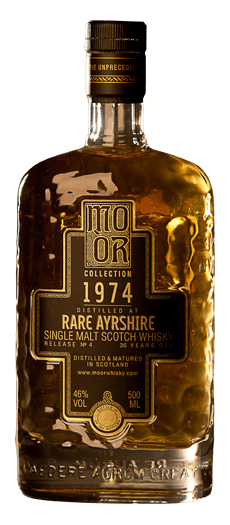 Color: Light Gold
Nose: Very aromatic. Sweet and clean. Pops out of the glass. Fruity and lively. Great combination of farmyness and fruity sweetness. On the nose it’s already a lot better than the 1975 Ladyburns I tried before. Nice wood too. Great greenish notes with gravy. If the taste will be anything like the nose, we’ll have a winner on our hands. When this get’s time to breathe the lively fruits make room for something more dark and broody. Meaty and some perfume. Very interesting.
Taste: Fresh, fruity (pineapple) and in nothing you would say this is such an old malt. Not as complex as the nose is. The initial fruits are very quickly replaced by caramelized wood. Finish is good and slightly woody. But considering it’s age you would definitively expect more wood in this.
Very likeable Ladyburn. The nose is very much better than the 1975 Signatories I tried before. Taste wise, maybe not so complex, but less woody than the Signatories. Very nice Ladyburn, one of the best that’s still around, ánd reasonably priced as well!
Points: 86
Thanks again to Henk for this sample.
 In the first weekend of October 2011 I went to the Whisky-Show in London with my friend Erik (both days). We liked the show so much that we went there again this year. Both years we tasted a lot of good whiskies. When we talk things over afterwards we always ask each other what surprised us. Last year we voted
  This Limited Edition 21yo is made out of 6 Bourbon Casks, since they don’t mention Barrels or Hogshead, I guess both are in the mix. For good measure also a Sherry Butt was thrown in. All casks were Refill casks. Casks were hand (or should I say nose and mouth) picked by Douglas Campbell. It’s called a Limited Edition since this is a one-off deal.
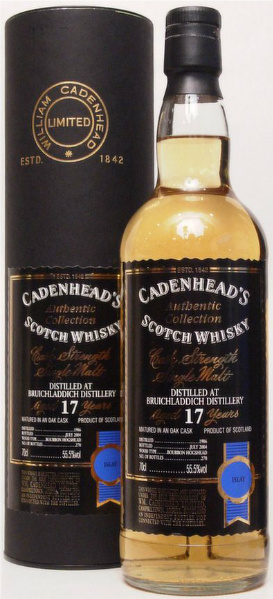 Also from 1986 but several years younger, a 13yo to be precise. Even though it was younger, this bottle showed more character to it. The 13yo was almost empty and maybe these Bruichladdich’s need a lot of air. Let’s have a look in my controlled environment and using my glass of choice, how this Bruichladdich really is. (This bottle, just open).
 Tormore. One of those distilleries, you don’t hear about too much. Tormore was founded in 1958 by Long John International, and distilling started in 1960. It was the first distillery that was built after the Pattison crash of 1898, and thus the first to be built in the 20th century. Today Pernod Ricard is the owner of Tormore and is already the fourth owner in its short history. Tormore was originally built with 4 stills and in 1972 that amount was doubled.
  In 1984 the heating system for the stills was converted, so that it could be heated with… woodchips to heat the stills. Officially only a 10yo was released, later replaced by the current 12yo. For a short while also a 5yo and a 15yo existed. So mostly independent bottlers issue Tormore Single Malt today. Still, over the years not a lot was issued this way, nor does it usually score very high. I guess it’s time to have a look into Tormore. First a Tormore bottled by Dutch bottlers
  Color: White wine
 Also from 2009 the second release became “Autumn 2009” next up was “Spring 2010” and after that the fourth release was this “Summer 2010”. Also in 2009 the first Single Cask releases were released at cask strength. From 2011 the Single Cask bottles were released with red labels. In 2012 a Sherry Cask release at 46% ABV was released with a black label. Also from 2012 a new addition to the core range was released called “Manchir Bay”. Last but not least there are a few releases of 100% Islay at 50% ABV, where all ingredients of the whisky were sourced form the island itself. Now it’s time for “Summer 2010” solely from Bourbon Barrels from Buffalo Trace.
 Yes! Another example from the distillery that took its water from the Penwapple Reservoir, yes say it again, the Penwapple Reservoir. This time one of the many sister casks from the last year of operation, bottled by Signatory.
 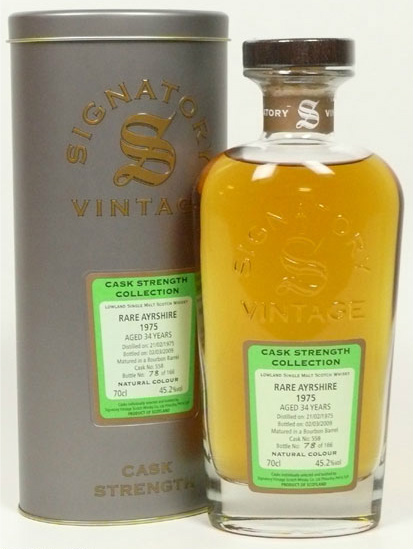 Color: Gold (slightly lighter than barrel #562)
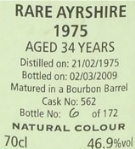 Ladyburn wasn’t long around. Opened in 1966 and already closed in 1975. It was built by W. Grant & Sons within their Girvan grain distillery complex. Not completely uncommon in those days, since there were more malt distilleries on a grain distillery site. Glen Flagler was added to the Moffat site and Ben Wyvis was added to Invergordon. All three didn’t last long and are pretty scarce these days. These Rare Ayrshire’s are still around, but there will be a time soon, they will not, and prices will soar. So is this worth your money? Lets see…
 Well officially there is no Ladyburn on the label, still it isn’t hard to guess what this must be. Out of the blue Signatory started to bottle a lot of casks from Ladyburn. Which is always nice since the place shut down in 1975 and whiskies from Ladyburn are getting more and more rare.
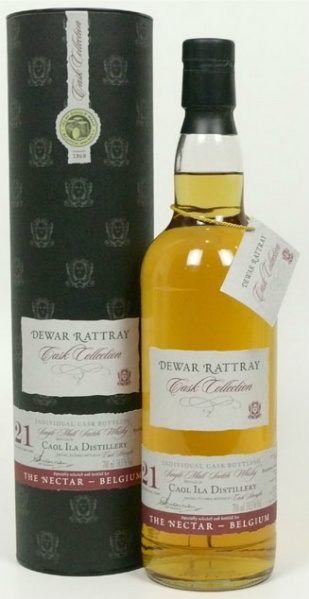 This whisky was distilled on December 12th 1984 and bottled 21 years later on September 6th, 2006, and was bottled for Belgian outfit, The Nectar.
 Sadly the Bourbon week is almost over. I had a lot of fun with it and (re)discovered some true gems of American Distilling. I’ll definitively do another Bourbon Week again. So, to close this week off, here is the first edition of the Parker’s Heritage Collection of Heaven Hill. Distilled in 1996 the year of the fire, so we can’t be sure where this is distilled. If it is from before the fire, than it’s from the original distillery in Bardstown. If it is from after the fire it can be sourced from anywhere or even distilled by Heaven Hill distilled in another distillery where they rented time to distill. It’s not from the new plant (the old Bernheim plant in Louisville), since they started to distill there from 2000 onwards.
 Color: Brown
 smells. Also a food-like sourness that seems to be partnered with the gravy and the Hopjes.
 This is one where the word savoring was invented for. Just give this a lot of time, and you’ll thoroughly enjoy this. Just drink this when you have a moment alone for some contemplation. Don’t let it be interrupted by noise or by the feeling you still have to do something. A bedtime dram, when you’re the last one to go to bed. Top, have fun with it!
 In 1987 Jim Beam bought themselves National Distillers, and by doing that, they also acquired Old Grand-Dad. For all the Bourbons that were kept in production, all original recipes were changed to the ‘Jim Beam’ recipe. All but Old Grand-Dad. This recipe survived due to its uniqueness, and is the only other recipe that Jim Beam uses. This Old-Grand-Dad recipe uses a lot more of the, so-called, flavour or small grains i.e. rye and barley.
 Excellent! No wonder that they couldn’t replace this recipe. This is very, very good. At least I like it a lot at this strength. Recommended. I haven’t tasted all of the “Small Batch Collection” yet, but I can’t imagine Jim Beam making anything better than this. Yeah I’m ‘younger public’ now! Another example of the water of life, that preserves youth.
 Master Quill