Next up is this Douglas Laing bottling of a 1974 Caol Ila and most probably from a Hogshead, but you never know. 1974 is a pretty special year for Caol Ila because from 1972 through 1974 the whole of the distillery was rebuilt, completely! Everything, apart from the warehouses, was demolished and completely rebuilt. In 1974 six new stills were installed, so here we can have a taste of the first whisky that ran off the stills in 1974. This is the first of the “modern” Caol Ila as we know it today. Is it new and improved?
 Color: Gold
Nose: A very refined yet fatty peat, quite sweet and floral. Fantastic organics! Grassy, lemongrass actually, in perfect harmony with excellent (fishy) peat. Do I detect some tarred rope? Pretty light for a Caol Ila, but so elegant and fresh, it does have some sea breeze to it. Oil spill on water. Beautiful bonfire smoke and leafy. Nice elegant wood. Bushes in summer in the rain. Nothing oomph or in your face, this a very refined Islay Whisky. I already like this very much, but the nose just keeps developing…
Taste: Again quite sweet, light peat and clay. A little bite from the smoke, than the wood and the smoke again (in that order), after that slightly sweet and a thin palate of yellow fruits. Very balanced. Lemonade fruitiness combined with fatty elegant peat (again) and nice smoke. The saltiness these old Caol Ila’s often have is absent from this 1974. medium finish that gets thinner, which underlines the brittleness of this malt. Old age. Still it is so good, the initial taste and the body are that nice, that I don’t care about the weaker, but not short finish. This is a lovely dram.
What a fantastic Caol Ila this is. Sure Ardbeg, Port Ellen, Laphroaig and Lagavulin all have fantastic old drams, and are big names, but those seventies and early eighties Caol Ila’s are right up there with them. How nice Douglas Laing had a 1974 Caol Ila, a shame only that it was only one cask… I would have wanted more.
Points: 91
Thanks Andries for the sample!
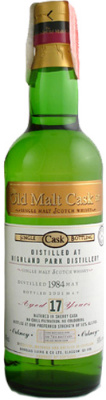 Color: White wine.
 Color: Light Copper Gold.
 A week ago “Het Genietschap” had its first ever tasting at my house. I’ve been a member for quite some time, but it took a while to get my ‘location’ added to the agenda. Well finally it was my turn. The organizer gets to choose a ‘theme’, and mine was “Talisker”. When I sent out the E-mail I got a lot of Talisker 10’s as entries, and even some replies implying that there wasn’t a Talisker in the house. Well that got me worried for a moment. My guest of the evening, Erik, asked if he could bring his
  Best bottle in the tasting was a young Port Ellen 15yo bottled by Cadenheads in 1996, Stunning! It was just a tiny bit better, or better: different, than the also stunning Talisker 20yo 1981/2002 (62%, OB, Sherry, 9000 bottles). Also the pre Classic Malts Talisker 10yo was fabulous. Even today’s 10yo is pretty good, but can’t be compared to the taste of the old bottle. This ‘Tactical’ wasn’t bad either…
 For the Douglas Laing brand, It all started in 1998 with the Old Malt Cask series, to commemorate their 50 years in business. Therefore if possible the series is bottled at 50% ABV. Later a more luxury series was introduced called The Old and Rare series. Although it is better known as the Platinum Series.
 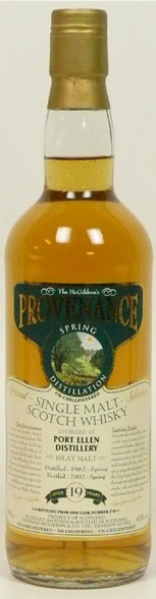 In fact there are a lot of ‘names’ on their labels. The third series I would like to mention here is the Douglas McGibbon’s Provenance series. A series placed under the Old Malt Cask series, also with lower ABV, usually 43% or 46%, but also cask strength and small batch versions exist. There are also some newer series, like the Director’s Cut, introduced in 2011 with cask strength single cask single malts and single grains. Other series by Douglas Laing are the Premier Barrel and Douglas of Drumlanrig.
 What could be more appetizing to you than the fact that the site of St. Magdalene in Linlithgow, West Lothian, housed a Lepper Colony in the 12th century, or that the water didn’t come from an ancient super pure melted snow mineral water source, but from the Union canal nearby. But enough facts. If you want more, have a look at
  Taste: Thick, grassy and medium sweet. Dried apricots and apple skins. It isn’t the same as the nose (for me the nose was not fruity), but it complements it very well. Again there is almost no wood. It’s there really, but it is hidden well and transports the body. You can taste the balancing spiciness or distant bitterness (again, hidden well) and the sourness in the finish is from the oak too. Great balance.
 Instead of expanding into unchartered territory, let’s do something oppositional and do yet another Port Ellen, and another bottle by Douglas Laing. This time from the old series in the normal scotch whisky bottle and not from the new tall bottle. People tend to think this older look contains better whisky. Let’s see if that’s true. By the way ,I read somewhere that in the few months Port Ellen operated during 1983, there weren’t a lot of good casks around, and they filled almost anything they could get their hands on. This Port Ellen looks quite light in color. Is this from a tired butt or a normal refill Fino butt?
 Taste: Peat and rhubarb. Sweet, big, leafy and chewy. Black tea with clean refined sugar. No rubber here and it’s no monster either. The peat is very mild here and the finish is quite simple. Still it seems to be very balanced, just not very complex. It has the dryness and a bit of the spiciness of the oak, but not the bitterness, and that’s a big plus (not a Chevrolet). It has citrus with cardboard in the finish. If tasted blind, I would have thought it to be some odd ten years younger.
 It’s an end of an era, even if it was a tired cask, this is still very typical and good. Really a shame this got closed. In a way it resembles Talisker in it always being decent. This may be no high flyer, but is has a lot of fine moments to give. No I’m not sentimental, this is good in itself. A very nice Islay Whisky. As I’m sipping the last few drops: “Here’s looking at you kid…”
 I did some rummaging in my boxes with samples and found another Glen Grant. Well I actually found several of them, but I just chose this one. You know Glen Grant, the place that was the first distillery that was illuminated without burning fuel by themselves. This time we have a Glen Grant bottled in the Old Malt Cask series by Douglas Laing. Again in the new tall bottle, just like the
  Color: (Light) gold.
 And here’s yet another Speysider and not just any Speysider but an example of Speyside’s finest distillery…probably. Just consider the statement for a moment (maybe not if you’re called Luc). There’s also Macallan, Longmorn and Strathisla in Speyside. I know there are others, but I didn’t want to make this list too long. Glenfarclas isn’t mentioned on the label, but let me tell you this is a Glenfarclas, and a very old one too. I have tasted several very old Glenfarclas, and sometimes they tend to be very woody, but that’s also because there are a lot of very old Glenfarclas around, and 42yo is a long time to spend in a cask. I’m 42 now and I wouldn’t want to spend my whole life in a cask.
 To the whisky then. Glenfarclas is still a family owned operation that started legally in 1836. In 1965 it was bought by John and George Grant. Since then there were a lot of Georges and John Grants. Very popular names indeed in that family (and The Beatles for that matter). Sometimes they have extra letters for identification purposes.
  Next time I’ll be up at Glenfarclas, I’m dying to meet Ringo S. Grant! Good to see a still family owned distillery surviving competing with the big conglomerates like Diageo. There are several more like Bladnoch for instance. Power to them!
 Its raining like crazy outside, and I have this Port Ellen on my lectern, so probably no better moment to have a go at this. Seize the day, the moment is now! There may be no tomorrow! Heed the call of the elements!
 Color: White Wine.
 Master Quill