 In this day and age of battles, battles for oil, battles in politics, and even dance battles, now there are also battles in Whisky. The guys in the picture are Jan Beek (right) and Dennis Mulder (left). They do tastings/battles to see who bottles the best Whisky, the distilleries themselves or the Independent bottlers. Jan represents the independent bottlers and Dennis the official bottlers. Time for my own battle. Well not a battle with axes and swords. Earlier I reviewed an official Highland Park 12yo and scored it a decent 85 points. Here we have a this independent 12yo Highland Park, bottled by Gordon & MacPhail and selected by Van Wees, so mostly sold in the low counties. Let’s see if this Gordon & MacPhail 12yo can beat the official 12yo, and score more than 85 points…
 Color: Lively orange brown.
Nose: Extremely sweet, spirity, spicy and woody. Raisins, lots of raisins. This smells exactly like a PX-Sherry. Apart from the thickness of it all, it does smell dryer later on because of the wood and spice. Gravy and meaty, something that fits the Sherry profile too. Definitely some honey and heather in the nose. Which surprises me since the Sherry cask might be very overpowering. Tar and sulphur come late into the mix. I love the coal and tarryness of sherried single cask Highland Parks. Burnt wood. Bonfire from a distance at night. The opposite of elegant I would say. The longer it breathes in the glass the better this gets. It reminds me of some of the better early seventies good sherried Whiskies.
Taste: This is sweet PX-Whisky with a bite. It starts out sweet and quickly turns into spicy wood. Syrupy sweet. But the initial sweetness terns into dryness because of the woody attack. Again coal, tar and even some licorice. Fireworks and a cold freshly half burnt log. Demerara Rum with a lot of smoke. It’s sweet but not quite honeyed. And no heather to be tasted too. Some dark chocolate and cola. Do I really taste a hint of soap?
OK, it’s a 12yo Highland Park all right, but this version has nothing to do with the official 12yo of today or any day for that matter. It’s a beast, but a lovely beast. If you can handle heavy Sherry, than this is one for you (and me). In the end I like this one better than the official 12yo, so this battle is won by Jan Beeks axe. But the whiskies are completely different and both have their moments. One is elegant and light(er), the other a beautiful beast at high strength. Still, I like the older official bottlings of Highland Park.
Points: 87
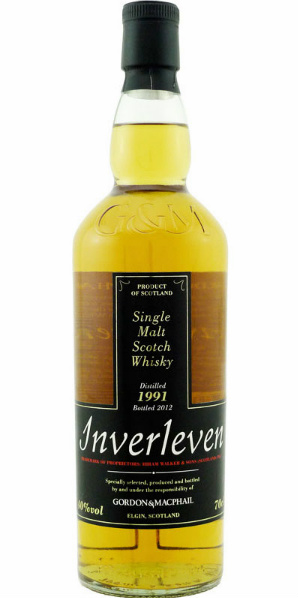 Color: Gold.
 Here we have one of the many 1991 Lochsides, and one of the many that were issued as a Gordon & MacPhail Reserve. This one was picked by Dutch retailer Van Wees. Gordon & MacPhail code for this one is AJ/JBEC. The spirit was distilled on September 18th, 1991 and eventually bottled on March 8th, 2010. Alas we don’t know exactly the date when Han van Wees tasted it and picked this ;-). Kudos to Gordon & MacPhail for all the information on the bottle and back label.
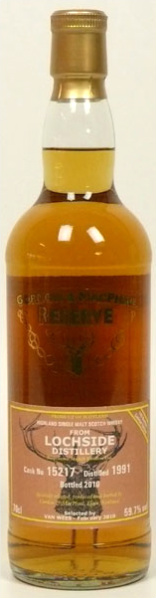 Color: Gold
 Happy new year! I wish all my readers a great year full of fulfillment, health and great drams. please don’t settle for mediocrity. Try to broaden your horizons for true beauty that can be put in your mouth, but do it in moderation, we don’t want to create modern drunks.
 Well what would be a better start, than with an old Strathisla! In the past I tried some nice old Gordon & MacPhail Strathisla’s from this series. The review for the 25yo can be found here, but together with this 25yo I tried the 21yo and that was similarly spectacular. Mind you these are the old 80’s bottlings for the italian market, and whiskies with these labels were issued for a couple of decades, so every batch will differ (massively). The 21yo and the 25yo were quite dark, and hopefully not colored, and being from the early eighties, the distillate is early sixties or maybe even late fifties.
 Short finish. The 21yo and the 25yo performed better in that respect. Treat this elderly Whisky with respect, but be bold and take bigger gulps. The whisky itself, maybe is a tad fragile and subdued, but hey, the stuff was made some 55 years ago and along the way was reduced to a mere 40%, so give it a break will you?
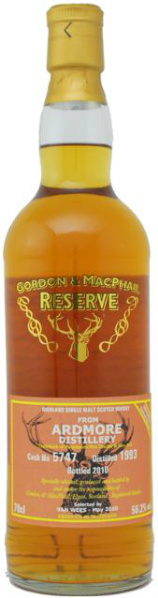 Let’s do another Ardmore and compare it to the day before yesterday’s offering by The Whiskyman. We all know that 1992 is somewhat of a good vintage for Ardmore. So let’s see what happened in the distillery a year later. This 1993 was bottled by Gordon & MacPhail and they were so kind to do that for Van Wees of The Netherlands.
 Ahhh, yes, Gordon & MacPhail never cease to amaze me! Next up is this Glencraig 1970/1996 (40%, G&M, Connoisseurs Choice, Map Label, IF/CCC), but now it turns out that the exact same bottle with the exact same code (IF/CCC) was also released with the Old Map label too. Why? Can we conclude from this that 1996 was the year the labels got changed?
 Color: Full Gold
 Color: Full Gold
 Founded in the year of the Pattison crash 1898 and located on the outskirts of the ancient market town of Forres. Mothballed between 1931-1937 and 1983-1998. Since 1993 the distillery is owned by Gordon & MacPhail. Yes, the bottlers. The first Benromach that was released and made by the new owners is Benromach Traditional, that was released in 2004. The year they started with the new look and bottles in tin tubes we know today. During the G&M years more and more new released see the light of day. Today the distillery is known to be Speyside smallest working distillery and is operated by just two people…
 Lots of times I witnessed situations where an ‘old’ bottle from Gordon & MacPhail was opened and we all started guessing how old the whisky was, since only a distillation year was printed i.e. “1970”. I fondly remember the discussions when a particular bottle was bottled because the bottle had a ‘nipple’. Another situation could be when a particular bottle was distilled and/or bottled, because only the age of the whisky was printed i.e. “30yo”. Very annoying when you taste a Strathisla 25yo by Gordon & MacPhail that was made for several decades with the same label and different batches are very different. Lots of those ‘old’ bottles don’t have such information, or do they?
 In the case of Gordon & MacPhail, since 1988 a laser Code can be found somewhere on the bottle. Usually printed on the back of the front label, or on the back of the bottle, near the bottom, for newer releases. As can be seen on the picture to the left. Here an enlarged view through the back of the bottle, through the whisky. The code is IB/ABD.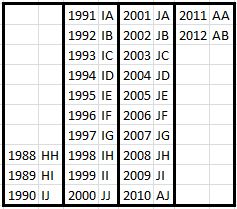
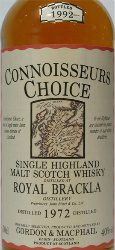 Of interest are the first two letters. IB in this case. The code used is like this: A=1, B=2, C=3, D=4, E=5, F=6, G=7, H=8, I=9 and J=0. IB therefore is 92. The bottle is very probably from 1992! The second series of letters are probably a batch code. On the right is a picture of the same bottle from the front, and indeed it is bottled in 1992.
 Sometimes the first part of the code comprises of three letters instead of two. This is very rare and when this happens two of the three letters match the table given here.
 In this case too there is a neck label with 1991.
 Like with many Gordon & MacPhail bottlings, it is reduced, this time to 45% ABV. I am a fan of cask strength Whiskies, but I learned to appreciate these reduced Whiskies more. Is it age? I’m a bit held back only by the fact that not every Whisky likes to be reduced. Let’s hope it’s not the case with this one.
 Master Quill