 And here is another Master of Malt bottling. Earlier I reviewed a reduced Tomatin, that was a true disappointment. I didn’t even know it’s possible to ruin a Tomatin, since usually I like Tomatins. So with this one I do worry a bit. This also is a Bowmore of the eighties, which quite often turn out to be your better hand-soap (lavender and violets come to mind). I once tried a 1989 Berry Bros. & Rudd bottling that made me physically ill. That was a first for me, so I tried that one half a year later and it happened again.
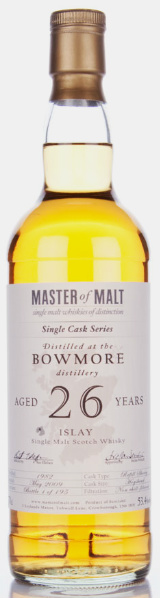 Color: Gold
Nose: Powdery and sweet. Not very Islay to be frank, hardly any peat or smoke. Lots of flowers though, soap, also some clay and thick, so it seems to have body. When freshly poured it is very closed. After a while some smoke trickles trough. Hey, waiting even longer there is peat too. All in minute quantities. Again not very Islay-ish. Is this really a Bowmore? Wet paper and a small hint of licorice. It’s not bad, but not very balanced either. Now we have sour oak. It’s fresh, fruity and floral, luckily not over the top lavender-soap eighties Bowmore.
Taste: Sweet and syrup, with ash and some wood. It actually attacks you in the beginning. The sweetness disintegrates quickly into something acidic. It’s like a syrup that shows, when stripped from your throat, some lemon. The attack is nice, and the middle is also quite nice, but bold tastes fade and leave you with a fairly dull and anonymous finish. What can this be, a strange and unusual Bowmore distillate in a Fino Sherry cask? Well, let’s leave it at that.
In the end it’s not a FWP-Bowmore from the eighties, but it also isn’t recognizable as a Bowmore either. It’s ok on the nose and when it enters your mouth is shows some promise. Halfway through though and especially the finish are a bit weak, which is a surprise after the bold body. But the most remarkable achievement is making and finding a Bowmore that has nothing to do with…Bowmore!
Points: 84
 Color: Light Gold.
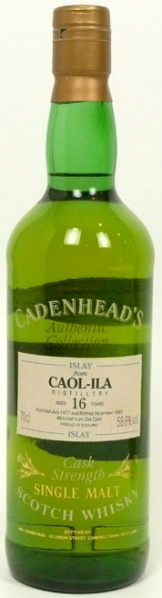 Color: Gold
 Caol Ila. This was recognizable blind. This has a nice full body with a perfect sweetness (slightly acidic) that matches the toned down peat a lot, combined with the smoke…a winner. Macaroons (made with almonds) and a slightly bitter finish (from the wood) and overall a tad too simple for a score into the 90’s.
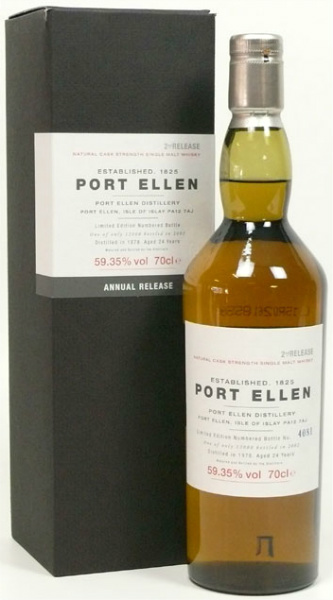 How nice it is to have another Port Ellen on these pages. This one in particular plays a strange role in the Port Ellen annual release series. First of al this strange ABV. 59,35%. New Japanese measuring equipment on loan? No it’s not that. This one is known to be a little closed. Very closed in fact. I had the chance to try this expression when it was freshly opened and it was really hard to taste this. Very hard to tell what is in there. It was nice, but nothing you’ve come to expect from such a Port Ellen. This time around the bottle is open for a while and less than half full. Is this, one of those whiskies that has to be put on the shelf without its cork, to maximize its breathing? Lets see…
 Well it does demand of you that you’ll work on it since it doesn’t give away its treasures easily, especially on the nose. Probably not the best from the series, but still it oozes Port Ellenness. It is an experience. Freshly opened bottle scored 87 Points, but after extensive breathing I’ll score this:
 And here is Ardbeg. Last of the Islay whiskies to feature on Master Quill. The first Ardbeg is also the last one being released. Ardbeg Galileo. A Whisky that in part was matured in Marsala Casks.
 Galileo Galilei was born on February 15th, 1564 and departed from this earth on the 8th of January, 1642. Galileo was an Italian physicist, mathematician, astronomer, and philosopher who played a major role in the Scientific Revolution [
 I hate to say it, but aren’t “Ardbeg” putting more money into marketing than in the actual Whisky? Don’t get me wrong, I love Ardbeg, just look at my
 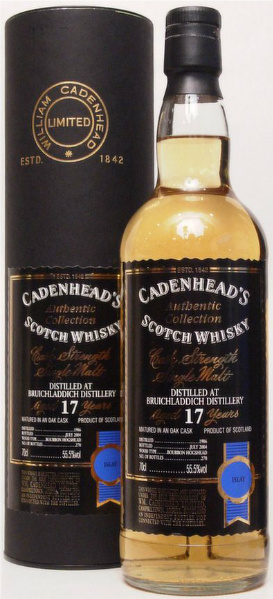 Also from 1986 but several years younger, a 13yo to be precise. Even though it was younger, this bottle showed more character to it. The 13yo was almost empty and maybe these Bruichladdich’s need a lot of air. Let’s have a look in my controlled environment and using my glass of choice, how this Bruichladdich really is. (This bottle, just open).
 Bunnahabhain is known for being the least peated of the island, still like a lot of others, raising to the occasion by answering the call of the public for more ppm’s. Burn Steward therefore started to bottle a “Moine” expression, with more peat, mimicking pre sixties Bunnahabhain.
 Also from 2009 the second release became “Autumn 2009” next up was “Spring 2010” and after that the fourth release was this “Summer 2010”. Also in 2009 the first Single Cask releases were released at cask strength. From 2011 the Single Cask bottles were released with red labels. In 2012 a Sherry Cask release at 46% ABV was released with a black label. Also from 2012 a new addition to the core range was released called “Manchir Bay”. Last but not least there are a few releases of 100% Islay at 50% ABV, where all ingredients of the whisky were sourced form the island itself. Now it’s time for “Summer 2010” solely from Bourbon Barrels from Buffalo Trace.
 Kilchoman then. The newest addition to the immensely popular Islay Whisky family. This new small farm distillery was built in 2004 near Kilchoman in the west of Islay, and therefore named Kilchoman. Operations started in 2005 and their first disaster struck in 2005 also. No distillery can call themselves a real Scottish distillery without a big fire. Well history was in the making so let’s do the fire thing quickly, they might have thought. Not hinting at any foul play of course. In 2005 the kiln burned down. Rebuild in 2006 and operations recommenced. As of 2009 but foremost 2010, Whisky started to be released. In 2009 the first release in the new core range was the “Inaugural Release”. Next up was “Autumn 2009” Let’s try our “Spring 2010” that was the third release.
 Like with many Gordon & MacPhail bottlings, it is reduced, this time to 45% ABV. I am a fan of cask strength Whiskies, but I learned to appreciate these reduced Whiskies more. Is it age? I’m a bit held back only by the fact that not every Whisky likes to be reduced. Let’s hope it’s not the case with this one.
 Master Quill