Bowmore Week – Day 1: Bowmore 12yo (40%, OB, Circa 2013)

Bowmore WeekYes this is the start of a new “Week” at Master Quill. This time it’s december and the weather is still pretty good for this time of year. Still the cold should be not too far away and I most definitely have an itch for something more peaty. Bowmore, as Caol Ila are known as the more medium peated Islay Whiskies, as opposed to Ardbeg, Lagavulin and Laphroaig that have a more heavy hitting reputation, and Bruichladdich and Bunnahabhain which are even lighter in peat than Bowmore is. Not to forgetting about Kilchoman (new) and Port Ellen (closed).

Bowmore itself had a little problem in the eighties and nineties with some of their Whiskies being called Badedas of heavily soapy, or even full of FWP (French Whore Perfume). I once had a Bowmore from 1989 that had so much of this it made me physically ill (on two different occasions when tasted blind). It made me ignore Bowmore for a long time (and the independent bottler that bottled the stuff as well…)

But after way more than a decade, and hearing Bowmore of late are very good it is time to have another go at Bowmore and look at some of their newer bottlings and maybe some old, who knows? Lets start the Bowmore Week with the newest version of the standard 12yo.
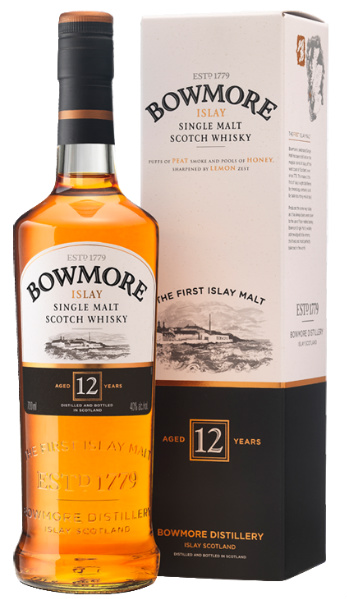
Bowmore 12yoColor: Full Gold.

Nose: Peaty, sweet and animalesk (smell it and you’ll know what I mean). Salty, smoky and vegetal. The peat gives off this typical coastal character. Burning off garden waste (not everything is dry), but also a clean wood fire. These two different kinds of fires coexist in this Bowmore! Hidden (sweet and aromatic) fruits come next, very nice! Little bit of toffee, vanilla and caramel. Fresh, sea air. But the whole is very elegant (for something from Islay). Not in your face. But Bowmore isn’t about heavy peating anyway. Cold tea. Good balance and quite complex, especially for such an entry-level Bowmore @ 40% ABV. Smell it for a while because not all is released at once.

Taste: Sweet, with lots licorice, peat, cardboard and black & white powder. Hints of vanilla ice-cream and wee bits of yellow and red fruits. Waxy, peppery and a funky kind of sugary sweetness underneath (ever so slightly too sugary sweet sometimes, but the fruity sweetness is good). Again an association with garden leaves, but this time just lying there (before being burned off). Very good Whisky. Alas, the palate can’t keep up with the more than excellent nose. To be taken in big gulps for maximum pleasure. Medium finish, but the aftertaste is very pleasant.

This is great Whisky, and has a lot of potential. I would have liked this very Whisky also being bottled at “the new export strength” of 46% ABV, I would be very curious how it would have turned out, also at cask strength it would be a blast. It smells fantastic, the taste is a wee bit simpler but still well made, very well made. It’s almost too good for an entry-level malt. It just is too watered down, which (alas) makes it an entry-level malt.

Points: 85

Bruichladdich 32yo 1970/2002 (44.2%, OB, First Fill American Oak Casks, 4200 bottles)

Let’s step things up a bit with this legendary Bruichladdich. Bruichladdich was founded in 1881, and the distillery was built by Barnett Harvey with money the family got from an inheritance from his brother. It is not the Barnett family’s first distillery though. In 1881 they also own the well-known distilleries: Yoker and Dundashill. Between 1929 and 1936 the distillery is closed. Much later in 1983 the distillery was closed as many others were, but fortunately it was saved (in the same year) and didn’t get demolished. Next the distillery was again closed between 1995 and 2000. In 2000 the distillery was bought for £6.5 million, by a group of investors. Quite a good investment since this group sold the distillery again for £58 million in 2012. The new owner being Rémy Cointreau.

Color: Full gold.

Nose: Old bottle. Waxy and very full and heaps of character. Vanilla with some nice acidity. There is also a fantastic woody note. Smells a lot like a 1972 Caperdonich (from a Bourbon cask), but fresher, less heavy, but don’t make the mistake thinking this is a light nose. Very drying nose, dusty and powdery and full of fresh air. All written here isn’t released by the Whisky in one go, it is released in layers. This nose alone would score sky-high. Absolutely stunning.

Taste: Fruity vanilla which is transported by a fabulous bed of wood. Sugared yellow fruits, again apricots (I get that a lot lately), but also a nutty part, almonds, but nothing bitter. A hint of toasted cask (sweet wood). Perfect big bold body with a mouthfeel to match. Good finish, it leaves a taste in your mouth that should have gone on forever.

This is a Whisky that fetches a pretty penny at auctions today. I should have bought this when it got out. In today’s market, Whiskies like this would be put in some sort of crystal decanter or another polished over the top packaging and would go for 1000 or 2000  Euro’s easily. Having said that, it’s probably worth the 500 Euro’s it costs today. Go and get it, I’ll vouch for it. I had this at 91 up untill now, but that was a grave error on my part. The new score is…

Points: 92

Ardbeg 10yo 1993/2004 (57.3%, Cadenhead, Refill Bourbon Hogshead, 252 bottles)

Wow, unbelievable, this is just my second Ardbeg review on these pages! I have this distillery up there with the greats, so what happened? This is an Ardbeg from 1993 bottled by independent bottlers Cadenhead’s. This is most definitely not the first Cadenhead’s on these pages, no it’s actually already the tenth, so for more information about Cadenhead’s, please have a look at all the other reviews of Cadenhead’s bottlings.

Color: White wine.

Nose: Sweet and mellow peat. Smells older than it actually is. Very nice, refined and balanced. Vegetal. Lemon sherbet. Fatty and smoky. Definitely citrus fruits this one, and some tropical fruits too. Not an in-your-face Islay monster, but with a lot of Islay character. Freshly cut peat. After a wee bit of breathing, some butter emerges, and it picks up a bit in oomph. More oily and smoky, ans even the citrus (lemon) is more dominant. The peat on the other hand recedes even more. Breathing adds something fishy and some vanilla to the mix. Somewhat more sea influence.

Taste: Sweet, sweet and light young peat. The smoke comes later. Nice effect. Hardly any wood. Whereas the nose showed me some light (old) peat, on the palate this Whisky does show its youth. Just as in the nose, very restrained lively and fruity Ardbeg, again not a kick in the head. With some air and time, it even gets a wee bit floral and ashy and slightly more pungent.

The offset and the body are nice and full, or round, if you prefer. The tastes fit together and show a more elegant side of Ardbeg. Towards the finish it does start to break down a bit. I said a bit. For an Ardbeg the finish is rather short and again light at first, but breathing lengthens the finish (and adds a little woody bitterness, finally). Typical Islay, not typical Ardbeg is you ask me. Probably not a very active cask, since there isn’t any wood detectable, nor has it picked up a lot op color.  It reminds me of an Ardbeg Bond Reserve I still have, so I’ll review that shortly (also from Cadenhead’s).

Summa summarum, nice Ardbeg that needs to breathe!

Points: 86

Port Ellen 31yo 1982/2013 (51.5%, Douglas Laing, Old Particular, Refill Hogshead, DL REF 9964, 286 bottles)

Next up, yet another Port Ellen, yes, Master Quill gets spoiled again! This time by Cara Laing ehhh Leggat (daughter of…) and Chris Leggat (now the son-in-law of…). Yes in the time between me receiving this Port Ellen, and reviewing it now, these two got married! Congratulations (again) guys! So let’s call this Port Ellen their wedding dram, shall we?

For those of you who didn’t know already, there have been some changes within Douglas Laing company. Brothers Fred (father of… & father in law of…) and Stewart Laing parted ways and divided the old Douglas Laing firm between themselves. Fred retained the ‘Douglas Laing’ name, ‘The Provenance’ series and ‘Big Peat’ and last but not least acquired the help of daughter Cara, who had to be bought back from Bowmore.

Stewart had to think up a new name: ‘Hunter Laing’ (also a family name) and has the highly succesful ranges of the ‘Old Malt Cask’ (OMC) and the ‘Old and Rare’ (O&R) series. Although OMC is probably the most impressive series the brothers had together, Fred created the new series of Old Particular, not wholly different from the OMC (and O&R lettering, if you ask me). So the loss of OMC and O&R are almost painlessly intercepted with The ‘Old Particular’ range and the ‘Directors’ Cask’ range. The future is looking great for the Laing’s and Leggats!

Color: Almost copper gold.

Nose: Lovely old and mellow peat, not very smoky, although there is some wood-smoke in here. Swamp-like plants (although this sounds horrible, it’s quite the opposite). The swamp also contained some lavas. Small hints of licorice and tar (worn down tarred rope). Under this all, some yellow sugared fruits want to emerge. Old dried apricots. (No I’m not mad). unusually mellow Port Ellen, but therefore absolutely lovely. Great balance too.

Taste: Sweeeeeeet, sweet and chewy at first. Fruity sweetness with ash and licorice again. Again old peat, very mellow. Small hints of mint (the mint stays in the back of my throat after the finish, it’s absolutely there), almonds and clove. A little bit of wood, but nowhere near the amount to be expected considering the age, also no bitterness. Quite a lively and full-bodied Port Ellen, but not a lot of legs in my glass. Medium finish but that fits the profile, it’s in no way an extreme Islay Whisky, but a more introvert and stylish Whisky. I love it!

Nothing to complain then? Not really, life is great, still having these Whiskies around, although more and more expensive. I was a bit surprised the finish wasn’t longer considering it’s a Port Ellen at 51.5% ABV, and comparing this to DL REF 4112, but really, who cares. The Whisky is great, the packaging looks great, Cara and Chris look great, and at the time of writing, the sun is shining, what more can we ask for. Ehhh, so more Port Ellen maybe…?

Points: 92

Thanks go out to Cara & Chris for providing the sample!

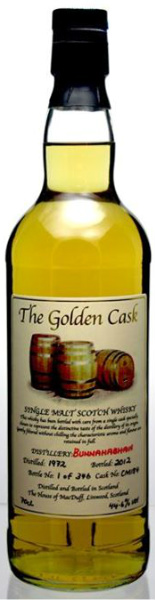
Bunnahabhain 40yo 1972/2012 (44.6%, The House of MacDuff, The Golden Cask, CM 184, 346 bottles)

Recently I reviewed an anonymous Bunnahabhain by David Stirk. That expression was heavy on Sherry. Here we have another Bunnahabhain, much older, and much lighter. As with all Golden Casks, this is again a cask that was picked by John McDougall. John has a big, big history in Whisky, so in the time when it is pretty hard for independent bottlers to find an exceptional cask, John still might be able to find one. Let’s see how this oldie he picked is holding up.

Color: Light Gold.

Nose: Waxy and old smelling (old bottle effect). Fatty wood, with hints of licorice and maybe even some lavas. The profile is also fruitier with pineapple, and dried apricots. It doesn’t have any apparent peat. I do detect, however, some smoke, some chalk and butter. Hints of latex wall paint and custard. Quite a list of funny aroma’s for this Bunnahabhain if you ask me. The most striking aroma of them all is the very special waxy oldness it oozes.

Taste: Interesting, at first a combination of white wine, wood and slightly bitter beer. Licorice again with toffee, but the whole is quite dry and light. The initial attack is there, but the body is already light and the finish is not very long. The more this Whisky gets a chance to breathe, for instance in the glass, the more bitter it gets. It’s still easy within limits, so not to worry. Lacks a bit of power though if you ask me. This cask strength Whisky was bottled at 44.6%, so the angels particularly liked it!

At first, it even shows some similarities to 1972 Caperdonichs, with this exceptionally waxyness, but soon it gets much simpler or should I say lighter. Especially the body of those 1972 Caperdonichs are quite full, whereas this Bunnahabhain has a more lighter style to it. A bit brittle or fragile, but this Bunnahabhain does have the old wax and wood, that Whisky these day just don’t have and with modern techniques, will never be made like this again. So treat this Bunna gently and see it as a time capsule of some sorts.

Points: 86

Bunnahabhain 20yo 1990/2011 “Isle of Islay” (52.8%, The Creative Whisky Company, The Exclusive Malts, Cask #251211, 298 bottles)

Here we go again. Another monstrously long title, again a Single Malt of which the distillery name is not on the label, but we know it’s a Bunnahabhain. So three in a row, this being the third Bastard Malt in a row, reviewed here on these pages. The Creative Whisky Co. Ltd. is non other than David Stirk. Fellow Rush lover and Whisky bottler par excellence, or should I say Exclusive Whisky bottler?

Bunnahabhain 20yo 1990/2011 "Isle of Islay" (52.8%, The Creative Whisky Company, The Exclusive Malts, Cask #251211, 298 bottles)This Bunna is pretty dark in color so my guess would be a Sherry cask. Since David didn’t specify what (kind of Sherry) the cask previously held, we can only speculate what this is. Maybe a Sherry Hogshead, or maybe a Butt that was shared with others, or only half the Butt was bottled? My guess would be the former (a Hoggie). It looks like a Oloroso or PX Sherry Hogshead to me, so we’ll have to try, to make another guess at it…

Color: Copper orange (the typical color of most Bourbons).

Nose: Fresh and Sherried but not heavy or cloying. Nice hints of spicy sweet and acidic wood. Definitely a lot of raisins and overall rather dry. Dusty with some fatty cardboard (nothing wrong with that). Ground coffee and hints of wet sugared cherries. Well balanced.

Taste: Heavy sherry with small hints of fat peat and a little bit of smoke and steam. Nice cloying black fruit. Tarry and a bit dirty. I like it. Yes it is a bit drying on the tongue, so maybe it should have been bottled a few years earlier. Still this is a great dram. It has a lot of character. Near the finish the wood starts to play a part with its spicy and slightly bitter finish and some black fruits come up. Dry black tea, so there are some tannins in here…

I brought this one with me when my Whisky club went to Switzerland two weeks ago and there the drying palate put some tasters off. I for sure noticed the drying qualities of this Whisky, but I didn’t have so much of a problem with it. Far worse for me is a heavily sherried malt, with lots of sulphur of bitterness in the finish, something this malt doesn’t have. By the way, for me this is a Oloroso Sherry Hogshead…

Points: 88

Bowmore “Dusk” (50%, OB, Bordeaux Wine Casked, Circa 2002)

Here we have a Bowmore oldie. This is the Bowmore Dusk, that was finished for two years in a Bordeaux Wine Cask (sometimes called a Claret finish). In 1999 Bowmore Claret was released, also a Bordeaux Wine Casked Whisky (12.000 bottles, 56% ABV), and was at the time a lot more expensive. Bowmore Dusk was introduced in 2000 whilst Bowmore Dawn, that had a second maturation in (Ruby) Port pipes, was introduced one year later. Both got the same look as Bowmore darkest, that had a second maturation in Oloroso Sherry Casks. Darkest wasn’t considered a speciality as Dawn and Dusk were, so Darkest was more accepted as part of the “standard” range and still exists today. Dusk and Dawn are no longer made, and hardly available anymore. The three were also sold together as a three-piece set (3 x 200 ml). Back to Dusk. There is some batch variation over the years, so there are versions available that are much lighter in color than the one I’ll be reviewing here…

Bowmore Dusk (50%, OB, Bordeaux Wine Casked, Circa 2002)Color: Copper Gold

Nose: Smoke pops out first. Very nice organic and peated smoke. Peat smoke, bonfire at the beach, at night. That sort of thing. Next some coastal freshness, with butter and something smelly from the animal world. Animal sweat? Clean oak, without any toast. A little bit powdery. Most definitely a wine finish. Caramel and vanilla, but the wine doesn’t allow them to be full, or round. They are around as an aroma, but more spiky in nature. Still this is all about smoke and luckily the wine doesn’t take over or ruin the bonfire at the beach party.

Taste: Sweet, caramel, toffee, fatty peat and lots of licorice. Medicinal. Great body, full and balanced. Long finish. After a long time, the finish that started out creamy, shows some woody sourness and the wine part shifts the whole into a slight unbalanced state, that is less sweet and creamy. But as I said that is way in the back of the finish. Not overly complex, but the wine finish is done with taste. Very drinkable. The ABV seems just right, and I can’t imagine this needing any water.

When I had this a long time ago, the taste is what I always remembered, the nose, well I completely forgot how nice this actually smells… I have to admit this is a tastefully crafted Whisky and I appreciate it better now, than I did back then (old score was 84). Here everything fits together nicely. Well done.

Is it just me, or do these older bottles look way better than the new ones? (Also true for Old Malt Cask bottles imho).

Points: 86

Bruichladdich 14yo 1991/2005 “Yellow Submarine” (46%, OB, WMD II)

WMD stands for Whisky of Mass Distinction. A name one would find on a Frankie Goes To Hollywood 12″ in the eighties. Two years earlier the first WMD was released (a 19yo from 1984) and had a rocket on the label. This second “weapon” is a Yellow Submarine. Most of us would have thought of the Beatles, but this time it about another submarine. One owned by the Royal Navy of Great Britain.

Islay Fisherman Baker was at sea to check his lobster baskets, when he saw a yellow object floating just under the surface of the water. Which first seemed a buoy seemed to be a 2 metres long radio-controlled mine detector from the Royal Navy. When Fisherman Baker called the coastguard informing them that he spotted a submarine with markings from the Royal Navy, they told him to he was drunk, not very uncommon on such an Island. Still fisherman Baker wouldn’t budge and the coast guard called the Royal Navy, but they denied it’s existence!

Just days later the Royal Navy admitted they had lost HMS Penzance (The Yellow Submarine) in a drill. But just after 6 months they decided to pick the thing up> They sailed out at night, to arrive very early in the morning, not to draw a lot of attention to the operation. But the people of Islay are no fools, so half the Island was present at the beach. 12.000 bottles of Yellow Submarine were made and the Royal Navy got six to commemorate the incident. Later the French manufacturer of the Sub ordered another 1000 bottles of this edition for marketing purposes…

Color: Light Gold.

Nose: Woody and smoky. Quite estery and fruity as well. Clay and wet earth. Chewy (in the nose?). In a way candied and wine-treated (it is ACE’d in Rioja Casks, well that’s very Obvious in the nose). The wine finish takes the nose hostage, never to let go, whatever ransom you’re prepared to pay. Is that a bad thing, no not really it is likeable in the nose. I just hope is does the palate some justice. Creamy milk pudding. Powdery perfumed wood. Fresh.

Taste: a bit harsh and winey from the start, but it seems balanced. Wood and milk chocolate pudding. Creamy. Also a little bit from the wood and a wave of sugary sweetness. The palate is very nice, but also very simple. Probably a good idea to reduce this to 46% ABV, because now we have a very drinkable whisky. Nothing overly special though, with also an unspectacular finish, but it definitely is all right!

Well this most definitely is a Rioja finish. The Rioja is all over the place. It draws all attention to itself. Although wine finishes almost every time ring my alarm bells, this is not bad. Alas the maker doesn’t state what kind of Rioja it was red, white or rosé, although rosé would be pretty uncommon, most probable would be red. Most used grape variety in Rioja is the Temperanillo grape, remember the Temperanillo casks used by Tomatin?

Points: 85

Caol Ila 26yo 1974/2001 (50%, Douglas Laing, Old Malt Cask, 294 bottles)

Next up is this Douglas Laing bottling of a 1974 Caol Ila and most probably from a Hogshead, but you never know. 1974 is a pretty special year for Caol Ila because from 1972 through 1974 the whole of the distillery was rebuilt, completely! Everything, apart from the warehouses, was demolished and completely rebuilt. In 1974 six new stills were installed, so here we can have a taste of the first whisky that ran off the stills in 1974. This is the first of the “modern” Caol Ila as we know it today. Is it new and improved?

Color: Gold

Nose: A very refined yet fatty peat, quite sweet and floral. Fantastic organics! Grassy, lemongrass actually, in perfect harmony with excellent (fishy) peat. Do I detect some tarred rope? Pretty light for a Caol Ila, but so elegant and fresh, it does have some sea breeze to it. Oil spill on water. Beautiful bonfire smoke and leafy. Nice elegant wood. Bushes in summer in the rain. Nothing oomph or in your face, this a very refined Islay Whisky. I already like this very much, but the nose just keeps developing…

Taste: Again quite sweet, light peat and clay. A little bite from the smoke, than the wood and the smoke again (in that order), after that slightly sweet and a thin palate of yellow fruits. Very balanced. Lemonade fruitiness combined with fatty elegant peat (again) and nice smoke. The saltiness these old Caol Ila’s often have is absent from this 1974. medium finish that gets thinner, which underlines the brittleness of this malt. Old age. Still it is so good, the initial taste and the body are that nice, that I don’t care about the weaker, but not short finish. This is a lovely dram.

What a fantastic Caol Ila this is. Sure Ardbeg, Port Ellen, Laphroaig and Lagavulin all have fantastic old drams, and are big names, but those seventies and early eighties Caol Ila’s are right up there with them. How nice Douglas Laing had a 1974 Caol Ila, a shame only that it was only one cask… I would have wanted more.

Points: 91

Thanks Andries for the sample!

Bowmore 12yo 1988/2000 (50%, Douglas Laing, Old Malt Cask, Sherry, 702 bottles)

The Master of Malt version of an eighties Bowmore did not turn out to be a FWP-Bowmore after all. Looking though the whiskies that have accumulated at Master Quill’s castle, I found another eighties Bowmore. This time an oldie by Douglas Laing. At one point in time, the Laing Brothers thought they would have to show the public what are the ‘young’ whiskies in their Old Malt Cask range, so decided on red lettering and a red tube. Somehow this ‘experiment’ didn’t last for very long, so this look is rather scarce. Lets see if this time we have a genuine FWP-Bowmore on our hands? Is it lavender & violets or peat & smoke?

Color: Light Copper Gold.

Nose: Butter, popcorn, quite some hints of flowers, but not like a FWP. Peat and a decent amount of smoke. Deep almost brooding kind of licorice. Clay, smelly pond in summer, probably a sulphur compound. This organic smell is actually great in this Whisky. Ashes and gravy, meaty.

Taste: Nice elegant Islay. Soft tasty peat, with smoke on top. Lots of caramel, toffee. Nothing is over the top. Perfect non-sugary sweetness in the background. But as with the Master of Malt version, it breaks down a bit towards the end, and has a sweet yet ‘light’ finish. There is something else that is pretty similar with the Master of Malt bottling. Again, the acidity quickly follows the sweetness. They somehow are linked. Do I detect some soap at the end of the finish? If it’s there it doesn’t hurt the whisky much. On occasions it takes the properties of a rum.

Not a perfect Whisky. Has some distillation faults (butter) and some issues with the finish and stability (with air), but overall it’s a very drinkable and likeable Whisky. Again not a victim of FWP.

Beware, this whisky doesn’t take air very well, let this breathe and you’ll see how it breaks down in your glass. Break open a new deck of cards, invite some (lady) friends over for a nice and friendly game and drink the whole bottle in one evening, you’ll do yourself and the Laing Brothers a big favour.

Points: 88