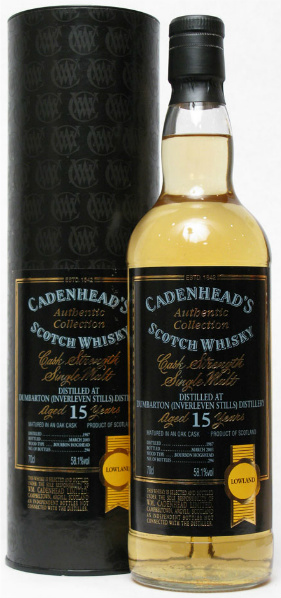
Inverleven (Dumbarton) 15yo 1987/2003 (58.1%, Cadenhead, Bourbon Hogshead, 294 bottles)

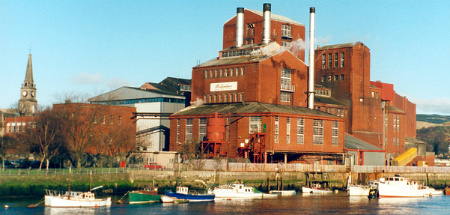
I ended the last post about Gordon & MacPhail’s Inverleven with the hope that they wouldn’t reduce the next issue (so much). Frolicking around in my stash of samples I unearthed this unreduced Inverleven bottled by Cadenhead’s. It’s from another year, so this may have a different profile, but still worth checking out. Dumbarton was foremost a Grain Distillery. The distillery was built in 1938. In 2002 the distillery was closed and demolition commenced in 2005. I’ve added a picture here, because I have always liked the big red brick industrial complex on the river. By the way, after stopping the production of the Inverleven malt, the Stills went on to Islay to produce Port Charlotte at Bruichladdich.
Color: White wine.

Nose: Grassy and murky, like sitting next to a ditch in summer, not bad, but certainly not lovely as well. A lot of citrus fruits. Lemon, lime, tangerines, but over this a lot of dried grass and hot butter. A slightly meaty or gravy like component emerges from all this. Quite fresh and slightly estery. Hints of mint when nosed vigorously.

Taste: Sweet and fresh. Lively, leafy, slightly woody and again lemons. Some underlying caramel and this type of whisky at this strength makes this hot, but that’s not a bad thing. Caramels, vanilla and toffee, are the main markers here. Not very complex. After some breathing, the bite of the wood enters, but luckily not a lot of bitterness.

Compared to the 1991/2012 G&M, this has even less than half of the wood the G&M. So this is more grassy, lemony and much sweeter to boot. This one lacks complexity, and even though the G&M was on the brink of becoming a log of wood, that one was more complex and therefore more interesting. This Cadenheads is easier to drink (as long as you like cask strength whiskies), sweeter and fresher. Still I like this type of Lowlander profile. Sadly gone.

Points: 84
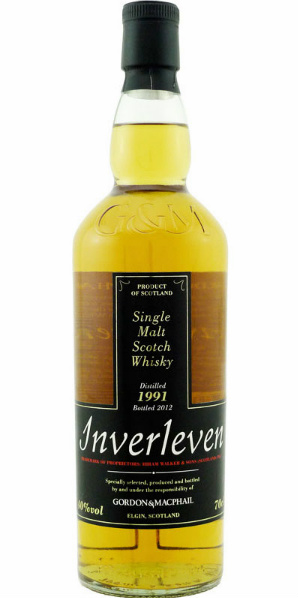
Inverleven 1991/2012 (40%, Gordon & MacPhail, AB/JDAD)

This is the latest Inverleven bottling of the now defunct Inverleven Distillery by Gordon & MacPhail. Gordon & MacPhail still have casks of Inverleven lying around, but have told me since Inverleven is a closed distillery, and the whisky more and more rare, this is the last time Inverleven was bottled in this series. Next time it will be issued in a ‘higher’ series (and hopefully at a higher strength). Inverleven is a whisky made in two Copper Pot Stills on the premises of the Dumbarton Grain Distillery. Whisky was made in these stills between 1938 and 1991, when the Stills were removed. Grain Whisky is still made here in a Column Still. For a while even a Coffee Still was in operation making the very rare “Lomond” Whisky (from 1959 to 1991). By the way, this is not Loch Lomond Whisky, that actually is only a few kilometres away, far enough to be a Highland Whisky. Dumbarton is the home of Ballantine’s blended Whisky.

Inverleven 1991/2012 (40%, Gordon & MacPhail, AB/JDAD)Color: Gold.

Nose: Very fresh, citrussy and creamy. Dry leaves in the autumn. So, lots of lemon and vanilla ice-cream. Very nice, slightly sour and spicy wood. Wood in wet earth. Never overpowering. Elegantly spiced, but all the spice is from the wood. Fresh air. This seems to me, based on the nose alone to be a great summer or autumn Whisky. For a Lowlander ánd a Whisky at this strength, this has a very rich nose and very good balance. I can only hope the whisky tastes as great as this nose does.

Taste: Well the first sip I took was quickly gone. So quick that the only taste that came to mind was sweet pineapple and after that I already tasted the spicy bite of the wood, which again is not overpowering, but firmly present. From the second sip I have some vanilla, caramel and even later on a dried grass element. It’s not quite hay.  The initial sweetness, dries out quickly. Malty.

Quite a lot of wood in this one. And the first time around I found the finish to be short. Second time around, when the Whisky had some time to breathe the finish became a wee bit longer. Still, the nose is very nice and the wood shows itself in the nicest of ways. After breathing the woody part got bigger as well, but the finish got a little bit unbalanced. Maybe this got reduced too much? Let’s hope that the next 1991 Inverleven get’s a better chance at 46% (and maybe more…).

Points: 85

Thanks to Stan and Alistair for the sample.

Auchentoshan 18yo 1991/2009 (46%, The Cooper’s Choice, Hogshead #491, 360 bottles)

Well living in the low-countries and doing a Auchentoshan review without pointing at the site of the A toshan man is impossible. So here is a link to Mark Dermul’s site about Auchentoshan. It’s about whisky obviously, but have a look at all those Auchentoshan Trucks! Lovely.

For now I will do a short intro to Auchentoshan. officially the first word of Auchentoshan is in 1823 when a guy named Thorne got a licence. But there is reason to believe that Auchentoshan started in 1800 named Duntocher. In the past the Germans didn’t like Auchentoshan too much and bombed the place already in 1941. Smart as the Scottish are they waited for the end of the war, rebuilding Auchentoshan. Just to be sure, they started rebuilding in 1948. In 1984 Stanley P. Morrison buys the place and sells his own company to Suntory ten years later. In 2008 Morrison Bowmore starts with the new packaging we know today. But first this expression by indie bottlers The Cooper’s Choice (actually The Vintage Malt Whisky Co. Ltd.) The people behind Finlaggan.

Color: White wine.

Nose: Grassy. Mocha and lemon. It’s sour in an ugly way. It’s whisky with an added layer of strange minty sourness, that wouldn’t gel at all. Very unbalanced. Air freshener.

Taste: Malty with menthol. Although the taste isn’t bad, something definitely went wrong with this cask. Hot and woody. Caramel. Leafy and some plywood. Toffee, with paper in the short finish.

Sorry Mark, but this wasn’t very good. Something went wrong and it showed in the nose. Unbalance. Funny though, that the taste wasn’t all that bad. So it can be drunk, but why should you want to, when it smells like this.

Points: 78

Glenkinchie 12yo (43%, OB, American Oak, Circa 2010)

Glenkinchie can be good, but despite the efforts of the proud people working there, Glenkinchie will always be known as the distillery that Diageo saved by adding it in the Classic Malts range and thereby closing Rosebank.

Earlier I reviewed a Single Cask Glenkinchie bottled by Signatory Vintage and that was pretty good! This time around let’s see how the entry-level 12yo bottled by the owners will do. This 12yo replaces the 10yo that was available earlier.

Color: Gold.

Nose: Malty and quite big. Should that be surprising for a Lowlander? Guess not, since the Glenkinchie mentioned above was quite big too. Cardboard and vanilla ice-cream. It may be simple, but it smells quite nice. Sour spices. A strange kind of sawdust vanilla. Also some thick sugary yellow fruit sensation. Passion fruit. Weak peppermint candy and a slight hint of plastic.

Taste: Sweet wood and a hint of urine. Beer and wood. A drop of liquorice water on cardboard. The beer is there in the finish too. Not a very strong finish. A bit anonymous actually and very simple and subdued. Luckily the initial taste is good.

Hmmm I wouldn’t choose this as my daily drinker, but it does show you what Glenkinchie can be. It does have potential, but it barely shows itself in this one. It’s decent and dirt cheap, but it’s a silent partner, it doesn’t say much (to me). There was also a Cask Strength version made for the Friends of the Classic Malts and that one was very good. One problem only. That version is four times the price of this Glenkinchie, and that’s a bit of a shame really.

Points: 83

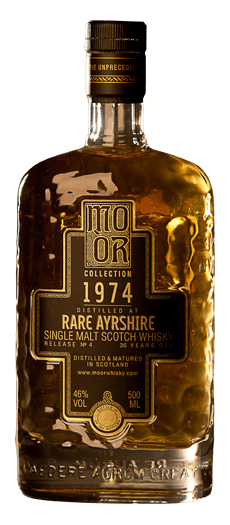
Ladyburn ‘Rare Ayrshire’ 36yo 1974/2010 (46%, Mo Òr, Bourbon Barrel #2608, 261 bottles, 500 ml)

As said before this distillery was briefly opened between 1966 and 1975. As far as vintages go not a lot were released. Officially a lot of 1973’s were released. This vintage was also released by Blackadder and Duncan Taylor. Signatory Vintage released a lot of 1975’s (and one 1974). Two of these 1975’s I have reviewed on these pages earlier. Last but not least in this case, Cadenheads had some releases from the opening year 1966, but that was a long time ago in 1979 and 1980. Besides these few ‘players” not a lot of Ladyburns are to be found. Now here pops up a 1974. As far as I know, there are three 1974’s released. Cask 2607 by Signatory @ 53.9% ABV (in 2011). Cask 2604 by Dutch bottler Van Wees @ 52.1% ABV, (also in 2011), and from 2010, Cask 2608 by fellow Dutch bottler Mo Òr @ 46% ABV. It’s not hard to guess how much (or how little) this got reduced. Rumour has it, these 1974 are pretty good.

Color: Light Gold

Nose: Very aromatic. Sweet and clean. Pops out of the glass. Fruity and lively. Great combination of farmyness and fruity sweetness. On the nose it’s already a lot better than the 1975 Ladyburns I tried before. Nice wood too. Great greenish notes with gravy. If the taste will be anything like the nose, we’ll have a winner on our hands. When this get’s time to breathe the lively fruits make room for something more dark and broody. Meaty and some perfume. Very interesting.

Taste: Fresh, fruity (pineapple) and in nothing you would say this is such an old malt. Not as complex as the nose is. The initial fruits are very quickly replaced by caramelized wood. Finish is good and slightly woody. But considering it’s age you would definitively expect more wood in this.

Very likeable Ladyburn. The nose is very much better than the 1975 Signatories I tried before. Taste wise, maybe not so complex, but less woody than the Signatories. Very nice Ladyburn, one of the best that’s still around, ánd reasonably priced as well!

Points: 86

Thanks again to Henk for this sample.

St. Magdalene 19yo 1979/1998 (63.8%, OB, Rare Malts Selection)

As mentioned before St. Magdalene is my favorite Lowland distillery. Compared to the others it seems St. Magdalene always was willing to show some muscle ánd being faithful to the Lowland style. I like lowlanders with a big body. A few days ago I reviewed a Douglas Laing Platinum Linlithgow from 1970, but for ages now this 19yo Rare Malts edition has been my favorite. I know this is only one style of St. Magdalene because there are also some really great St. Magdalenes from the 60’s bottled by Gordon & MacPhail. Those bottles look completely different (dark) and are bottled at 40% ABV, and still can be fabulous. As some of you might know I’m a member of “Het Genietschap” and luckily there’s also a whisky madman there (come to think of it, they all are whisky madmen and women over there), who has the tendency bringing those 60’s St. Magdalenes quite often. André thanks! I hope he lets me take a little sample home someday, so I can review it here…

Color: Gold

Nose: Sweet and full with hints of smoke and very nice wood. Caramel with a some cream and vanilla. Flowery quality, not so much grassy. Yellow fruit. Powder, slightly toasty and spicy again. Bonfire on a damp evening, after a drizzle. And after a while, a second wind. The is another explosion of aroma’s. This time more like sweet lemongrass vanilla yoghurt. The wood turns from spicy to sour. It’s a different ballgame now. More green components now. Plants after watering. Dry summer wind, laden with pollen. Vanilla Ice cream, clay. More smoke…It just goes on and on. One of the best lowlanders I know.

Taste: Sweet and here it is grassy, well more like hay. Big fruity body. Yeah this is my baby! it has some oak, but that’s far away and complements, transports the big bold body. Yellow fruit, hints of peach and a bit more than just a hint of pineapple. Like with the nose, this grows to. The body becomes even more big, with hints of rubber even, can you imagine that, in a Lowlander? The wood taste that emerges is just fabulous. Perfect sweetness that is kept on a leash by a new acidity. Fruity acidity, lime maybe? Not only the acidity, more and more a nice component from the wood makes this a three unity. Also, and this comes very late into the fold: a nutty component. Almonds and chestnuts. This whisky will never end…

I’ve had this lots of times and the fact everything happens in beautiful layers is what makes this whisky unique. Give it lots of time to let it all happen. Use a big copita they use for brandy or cognac. Forget about the strength and forget about water for the first hour you have this in the glass. Give it time, waltz it around in your glass, play with it, sniff it in tiers. Give it a chance and you’ll be rewarded. What a whisky, what an unusual great balance. WOW!

You know about those deserted islands questions? Well, I bring this and a Brora 1972 (and a glass), and worry about the rest later.

Points: 96

Linlithgow 31yo 1970/2002 (52.4%, Douglas Laing, Platinum, 139 bottles)

This was staring me in the eye for a while now, and since this is my favorite Lowland distillery, no, one of my favorite distilleries of them all, it is time to try out a very old Linlithgow. Well Linlithgow’s on the label, but it is better known as Saint Magdalene.

What could be more appetizing to you than the fact that the site of St. Magdalene in Linlithgow, West Lothian, housed a Lepper Colony in the 12th century, or that the water didn’t come from an ancient super pure melted snow mineral water source, but from the Union canal nearby. But enough facts. If you want more, have a look at Tomas Karlsson’s site.

Founded in 1798 and closed like many (good) others in 1983. The distillery is no more and there are no casks maturing there anymore, only people. It’s an apartment building now. What a shame. Didn’t they know then, it was this good, am I wrong, or isn’t it about the quality anymore…

Color: Light Gold.

Nose: Malty. Light citrus freshness and seems very clean at first. It doesn’t take long for a lot more to show up. Grass on a hot day. Dust and hay. It has a touch of floral sweetness to it. Given some time, there is a new depth to this. Or a “growing” depth you see in Hitchcock’s Vertigo. Oily, fatty, toffee, licorice and hot tar (all in tiny amounts). No wood. Very special.

Taste: Thick, grassy and medium sweet. Dried apricots and apple skins. It isn’t the same as the nose (for me the nose was not fruity), but it complements it very well. Again there is almost no wood. It’s there really, but it is hidden well and transports the body. You can taste the balancing spiciness or distant bitterness (again, hidden well) and the sourness in the finish is from the oak too. Great balance.

For some people these whiskies are to light, or more of an acquired taste, but if you work on this a bit, it will be really rewarding.

It’s a first for me, but this is one, I’d recommend, you enjoy in absolute silence and by yourself. Almost any other Single Malt is best shared with friends, but this is a private one, maybe because the beauty lies in the details. But that’s not all. This has a lot to give and it doesn’t give it all at once. Again time is a friend here. I’m quite stunned also that this is a 31yo and that it’s from 1970, because it can come across much younger. For me it resembles some of the 1982 expressions also bottled by Douglas Laing. I’m a fan!

Points: 91

Ladyburn ‘Rare Ayrshire’ 34yo 1975/2009 (45.2%, Signatory Vintage, Cask Strength Collection, Bourbon Barrel #558, 166 bottles)

Yes! Another example from the distillery that took its water from the Penwapple Reservoir, yes say it again, the Penwapple Reservoir. This time one of the many sister casks from the last year of operation, bottled by Signatory. Yesterdays cask was nice, but I couldn’t say it was worth your money (when you plan to drink it, rather than just mere collecting it), so will this be any better? This will be nice to compare to yesterdays one. Are they all the same? What does happen, when the same spirit is put into ‘supposedly the same casks’? In effect we can see a little bit here, what maturation in wood can do.
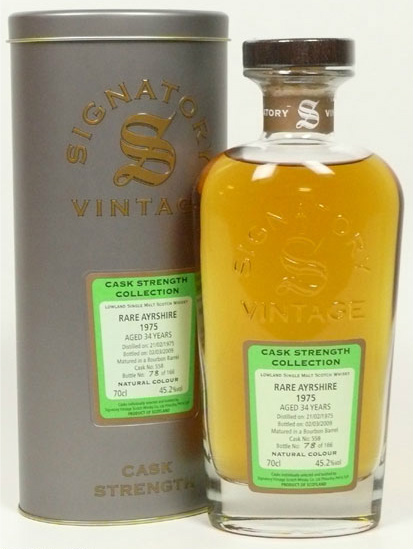
Color: Gold (slightly lighter than barrel #562)
Nose: Spicy wood. Clean and citrussy. Fresh sea air. Mocha and Cappuccino. Fresh cut grass. It’s different from cask #562, with a more typical Lowlander style. Fruitier, lemons and apples. Slightly woody with grass and hay. Lovely.

Taste: Sweetish, more estery sweet. This seems a bit  young too. Not very complex but a good body with apples. It has a different kind of sweetness, thicker and more tiresome if you have a lot of it. Nuttier too. Yes more hazelnuts. The finish has more woody influence and is a bit more bitter, but nothing to be afraid of. This has more balance and body. The other cask seems thinner.

No two casks are alike. whats the influence of cask, wood etc. Of the two, this is the better one. Nice full body and a great Lowlander. I enjoyed this one more. Good finish and nice aftertaste too. Because of the different sweetness this has, (corn-sugar), this seems to me less drinkable than cask #562. Still, who would try to drink the whole bottle at once, of this museum piece, so drinkability is not an issue here. Nice Ladyburn. Recommended.

Points: 84

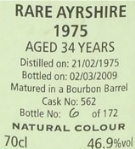
Ladyburn ‘Rare Ayrshire’ 34yo 1975/2009 (46.9%, Signatory Vintage, Cask Strength Collection, Bourbon Barrel #562, 172 bottles)

Ladyburn wasn’t long around. Opened in 1966 and already closed in 1975. It was built by W. Grant & Sons within their Girvan grain distillery complex. Not completely uncommon in those days, since there were more malt distilleries on a grain distillery site. Glen Flagler was added to the Moffat site and Ben Wyvis was added to Invergordon. All three didn’t last long and are pretty scarce these days. These Rare Ayrshire’s are still around, but there will be a time soon, they will not, and prices will soar. So is this worth your money? Lets see…

Well officially there is no Ladyburn on the label, still it isn’t hard to guess what this must be. Out of the blue Signatory started to bottle a lot of casks from Ladyburn. Which is always nice since the place shut down in 1975 and whiskies from Ladyburn are getting more and more rare.

Color: Gold

Nose: Clean, like you would expect from a younger bourbon cask. Grassy, cold butter. Spicy yet light. Caramel, vanilla and clay. Powdery. Mild wood, which smells a bit odd here, small hint of rot maybe? It smells old now, but also not quite right. Grainy and with that, hinting at sourness. Finally perfumy and creamy.

Taste: Butter. Very grassy, lemonade-like. Mild wood, like liquid old sawdust. It’s not without body this. Caramel and powdery cream. Sweet and ever so slightly bitter. Nutty, hazelnuts. Not very balanced and rather anonymous. If you close your eyes you could imagine this being from a bourbon barrel. It slightly resembles Woodford Reserve.

I have to say that after some breathing it tastes better compared to when it was freshly opened. Beware, this Lowlander is easily drinkable and that’s not good for what is essentially a museum piece Whisky.

Points: 81

Rosebank 15yo 1990/2006 (61.1%, Gordon & MacPhail, Cask, Refill Sherry Butts #1605 & 1606)

Time for another Lowlander. Rosebank this time. I reviewed a Glenkinchie recently. The Distillery Diageo chose to be in their Classic Malts range. The obvious choice for the whisky drinker would have been Rosebank, but Rosebank didn’t make it, got closed and in part, turned into a restaurant. Just like with Brora, a lot of people keep hoping for a resurrection. Who knows. For the time being, lets see if this Rosebank is any better than the Glenkinchie reviewed earlier.

Color: Gold

Nose: Extremely fresh with lemons, lemongrass and apple skin in the summer. Leafy, powdery and woody with some caramel thrown into the mix. A sort of garden of Eden. Given some time a more meaty part starts to play a role. And is it the toast from the butts or dare I say that it has a slight hint of peat?

Taste: Sweet (clay) and leafy, woody and powdery. Fits the nose perfectly. Great balance here. Finish stays well constructed, because it doesn’t break down into sour wood, as with a lot of other whiskies like this. It does show some bitterness from the wood though, and vanilla, especially after some breathing.

It’s very good, and very typical for a Lowlander ánd Rosebank, a good Rosebank that is. Compared to the Glenkinchie, I think the jury is in favor of the Glenkinchie…just. Both bottles are good, just a tad different from one another and the Rosebank being the more typical Lowlander and the Glenkinchie having a more interesting composition.

Points: 88