It’s funny how a big company like Diageo works. For instance, There are almost no independent bottlings available by Diageo owned Lagavulin whereas the is a vast amount available from fellow Diageo and Islay distillery Caol Ila. There are almost no independent bottlings available from Oban, but a huge amount from fellow Diageo Distillery Clynelish. Here is another independently released Clynelish from the massively popular 1995 vintage. Although vintages belong more to Wine, vintages also became popular in Whisky.
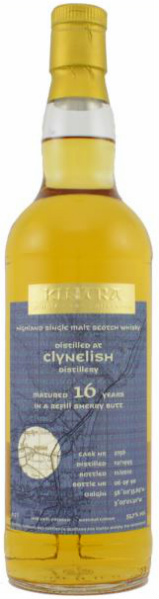 This Clynelish, of which only 90 bottles were released (a Butt shared with others, and Butts are large casks), is marketed by Kintra from the Netherlands. A small outfit, but from a nice guy and with good looks (both the bottle and the guy). As the label states, this is from a Refill Sherry Butt, but even if its from a Fino cask, is doesn’t have a lot of colour. A somewhat inactive Butt?
Color: White wine.
Nose: Somewhat acidic malt. Vegetal. Drying. Does fit the Fino Sherry profile, it’s smells like flor. Herbal and dusty. Milk chocolate with distant hints of vanilla. A little bit dry grass and freshly cut, sappy oak. Freshly peeled almonds. Typical Fino Sherry Butt.
Taste: Again very malty and very Fino Sherry. Wood upfront, and after that some glue and toned down vanilla. There is some sugary sweetness in this Whisky, but that is “hidden” by the Fino and the active wood. No wax! Salty lips. Malt returns in the finish. Otherwise a little bit hot, and spicy.
This is absolutely a pre dinner dram. Tasting this I want to eat! Typical Fino Sherry Butt, playing with wood and grassy, nutty tones. Not as waxy as we are used to from Clynelish. Don’t let the colour fool you, the Sherry did its job here, as did the wood, without being dominant. If you like your whiskies Fino, than this will be no disappointment.
Points: 85
Get well soon Erik.
 Time to take a moment and celebrate. Not just to celebrate that the first winter month of 2014 is already over and we are one month closer to summer, (at least over here we are), but also since this is the 300th post on Master Quill, I’ll take a look at this Glengoyne from “my” year: 1969. Enjoy!
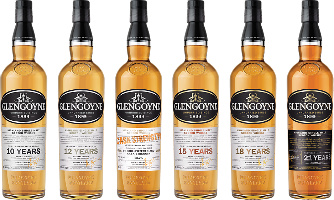 You know of the Chieftain’s and the Dun Bheagan’s) bought the distillery from the previous owner Edrington (Macallan and Highland Park amongst others), and are doing well with the distillery. So happy with this purchase, in 2011 they also bought Tamdhu from the Edrington group. One year later (2012) they revamped their standard range. Just have a look
  Color: Orange gold (slightly cloudy).
 Color: White wine.
 For those of you who didn’t know already, there have been some changes within Douglas Laing company. Brothers Fred (father of… & father in law of…) and Stewart Laing parted ways and divided the old Douglas Laing firm between themselves. Fred retained the ‘Douglas Laing’ name, ‘The Provenance’ series and ‘Big Peat’ and last but not least acquired the help of daughter Cara, who had to be bought back from Bowmore.
 Color: Almost copper gold.
 Color: Dull light gold.
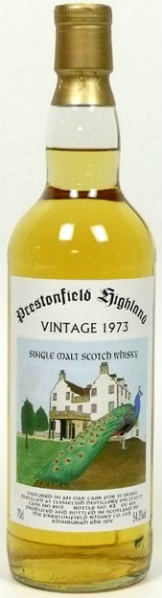 This Clynelish was distilled July 23rd 1973, a year Brora was still open but not very active, if active at all. As we all know, 1972 was Brora’s finest year, or so it seems. Time to find out what they did one year later at Clynelish…
 Yet again we have one of the many 1991 Lochsides, and one of the many that were issued as a Gordon & MacPhail Reserve. This one was picked by Dutch retailer Van Wees. Gordon & MacPhail code for this one is JI/ACAC. The spirit was distilled on September 18th, 1991 and eventually bottled on October 15th, 2009. Picked by Van Wees in July 2009. Those of you that meticulously read this blog probably had a Deja Vu experience. We know this bottle, we know this lay-out. Well yes and no. February 4th 2013, I published a review of quite a similar Lochside, opened by Master Quill’s Apprentice (like this one). That was
  Color: Gold (ever so slightly fuller in color)
 And then there is Glen Keith. Glen Keith lies a stone’s throw away from Strathisla. The spirit from Strathisla was pumped to Glen Keith for filling into casks, but also the boiler at Glen Keith warms water for Glen Keith’s production. Glen Keith’s production started in 1958 with three stills (triple distillation). In 1970 the first two stills in Scotland that are heated by gas were installed. Soon after that, the distillery stopped the triple distillation. In 1983 a sixth still is installed. The distillery is mothballed since 1999, but plans are to restart the distillery next month (April 2013).
 Color: Copper, cloudy.
 This is now my favorite Christmas malt. Just smell that dried Orange in combination with the cloves. It’s not a perfect old bottle though, but it’s so clearly a time capsule. It’s impossible to not love this. I was always a big fan of Strathisla of the sixties and seventies and this Glen Keith is therefore really no surprise at all. Merry Christmas everybody!
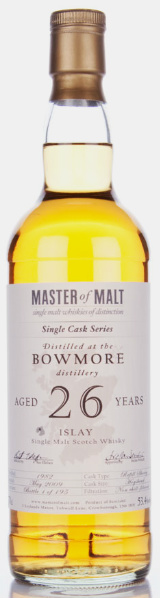
 And here is another Master of Malt bottling. Earlier I reviewed a reduced
  Color: Gold
 In this day and age of battles, battles for oil, battles in politics, and even dance battles, now there are also battles in Whisky. The guys in the picture are Jan Beek (right) and Dennis Mulder (left). They do tastings/battles to see who bottles the best Whisky, the distilleries themselves or the Independent bottlers. Jan represents the independent bottlers and Dennis the official bottlers. Time for my own battle. Well not a battle with axes and swords. Earlier I reviewed an official
  Color: Lively orange brown.
