A.H.Riise X.O. Reserve Christmas Rum (40%, 875 bottles, 2013, Saint Thomas, U.S. Virgin Islands)

Albert Heinrich Riise was born on the 11th of September 1810 on the Danish Island Ærø. In 1932 he graduated as a pharmacist in Copenhagen. In 1838 he followed his dream to work as a pharmacist in the Danish West Indies in St. Thomas. In 1842 he married Henriette Marie Worm (1821-1889) on St. Croix. The couple had 13 children. I guessed he felt at home in the Carribean! In 1843 he had his own pharmacy which he turned into a succesful business. Being an excellent pharmacist Riise used Caribbean plants and herbs for the manufacture of pharmaceutical alcohols and cosmetics. He especially was succesful in selling Riises Bay Rum, yes you guessed it, a perfume! He also started distilling Rum and bitters as medicine. Way to go Albert. In 1868 an epidemic broke out of cholera, yellow fever and smallpox. No Rum would cure that, so the family decided to go to Denmark for a year, but in the end never returned to live on St. Thomas. Albert passed away in 1882 and his wife Henriette followed him in 1889.

A.H. Riise X.O. Reserve Christmas Rum has aged up to 20 years, and was finished in PX Sherry casks. Each bottle comes from a single cask.

A.H.Riise X.O. Reserve Christmas Rum (40%, Saint Thomas, U.S. Virgin Islands)Color: Brown with an amber hue.

Nose: Nice Demerara type of Rum nose with notes of cloves in (partly dried) orange skin and cinnamon. Old wood, speculoos cookies and very festive smelling. Its like visiting and old distillery museum where a lot is done with spirits and spices or a bakery museum where all the spices are stored for making cookies. Vanilla, hot butter and fruity acidity. Very aromatic. Also hints of ginger, cardamom, dust and nutmeg. Very nostalgic, appetizing and tasty. Based on the nose alone a must-have so lets see if it also tastes as good…

Taste: Thick and sweet. Syrupy. Sugared red fruits. White pepper and some wood. Fresh cookie dough. The orange skins are present too, but without the cloves. Noticeable is the finish in PX casks. Not the longest of finishes, but warming and just right. The part that stays on the longest is the fruity acidity, but wait…the cloves return for the finish, excellent!

The nose alone puts me in a melancholic mood and puts me in a bakery or Jenever distillery where spices and botanicals are used for the spirit. It makes me feel like it’s the 1930’s again (or so I imagine, since I wasn’t born yet in the 1930’s). The nose is very nice and suits the Christmas name they use for this Limited Edition. The taste is somewhat simpler and the finish shows that 40% ABV was  a little too light for this kind of rum. On the website the claim is made, or maybe that’s just how I read it, that the typical aroma’s come from the PX casks that were used for the finish and not by added spices, so it should not be a spiced Rum. In the end that’s not entirely important, since it is a very nice Christmas Rum, and even if it was spiced, isn’t Christmas a time to forgive? Wink, wink, nudge, nudge. Merry Christmas everybody!

Points: 87

Caol Ila 11yo 1994/2005 (58.2%, Gordon & MacPhail, Cask Strength, First Fill Sherry Butts #12423 & #12424)

I actually picked the 1990 Caol Ila and this 1994 Caol Ila, to compare Bourbon cask matured and Sherry cask matured young Caol Ila’s. However I don’t think the 1990 was aged in a Bourbon cask, but rather in a Fino or similar type of Sherry cask. However, American oak is probably the wood of choice for the 1990, and maybe the comparison with the two types of Sherry is maybe even a more interesting one. I’m a bit on thin ice here, since nowhere it is said in what kind of cask the 1990 has matured, nor is there any mention for both of what type of Sherry previously inhabited the casks.

Caol Ila 11yo 1994/2005 (58.2%, Gordon & MacPhail, Cask Strength, First Fill Sherry Butts #12423 & #12424)Color: Slightly orangey gold.

Nose: Fatty and funky Sherry. Raisins and wax. Stale rainwater and some muddy peat. Peaty clay, not very fatty or round, as some might say. The raisins do remind me a bit of a Highland Park bottled by Gordon & MacPhail as well. Although that one is much, much darker, it is the same raisiny aroma. Probably the same kind of Sherry. Wood spice and salty smoke. Nice creamy wood, smoky licorice. Perfumy sandalwood and a buttery acidity. Creamy and slightly meaty. Burning candles. Enough happening in this one. Vanilla comes late, it is just overpowered by so many other elements in the nose. A nose from an old house at christmas.

Taste: Initial sweetness with some toffee. Lots of wood, slightly dry, but it is soothing and not harsh nor sour. Some sweet licorice again, with some dusty spice and Cappuccino. After the dusty part comes a woody and slightly acidic wine-note. A fruity acidity that doesn’t fit this Whisky. It makes all the tastes up ’till now, fight each other, instead of becoming a band of brothers. It is obvious that this Sherry didn’t integrate that well. Dries the lips. Finish has only a medium length and quite bit of an unbalanced aftertaste, an apply acidity, which is not entirely tasty if you ask me. The aftertaste ruins it a bit for me. I definitely prefer the previous Caol Ila.

It almost seems as if you can’t go wrong with Caol Ila. Let’s say this is from a Oloroso Sherry or even a PX, both are considered somewhat “normal” Sherries, by wine-people, and considered of a lesser quality then a Sherry that has matured under flor, a “hat” of fungus that grows on the surface of the Sherry. The hat prevents contact with air. The G&M Caol Ila I reviewed the day before yesterday, I believe came form such a Sherry. For me that is the superior one of the two. I do usually prefer Oloroso ageing, especially when it is a Whisky that was aged a while back. Good Oloroso Sherry matured in European oak, instead of the American oak preferred by the Sherry industry these days. Vanilla, people, Sherry drinkers prefer a more creamy Sherry these days. European oak also seems to need longer ageing, to deal with the tannins, and that is time we don’t seem to have…

Points: 80

Ledaig 16yo 1997/2013 (56.8%, Gordon & MacPhail, Cask Strength, for The Whisky Exchange, Refill Sherry Hogshead #465, AC/AEHI)

Third of October and right now the doors are opening for the 2015 Whisky Show in London, England. As many years before I’m attending this wonderful Whisky fest, the best few days of the year. Maybe not even the Whisky, but the people. I really can’t wait for it to begin. For those of you that are not there I’ll have a go here at a Ledaig (a.k.a. peated Tobermory) that was picked by The Whisky Exchange. This was a Whisky that was bottled a few weeks after the Whisky Show 2013, but luckily I got a chance to try from Gordon & MacPhail, before it was bottled. People from the Netherlands will know its sister cask #464 which was also excellent but much lighter in color.

Ledaig 16yo 1997/2013 (56.8%, Gordon & MacPhail, Cask Strength, for The Whisky Exchange, Refill Sherry Hogshead #465)Color: Copper orange gold.

Nose: Fatty peat and candy sweetness. Animalesk and organic. Wild stuff. Hints of burnt cable. Unlit tobacco and dark chocolate powder. Very vegetal. Thick and full of itself. Big. Hints of vanilla and cream. Some dried grass and yes some wet grass from a muddy field in October as well. Funky fresh fungi. This never stops giving. Great peat that is balanced out nicely by the Sherry, but the former is the more dominant in this bottling.

Taste: Excellent entry. Sweet, mixed perfectly with licorice and lots of almonds. Even the wood is almondy. Utter and perfect balance. What a great integration of flavours. Red fruits and berries and hints of Gin. Fresh at times. Sea spray and hints of blobs of fresh fatty tar. Remember Lightning McQueen? Hints of stable (cow) and a bit of wood, but not much. Strange enough, with this amount of aroma and at almost 57% ABV., this only  has a medium finish, it gone sooner that you would want. Great aftertaste though. Almonds and red fruit. Salty lips!

If this would be older (tasting), had a longer finish and had even more added depth it would score well into the nineties. If it had more notes of curry and red peppers you could eat this dram. What a near-perfect modern dram this is. Excellent stuff can still be made. I’m happy I had some prior knowledge to snap this up when it was released.

Points: 90

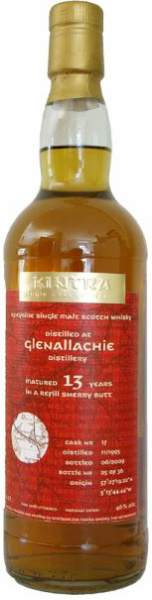
Glenallachie 13yo 1995/2009 (46%, Kintra, Refill Sherry Butt #17, 36 bottles)

Rummaging through the unsorted part of my sample collection I found this Kintra from 2009. Another Glenallachie and that’s great! Kintra’s big cheese, Erik started releasing Kintra Whiskies in 2009 so this is one of the first bottlings, and who knows, maybe even the very first. 2009 saw the release of a 1996 Ben Nevis, a 1997 Clynelish, a 1984 Macduff and in June, this 1995 Glenallachie.

A mind boggling amount of 36 bottles were released of this Glenallachie, so this is a collector’s item for sure! I don’t think this was from a small cask, probably only part of a cask, just like the Ledaig he bottled in 2010.

Color: Gold.

Nose: Fatty and fruity. Some butter and wood smelling like jasmine. Thus quite floral and spicy. Fresh air. Hints of white pepper and again and again this florality whiffs by. Pencil shavings come next. A lovely nose. Nice added depth from the Sherry cask, not only giving it some mustiness, but also some fruit. When smelled more vigorously, whiffs of toned down peppermint pass by, but also some hay, dry raisins and cardboard. If I would hazard a guess, I would say Fino Sherry?

Taste: Spicy first but quickly turning into sugar water sweetness. Dare I say it has some peat to it? The spice and the sweet balance each other out, so it’s not overly sweet. Warming going down. Hints of milk chocolate and a slightly burnt note. Still, lovely stuff, but also a bit unbalanced. Highly drinkable and enjoyable nevertheless. The sweetness makes way for a more woody, and acidic, dryness towards the finish. The finish itself is of medium length and pleasant, but doesn’t leave a great aftertaste, since especially a weak wood and cardboard note stays behind for a short while.

This is one of those highly drinkable Whiskies, where the weakest link is the finish, and especially the aftertaste. To get past that you tend to take another sip, and yet another sip, and yet another, so you’ll finish your glass rather quickly and after that you ask yourself where has the bottle gone? Maybe not my favourite Kintra bottling, but still very good and entertaining.

Points: 84

Edradour 10yo 1994/2004 (46%, Signatory Vintage, The Unchillfiltered Collection, Cask #349, 783 bottles)

In 2004, 2005 and 2006 most of the 1994 vintage were released by Signatory Vintage in the Straight from the cask series. You must remember the 50 cl bottles in the colored wooden boxes with all kinds of (fortified) wine finishes. However a few of those were rescued from that sometimes ill fait and released as is, under the unchillfiltered moniker, reduced to 46% ABV. Here we have one such cask that didn’t undergo a wine finish, simply because the Whisky at hand came from a Sherry cask.

Edradour 10yo Cask #402Color: Orange gold.

Nose: Quite creamy and already lots of aroma. Very dry with enough influence from the wood. It does remind me of cherry liqueur, without it being overly sweet. The Whisky also has a more vegetal side to it as well as some good Sherry funk. Fruity. Watered down red fruit juice, with toffee, chocolate butter and (milk) powder and some herbal smelling wood. Quite spicy when I come to think of it.

Taste: Paper, pepper and sometimes a bit hot. Artificial hard red candy juice. Remember those little raspberry ones? Warming and in the distance quite sweet. Candied citrus fruits (predominantly oranges) and the zestier note is provided by some lemon curd. After that the lengthy finish starts with some burnt newspaper ashes, cheap chocolate powder and some soft dark wood, not necessarily oak. Nutty coffee (Inca).

This is quite a Whisky, but I can’t help to feel that something is not quite right. That is probably personal, because I get that a lot with Edradour. Probably a typical Edradour marker, I still have to get used to. Still, this is quite quaffable. Go for one if you come across it. Maybe the 1994 vintage is sold out by now, but there should be still some 10yo’s from 2004 around. The picture is from one of the 2004 vintages, the 1994 looks the same.

Points: 82

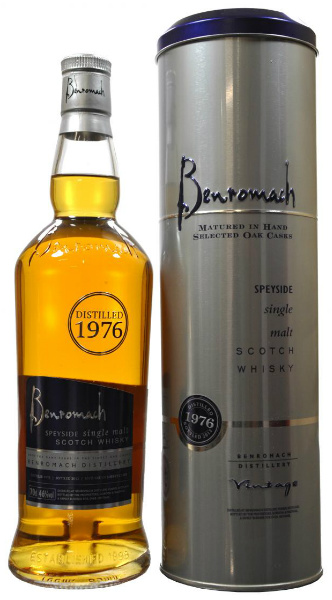
Benromach 1976/2012 (46%, OB, First Fill & Refill Sherry Hogsheads)

This is a 1976 Benromach, bottled in 2012. So it’s either 35 or 36 years old. Said to be from First fill and refill Sherry hogsheads. Just compare it to the 1969 vintage, which is from refill Sherry hogsheads only. The 1969 is much darker in color. So what kind of Sherry was this from? Sherries exist in lots of different styles, and just like a “normal” wine, Sherry has lots of different colors, and aroma’s, too.

Benromach 1976-2012Color: Gold with a slight reddish glow.

Nose: Oak and vanilla. Spicy, dry and vegetal. The smell you get when you break a fresh twig. Slightly burnt wood and a tiny hint of peppermint. It smells younger than it actually is and despite the 100% Sherry statement it is not far away from an older Bourbon matured Whisky (at first). The isolated oak flavour is there, but when this is not from American oak, there is less vanilla to go around. That seems to be the case. So European oak it is. Lovely wood notes, elegant and fine. The wood seems to hold some bitter orange skins in its aroma. Also noticeable is a slight (white) winey note, but also some nuttiness which leads me to believe these casks also held some Fino’s and/or oxidized white Sherries. Not a lot of fruitiness which sets it apart from the famous Tomatin’s from the same vintage.

Taste: Well hello there. This starts with the fruits the nose lacks, but also the wood plays a nice role in here too. Even at 46% ABV, this is quite hot and peppery. Dark chocolate. Nice. The initial fruits quickly disperse which leaves more room for the wood. Not a lot of sweetness, and the wood brings a slight bitterness that suits this exercise in wood (and the nuttiness of dry white Sherries) well.  The finish carries hidden notes of flor. This one needs lots of air to settle and to get the balance right (Depeche Mode), but when it does, it shows you its high quality. Still not an easy one and this one will only reward you if you keep an open mind and work at it a bit.

The contrast between this lighter Sherry bottling and the darker 1969 Sherry bottling probably isn’t a coincidence. They go together like the Glengoyne Summer (dark) and Winter (light). Sure this is high quality stuff, and you have moments in your life when you really need a Whisky like this. The aforementioned Glengoyne Winter is a similar Whisky. (The only differences being that the Winter is more funky and less elegant, but slightly sweeter and much higher in ABV). Having said that, in my case, there just aren’t a lot of days like that, so a Whisky like this lasts very long. Every time I need it, I thoroughly enjoy it, but when I have it at the wrong moment, it’s a difficult Whisky. So choose wisely, first when you buy it, it’s quite expensive, and second when to sip it. One thing for sure, or actually two, its great stuff and it will last long.

Points: 87

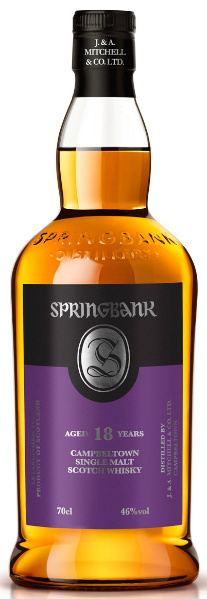
Springbank 18yo (46%, OB, 14/301)

Reviewing the utterly wonderful Glenfarclas 29yo I came across some notes and hints of coconut. Coconut is something I always found a lot of in old Springbanks, so Springbank stuck a bit in the back of mind, when I was tasting the Glenfarclas. Very conveniently, I have an open bottle of Springbank 18yo on my lectern, so lets see if this Springbank still has a hint of the old coconut up its sleeve. If I’m not mistaken, this Springbank is made from 80% Sherry casks and just 20% Bourbon. Lets hope the Springbank coconut is not (only) from the Bourbon casks.

Springbank 18yo (2014)Color: Gold.

Nose: Ferns and leafy. Garden bonfire (smoldering grass). Lots of forest floor aroma’s. Partly creamy. Sowing machine oil and slightly smoky. Sweet cold black tea. Give it some time and this actually is a beautiful nose. Red fruit juice and sweet red apples, but also some Golden Delicious, combined with hot metal. The smell of dead, old steam equipment. When given some more time to breathe some nice yellow fruits come through. Dried apricots combined with mint. Very fruity Sherry, almost a sweet white Sherry. It also reminds me a bit of Sauternes and sweet Moscato. Fabulous balance. Wonderful batch of Springbank 18yo. However, no coconut in the nose.

Taste: Sweet, oily and nutty. Fruity as well. Strange enough when the fruity part comes the sweetness hops into the back seat, so even though the fruity bit is highly aromatic, it isn’t sweet. So not a lot of fructose nor thick fruit, but a thin kind of yellow fruit. Slightly perfumy as well. Well balanced and everything stays in its place. Not a lot of development over time. Nice smoky note too and the sowing machine oil is present as well, but alas no coconut.

This is great stuff, but I still think this is not a Whisky for everybody. It’s not a lovely, fruity and soft Whisky. This is more a Whisky with muscles. A masculine dram with oil and smoke. Although almost three times distilled, it is miles apart from the typical triple distilled grassy and citrussy Lowlanders. Artisan Whisky from a lovely distillery.

Points: 88

Glenallachie 7yo 2007/2014 (50%, Dewar Rattray, The Specialists’ Choice, Sherry Butt #900168, 350 bottles)

Glenallachie, just like Braeval, is one of the fairly new distilleries originating in the sixties. Glenallachie was founded in 1967. (Remember Sgt. Pepper’s ?) Glenallachie is located in Banffshire in a region that we particularly know as Speyside. Built by Scottish and Newcastle Breweries and sold to Invergordon Distillers in 1985. S&N ran it for two years and thus closed it down in 1987 and subsequently sold it to Pernod Ricard. Those of you who have read my recent reviews of Glenlivet, Strathisla and Braeval, know that Pernod Ricard are putting a lot of effort into marketing their big brands Aberlour and especially The Glenlivet, but don’t do a lot, if anything, with their other distilleries Strathisla and Braeval, but also Glenallachie, Glenburgie, Glentauchers, Miltonduff, Scapa and Tormore don’t get a lot of “Airplay”.

Glenallachie 7yo 2007/2014 (50%, Dewar Rattray, The Specialists' Choice, Sherry Butt #900168, 350 bottles)Those distilleries are viewed as production capacity for numerous blends owned by Chivas Brothers, like the well-known Chivas Regal. As said before, I would like to see those marketed as Single Malts by their owners! For the time being we’ll have a look at this independent version of a quite young and Sherried Glenallachie.
Color: Copper gold.

Nose: Nice half-stale meaty Sherry, with lots of wood, sawdust and pencil shavings and some nice woody spices. All of this wood after only seven years! Chocolate with a breath of fresh air. Lavas and other leafy spices. Remember cleaning out the gutter, when the heap of leaves aren’t completely dried out? After that chocolate combined with toffee, so it is most certainly interesting. Cold gravy.

Taste: Wood with chocolate and a hint of cherry liqueur. Forget about Ferrero Rocher, now we have this! Dark chocolate again and all the woody notes I mentioned above apart from the cedary pencil shavings. The wood brings some bitterness and a kind of acidity, The Whisky really doesn’t need. This sour note would probably disappear after some more ageing, so for me it shows its youth. Wood and leaves is what stays behind towards the finish.

Although initially very interesting, the nose is pretty nice and starting to sip this, yes, nice again, but along the way parts of the taste doesn’t seem to match the rest of it. Somewhere it’s pretty unbalanced and pretty young. A bit mono dimensional. It’s ok and without mayor flaws, but also not a lot to rattle my boat as well.

Points: 83

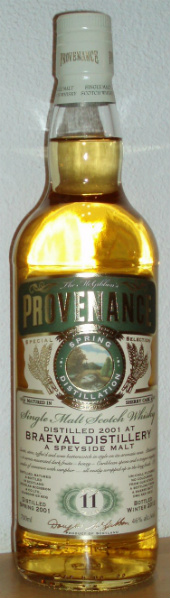
Braeval 11yo 2001/2012 (46%, Douglas McGibbon, Provenance, Spring/Winter, Sherry Cask, DMG 9312)

You don’t have to polish your glasses. So soon after the other Braeval and Braes of Glenlivet Whiskies I reviewed, yet another Braeval graces these pages. Yes, another independent bottling of Braeval. This should come as no surprise since the owners Pernod Ricard (Chivas Brothers) don’t do a lot with this brand either. More or less the same situation as Strathisla, which is owned by the same company. It seems to me all their energy flows into The Glenlivet and Aberlour and not a lot of faith exists in marketing Single Malts from these lesser known distilleries. Bacardi (John Dewar & Sons) which owns Aberfeldy, Craigellachie, Aultmore, Macduff, and Royal Brackla, have recently decided to market the Whiskies of all their distilleries with an age statement. Lets hope Pernod Ricard will follow suit.

Braeval 11yo 2001/2012 (46%, Douglas McGibbon, Provenance, Sherry Cask, DMG 9312)Color: White wine. Not too pale.

Nose: Sweet, Bourbony and malty. Sweetish and pretty clean. Vanilla and pleasant oak. Spicy and leafy. Whiffs of latex paint and even slightly perfumy. Sometimes even vanilla ice-cream and Cappuccino. Becoming grassy over time, combined with a breath of fresh air. Not very outspoken though. 46% ABV is a decent strength, and since all aroma’s aren’t that outspoken I guess this didn’t benefit from reduction. Still a very agreeable nose.

Taste: Spicy and slightly (new) woody. Sweetish and lots of vanilla. American oak Sherry cask? Good balance. Good strength, but I’m sure this would be better undiluted, maybe that way it was too hot or just to plain strong for some. After some time the new wood and leafy note stays and combines with a little bit of barley with vanilla, mocha and vanilla ice-cream. Fresh forest after a rain shower, including the wet forest floor and mushrooms. Nice, innocent and anonymous.

Unlike both other examples of this distillery I reviewed before, this one has been reduced to 46% ABV. This example is also from this very decade and a bit younger than both others, so what does that do for this distillery? Well hard to tell actually since this isn’t a very complex malt. As all other Braevals, this is pretty good, yet this example is a bit anonymous. Reduction places it into the path of maybe less experienced drinkers, who still are a bit cautious with cask strength Whisky.

Points: 82

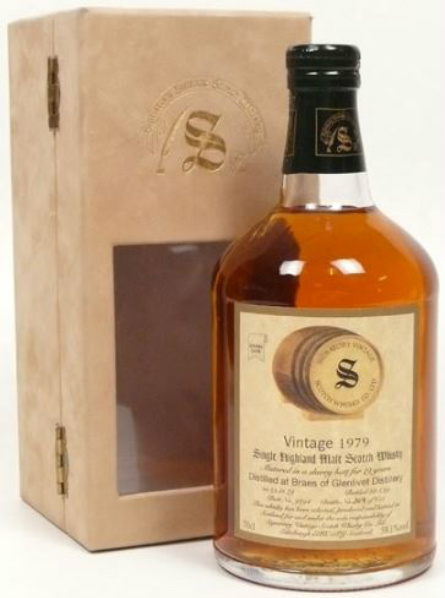
Braes of Glenlivet 19yo 1979/1999 (58.1%, Signatory Vintage, Sherry Butt #9294, 658 bottles)

The day before yesterday I reviewed the first Braeval on Masterquill.com, the domain I was finally able to acquire. Today we’ll have another first, this time the first Braes of Glenlivet. Well not really since both are one and the same distillery.

Braes of Glenlivet was founded just in 1973, so it’s not thát old. At that time Seagram’s was a company with only two distilleries: Strathisla (I love Sherried Strathisla’s from the 60’s and 70’s) and Glen Keith (equally so). Both distilleries are next to one another by the way. Chivas needed more capacity, due to huge demand of the Chivas Regal 12yo blend in the States and was looking for a distillery to take over. When that didn’t work, plans were made to “build” five distilleries in the same amount of time. Braes of Glenlivet was the first in 1973 and Allt-a-Bhainne the second a year later. The next three distilleries were brought into the portfolio by acquisition in 1978: Glenlivet, Longmorn and Glen Grant (now owned by Campari since 2006). Other noteworthy facts are that the name of Braes of Glenlivet changed to Braeval in 1994 (to allow Glenlivet to be The Glenlivet, as in “there can be only one”). Breaval was mothballed between 2002 and 2008 and is the highest situated distillery in Scotland. 1665 feet.

Braes of Glenlivet 19yo 1979/1999 (58.1%, Signatory Vintage, Sherry Butt #9294, 658 bottles)Color: Copper Gold.

Nose: Musty and a high quality Sherry note. Not a big heavily Sherried nose (hence the color). But dry and meaty. Slightly smoky (char) and vegetal (fern). Nicely oaky but also pencil shavings, which usually isn’t oak but cedar. Perfumy. This needs some air to balance itself out. Again the wood is playing a big role in this Braes/Braeval, just like the one I reviewed before. The vegetal part is developing into what I can only guess is a Japanese tea kind of note. Not floral, so it’s not the perfumy part of the nose, but very deep, profound, but also elegant and light. Having said that, next up is a hint of Velpon or Uhu (clear glue). Great herbal and earthy complexity (surely not only from the wood?), with a tiny hint of new make spirit. This is a very nice one to take deep breaths of. Stuff for connoisseurs I guess, so maybe not everybody’s cup of tea.

Taste: Strong, sweet and dry at the same time. Very nice. Lot’s of Beer and Hops, and not really Sherried for me. The hops doesn’t make this all that bitter. Quite some masked sweetness and again quite woody too. The bitterness is really a hoppy one. Interesting. Just like it’s younger brother, it’s coming undone a bit in the finish. The alcohol is really prominent, so most definitely a force to deal with. Finish with tea and wood, a hint of soap and rather drying. Beer and soap who would have guessed? The complexity of the nose isn’t really here in the taste. And I really miss the high quality Sherry I smelled initially. Beer and Sherry who would have guessed?

What really caught me by surprise were the similarities between the 1991 Braeval bottled by The Whisky Mercenary and this particular expression from 1979. Especially on the nose. One was distilled in 1991 and this one in 1979. Both have a similar full on smell and a woody part that plays a big role in the bigger picture. This Signatory has a more pronounced Sherry derived full and sweetish body, whereas the 1991 was more fruity.

Points: 85